I. Introduction
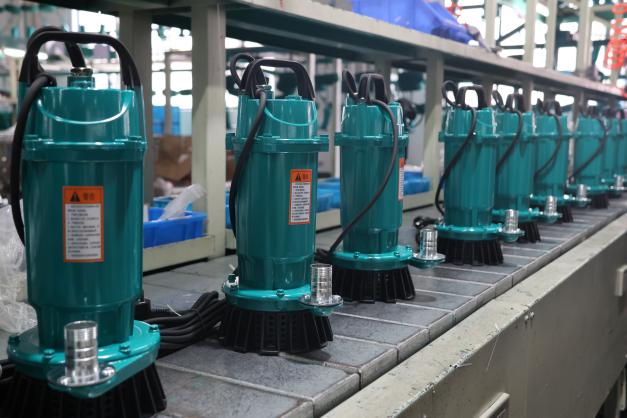
Choosing the wrong irrigation pump might lead to low water pressure, uneven irrigation, or frequent pump burnout.
Hungerät focuses on helping B2B partners select pumps that deliver consistent performance and reduce warranty claims.
This guide helps you learn different irrigation types and the key points of choosing the right irrigation pumps for your systems.
II. What Irrigation Pumps Do & Why They Matter
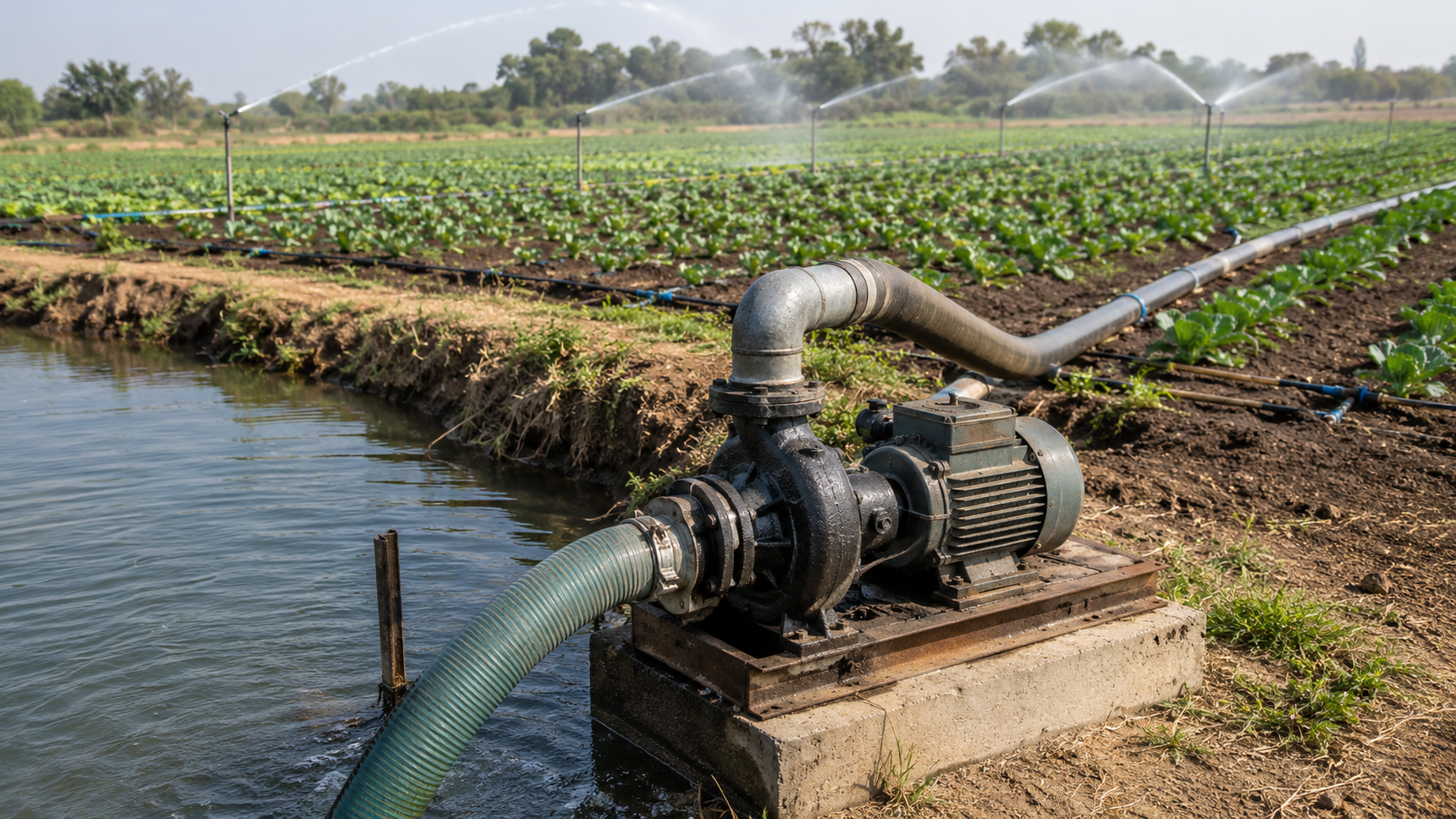
An irrigation pump delivers water from sources like wells, ponds, or rivers to the lands that require watering.
As the core of an irrigation system, the pump keeps the water pressure and flow steady for even distribution through sprinklers or drip systems. With the right water pump, farmers can get water more easily, water their crops more evenly, and reduce waste in the process.
III. Understanding the Key Terms Behind Your Pump
Flow rate (m³/h or GPM): This tells you how much water is delivered over a period of time. It helps determine whether the pump can meet your irrigation needs. We usually measure it in m³/h or GPM.
Head (meters or feet): How high a pump can lift water or how much pressure it can produce. The higher the head, the farther or higher the water can be moved. We usually express it in meters or feet.
Pressure (bar or psi): Pressure is the force the pump applies to move water through pipes, sprinklers, or drip lines. We usually measure it in bars or psi. For reference, 1 bar is roughly equal to 10 meters of water head.
Suction lift and discharge head: Suction lift shows how far a pump can pull water from the source. The discharge head shows how high it can push water out. We usually express both in meters or feet.
Power (kW or HP): The energy the pump uses to move water. We usually measure it in kilowatts (kW) or horsepower (HP).
IV. How to Read a Pump Performance Curve
A pump performance curve is like a map that shows how your pump performs under different working conditions. The horizontal line shows the flow rate, and the vertical line shows the head. You can find your flow and head on the chart to see if the pump fits your system needs.
Reading the performance curve helps you avoid choosing a pump that’s too weak or too powerful than you actually need.
V. Types of Irrigation Pumps
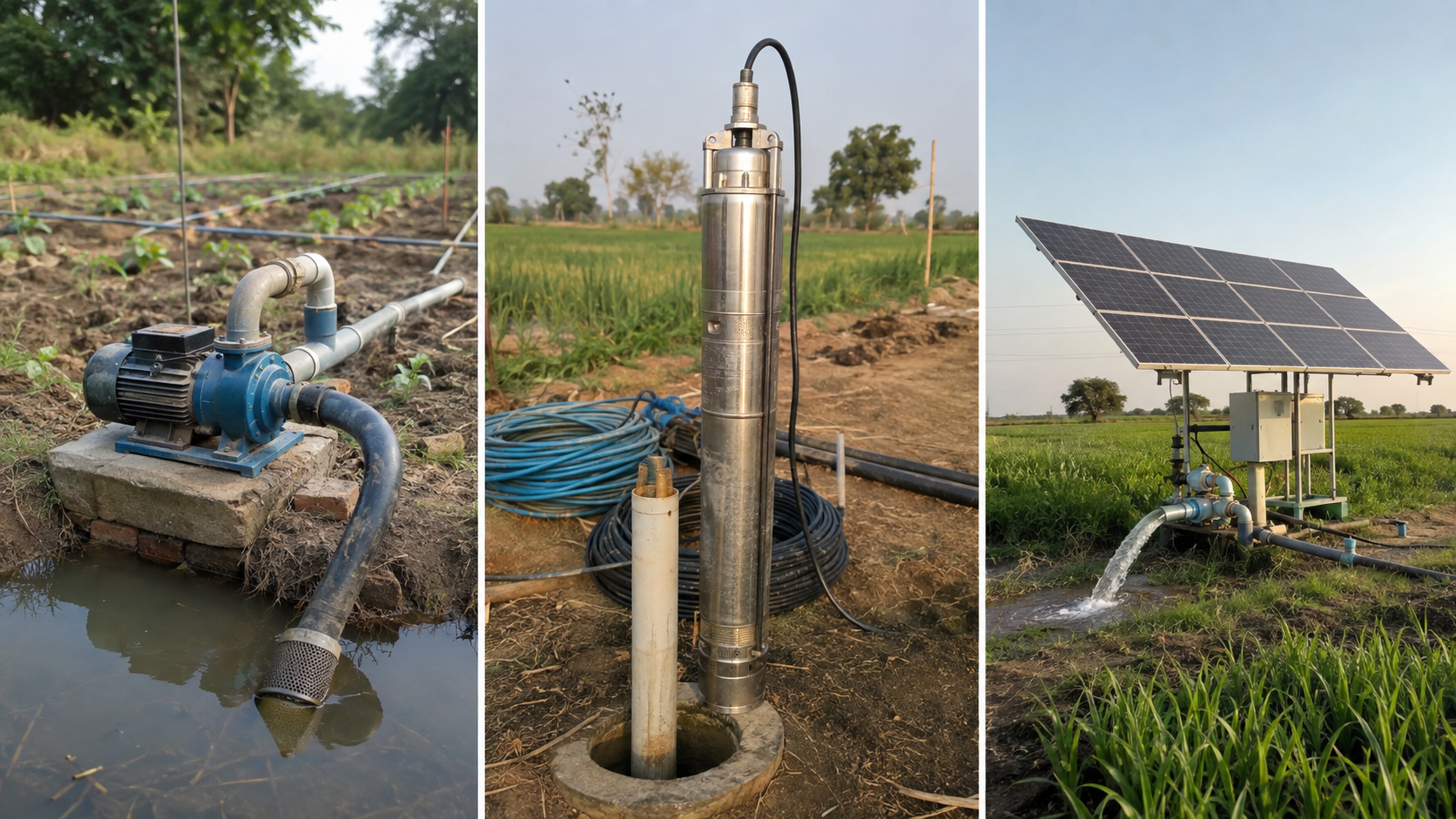
The different water sources, elevation differences, and irrigation methods all influence water pump selection. You need to consider the suction capabilities and installation methods, and choose the right pump to get a stable water supply and high working efficiency.
Surface pump is installed on the ground, suitable for drawing water from shallow water sources. It includes centrifugal pump, jet pump, and booster pump. The suction is usually lower than 8 meters, widely used in garden watering and small-scale field irrigation.
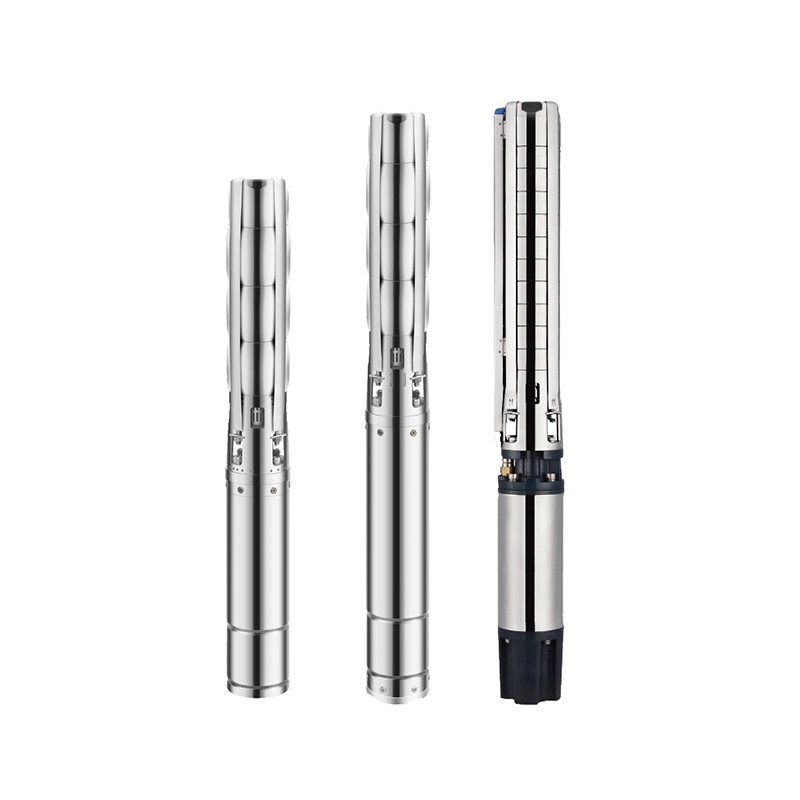
Submersible pump is designed for deep water sources. It includes submersible pump and deep well pump, suitable for continuous water supply, deep wells, or large-scale agricultural irrigation systems.
Solar powered and fuel-driven pumps are suitable for off-grid areas, like farms without a stable electricity supply or temporary irrigation projects.
| Pump Type | Typical Applications | Key Features | Pros | Cons |
|---|---|---|---|---|
| Surface pump | Gardens and small farms | Simple design | Large flow rate, affordable | Not waterproof, can’t be used in high-lift needs |
| Submersible pump | Ponds, rivers, and deep wells, etc. | Operates underwater | High head, efficient | Expensive, costs more in installation and maintenance |
| Solar powered and fuel-driven pumps | Remote or off-grid areas | Powered by sunlight or fuel | Cost-effective in the long-term use | High investment, the performance is influenced by the sunlight |
Knowing your water source and power condition is the first step to finding the most suitable pump.
VI. Matching Pump Type to Irrigation System
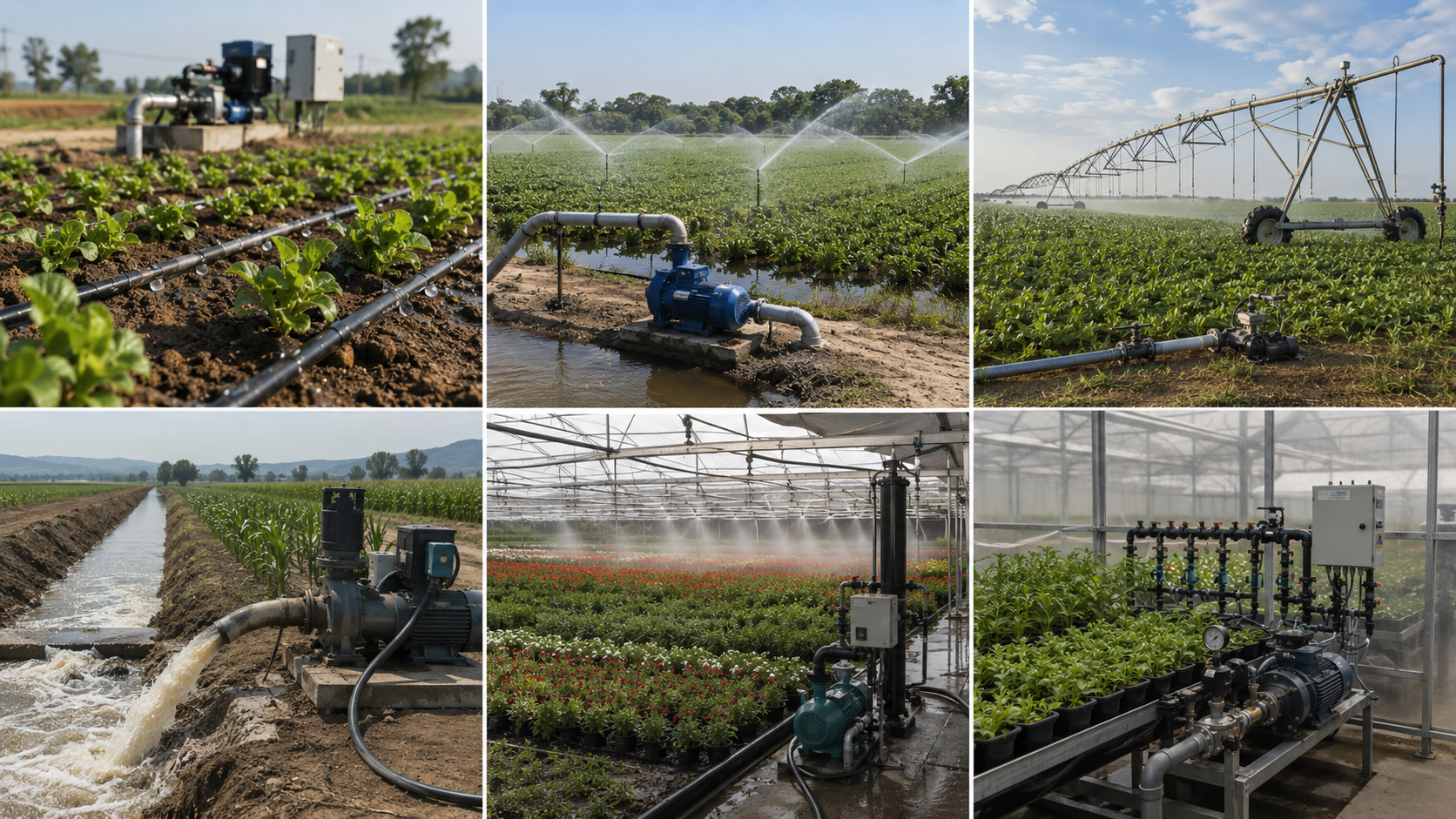
Different irrigation systems require different levels of water pressure, flow rate, and pump stability. This part helps you understand which type of pump works best for your irrigation system.
1. Drip Irrigation Systems
Drip systems work best with a low flow rate and steady, low pressure for uniform watering . Small centrifugal pump, VFD pump, and self-priming pump with pressure control are ideal choices.
2. Sprinkler Systems
This system needs medium to high pressure to achieve even water coverage, often used in lawns and farmland. Centrifugal pumps, self-priming pumps, and booster pumps are recommended to ensure the proper spray radius and uniformity.
3. Pivot or Lateral Move Systems
These systems cover large areas and use long pipelines that demand stable, high-pressure output. The high-head centrifugal pumps and deep well pumps can support a continuous high-pressure water supply while minimizing maintenance.
4. Flood and Furrow Irrigation
This method relies on natural terrain flow, requiring a high flow rate but low pressure. The large flow centrifugal pumps and diesel pumps can deliver an abundant flow and high working efficiency.
5. Micro-Spray or Misting Systems
This system operates at a low flow but needs stable and consistent pressure. It’s widely used for flowers and greenhouses. We suggest small booster pumps, VFD pumps, and pumps with pressure control to keep the pressure stable.
6. Greenhouse or Nursery Irrigation
This irrigation method requires pressure and flow control, frequent start-stop cycles, and high automation compatibility.
Each irrigation system has unique water demands. Selecting the right pump improves efficiency and reduces after-sales issues. In the next section, we’ll look at the key factors to consider when choosing a pump.
VII. Key Factors to Consider When Choosing an Irrigation Pump
When choosing a pump, do you only focus on brand or price? There’s actually more you need to consider.
1. Your purpose
What’s your pump used for: irrigation, booster, or transferring water? The application determines the flow, pressure, and type of the control system.
2. Water Source
Do you get the water from the well, river, or pond? Is the water dirty or clean? It’s best to choose a pump that fits your water conditions. You’ll avoid unnecessary wear and keep the pump running longer.
3. Power Supply
Single-phase power is common for homes and small farms. Three-phase power is ideal for large-scale irrigation and industrial systems. Solar or fuel-driven pumps are perfect for off-grid or mobile systems.
You need to ensure that the pump’s voltage and frequency match your local standards. We’ve seen cases where using the wrong voltage burned out motors early. It’s an easy mistake to avoid.
4. Required Flow Rate and Head
You need to calculate the flow rate and head according to your irrigation area, pipeline layout, and discharge height. And consider the loss of energy and pipes, leaving a 10–15% safety margin is a smart move.
5. Installation and Maintenance
For most farmers, a pump that’s easy to install and maintain makes irrigation a lot easier.
6. Cost vs. Lifetime Value
You need to consider the total cost, but not the upfront cost. Compare the pumps on energy consumption, maintenance, and lifetime. The correct investment will pay off in the long run.
VIII. 8 Steps for Choosing and Sizing an Irrigation Pump
1. Select the Right Pump Type
It’s better to select the pump type based on your water sources and environment. If you only consider the brand and large power pumps, you might not get the most efficient pump for your irrigation system.
2. Confirm Your Water Demand
Before you calculate the numbers, think about what you really need.
What’s the size of your field? What kind of crops are you growing? Are you using drip irrigation, sprinklers, or open channels? Knowing this helps you avoid choosing a pump that’s too big or too small.
3. Calculate the Flow Rate
You can estimate how much water you’ll need to deliver each hour according to your irrigation situation. A simple rule is to add 10-15% extra capacity to handle seasonal variations or small losses in the pipeline.
4. Pressure Requirements
Sprinklers and drip systems don’t just need water—they need the right pressure to perform well. If the pressure is too low, water won’t reach the pipe ends evenly, and some areas may stay dry.
5. Calculate the Pressure
When you calculate the total head, don’t just think about how high the water needs to go. You also need to consider the pressure loss from the long pipelines. If you’re not sure how much to add, leaving around 10–15% extra head is usually enough to cover pipe losses and ensure stable pressure at the outlet.
6. Confirm the Flow and Head
Flow rate and head are the key figures of a pump. You need to check the performance curve first to ensure the working point is in the best efficiency range.
7. Check Power Compatibility
For an electric pump, you need to check if it’s for single-phase or three-phase, and choose the right one that matches your standard.
8. Compare and Choose
Lastly, you need to compare the brand, check what after-sales service they can offer, and if they can support spare parts for maintenance. The best pump is not the most expensive, but the one that fits your system best.
IX. Common Mistakes You Might Make in Pump Selection
1. Improper Installation
Some problems are not caused by the wrong pump type, but by the improper installation. You have to make sure there’s no air in the suction pipe, and all the fittings are tight enough.
2. Wrong Material
The pump may rust or be abraded quickly if you choose the wrong material. The pump material depends on your local water quality conditions. If you don’t know which material is suitable for your situation, ask your supplier for help.
3. No Protection Against Dry Running or Overload
If you want to get a pump with a longer service time and avoid motor burnout, adding the dry run or overload protection is a good solution.
X. Examples from Our Clients
1. Greenhouse Using a Booster System for Stable Pressure
This greenhouse grows flowers in a small area, but the irrigation system needs finer control over the flow rate and water pressure.
The drip and micro-spray nozzles need steady water pressure to work well. If the pressure is not stable, some sprayers can’t get abundant water, which will cause uneven irrigation. To solve this, we installed a small booster pump with pressure control to ensure stable pressure at the pipe end.
The greenhouse runs smoothly with less maintenance and no need for extra manual adjustment.
2. Solar-Powered Irrigation in a Remote Area
This remote farm is located in an off-grid area, and the electricity supply is very unstable.
The farmers need a dependable water solution for their vegetable fields, but traditional electric pumps couldn’t meet the requirements. We chose a solar water pump with battery storage to ensure a continuous water supply throughout the day and night.
The farm now gets an independent and eco-friendly water supply.
XI. Conclusion
Now you probably know how to make a confident choice for your irrigation system. Selecting a pump isn’t just about the specifications; you also need to consider your actual requirements, working environment, and pump efficiency.
With the eight guiding steps and common mistakes we’ve discussed above, you can avoid many unnecessary issues and build a reliable irrigation system by yourself. A good choice saves maintenance costs and improves irrigation efficiency.
Before you buy a pump, don’t forget to check the following:
- Water Source Type
- Required Flow and Head
- Pipeline Length and Loss
- Materials and Power Supply
- Optional Automatic Control or Protection
If you are still unsure about the right model for your system, contact your supplier or technical team for suggestions. Don’t hesitate to reach out anytime-we’ll recommend a suitable pump solution according to your irrigation needs.
XII. FAQ
Q1: What pump is best for drip irrigation?
A1: Drip irrigation needs a stable pressure and a low flow rate. We suggest you choose a small centrifugal pump or booster pump with pressure control or VFD. If you draw water from wells, take the self-priming capability into consideration. Make sure the pump can provide a consistent water pressure for even distribution.
Q2: Can I use one pump for multiple irrigation zones?
A2: Yes, but it also depends on the total flow and pressure. If you open multiple zones at the same time, the pressure drops, and the flow also gets smaller. Water supply can be scheduled through valves or implemented by control systems. For a large irrigation field, we suggest you add more pumps or storage tanks to distribute the load.
Q3: How to choose between self-priming and submersible?
A3: If the pump is used underwater, choose a submersible pump; if it’s used on the ground and needs suction lift, choose a self-priming pump. The submersible pump is quiet, saving space; the self-priming pump is easy to maintain.
Q4: What happens if my pump runs dry?
A4: Dry run leads to overheated motor, burned sealings, and broken pump body. We recommend that you choose a pump with dry run protection or water shortage protection. If your water source is not so stable, equipping a float switch or liquid level controller will help a lot.
Q5: How do I know if the head is suitable for my system?
A5: If the water is too weak at the nozzle, or no water comes out at the pipe end, the head is too low. If the pump is noisy and the water flow is intermittent, it may be due to excessive head or airlocks in the system.