I. Introduction
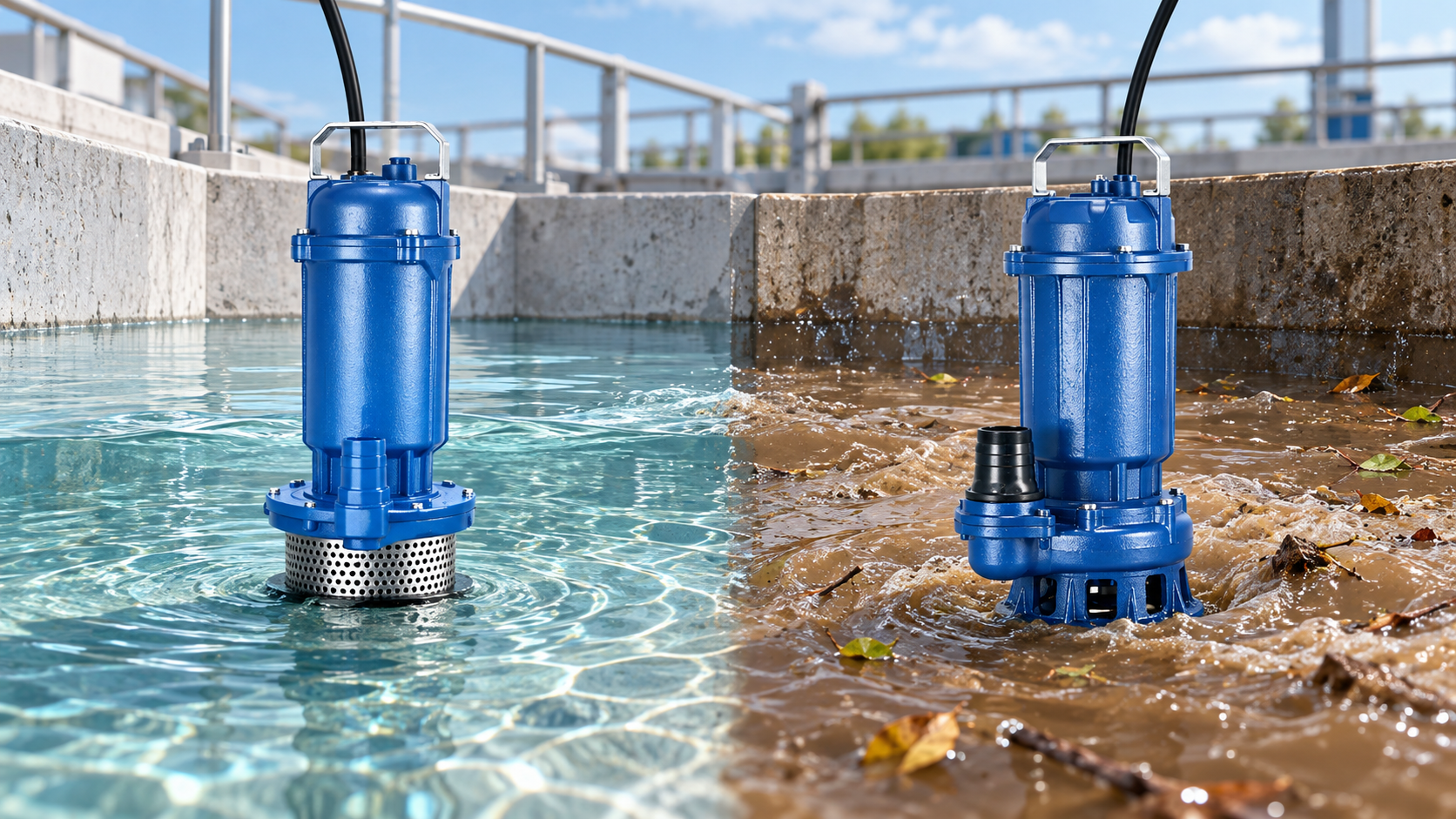
Clean Water Submersible Pumps and Dirty Water Submersible Pumps may have the same power and outlet diameters, but they are suited for different types of water. Selecting the wrong one can result in clogged inlets, quick wear, low flow, or excessive expense. The essay examines their solids handling, internal construction, performance, applications, and selection factors to assist you in choosing suitable models and build a clearer submersible pump range.
II. Clean Water and Dirty Water Submersible Pumps
1. Clean Water Submersible Pumps
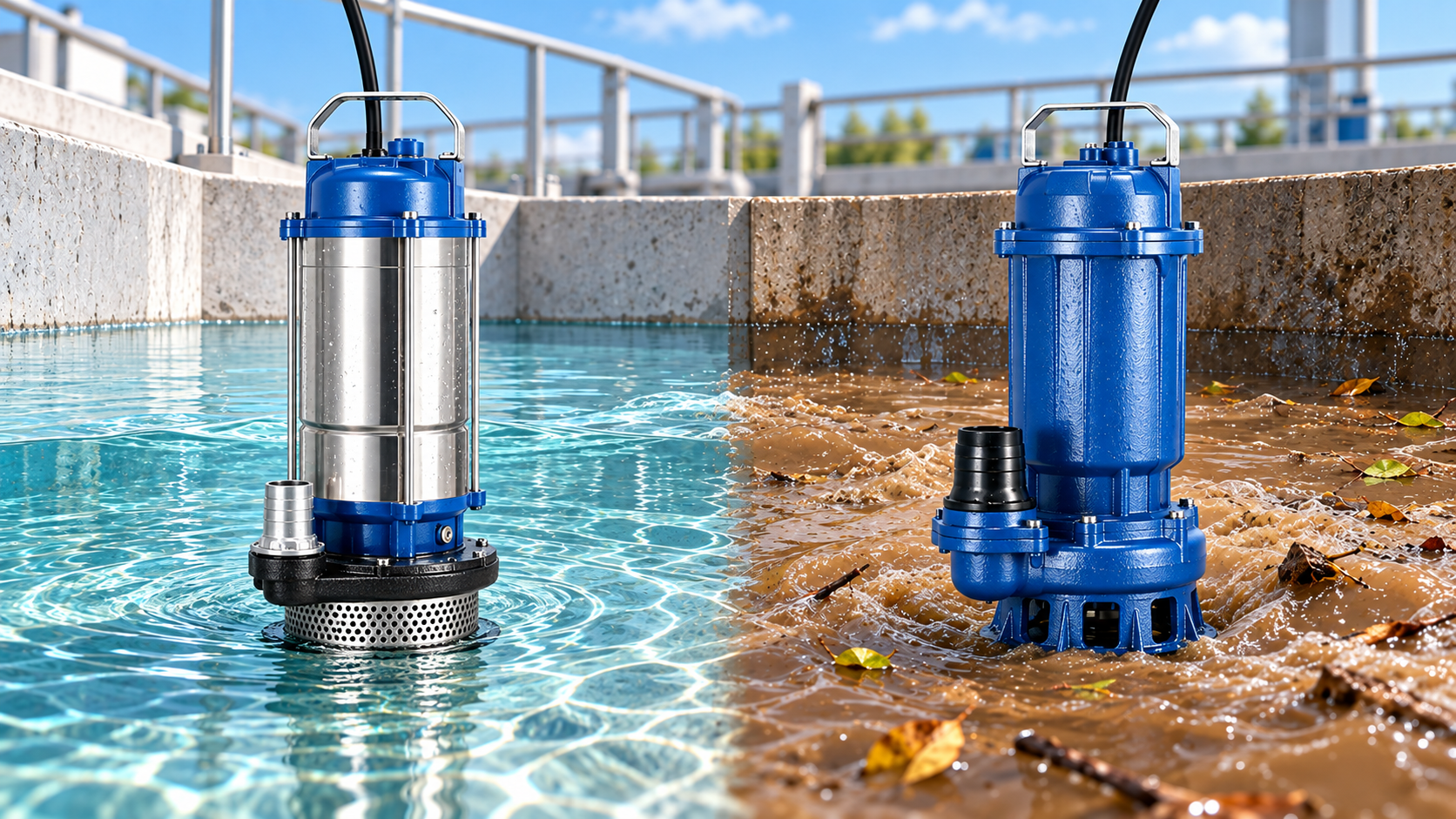
A Clean Water Submersible Pump in this article indicates a drainage pump for reasonably clean water, not a borehole or deep well pump. It is used for water without big particles, for example from tanks, swimming pools, flooded rooms and covered rainwater containers.
Clean water variants tend to have smaller intake apertures and narrower interior channels. Some types also have a low-suction design that allows them to drain water to a lower level. The permissible particle size and minimum water level are a function of the specific pump.
2. Dirty Water Submersible Pumps
A Dirty Water Submersible Pump is intended for water that contains acceptable solids, mud, leaves, or other soft material. It usually features larger intake apertures and broader internal channels which allow particles of typical size to pass through the pump.
The term “dirty water” does not suggest that the pump can handle any kind of waste. The size and substance of the particles depend on the pump design. A typical dirty water model may still not be suited for stones, metal, long fibres, raw sewage or big amounts of sand.
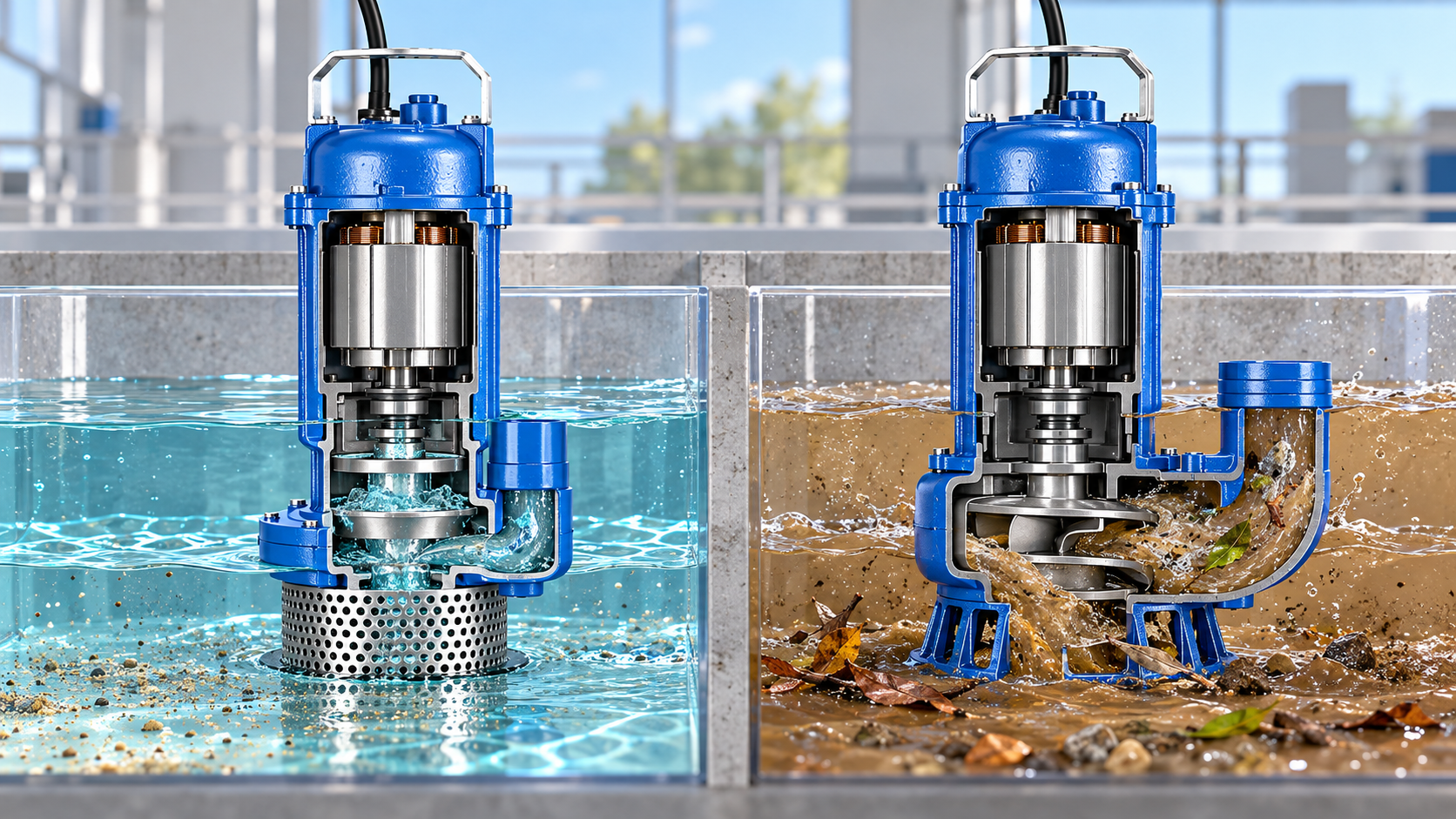
III. Key Differences Between Clean Water and Dirty Water Submersible Pumps
1. Water and Solids Handling
The Clean Water Submersible Pump is designed for clean water or water containing small particles within the rated limit. Larger debris can obstruct the entrance or become lodged around the impeller.
A Dirty Water Submersible Pump has an enlarged path for acceptable solids. The maximum size of solids must be verified for each model, since it is not defined by the motor power or the discharge size.
A 2” outlet pump will not automatically pass 2” solids. The outlet size is the size of the pipe connection, and the solids-passing size is the largest authorised particle that can pass through the pump.
2. Inlet and Impeller Design
Clean water pumps have smaller inlet ports to keep bigger material out of the pump. Their impeller and internal channels are designed primarily to move water with little or no solid particles.
Dirty water pumps include wider input apertures and an impeller that allows more room for particles of normal size to flow through. Depending on the model, the pump may use a semi-open, vortex, or other solids-handling impeller.
Solids-handling capability is not solely determined by the impeller type. The intake apertures, internal channel, impeller clearance and rated solids size should all be appropriate for the liquid.
3. Flow and Head
Clean water and dirty water pump with the same motor power may have varying flow and head. Their impellers and internal channels utilise the available motor power differently.
Usually the maximum flow is obtained at extremely low head and the maximum head is measured at zero or near zero flow. Neither of these values is a true representation of what the flow will actually be like after the pump is attached to some pipe or hose.
If an application demands 10 m3/h at 8 m head, the pump curve must display approximately 10 m3/h at 8 m. Vertical lift and pipe resistance will decrease the maximum flow of a pump. A pump rated at 10 m3/h will flow less than that.
4. Minimum Water Level and Remaining Water
Some of the Clean Water Submersible Pumps have a low intake or flat suction design, allowing them to drain water near the floor. This is important when the level of the remaining water has to be low.
A Dirty Water Submersible Pump normally needs a wider input and enough water surrounding the pump for particles to enter. It may consequently hold more water after stopping than a low-level clean water model.
5. Wear and Blockage
A Clean Water Submersible Pump can become clogged when operated in water with particles larger than the internal passages of the pump. Even if the sand is tiny enough to get into the pump, it can also wear the impeller, pump casing, shaft, and mechanical seal.
Although a Dirty Water Submersible Pump is less likely to clog when dealing with permitted debris, hard or fibrous objects can still cause damage. Stones can damage the impeller, metal can block the pump, and long fibres can wrap round the shaft.
| Comparison | Clean Water Submersible Pump | Dirty Water Submersible Pump |
| Suitable liquid | Clean water or water with very small particles | Water containing approved solids and debris |
| Inlet openings | Usually smaller | Usually larger |
| Internal passage | Designed mainly for clean water | Provides more space for solids |
| Solids handling | Limited | Depends on the rated solids size |
| Remaining water | Can be lower on some models | Usually requires a higher minimum water level |
| Main applications | Tanks, pools and indoor drainage | Pits, outdoor flooding and construction drainage |
| Main selection point | Flow, head and minimum water level | Flow, head, solids type and solids size |
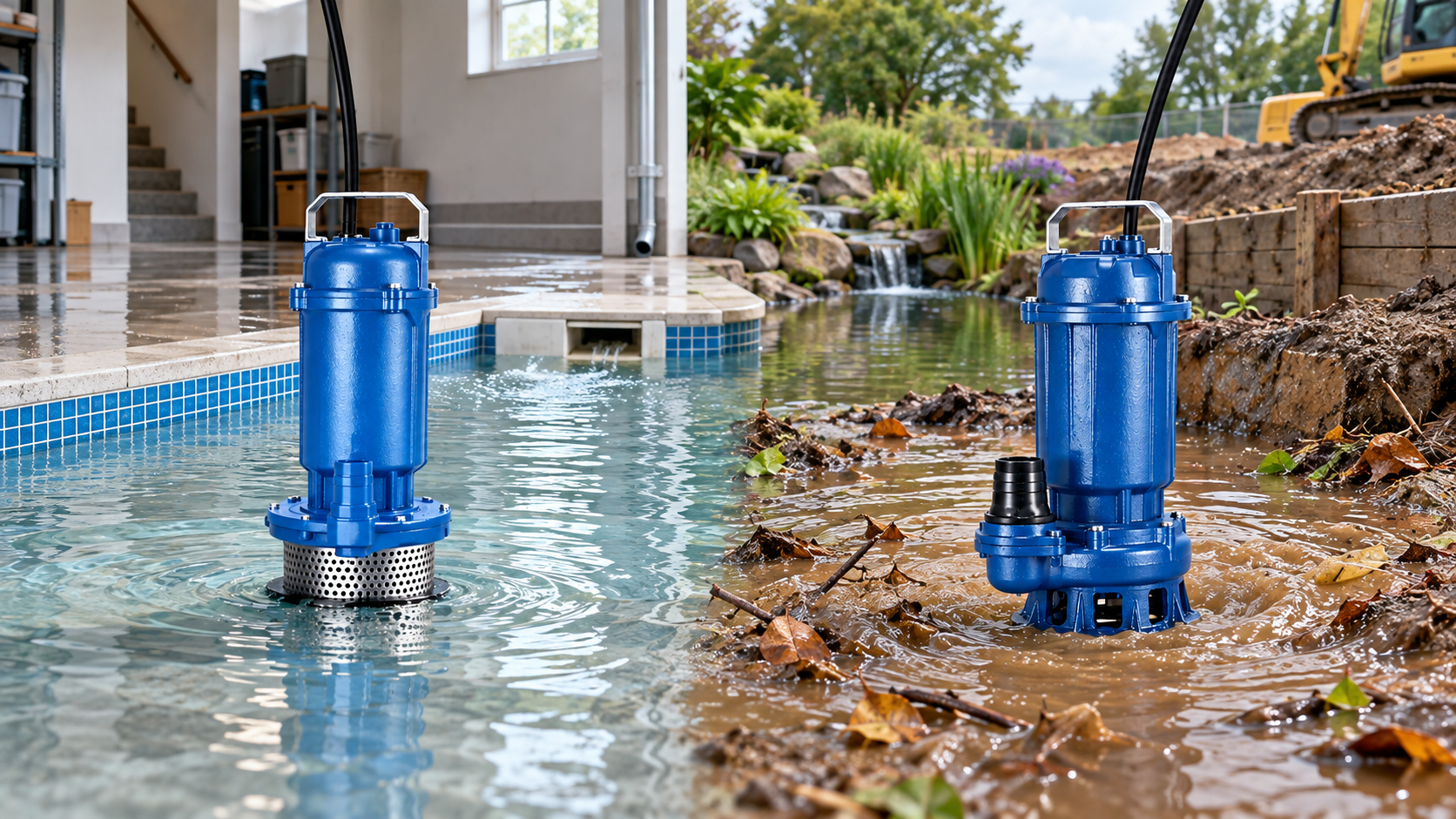
IV. Applications of Clean Water and Dirty Water Submersible Pumps
1. Water Tanks and Swimming Pools
A Clean Water Submersible Pump is commonly used to empty tanks, swimming pools, etc. when the water is free from large particles. Don’t assume that any clean water pump will empty down to the floor. If you want the pump to leave very little water behind, you should choose a type that specifies a low suction level.
2. Basement and Flood Drainage
A Clean Water Submersible Pump can manage fairly clean water from a broken pipe or indoor leak. Outdoor floodwater may contain dirt, leaves, and other particles. A Dirty Water Submersible Pump is usually better suited for that circumstance.
3. Construction Sites and Drainage Pits
Construction pits generally include muddy water and small debris that generally necessitate a Dirty Water Submersible Pump. If the water is very sandy, stony, or abrasive, a regular dirty water model may not be sufficient, and a pump built for abrasive water would be needed.
4. Garden Ponds and Rainwater Collection
A pure Water Submersible Pump can be used in a rainwater tank (covered) with generally pure water. Dirty Water Submersible Pumps are more suited for open ponds, ditches and rainwater pits where leaves and dirt may be present. Long plants or stringy-type algae can still wrap up around a standard impeller and need to be examined.
5. Agricultural and General Water Transfer
Clean Water Submersible Pump may transfer water from clean storage tanks and reservoirs. A Dirty Water Submersible Pump is better suited for open channels and permitted rubbish collection pits. In either instance, the pump must provide the appropriate flow at the actual total head.
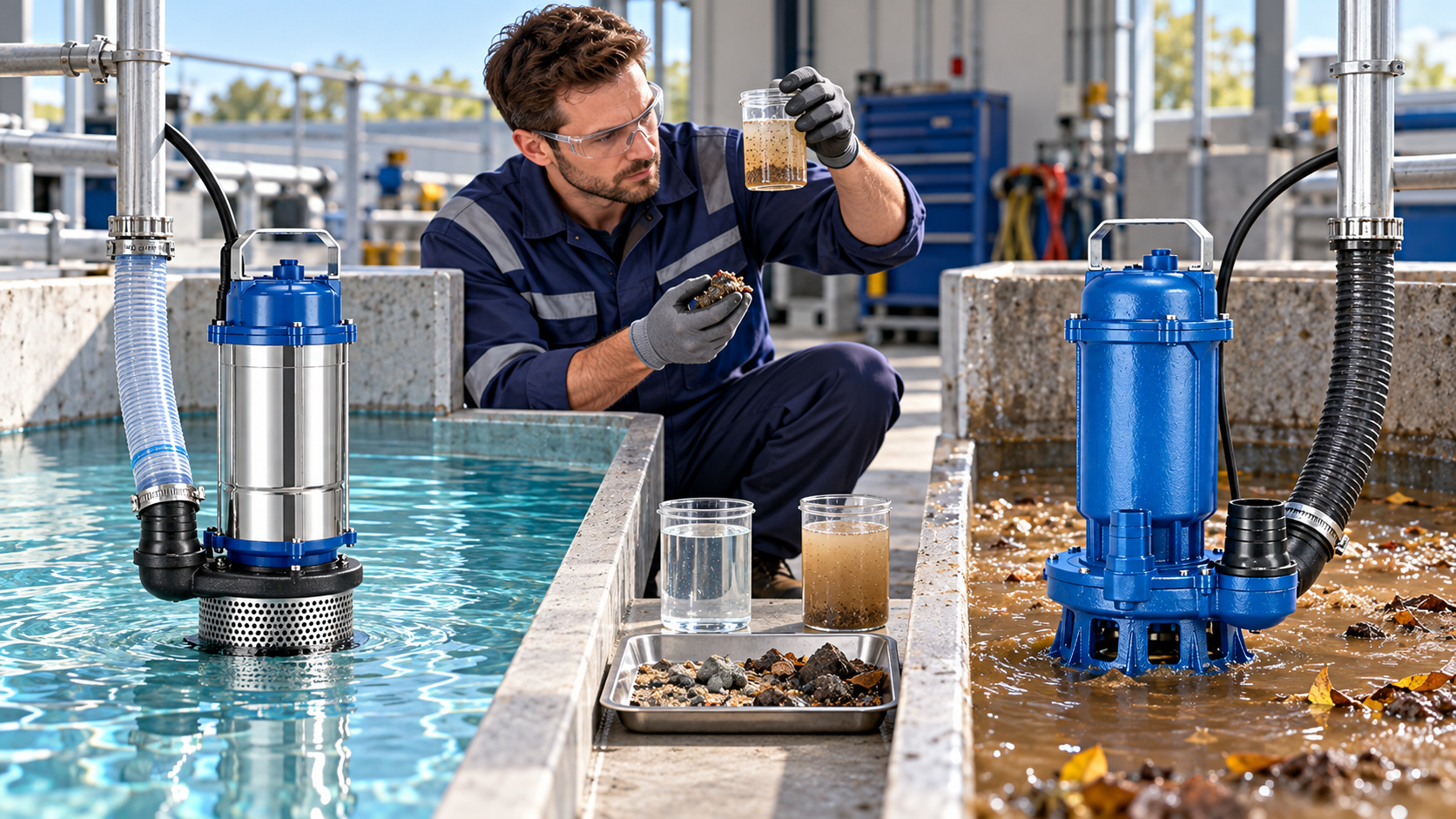
V. How to Choose Between a Clean Water and Dirty Water Submersible Pump
1. Identify the Water Source
First, find out if the water is from a tank, pool, flooded room, pond, ditch, or construction hole. The source offers you an initial notion of the likely water state.
But you should still inspect the water itself. A covered rainwater tank can store water that is practically clean, but an uncovered rainwater pit might accumulate mud, leaves, and plastic.
2. Check the Type and Size of Solids
Check what is in the water and if the solids are soft, hard, fibrous or abrasive. Then compare them to the rated solids-passing size and allowable liquid type for the pump.
The maximum size of solids does not indicate that the pump can pass any item smaller than that diameter. A lengthy piece of fibre, a strip of metal, or a sharp stone can still obstruct or damage the pump.
3. Match Flow and Total Head
Calculate the required flow from the water volume and the time available for drainage. If a 20 m³ pit must be emptied in two hours, the basic required flow is:
20 m³ ÷ 2 hours = 10 m³/h
Next, calculate the total head by adding the vertical lift and resistance from the pipe, hose, bends, valves, and fittings. You should then select a pump that provides at least 10 m³/h at the calculated head.
Do not choose the pump from its maximum flow alone. If a pump has a maximum flow of 10 m³/h, its actual flow will be lower after it begins lifting water and overcoming pipe resistance.
4. Check the Required Remaining Water Level
When the pump has to empty a flat floor, swimming pool, or tank almost fully, note the minimum suction level and the stopping level. These numbers reflect how much water will be left after pumping.
For dirty water or water with debris, the pump may need a higher water level surrounding its entrance. Running at a very low level can cause air to be drawn into the pump and reduce cooling of the motor.
5. Choose Automatic or Manual Operation
An automatic submersible pump has a float switch or other level sensor that turns it on and off according to the water level. Suitable for drainage wells, basements, and systems that may need to work without human control.
A manual pump will switch on when power is applied and generally requires human control or an external control system. It is suited for temporary drainage and for those systems which already have independent level controls.
You should also look at the clearances around the pump. A cable float needs plenty of freedom to move, but a confined pit can require a vertical float, an internal float, or an external level controller.
6. Confirm Materials and Working Conditions
Check pump body, impeller, shaft, and mechanical seal material according to water conditions. The selected materials must be suitable for the expected corrosion, wear, impact, and service temperature.
You should also check the temperature of the liquid, the depth of immersion, running time, and the allowed starts per hour. Do not use standard drainage pumps for saltwater, chemicals, hot water, or extremely abrasive liquid unless approved by the manufacturer.
7. Check Outlet Size and Power Supply
Confirm discharge size, pipe or hose diameter, voltage, frequency, phase, plug type, and cable length. A tiny hose can increase resistance and decrease the actual flow even when it can be connected with an adaptor.
Check the existing pipe connection and the required operating point for a replacement order. The pump may fit the pipe but may not give the appropriate flow and head.
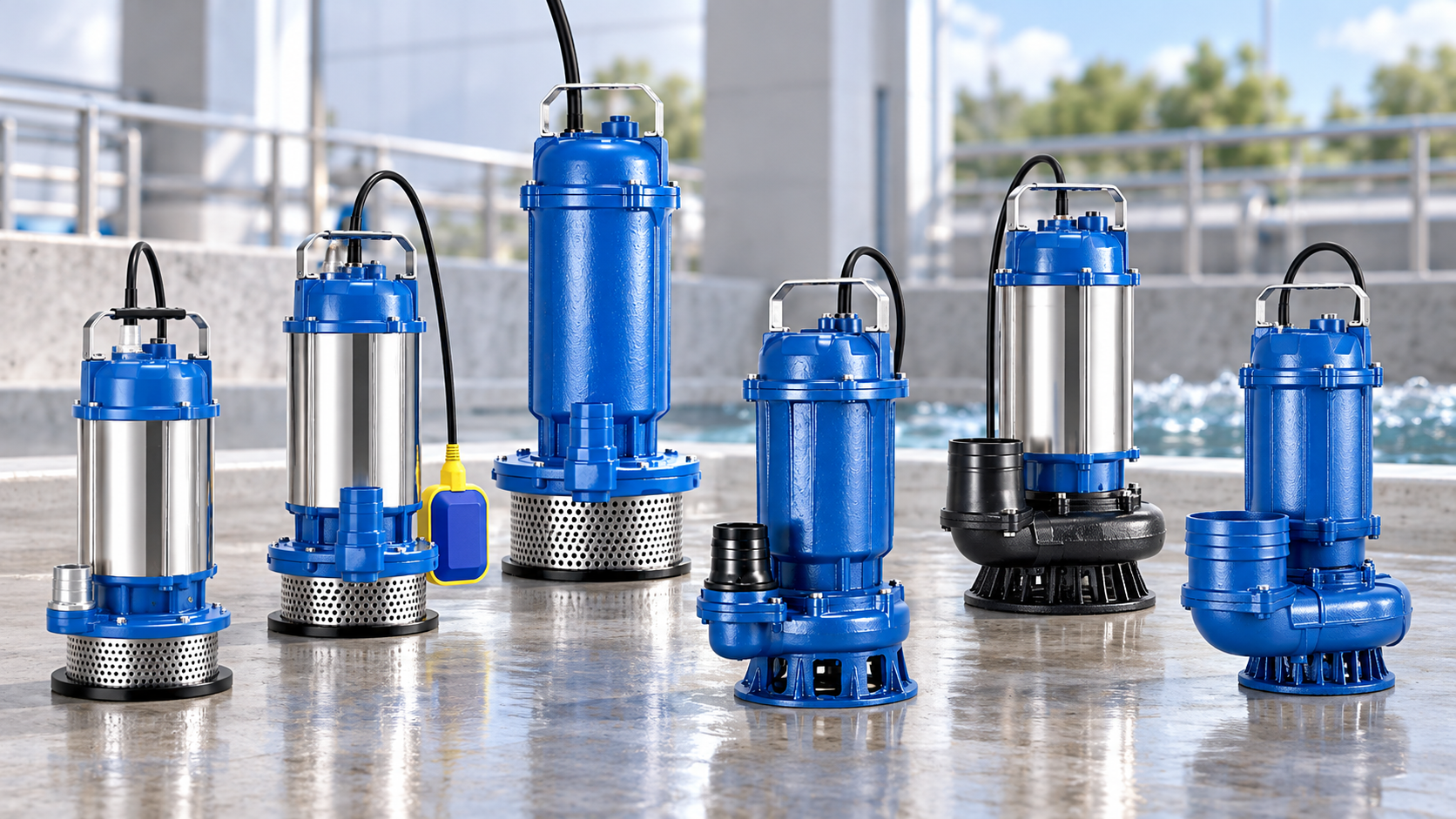
VI. Building a Practical Submersible Pump Range
1. Separate Models by Water Condition
Divide the range into clean water drainage, low-level clean water drainage, and dirty water drainage. These three categories fulfill separate needs and offer each model its own purpose.
A general clean water submersible pump may cover tanks and drains inside. A low-level model can service applications that need less leftover water.” A Dirty Water Submersible Pump can handle water with acceptable solids.
This structure prevents numerous comparable models from vying for the same orders, while leaving additional applications undiscovered.
2. Divide Dirty Water Models by Solids Size
Compare Dirty Water Submersible Pumps by rated solids passing size, allowed solids type, flow, and head. Adding another motor power does not help your product range if the new model covers the same water conditions and operating points as the previous ones.
A clear range can include models for small particles and models with bigger solids transit. Sewage and fibrous-waste pumps should be kept separate. They are different in their applications and internal structure than normal dirty water drainage pumps.
3. Include Automatic and Manual Models
Automatic variants are convenient for unattended drainage and typical retail applications. Manual models work well for temporary pumping and for systems that already have external level controls.
If you have both automatic and manual versions of the same hydraulic device, you get two control options without adding many overlapping flow and head ranges. You should still verify that the float design matches the pit size used in your target market.
4. Compare Useful Operating Points
Arrange the models not only according to the maximum flow, maximum head or motor power, but also according to their actual flow at common head positions. This demonstrates if each model adds a useful range of performance.
If many pumps give nearly the same flow at the same head, they may be suitable for the same application even if their maximum values look different. Comparing working points will assist in uncovering repetitive models and true gaps in your range.
VII. Conclusion
Clean Water Submersible Pumps are constructed for clean water with little or no solid debris. A Dirty Water Submersible Pump has bigger inlet apertures and internal channels for handling allowable particles and debris. The two varieties can also be different in terms of residual water level, impeller design, flow, head, and applications.
Consider the water source, type and size of solids, desired flow, total head, minimum water level, control technique, materials, and power supply when selecting the right pump. This enables you to develop a variety of products with well-defined uses, rather than simply comparing models in terms of motor power and outlet size.
If you are creating or extending your range of Clean Water Submersible Pumps and Dirty Water Submersible Pumps, submit to HunGerät your intended applications, flow and head, water conditions, voltage, frequency, and control requirements. We can assist you in comparing relevant models and combinations for bulk supply and OEM orders.
VIII. FAQ
1. What Is the Main Difference Between a Clean Water and Dirty Water Submersible Pump?
The Clean Water Submersible Pump is intended for water with very fine particles, and the Dirty Water Submersible Pump has bigger passageways for allowed solids. Each model must be validated for the precise particle limit.
2. Can a Clean Water Submersible Pump Handle Small Solids?
Yes, provided the particles are kept under the limit set by the pump manufacturer. Even if the fine sand is small enough to penetrate the pump, it might still cause damage.
3. Can a Dirty Water Submersible Pump Be Used for Clean Water?
Yes, a Dirty Water Submersible Pump can usually pump clean water. However, it may not have the same minimum water level or hydraulic performance as a clean water model built for that purpose.
4. Does a Dirty Water Submersible Pump Provide Less Head?
Not necessarily. The head is a function of the motor and hydraulic design therefore, you should compare the pump curves of the individual models.
5. How Do You Check the Maximum Solids Size?
Check the product data for the rated solids-passing size. You also need to confirm what type of solids are allowed, because hard, sharp, or fibrous materials can damage the pump even if they are smaller than the size mentioned.
6. Is Outlet Size the Same as Solids-Passing Size?
No. Outlet size is the size of the pipe connection. Solids-passing size is the maximum size of an authorised particle that can pass through the pump.
7. Which Pump Is Better for Basement Flooding?
For relatively clean water from an indoor leak, a Clean Water Submersible Pump will work. If your water contains mud, leaves, or other permitted debris, choose a Dirty Water Submersible Pump.
8. Which Pump Is Better for Emptying a Swimming Pool?
A Clean Water Submersible Pump is generally the superior choice. If there are leaves or other debris in the pool, remove them first, or make sure the pump can pass them.
9. Can a Dirty Water Submersible Pump Handle Sand?
Depending on the model, it may require a bit of fine sand. This is water with a lot of sand in it. You need a pump designed to work in abrasive environments.
10. Can These Pumps Handle Sewage?
Not necessarily. Use them for sewage only when the manufacturer specifically approves the model for sewage service.
11. What Is the Difference Between a Dirty Water Pump and a Sewage Pump?
A dirty water submersible pump is generally used for draining water with acceptable debris. It is a Sewage Pump, for wastewater and for soft solids only.
12. Can a Dirty Water Pump Handle Long Fibres?
Only if the pump is made for fibrous matter. Even if the long fibres are thinner than the rated particle size, they can wrap around the impeller or shaft.
13. Why Does a Clean Water Pump Block in Dirty Water?
The particles may be too big to fit in its inner tube or inlet. Before selecting a replacement, check water condition and rated solids size.
14. Why Is the Actual Flow Lower Than the Maximum Flow?
Maximum flow is usually measured at a relatively low head. The real flow is lower because there is less vertical lift and resistance from pipes, hoses, bends, valves, and fittings.
15. How Low Can a Submersible Pump Drain the Water Level?
The remainder of the water level relies on the inlet and float design. See the minimum suction and cut-off levels indicated for the model in question.
16. When Should You Choose a Pump with a Float Switch?
Choose a float switch model if the pump is to automatically turn on and off based on the water level. Ensure that the float has enough space to move about.
17. Can a Submersible Pump Run Continuously?
Only if the pump is rated for continuous duty at the indicated circumstances. Check the required immersion depth, motor cooling, liquid temperature, and operating point.
18. Can Clean Water and Dirty Water Pumps Use the Same Discharge Pipe?
They can if the connection, pipe size, flow required, head, and solids conditions are compatible. A pipe that is too narrow increases resistance and can trap solids.
19. What Information Is Needed to Select the Correct Pump?
Source of water, size and nature of solids, flow necessary, vertical lift, length of pipe, diameter of pipe, voltage, frequency, mode of control, probable running time.
20. What Should You Compare When Choosing a Submersible Pump Supplier?
Consider pump curves, rated solids size, allowable liquid type, motor and seal construction, cable and float alternatives, electrical setups, production consistency, and OEM support. These details are a better comparison than just price and power.