I. Introduction
If low water pressure is an issue for you, you know how frustrating it can be. A booster pump simply takes that existing supply and pumps it up at pressure. This guide explains residential single-stage and commercial multi-stage pumps and helps you identify the exact hardware that you require.
II. How a Booster Pump Operates
Pressure Amplification (Not Volume Generation)
A normal transfer pump and a booster pump may look like they do the same thing. But there is a very important difference. A normal pump takes water from a still source, like a pond or an underground storage tank, in order to move a lot of water. A booster pump works in a different way. It takes in water that is already in a pipe, like a city line, and raises the pressure inside that pipe. You don’t need to make more water; you just need to give the water you already have a huge, powerful push.
Increasing Total Dynamic Head (TDH)
Total Dynamic Head (TDH) is a word that is often used to talk about pipe resistance. However, how does a booster pump make the pressure that it needs? It takes place inside the pump body. When water comes in, it hits the impeller, which is a wheel that spins quickly. Using centrifugal force, the blades grab the water that comes in and throw it out at very high speeds. The pump’s specially shaped casing then grabs this moving water and pushes it into the pipe that lets it out. The sheer speed of the water is directly turned into raw, forcing pressure by this physical action. TDH is made in that exact way, which gives the water the force it needs to fight gravity and friction in your systems.
III. Residential Structure vs. Commercial Structure
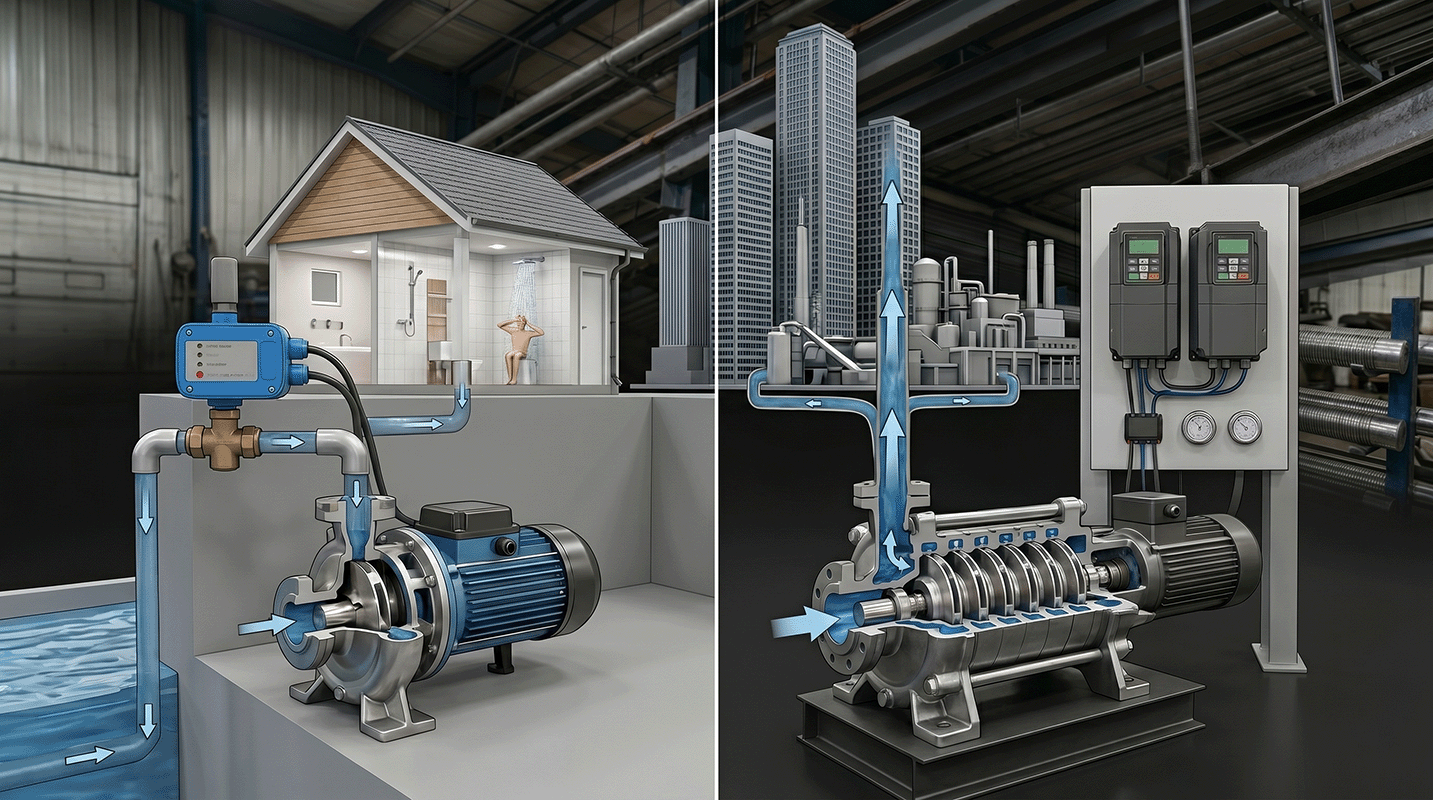
Single-Stage (Residential & Light Duty Application)
Inside a typical home booster pump, you will only find one rotor that was carefully designed and built. A single-stage design is what we call this. What you need if you’re having normal problems with home pressure, like fixing a weak shower or making sure the water flow stays steady. The pump is small, cheap, and very quiet thanks to its single-impeller design. It takes up very little room and does a great job of smoothing out normal inline pressure.
Multi-Stage (Heavy Commercial Application)
If you have a big business project, it’s impossible to use just a single stage. This is where design with a multi-stage approach comes in. You put several impellers in a row inside the pump body instead of just one. The pressure builds up as the water goes from one stage to the next. With this clever design, you can create huge hydraulic pressure for tall buildings or industrial systems without using a big motor that uses a lot of power.
Intelligent Control Integration
You can’t just turn these pumps on and leave them alone; you need the right settings to keep them in check. Most of the time, all you need for a simple home is an automatic water pump controller to tell the pump when to turn on and off. If you want to connect heavy commercial devices, you need to be much smarter about it. The system constantly checks how much water is needed and changes the motor speed in real time using Variable Frequency Drives (VFDs) and accurate pressure sensors. This keeps the pressure steady and stops the pump from going on and off quickly, which is called “short-cycling.” This keeps the motor from breaking down too soon.
IV. Application of Booster Pump
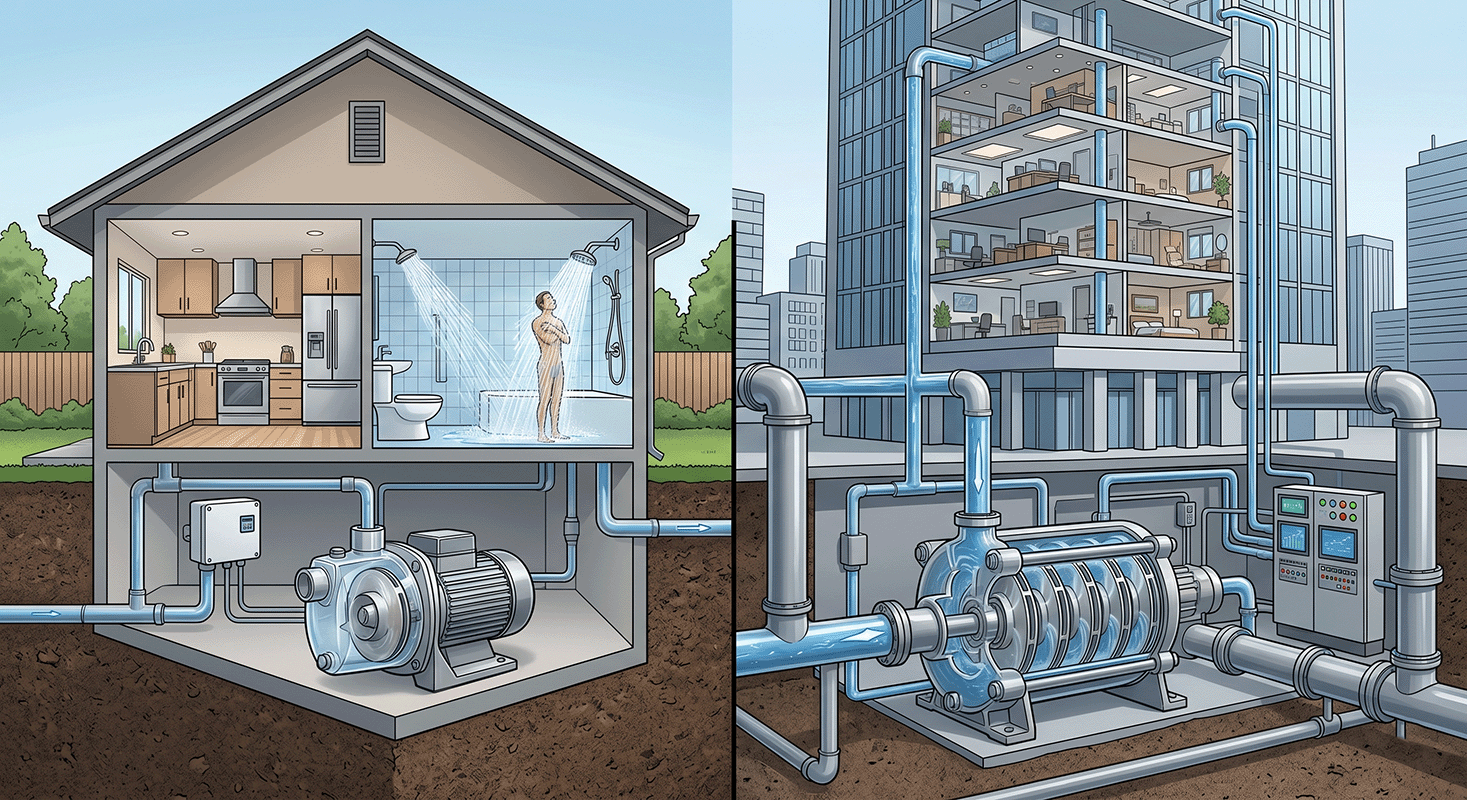
Residential Whole-House Boosting
Every day of life is hard when you come across a house with low municipal water pressure. You need a single-stage booster pump if your shower only drips water or your washing machine takes a long time to fill up. These small pumps can be hooked up straight to the house’s main water line to keep the pressure steady for the whole property. In this way, home tools and small yard sprinklers are guaranteed to work as they should.
High-Rise Commercial Plumbing
It’s not the same thing to push water to the top floor of a hotel, an apartment building, or an office building. You have to fight against very strong vertical gravity here. You need to use multi-stage booster systems along with VFD settings for these heavy-duty jobs. This setup makes sure that strong, consistent water flow is sent all the way to the top floor, even if someone turns on a faucet on the first floor and fifty people are all taking showers at the same time.
Reverse Osmosis (RO) and Filtration for Home
Filtration systems for water, especially Reverse Osmosis (RO) systems, make it very hard for water to move. The internal membranes are very thick so that they can catch impurities that are very small. If you only use normal pipe flow, the water will not get very far through the system. A booster pump is needed to give the water the strong, high-pressure push it needs to get through those thick filters. This makes sure that the flow of clean water on the other side stays steady and can be used.
V. Strategic Sourcing: Mitigating Field Failures
Eliminating Post-Installation Burnouts
This is the last thing you want: a few weeks after putting in a pump, getting a call saying the motor burned out. A simple way to avoid these pricey problems is to buy booster pumps with high-quality copper windings, thermal safety built in, and dry-run sensors. These safety features make sure that the pump stops working right away if it gets too hot or if the water supply cuts off quickly. If you choose tools with these built-in safety features, you won’t have to keep fixing problems and will get a lot fewer annoying, false warranty claims.
Just getting the plumbing right is hard enough without having to worry about difficult electrical work as well, especially for everyday tasks around the house. If you choose a fully integrated home booster pump, it will work right out of the box. The pump and smart controller are already wired and perfectly matched in these home units, unlike large business systems that need detailed electrical commissioning. This totally removes the chance of making wiring mistakes on-site, making the installation very quick, easy, and error-free for the person doing the work.
Inventory Scalability
You need pumps that can do all kinds of jobs so that your business can run smoothly and make money. It makes more sense for a business to rely on a full product line than to try to piece together tools from different places. When you can get both high-volume, single-stage domestic pumps and heavy-duty, multistage commercial systems from the same place, it’s easy to make your projects bigger. You can handle anything with confidence, from a quick fix around the house to a big business bid, without having to worry about quality issues.
VI. Conclusion
To sum up, a booster pump is an important part of fixing low water pressure. It doesn’t matter if the job is a small residential one that needs a single-stage pump or a big business one that needs the extra power of a multi-stage system. The key to getting it right is always matching the right hardware to the site’s pressure needs.
It is best to work with a manufacturing partner who really knows a lot about engineering when you need tools that you can depend on. We make a full line of tough, dependable booster pumps at HunGerat to meet all of your project needs. We’re here to make it easier for you to find what you need and to make sure that every pump you send out into the field works perfectly.
VII. Frequently Asked Questions (FAQ)
- Where is the best place to install a water booster pump?
To make sure the whole plumbing system benefits from the higher pressure, you should put the pump right after the water meter, as close to the main water shut-off button as possible.
- Do we need a pressure tank with a booster pump?
Yes, if your pump doesn’t have a Variable Frequency Drive (VFD), using a diaphragm pressure tank with it will store extra compressed water and keep the motor from quickly short-cycling when there isn’t much demand for water.
- How much pressure (PSI) can a booster pump add?
Most standard residential units add 30 to 50 PSI. Commercial multi-stage systems, on the other hand, can be designed to add well over 100 PSI, based on the height of the building and the needs of the project.
- What causes a booster pump to constantly cycle on and off?
If you keep short-cycling, it’s likely that there is a pipe leak somewhere in the building, the pressure tank is full of water and has lost its air charge, or the check valve is broken and letting the pressure drop.
- Can a booster pump be installed outside?
Yes, but only if it is kept in a waterproof container with air flow. This keeps the electrical motor and sensitive controllers from getting damaged by cold weather, heavy rain, and direct sunlight.
- What is the difference between a jet pump and a booster pump?
A jet pump uses strong force to pull water up from a deep well, while a booster pump needs water to be pushed into its inlet in order to boost the pressure in the pipe.
- Does a water booster pump require a dedicated electrical circuit?
Yes, it is strongly suggested that you connect the pump to a separate breaker. When they first turn on, booster pump motors use a lot of electricity (called “inrush current”). This can easily short out a common circuit and cut off the water supply.
- Why is the water booster pump making excessive noise?
Most of the time, loud grinding or rattling means that the motor bearings are worn out, the pump is experiencing cavitation (not getting enough water), or the mounting hardware is loose and moving against the concrete floor.
- Is a bypass valve necessary when installing a booster pump?
A three-valve bypass loop should always be put in by builders. To service the pump, you can easily disconnect it and take it out of the house without cutting off the main water supply.
- Can a standard booster pump handle hot water?
No, normal models are only rated for water that is cold or room temperature. For mechanical failure to be avoided when pumping hot water, special high-temperature mechanical joints and stainless steel hydraulics are needed.
- Will a booster pump fix a clogged or calcified pipe?
Not at all. If your low pressure is caused by mineral buildup blocking the lines, adding a pump will only put stress on the motor and not fix the plumbing problem.
- What is the ideal incoming city water pressure before boosting?
Most booster pumps need a feed pressure of at least 10 to 20 PSI. If the pressure coming in is too low, the pump can create a vacuum, which hurts both the pump and the pipes in the city.
- Do you need a check valve with a booster pump?
Yes, a heavy-duty check valve needs to be put in place on the output side to stop highly pressurized water from flowing backwards and turning the impeller of the pump around when the motor turns off.
- How long does a water booster pump typically last?
A unit that is the right size and is placed correctly should last between 7 and 10 years, but this depends a lot on the water quality, the duty cycle, and whether the system has thermal protection.
- Does a booster pump require regular maintenance?
They don’t need much care, but you should clean the pre-filter screen every so often to keep debris from getting stuck and check the air pressure in the pressure tank at least once a year.
- What size pipe should you use for a booster pump installation?
Always use pipes that are the same width as or bigger than the pump’s inlet port. Using lines that are too small limits the flow of water, which leaves the pump without enough to work and leads to damaging cavitation.
- Can a water booster pump run continuously?
If a pump has a continuous-duty motor and the right amount of cooling, it can run all the time. But if a pump never turns off, it usually means that the system is too small for the high water demand.
- What is cavitation in a booster pump?
Cavitation takes place when the pump tries to remove more water than it is taking in. This makes tiny bubbles that pop when they come under pressure, wearing away the metal fan over time.
- Can one booster pump system supply multiple buildings?
Yes, heavy-duty business multi-stage systems can be set up with central manifolds to make sure that the hydraulic pressure stays the same across an entire industrial campus or residential subdivision.
- How do you size a booster pump for a residential home?
Based on the number of bathrooms and big appliances, you need to figure out the peak water demand (GPM) and match it with the end pressure (PSI) you want to reach in order to choose the right pump curve.