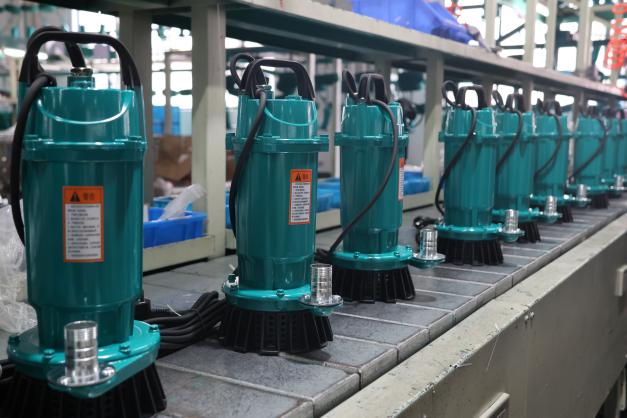
I. Introduction
It’s important to follow standard steps exactly when replacing a deep well pump to avoid losing money. This guide teaches you how to safely take out the old pump, make sure the wiring is waterproof, and choose the right long-lasting tools so that you can install the new pump correctly the first time, without having to do any extra work.

II. Pre-Replacement Diagnostics: Confirming the Failure
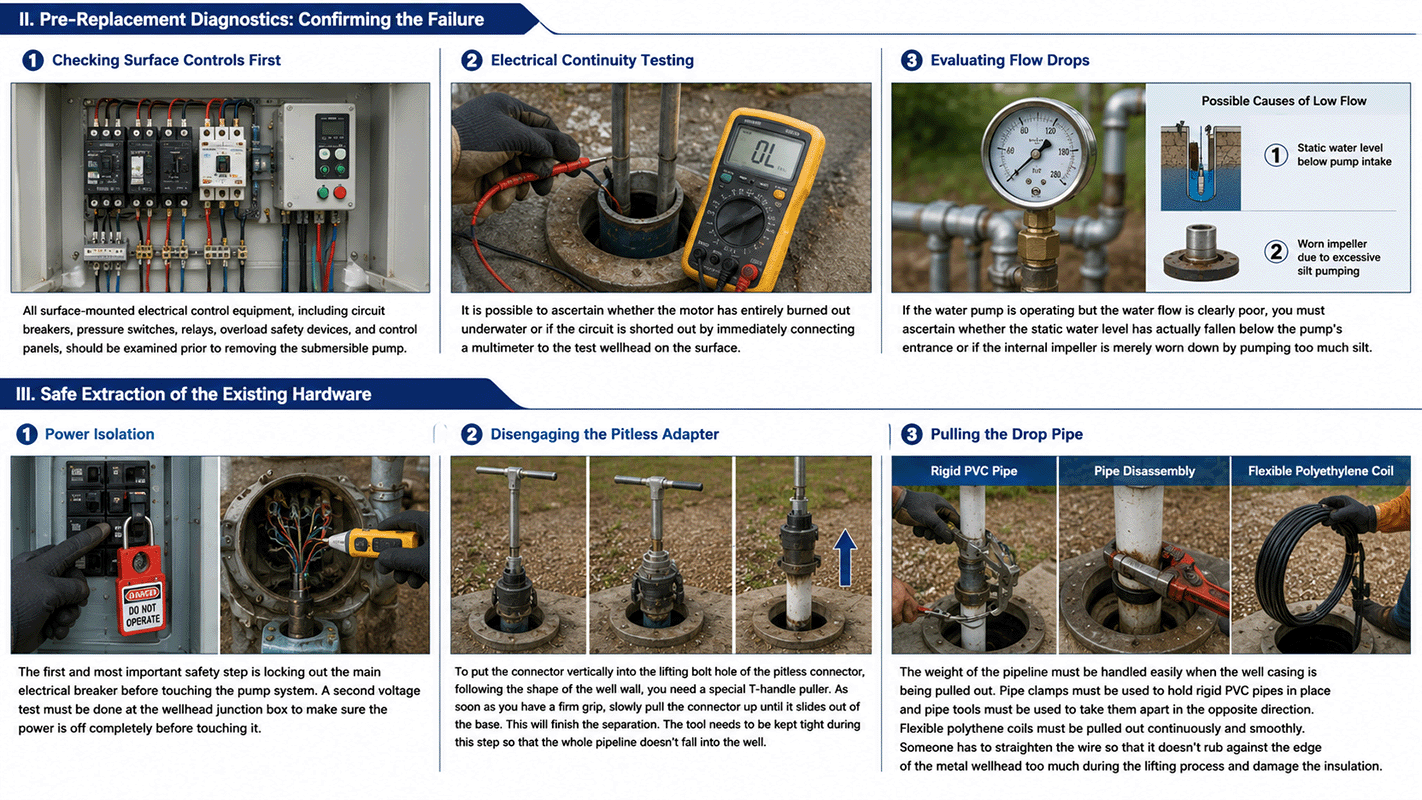
Checking Surface Controls First
All surface-mounted electrical control equipment, including circuit breakers, pressure switches, relays, overload safety devices, and control panels, should be examined prior to removing the submersible pump. The pump below will just not start if these surface parts malfunction.
Electrical Continuity Testing
It is possible to ascertain whether the motor has entirely burned out underwater or if the circuit is shorted out by immediately connecting a multimeter to the test wellhead on the surface.
Evaluating Flow Drops
If the water pump is operating but the water flow is clearly poor, you must ascertain whether the static water level has actually fallen below the pump’s entrance or if the internal impeller is merely worn down by pumping too much silt. This will assist you in determining whether the hardware needs to be replaced.
III. Safe Extraction of the Existing Hardware
Power Isolation
The first and most important safety step is locking out the main electrical breaker before touching the pump system. A second voltage test must be done at the wellhead junction box to make sure the power is off completely before touching it.
Disengaging the Pitless Adapter
To put the connector vertically into the lifting bolt hole of the pitless connector, following the shape of the well wall, you need a special T-handle puller. As soon as you have a firm grip, slowly pull the connector up until it slides out of the base. This will finish the separation. The tool needs to be kept tight during this step so that the whole pipeline doesn’t fall into the well.
Pulling the Drop Pipe
The weight of the pipeline must be handled easily when the well casing is being pulled out. Pipe clamps must be used to hold rigid PVC pipes in place and pipe tools must be used to take them apart in the opposite direction. Flexible polythene coils must be pulled out continuously and smoothly. Someone has to straighten the wire so that it doesn’t rub against the edge of the metal wellhead too much during the lifting process and damage the insulation.
IV. Prepping the New Submersible Architecture
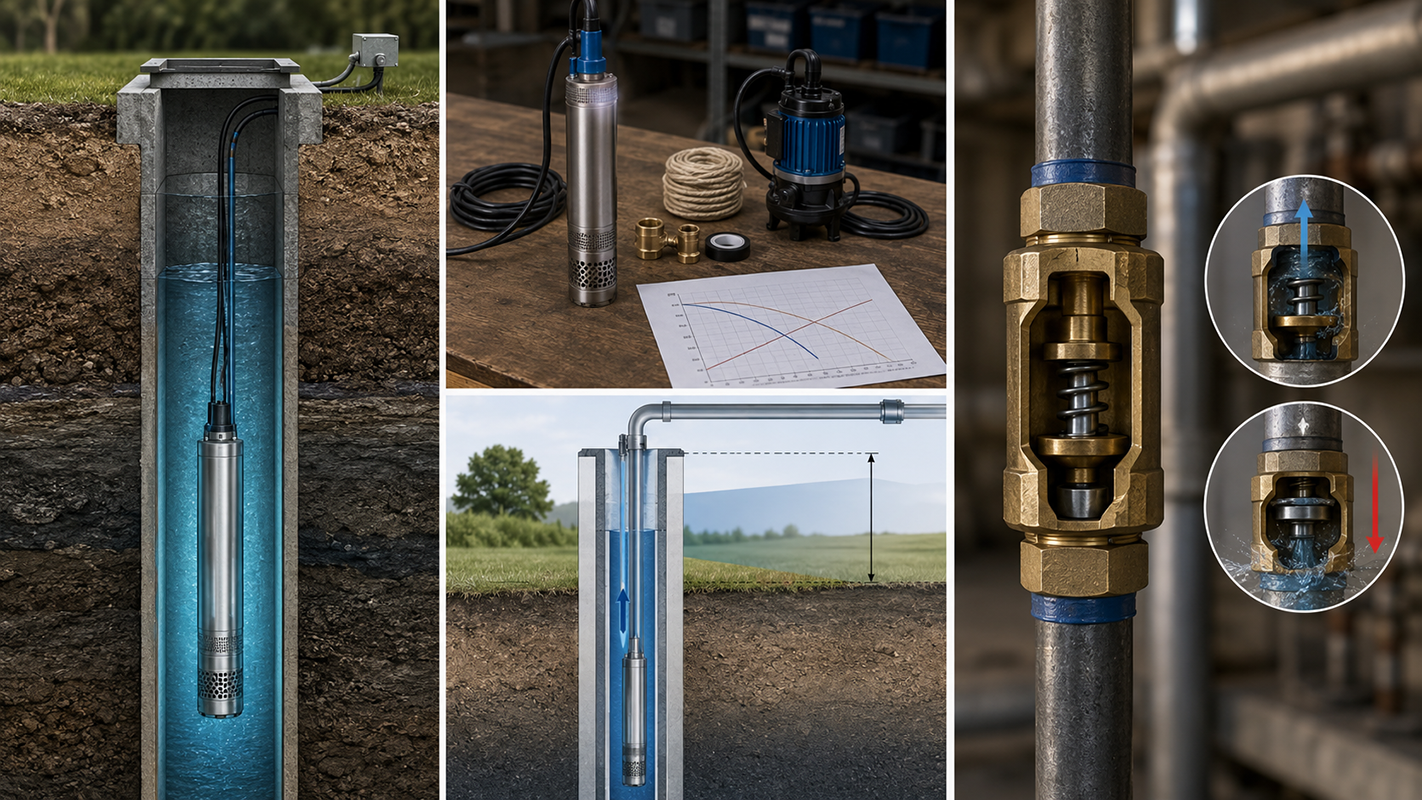
Fully Submerged Configuration
Because they are completely enclosed, submersible pumps can function in deep water. The surrounding cold well water prevents the motor from overheating, and it doesn’t need any external mechanical components that are above the water’s surface.
Matching GPM and TDH
Selecting the appropriate specifications for the new pump is essential; you must first confirm the pertinent information. The flow rate (GPM) and total dynamic head (TDH) of the new pump must precisely fit the depth and pressure requirements of that particular well. If not, the motor may become overloaded and eventually fail due to an obstruction in the piping system.
Check Valve Verification
Lastly, you must inspect your check valve. The water jet stuck in the pipe will forcefully strike the pump body as soon as the pump is turned off if a valve fails. The submersible pump will sustain physical damage as a result of the impeller’s forceful backwards rotation brought on by this enormous reverse impact.
V. The Most Critical Step: Waterproof Electrical Splicing
Stripping and Crimping
Instead of cutting every cable to the same length, cut them alternately. When you lower the pump pressure, this will stop the connector from rubbing against the steel tube. Use a secure crimp connector after carefully removing the cable sheath.
Applying Heat Shrink Tubing
For deep water applications, marine-grade heat shrink tubing with an adhesive lining is necessary. The interior adhesive in this kind of tubing melts when heat is applied, totally encasing the wires. This seal successfully stops groundwater intrusion.
VI. Lowering and Setting the New Pump
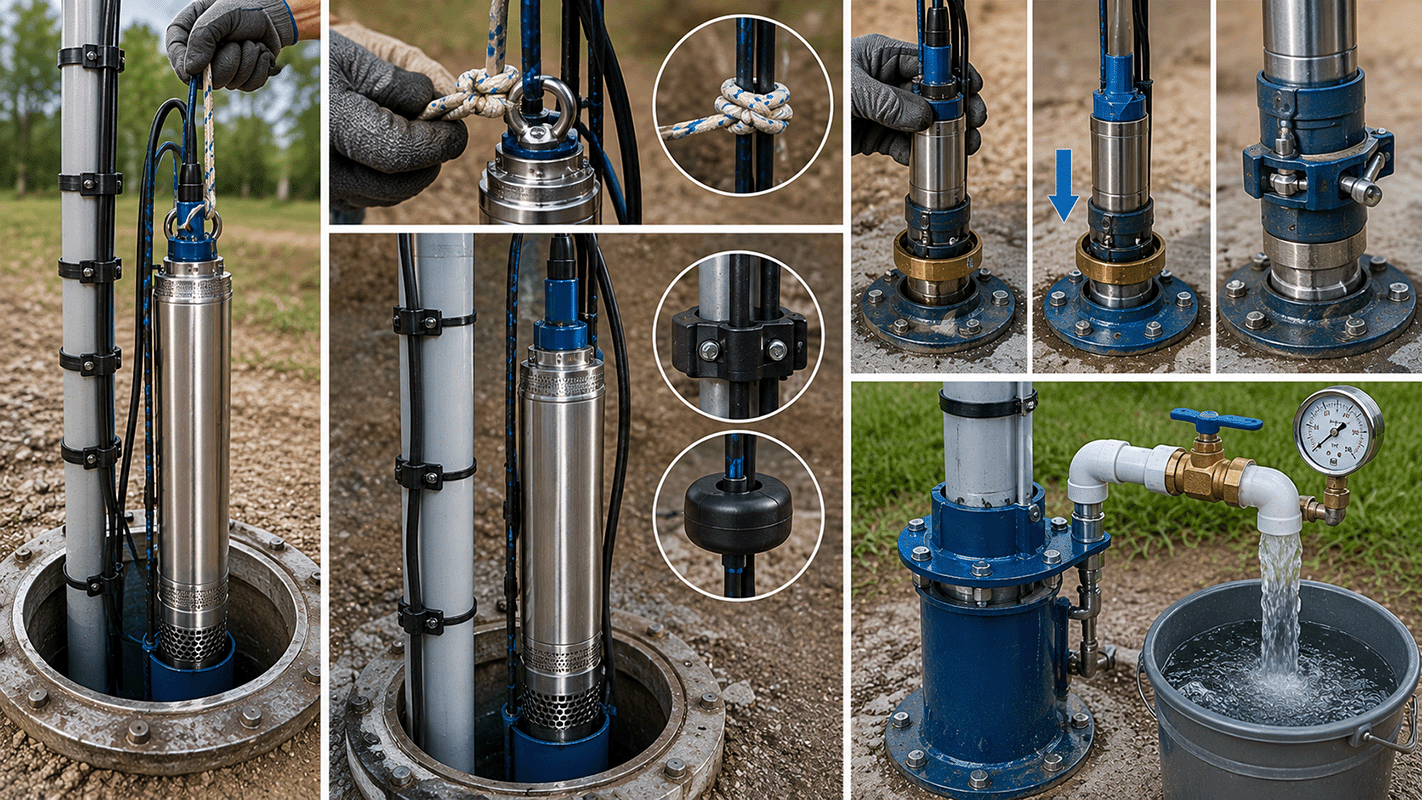
Attaching the Safety Rope
To avoid drain pipe breaks or the loss of malfunctioning equipment, securely fasten the pump body using stainless steel or polythene safety ropes.
Cable Guards and Torque Arrestors
The pump body will rotate as soon as the motor starts. To make sure the equipment can hold its place, you will need to install a torque damper. Additionally, the cable should be fastened to the downpipe to prevent it from rubbing against the rough steel well casing when the pump starts, which could cause a major short circuit and hasten the insulation’s deterioration.
Re-seating the Pitless Adapter
Relock the pitless adapter into its mounting bracket once all equipment has been safely lowered. Make sure the water is pure and the pressure is stable enough to permit continuous flow by performing a clean water test prior to sealing the wellhead.
VII. Strategic Sourcing: Minimizing Future Replacements
The Cost of Cheap Hardware
If a weak valve fails or the casing cracks at a depth of 300 feet on cheap well parts, the customer has to pull the whole system back up. This costs money and hurts their image.
The Value of Heavy-Duty Materials
You should get a heavy-duty water pump. Its strong stainless steel case and solid brass parts make it last a long time and not rust in salt water. Salt water will not damage the propeller because it is tough.
VIII. Conclusion
The key to a good pump replacement is equipment and execution. Installing a mechanically sound submersible pump, handling the pipe extraction with caution, and making sure the electrical splices are entirely waterproof are all necessary. Taizhou Hangge Pump Co., LTD produces durable, highly effective submersible well pumps that are designed to withstand challenging groundwater conditions. We provide the simple, heavy-duty equipment you require to optimise your installations and sustain a steady, lucrative business.
IX. Frequently Asked Questions (FAQ)
- What is the difference between a 2-wire and a 3-wire submersible well pump?
The starting capacitors and relays of a 2-wire pump are located inside the submerged motor. These essential beginning parts are housed in a surface-mounted control box of a 3-wire pump, which makes future electrical repair considerably simpler without having to pull the pump.
- How far off the bottom of the well should a submersible pump be installed?
The pump should be suspended by contractors at least 10 to 20 feet above the bottom of the well screen or casing. If it is set too low, heavy sand and debris might be sucked up by the intake, rapidly destroying the impellers.
- Do I need to use a flow inducer sleeve with my submersible pump?
Yes, provided that the pump is being installed in an open body of water or an enlarged well casing (more than 4 inches). The sleeve provides the required cooling to avoid thermal overload by forcing the incoming water to flow quickly over the motor casing.
- What is the ideal wire gauge (AWG) for a deep well submersible pump?
The horsepower of the motor and the overall depth of the borehole determine the appropriate American Wire Gauge (AWG). A significant voltage drop is produced by utilising wire that is too thin for a deep drop, which causes the motor to overheat and burn out too soon.
- Can a submersible well pump run dry without water?
No. Water is needed to lubricate the internal mechanical seals of submersible motors, which are completely dependent on the nearby cold groundwater for cooling. In just a few minutes, operating the pump dry will melt the motor and ruin the seals.
- Why is my newly installed submersible pump constantly turning on and off?
Usually, rapid short-cycling is a sign of a malfunctioning or flooded surface pressure tank rather than a pump problem. The pump will instantly cycle on and off with each small water demand if the diaphragm tank loses its internal air charge.
- Can I replace just the submersible motor instead of the entire pump?
Yes. A burned-out motor can be unbolted from the hydraulic wet end (the impellers) and replaced separately to save equipment expenses because the majority of professional-grade submersible pumps are constructed to standard NEMA dimensions.
- What causes a submersible well pump to suddenly trip the circuit breaker?
A tripped breaker typically indicates a blown starting capacitor in the surface control box, a locked rotor due to a sand-jammed impeller, or a dead short in the subterranean wire splice.
- Is it safe to use galvanized steel pipe for a submersible pump drop line?
Because of its extreme physical weight and severe corrosion, galvanised pipe is no longer the industry norm. To expedite extraction and avoid rust, contractors are now required to use rigid Schedule 120 PVC or heavy-duty continuous polythene (poly) tubing.
- What is a torque arrestor and why is it mandatory?
A rubber expandable bumper placed directly above the pump casing is called a torque arrestor. It keeps the pump precisely centred and keeps the electrical line from smashing into the steel case by absorbing the strong twisting force that occurs when the motor starts.
- Can lightning strikes damage an underground submersible pump?
Yes. Voltage spikes caused by lightning can quickly ruin the motor windings by travelling down the well casing. Surge Protection Devices (SPDs) must be installed at the control box and the wellhead must be grounded for proper installations.
- Why does my well water surge and spit air out of the faucets?
Air in the plumbing lines typically indicates that the internal check valve of the pump has failed, enabling the pipe to return to the well. Additionally, it may show that the pump is overpumping and bringing the static water table down to the intake screen.
- How do you size the GPM for a residential submersible well pump?
For residential contractors, calculating one GPM (gallon per minute) for each water fixture in the house is a conventional size guideline. To maintain steady pressure, the majority of typical homes need a pump rated between 10 and 15 GPM.
- What is the purpose of a pitless adapter in a well system?
Underground, the pitless adapter offers a hygienic, frost-resistant mechanical connection. It enables the vertical drop pipe to firmly attach itself completely below the freezing line to the horizontal supply line that leads to the building.
- How much does a standard submersible well pump weigh?
The weight of the actual pump and motor combination typically ranges from 25 to 50 pounds. But when the drop pipe, hefty copper wiring, and internal water column are taken into account, contractors need to be ready to lift hundreds of pounds of total weight.
- Does a submersible well pump require annual maintenance?
The submersible pump requires very little upkeep. To guarantee system health, the surface-level parts—such as the tank air pressure, control box relays, and pressure switch contacts—should be examined once a year.
- What causes a submersible pump to lose water pressure over time?
Scaling accumulation obstructing the pipe intake, a little friction leak forming in the subterranean drop pipe, or sand abrasion gradually grinding down the plastic impellers are the usual causes of gradual pressure loss.
- Can a submersible well pump freeze during the winter?
The motor itself won’t freeze because the pump runs far below the frost line. However, the pipes will burst and the system will halt if the pitless adapter or surface manifold is exposed to freezing air.
- Why is a pressure relief valve necessary on a submersible well system?
The system will quickly over-pressurize if the pressure switch fails and the pump runs nonstop. As a crucial fail-safe, a mechanical pressure relief valve releases water to stop the plumbing pipes or pressure tank from blowing up.
- What is a pump curve and why does it matter for well installations?
An engineering chart known as a pump curve illustrates precisely how much water (GPM) the pump will deliver at a given depth and pressure (TDH). Poor hydraulic performance is guaranteed when a pump is chosen without looking at its particular curve.