I. Introduction
Knowing how centrifugal water pumps move water can help you choose the best option and enable you to quickly spot issues like inadequate flow, overheating, or incorrect installation. This handbook describes their performance traits, how water pumps work, and how to troubleshoot them.
II. The Structure of a Centrifugal Pump.
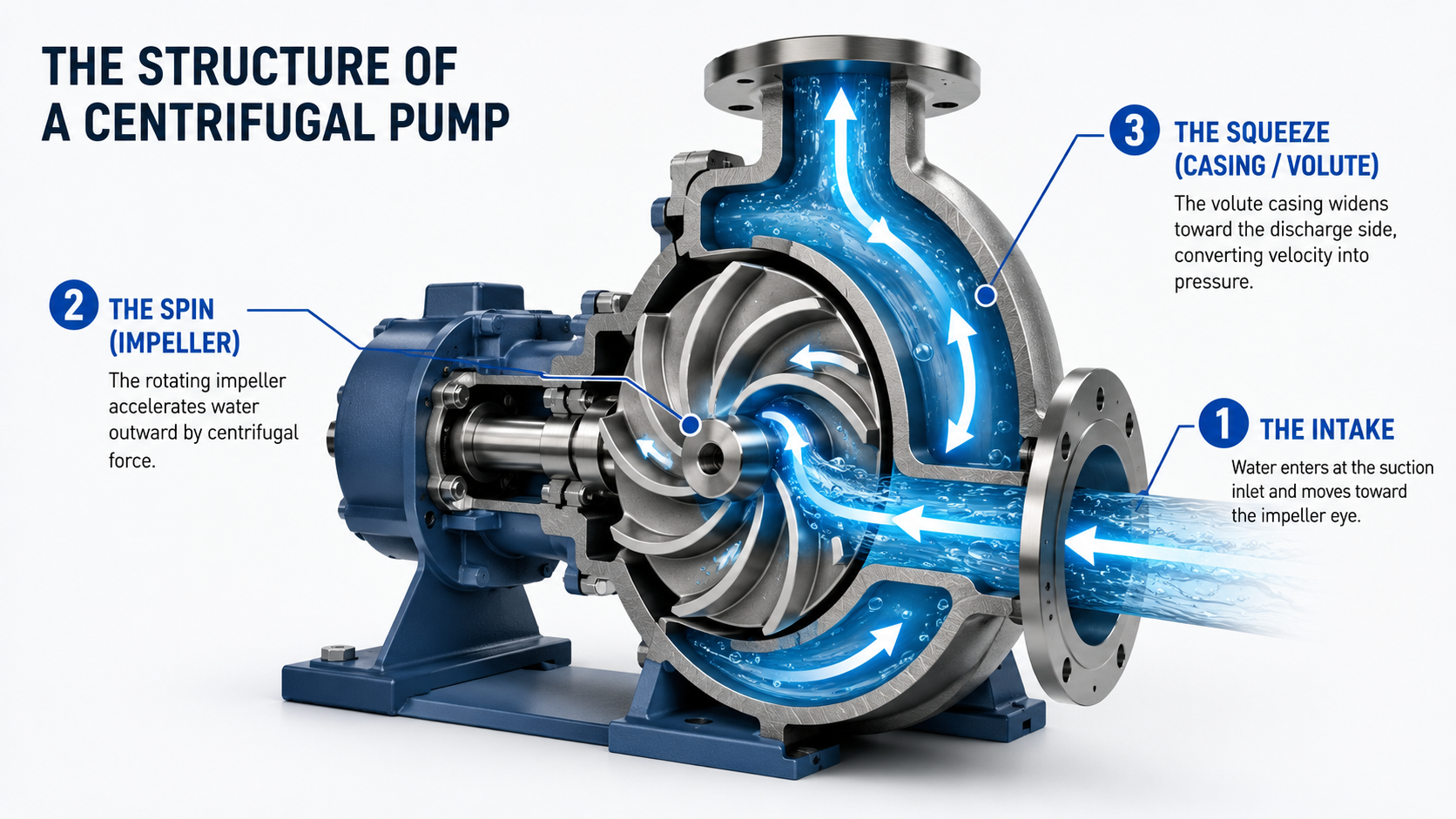
The Intake
Water enters the pump through the suction inlet and travels straight to the impeller’s “eye,” or centre. The pressure at this centre point decreases as the impeller revolves. The water can be forced into the pump by the external atmospheric pressure, thanks to this pressure drop. The system won’t prime if your client’s input line has even a small air leak since the pump won’t be able to lower the pressure sufficiently to pull in water.
The Spin (Impeller)
The water strikes the motor-driven impeller blades as soon as it reaches the centre. The water is accelerated and thrown forth towards the pump chamber’s outer edge at a high speed by the impeller’s rapid rotation and centrifugal force. The impeller is typically the problem if the pump is operating but not producing much water. It is either rotating in the wrong direction because of improper motor wiring, clogged with dirt, or worn down by sand.
The Squeeze (Casing/Volute)
It is insufficient to simply launch the water outward at a high speed; that velocity must be converted to pressure. The chamber in the outer casing, also known as the volute, widens as it gets closer to the discharge pipe. The water’s energy is directly transformed into the pressure required to force it through the pipeline as the fast-moving water slows down as it enters this growing area. A significant decline in performance will result from the water recycling inside the pump rather than creating pressure if there is internal damage or severe wear on the casing walls.
III. The Principle of a Centrifugal Pump.
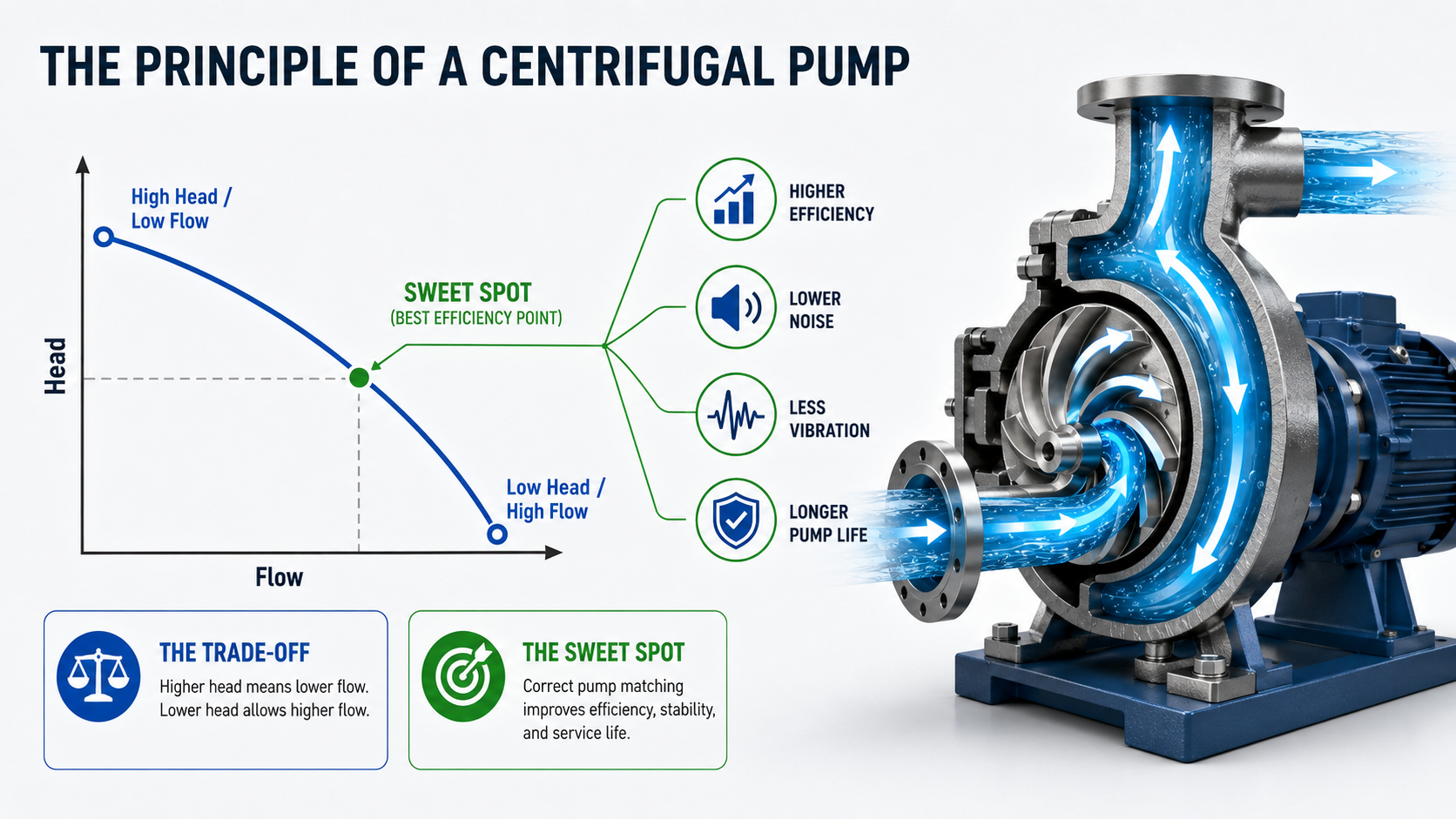
The Trade-off
Flow and head are always related in any centrifugal pump system. The pump will naturally provide less flow volume if your system requires water to move longer, higher, or through more resistance. Lower head enables the pump to move more water, whereas a higher head results in less flow.
The Sweet Spot
The pump operates more smoothly and efficiently when it is properly matched to the real system needs. In addition to extending the pump’s lifespan, you prevent issues like motor overload, excessive noise, vibration, and unsteady operation.
IV. Using Mechanics to Prevent Warranty Claims
Dry Running (No Air)
The impeller is essentially spinning in the air if the pump casing is not filled with water before starting. You already know that this kind of pump is designed to transport heavy water, not light air.
Therefore, there is virtually no cooling and no appropriate load on the impeller when you start it dry. The outcome is straightforward: the pump overheats quickly, wears out the mechanical seal, and may fail quickly. The majority of the time, this is not a manufacturing defect; rather, it is simply inadequate or absent priming prior to commencement.
Suction Starvation (Cavitation)
This occurs when the pump is unable to draw in enough water from the intake side, frequently due to a poorly built, too-long, or too-small suction line.
Although the pump appears to be operating, it is actually “starving.” It attempts to expel water more quickly than it can draw it in. Low-pressure pockets are produced as a result, and these pockets eventually become bubbles. The metal components within are struck like tiny impacts as the bubbles burst. This “chewing” effect eventually deteriorates the impeller and casing, causing noise, vibration, and a decline in performance.
In actuality, this is not a manufacturing flaw but rather another typical installation problem.
V. Conclusion
Precision casting and balance technologies have a direct effect on how well centrifugal pumps work. Taizhou Hangge Pump Industry sells water pumps that work well and rarely break down. These pumps are your steady source of water.
VI.FAQ: Common Centrifugal Water Pump Problems & Solutions
Q1: Why is my centrifugal pump running but not delivering water?
A: If your centrifugal water pump turns on but doesn’t pump water out, the most common reasons are a loss of prime, an air leak in the suction pipe, an impeller that is totally clogged, or the motor turning in the wrong direction. Make sure that the foot valve works properly and that the pump casing is fully charged.
Q2: What causes a centrifugal pump to lose its prime repeatedly?
A: If you keep losing priming, it’s likely because of a leaking foot valve, air holes in the suction line, or a broken mechanical seal that lets air in. Make sure that none of the joints in the pressure pipes is broken and that the liquid level source has not dropped below what the pump can handle.
Q3: How do I know if my centrifugal pump is experiencing cavitation?
A: When a pump cavitation happens, it makes a clear noise that sounds like marbles or gravel, along with a lot of shaking and a drop in output pressure. It takes place when the system’s Net Positive Suction Head Available (NPSHA) is less than the pump’s needed NPSHR. This makes vapour bubbles form and burst against the impeller.
Q4: Why is my centrifugal water pump motor drawing excessive current and overloading?
A: If the pump works too far to the right of its Best Efficiency Point (BEP) on the pump curve (low head, high flow), or if the shaft is bent, the packing gland is overtightened, or the viscosity is higher than the pump’s rated design, this can cause the motor to overload.
Q5: What causes a mechanical seal to leak on a centrifugal pump?
A: Mechanical seal failure is often caused by dry running (using without any liquid lubrication), shaft misalignment that is too great, pipe strain that puts pressure on the pump casing, or solids in the water that scratch the seal faces.
Q6: Why is my centrifugal pump vibrating excessively and making loud noises?
A: A lot of vibration is generally caused by an unbalanced impeller, a shaft that isn’t lined up correctly between the motor and the pump, worn-out ball bearings, or hydraulic instability like cavitation or working at a shut-off head.
Q7: How do I fix a centrifugal pump that is running hot or overheating?
A: Most of the time, a water pump gets too hot when it works against a closed outlet valve (shut-off head) for too long. This forces water back into the volute casing, which creates friction heat. Make sure that the system always has at least a minimum of constant flow.
Q8: Can a wrong motor rotation direction damage a centrifugal pump?
A: Yes. If you wire a three-phase motor wrong and run a centrifugal pump backwards, the flow and head are greatly reduced. When some designs are turned backwards, the threaded impeller can come loose and hit the volute case, doing a lot of damage to the machine.
Q9: What is the difference between Best Efficiency Point (BEP) and shut-off head?
A: The Best Efficiency Point (BEP) is the exact flow rate and head at which a centrifugal pump works most efficiently and with the least amount of shaking. The shut-off head is the highest pressure that the pump can reach when there is no flow (the outlet valve is fully closed).
Q10: How does Net Positive Suction Head (NPSH) affect centrifugal pump performance?
A: NPSH checks how much room there is for liquid to boil and evaporate inside the pump. There should always be more available suction head (NPSHA) in the system than the pump manufacturer’s minimum head (NPSHR) to avoid damaging cavitation.
Q11: What is Total Dynamic Head (TDH) in a water pump system?
A: Total Dynamic Head (TDH) is the total equivalent height that a fluid has to be pumped. It takes into account the static lift, changes in elevation, and friction losses caused by all the pipes, valves, and fittings in the plan.
Q12: Can I adjust the flow rate of a centrifugal pump by throttling the suction valve?
A: No, you should never open and close the suction valve too quickly to control flow. Doing so starves the input, lowers the suction pressure, and causes severe cavitation. A control valve on the outflow pipe or a variable frequency drive (VFD) should always be used to change the flow rate.
Q13: What is impeller trimming and when is it necessary?
A: Trimming the impeller means making it smaller so that the pump’s flow and head output are forever lower. It works well to make sure that the pump’s performance fits the needs of the system without losing energy by slowing it down with valves.
Q14: How does fluid viscosity affect centrifugal pump operation?
A: Centrifugal water pumps are made to move liquids with low viscosity. When you pump thick, highly viscous fluids, the flow volume goes down, the overall dynamic head goes down a lot, and the brake horsepower (BHP) needs to go up. This can easily trip or burn out the motor.
Q15: What is water hammer and how do I prevent it in a centrifugal pump system?
A: Water hammer is a damaging pressure surge that happens when a moving fluid has to stop quickly, usually because a valve closed quickly or a pump stopped running. You can stop it from happening by putting in check valves, surge tanks, or automatic valves that close slowly.
Q16: How do I properly align a flexible coupling on a frame-mounted centrifugal pump?
A: To align a coupling correctly, you need to use a dial indicator or laser alignment tool to check both the radial (offset) and axial (angular) alignment. When the bearings and mechanical seals are properly aligned, the shaft doesn’t bend, which means they last longer.
Q17: What is the purpose of a wear ring in a centrifugal pump?
A: Wear rings seal the moving impeller to the still pump body and can be replaced when they wear out. They stop water from the high-pressure outflow side from leaking back into the low-pressure suction side. This keeps the volumetric efficiency high over time.
Q18: How do I choose between a self-priming pump and a standard centrifugal pump?
A: Before starting up, most centrifugal pumps need the case and suction line to be fully filled with water. Pick a self-priming centrifugal pump if it needs to be placed above the liquid source and clear air from its intake line on its own when it starts up.
Q19: Can a centrifugal pump be operated continuously at zero flow?
A: No, running a water pump with no flow (called “dead-heading”) turns the motor’s mechanical energy into heat. The water inside the volute case will boil in a matter of minutes, breaking the mechanical seal, warping the impeller, and maybe even cracking the casing.
Q20: What routine maintenance prevents unexpected downtime in commercial centrifugal pumps?
A: Checking for mechanical seal leakage, making sure the shaft is aligned, lubricating the bearings according to the manufacturer’s manual, and comparing the motor’s current draw to its rated nameplate amperage are some of the most important preventive maintenance tasks.