I. Introduction
Two wells of the same total depth may require completely different pumps. If you select based just on well depth, motor power, or maximum head, you may not get the flow and pressure you expect from the pump. This article compares deep well pumps and shallow well pumps on the basis of water level, working, flow, head, installation, cost, and local market demand to help you make a more realistic choice.
II. What Are Deep Well and Shallow Well Pumps?
1. What Is a Shallow Well Pump?
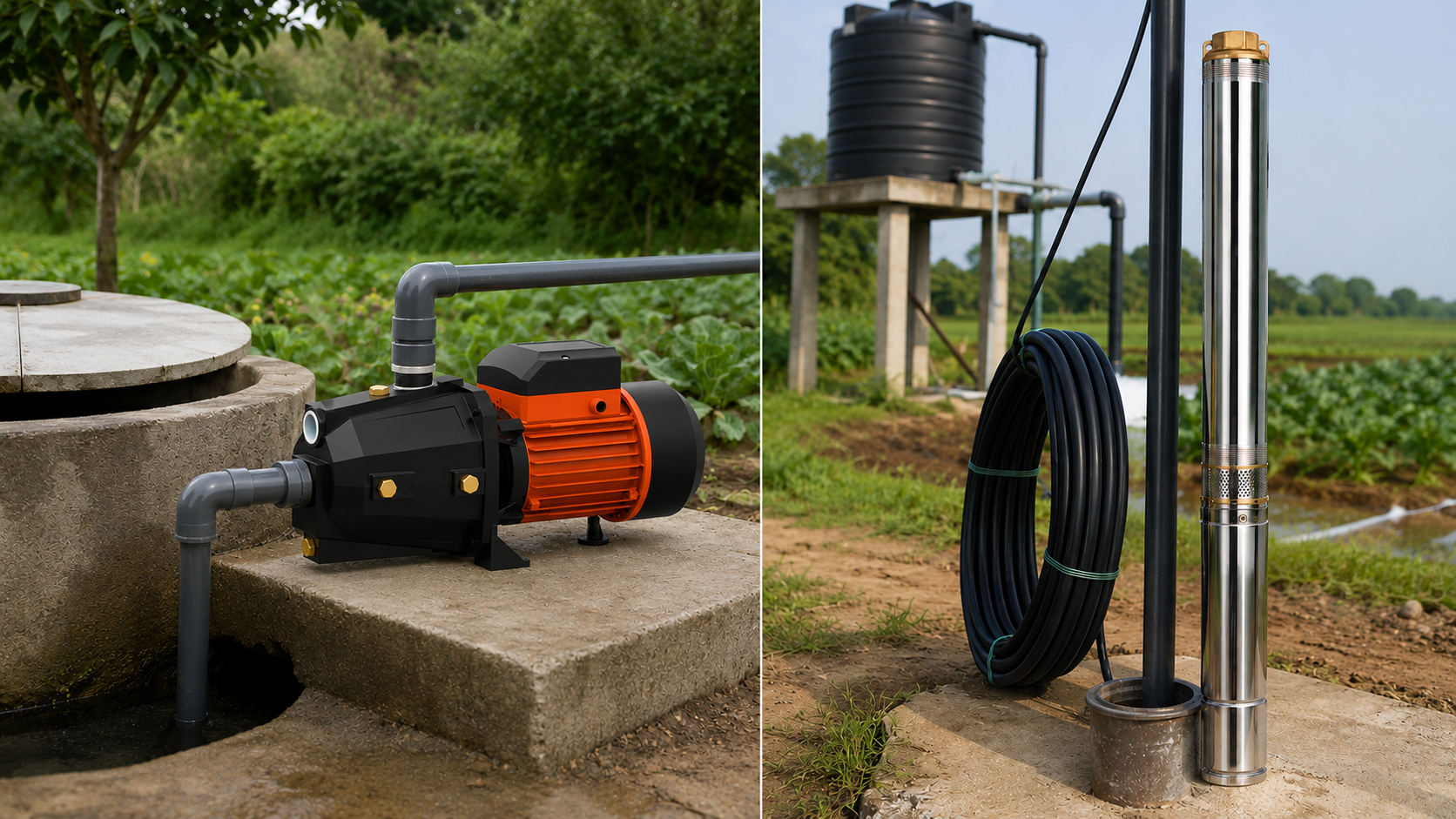
A shallow well pump is installed above ground and pulls water through a suction pipe. The working depth is the vertical distance between the pump inlet and the dynamic water level, not the overall depth of the well. The water level for most installations is not expected to be more than about 7-8 m from the pump inlet.
2. What Is a Deep Well Pump?
A deep well pump is usually located in the well below the dynamic water level. It pushes water upwards via the delivery pipe by using several impeller stages and is therefore not restricted by the suction range of an above-ground pump. Different versions can cope with deeper water levels, higher heads, and a broad range of water supply requirements.
III. Deep Well vs. Shallow Well Pumps: Key Differences
1. Water Level and Pumping Depth
Shallow Well Pump: Its pumping depth is based on the distance between the pump and the lowest dynamic water level, not the total well depth. For example, a shallow well pump can still be used if a well is just 5 m deep to the water and the well is 30 m deep. Its useful suction range is usually restricted to around 7-8m.
Deep Well Pump: It is installed below the dynamic water level and is not limited to the 7-8m suction limit. Depending on the model and the available head, it may pump water from wells of several tens or even several hundred metres depth. The pump head range must match the actual lifting height and the desired output pressure.
2. Pulling Water vs. Pushing Water
Shallow Well Pump: It is placed on top of the water source and sucks the water through a suction pipe. The pump body, suction pipe, and foot valve should all be filled with water, and all the joints of the pipes should be sealed. If there is a leak at the foot valve or if there is a loose connection, the suction will be reduced, even while the pump is running normally.
Deep Well Pump: It works underwater. And it pushes the water up through the delivery pipe. Water enters the pump directly, and each impeller stage adds pressure as the water flows through the pump. Since there is no long above-ground suction pipe, it is not subject to the same suction-depth and air-leak limits.
3. Installation Position
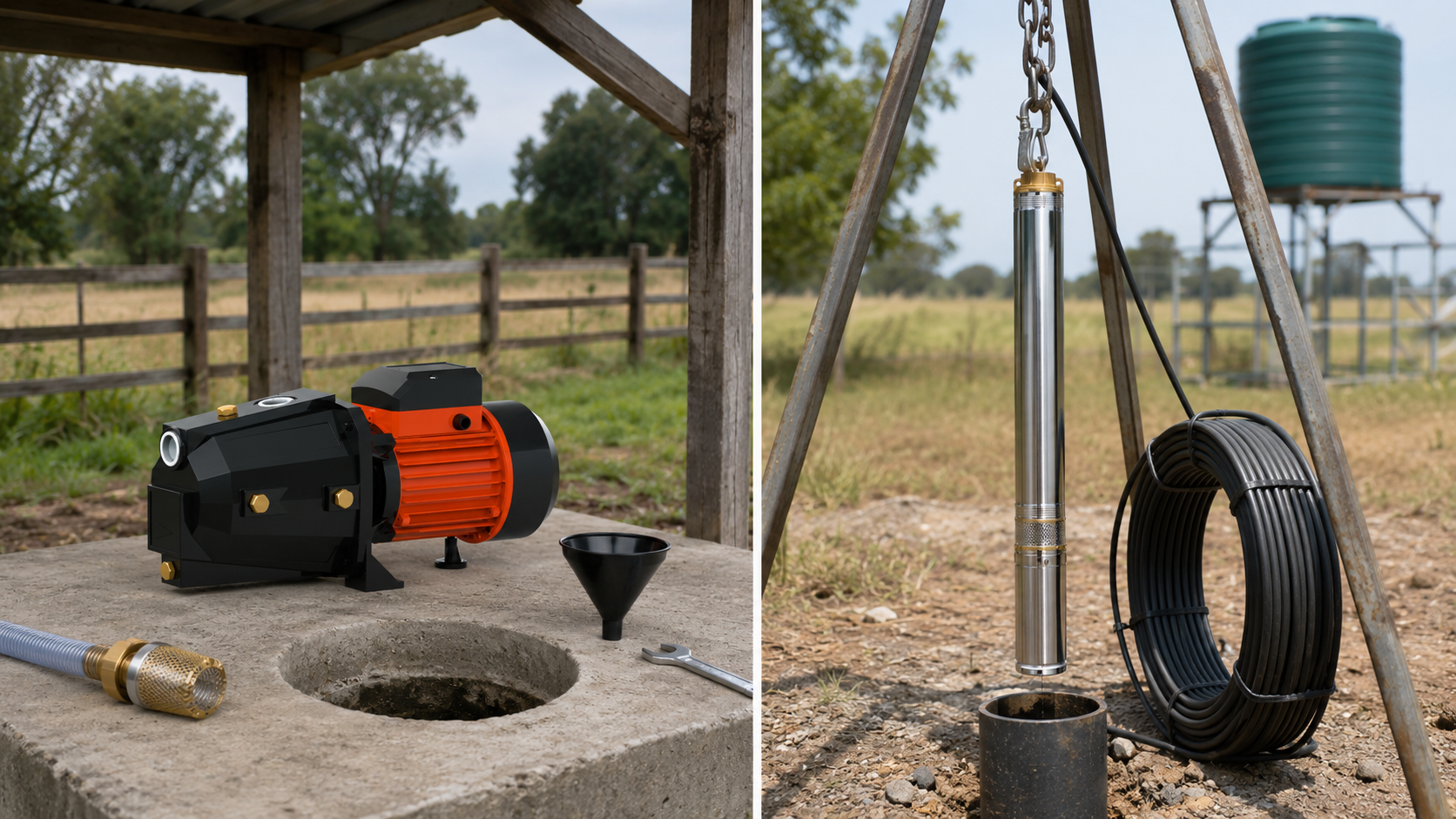
Shallow Well Pump: The motor and pump body are located above ground, at the wellhead or in a dry pump room. Only the suction pipe and foot valve are placed below the water. This gives easy access to the motor, mechanical seal, pipe connections, and control sections for inspection or repair.
Deep Well Pump: The pump, motor, power cable and pipe are lowered together in the well. The pump must be below the lowest projected dynamic water level but far above sand and sediment at the bottom. The outside diameter must also match the inside diameter of the well casing.
4. Priming Requirements
Shallow Well Pump: Before the first start, the pump body and suction pipe should be filled with water. When the pump stops, a foot valve keeps this water within the system. If the foot valve leaks or air enters the suction pipe, the water may drain away, and the pump may have to be primed again.
Deep Well Pump: No priming is required since the pump inlet and impellers are submerged. The motor may be turned on, and water is available immediately once the pump is properly installed and submerged. An above-ground suction pipe need not be filled and sealed before pumping starts.
5. Head and Pressure
Shallow Well Pump: Suction lift. Vertical delivery height. Horizontal pipeline resistance. Required outlet pressure. Its entire head. For rapid selection, each 10 m of horizontal pipe is equivalent to approximately 1 m of head. 1 bar of pressure is equivalent to approximately 10 m of head. Some of the head of the pump is already used to lift the water from the well to the pump.
Deep Well Pump: It is multistage, each impeller stage adds additional pressure. This makes it ideal for deep water levels, tall tanks, long pipelines and systems requiring higher output pressure. Adding stages only mostly increases head therefore a model with more stages does not necessarily give a larger flow.
6. Flow Performance
Shallow Well Pump: Its true flow depends on the pump design and the entire suction system. Low water level, thin suction pipe, long inlet distance, blocked foot valve, or air leak might restrict the volume of water entering the pump. Water production is generally more stable when the source is kept close to the pump and the suction pipe is properly sized.
Deep Well Pump: The flow rate is mainly affected by the pump diameter, passage of the impeller, hydraulic design, power of the motor, and real working head. Some models have a low flow but a high head; larger models give more water at a moderate or high head. A deep well pump does not necessarily mean more flow just because it is working deeper.
7. Water-Level Changes
Shallow Well Pump: As the dynamic water level falls, suction lift increases. The same pump will have a greater suction allowance when working with a water level of 5 m than with a water level of 7.5 m. Seasonal changes can, therefore, force a shallow well pump to or beyond its maximum suction range.
Deep Well Pump: It can deal with bigger changes in water level, as long as the pump input remains below the water surface. The water can go up and down above the pump and it will not change the way the pump pushes water up. The practical range of water level depends mostly on its installation depth and the lowest projected dynamic water level.
8. Energy Efficiency
Shallow Well Pump: It can produce a cheap operation where the water source is quite shallow, and the suction pipe offers little resistance. A large suction lift, a small pipe, or too many bends will reduce the amount of water that reaches the pump. The engine may continue to draw power even when the useful output of water has decreased.
Deep Well Pump: It starts pumping below the water level and is thus more suitable for deep water and high-head operation. However, more impeller stages and/or more motor power do not necessarily mean increased efficiency. The pump still must be run near the desired flow and head on the pump performance curve.
9. Noise and Freezing Protection
Shallow Well Pump: The motor and pump casing are above ground level, so the noise is more readily heard near the installation. Freezing temperatures also harm the pump, suction pipe, and exposed connections. A dry, insulated pump chamber helps reduce noise and protects the equipment from rain, flooding, and cold weather.
Deep Well Pump: The motor runs underwater, and the well casing reduces most of the sound that gets to the surface. In normal operation, the pump body is below the freezing line. However, the wellhead, delivery pipe, cable connection, pressure tank, and controls above ground still require appropriate weather protection.
10. Cost and Maintenance
Shallow Well Pump: Because it uses a simpler suction system, this keeps the pump above ground and usually the expenses of its purchase and installation are lower. The motor, mechanical seal, suction connection, foot valve, and controls may all be tested without removing the pump from the well. Lifting equipment is usually not required in routine maintenance.
Deep Well Pump: Its installation is usually more expensive, since it requires a submersible cable, delivery pipe, check valve, waterproof connections and equipment for lowering the pump. The pump must be pulled from the well for major inspection or repair. The installation depth and weight of the pipe and cable may make this operation more challenging.
IV. How to Choose the Right Pump Range for Your Market
1. Start with Local Groundwater Conditions
If your market is dry and groundwater is usually sourced from deep boreholes, deep well pumps should be the foundation of your portfolio. Shallow well pumps are still able to serve tanks, ponds, canals, and other surface water sources, but should not be the main focus of the range. Shallow well pumps will generally meet more local demand in areas of high water tables and many shallow wells.
2. Check Common Well Types and Casing Sizes
If you are in an area where narrow drilled boreholes are typical, then choose deep well pumps based on the casing sizes used in your area, for example, 4-inch or 6-inch sizes. Better to have a range covering the different flow requirements with a number of head alternatives than a lot of models with the same performance. Shallow wells and self-priming pumps will find widespread application wherever dug wells, cisterns, tanks, and open water sources are common.
3. Match the Main Local Projects
If the local need is mainly for orchards, farms, groundwater irrigation or continuous water delivery projects, deep well pumps with varying flow and head ranges will generally be more suited. Shallow well pumps will be easier to use if there is more use of small irrigation systems, greenhouse watering, tank filling, and surface-water transfer. The type of pump is not determined only by the size of the project, as the depth of the water source is still the key difference.
4. Consider Power and Installation Conditions
Deep well pumps are easier to use in places where borehole drilling and expert installation are already popular. In distant agricultural locations where grid electricity is restricted, deep well pumps compatible with solar power might be a better fit. Shallow well pumps are more practical if above-ground installation, convenient access and standard AC power are desired.
5. Build a Practical Product Range
For a deep-water market, construct the main range around local borehole diameters, multiple flow series, and varied head possibilities. Additional items for tanks and open water sources can still be shallow well pumps. For the shallow-water market, the main range is shallow well pumps, while for borehole projects, deep well models are picked. In a mixed market, use actual local well data and do not split both ranges evenly.
V. Common Selection Mistakes
1. Choosing by Total Well Depth
If the dynamic water level is 5 m below the surface pump, then the 30 m well does not need 30 m of suction lift. Total well depth can result in a pump with excess head or motor power. The lifting need is specified from the dynamic water level, not from the bottom of the well.
2. Treating 7–8 m as the Total Well-Depth Limit
The figure of 7–8 m is the vertical distance between a shallow well pump and the dynamic water level. It is not a limit on the physical depth of the well. If the water is still close to the surface in a deep well, it might still have a shallow well pump.
3. Using Maximum Head as the Working Head
The maximum head is generally obtained while the pump is running with nearly no water. A 60 m maximum head model does not automatically supply the required flow at 60 m. If the system requires 5 m^3/h at 60 m, then the entire operating point has to be on the pump curve.
4. Choosing Only by Motor Power
A bigger motor does not automatically mean higher flow or useful pressure. They can differ not only in impeller diameter, but also in the number of stages and internal water passageways with equal motor power. Flow and head must first be checked, and then the correct motor power can be set.
5. Ignoring Drawdown
Drawdown is the difference between the water level before pumping starts and the level to which the water declines when the pump is in operation. Ignoring this warning can result in a shallow well pump running out of its suction range or a deep well pump running above the working water level. A pump test provides a more reliable selection value with a stable dynamic water level.
6. Using an Undersized Pipe
A pipe that is too small has higher resistance and less flow and pressure available. It can also cause unstable priming and poor water uptake on the suction side of a shallow well pump. For fast selection, 10 m of horizontal pipe can be taken as about 1m head, but the pipe diameter must still be suitable for the flow rate needed in m3/h.
7. Oversizing the Pump
An oversized pump will cause excessive pressure, frequent starts, increased power consumption, and unstable functioning at low flow. It can also suck water from the well faster than it can recover. If the well can only deliver 6 m³/h constantly, then building a pump that can pump 10 m³/h will not increase the sustainable amount of water available.
VI. Conclusion
If the lowest dynamic water level is still roughly 7 to 8 m from the pump inlet and an above-ground installation is suitable for the system, select a shallow well pump. A deep well pump should be selected if the dynamic water column is lower, if the seasonal water variations are larger, or if a higher overall head is required for the project. Send us your well conditions, needed flow in m3/h, total head in m, voltage, and water quality, and we will help you select the suitable pump model.
VII. FAQ
1. How Much Safety Margin Should a Shallow Well Pump Have Below Its Suction Limit?
Maintain a distance of 1–2 m between the usual operating suction lift and the maximum specified suction lift of the pump. If the practical maximum is 8 m, the usual working lift should be approximately 6-7 m nevertheless.
2. Can a Shallow Well Pump Be Installed Below Ground Level?
Yes, placing it in a dry chamber closer to the water will cut down the vertical suction lift. The chamber must be above the highest projected water level and protected from flooding.
3. How Far Below the Dynamic Water Level Should a Deep Well Pump Be Installed?
The pump input is usually located 1–3 m below the lowest estimated dynamic water level. The higher the drawdown on a well, the more submergence it may require.
4. How Far Above the Well Bottom Should a Deep Well Pump Be Installed?
Position the pump roughly 1–3 m above the clean bottom of the well. If the well has visible sand or sediment, increase this distance.
5. What Should You Do When the Well Yield Is Lower Than the Required Flow?
Choose a pump with a working flow rate that does not exceed the sustainable well yield. If increased flow is needed for a short period of time, the water should be pumped into a storage tank beforehand.
6. Does a Well Pump Need a Pressure Tank?
If you have water outlets that are opened and closed often during the day, a pressure tank is useful. Choose a tank size appropriate to ensure the motor starts no more than 10-20 times per hour.
7. Where Should the Check Valve Be Installed?
The prime is maintained by a foot valve installed at the bottom of the suction pipe of a shallow well pump. Install a check valve at or near the discharge of a deep well pump to prevent water from backing down the discharge pipe.
8. Can a 50 Hz Well Pump Run on a 60 Hz Power Supply?
A 50 Hz pump should not be directly connected to 60 Hz unless the pump and motor are rated for both frequencies. Changing from 50 Hz to 60 Hz can raise the motor speed by around 20% and modify its flow, head, current, and power requirement.
9. How Much Voltage Drop Is Acceptable for a Deep Well Pump?
Maintain the running voltage drop at 3% or less and do not let it exceed 5%. If the cable is long, this may create a high voltage drop. Use a bigger cable cross-section.
10. Can HunGerät Deep Well Pumps Handle Sandy Water?
Yes, In addition to the plastic-impeller models with a specific sand-resistant design, the HunGerät deep well pumps are available with stainless steel impeller models with a stronger sand resistance. Please contact us for further information and an appropriate model recommendation.
11. Does Horizontal Pipe Length Count as Vertical Head?
Yes, as a rule of thumb, every 10 m of horizontal pipeline can be considered as 1 m of vertical head for quick pump selection. For example, a 100 m horizontal pipeline adds around 10 m to the total head required.
12. Can a Deep Well Pump Be Used in a Shallow Well?
Yes if the pump is left submerged it fits into the casing and can generate the appropriate flow at the operating head. It can be used if quiet operation, higher pressure or underground installation is desired.
13. Can a Deep Well Pump Run Continuously?
Yes, but we typically suggest a deep well pump be run for about 8 to 10 hours a day and not run continuously for 24 hours. Keep it well under water, and it should not flow any faster than the well can fill it.
14. What Causes a Deep Well Pump to Deliver Less Flow Over Time?
Common causes can be low water level, blocked entrance, damaged impellers, leaky pipes, low voltage, and increased resistance in the pipeline. Look at the actual flow in m³/h, the dynamic water level, the running voltage, and the outlet pressure to find the problem.
15. What Information Is Needed to Select the Correct Well Pump?
Static and dynamic water levels, diameter of the casing, depth of installation, needed flow in m3/h, head in m, voltage, frequency, quality of water, daily working hours. These details include the complete working and installation conditions necessary to pick the pump.