I. Introduction
Automatic and mechanical pump pressure switches can both start and stop a water pump, but they come in very different kits. A pressure tank and a mechanical switch are most of the time used together. It is possible to make an automatic model that can detect pressure and flow and make sure the pump is safe. These differences will help you keep track of package costs, make sure you don’t give out the wrong extras, and cut down on problems that happen after the sale if you sell pumps.
II. Mechanical and Automatic Pump Pressure Switches
1. Mechanical Pump Pressure Switch
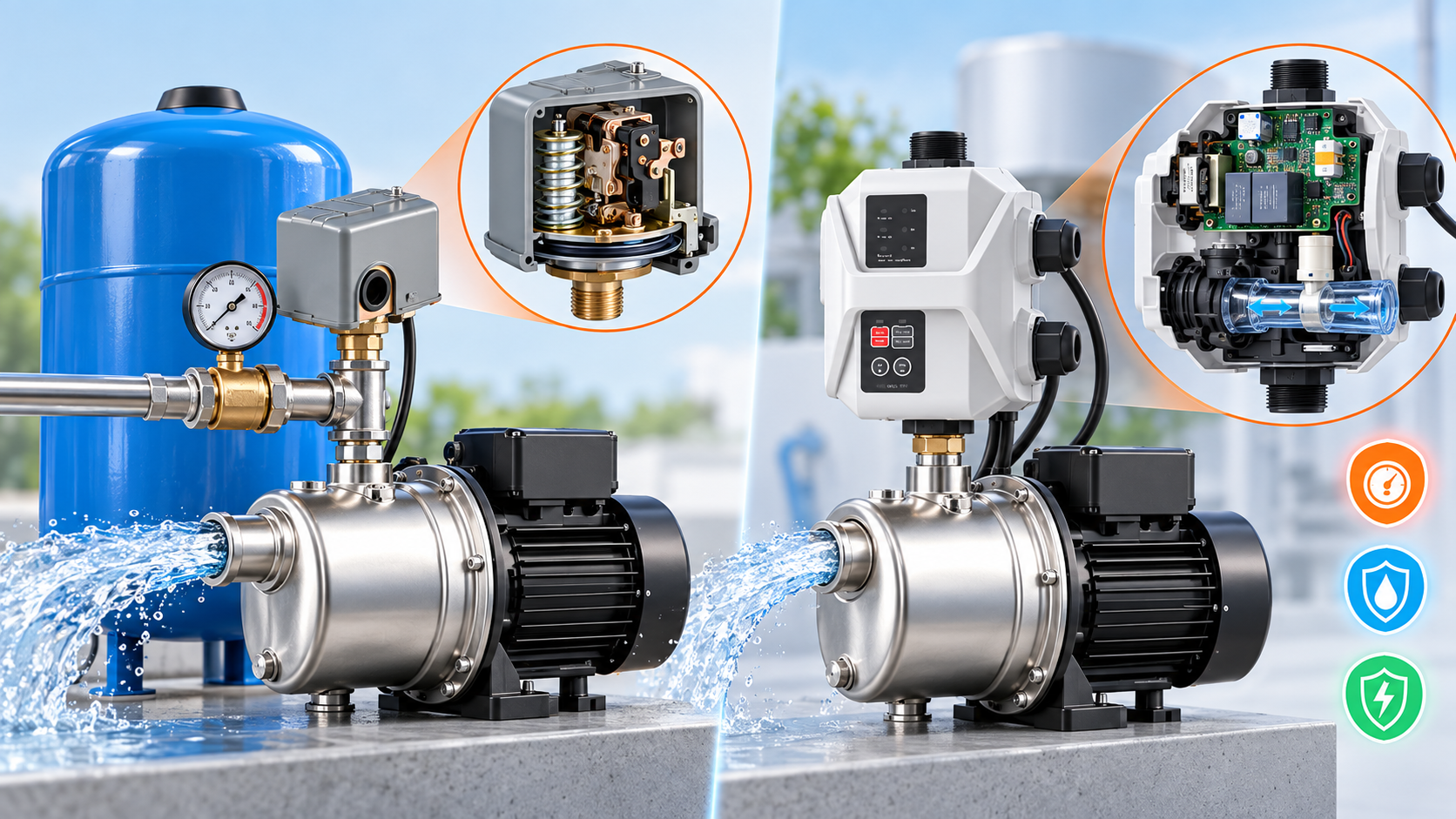
A diaphragm or piston in a mechanical pump pressure switch is moved by the water pressure. The diaphragm or piston then moves springs and electrical contacts. When the pressure drops to the cut-in setting, the contacts close and the pump starts up. The contacts open and the pump stops when the cut-out pressure is reached. A pressure tank, a pressure gauge, and a check valve can all work with this type of switch. Because it is cheap and easy to build, it is often used in standard water supply and pressure-boosting systems for homes.
2. Automatic Pump Pressure Switch
The electronic automatic pump pressure switch usually keeps an eye on both the flow and pressure of the water. When a tap is opened and the pressure drops, it turns on the pump. When the water is used up and the flow drops to the controller’s stopping level, the pump stops. Depending on the type, it may also stop dry runs, start up by itself, sound an alarm if there are leaks, or have warning lights. Because it can do so many things, it’s great for small home pump systems that need to be simple to set up and run on their own.
III. How the Two Pressure Switches Work
1. Mechanical Pressure Control Cycle
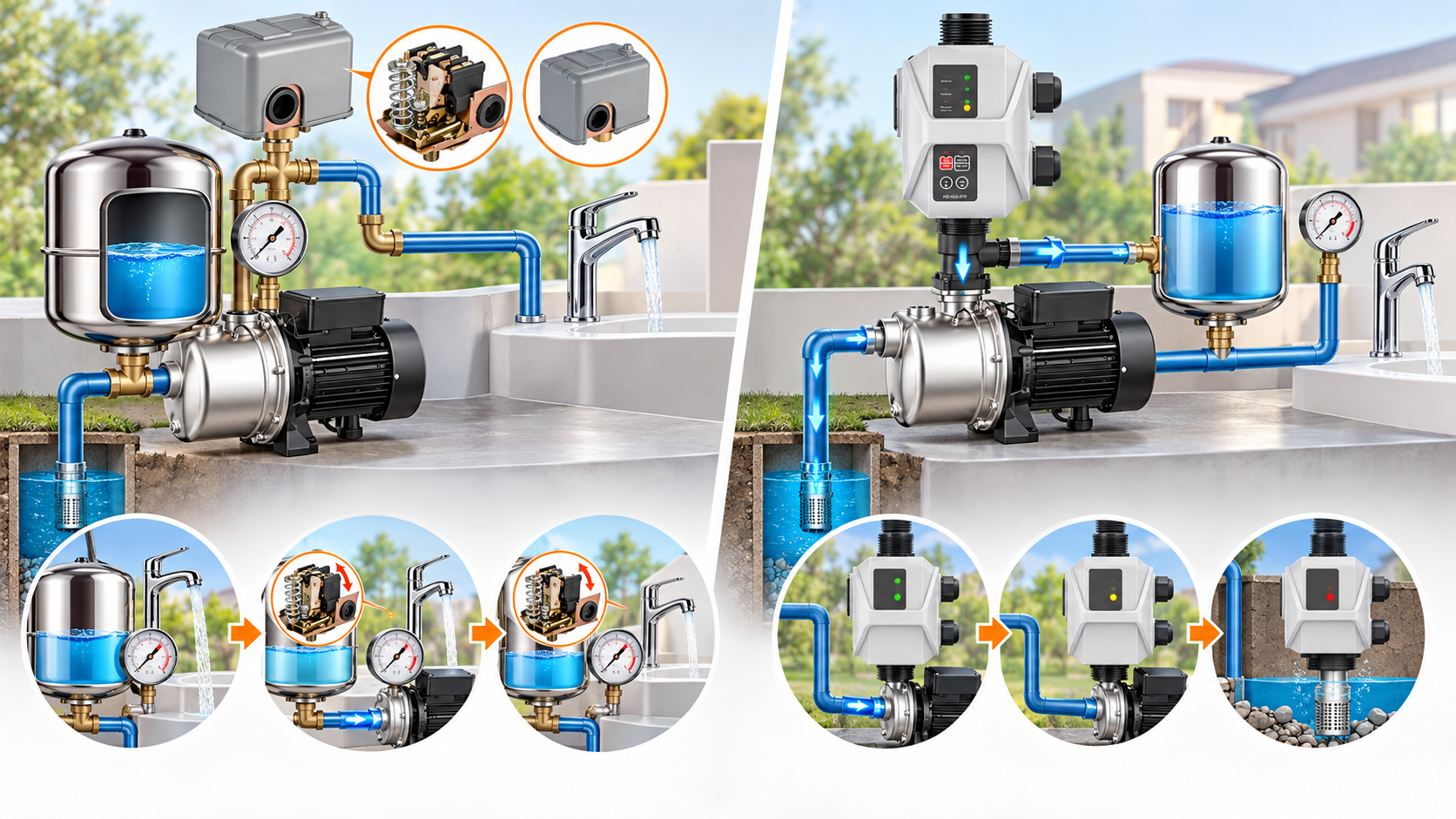
The water from the pressure tank is the first thing that comes out of a tap in a mechanical pressure system. As water is taken out of the tank, the pressure in the system drops. The electrical contacts close and the pump starts as soon as the cut-in pressure is met. After that, the pump fills up the pressure tank with water. The contacts open and the pump stops when the cut-out pressure is reached. The pump turns on and off more or less often depending on the tank’s size and level of pre-charge. This is because the tank keeps water under pressure until it’s time to use it.
2. Automatic Pressure and Flow Control
When you open a tap in an automatic system, the pressure drops, which tells the controller to start the pump. The water flow is then checked by a flow sensor. The flow slows down when the tap is closed, and the controller turns off the pump when its set delay or stopping condition is met. Models with dry-run protection can tell when the pump isn’t getting any water and stop it before it keeps going. The way that different controller designs find problems and start up again is different.
IV. Main Parts and Control Structure
1. Pressure-Sensing Mechanism
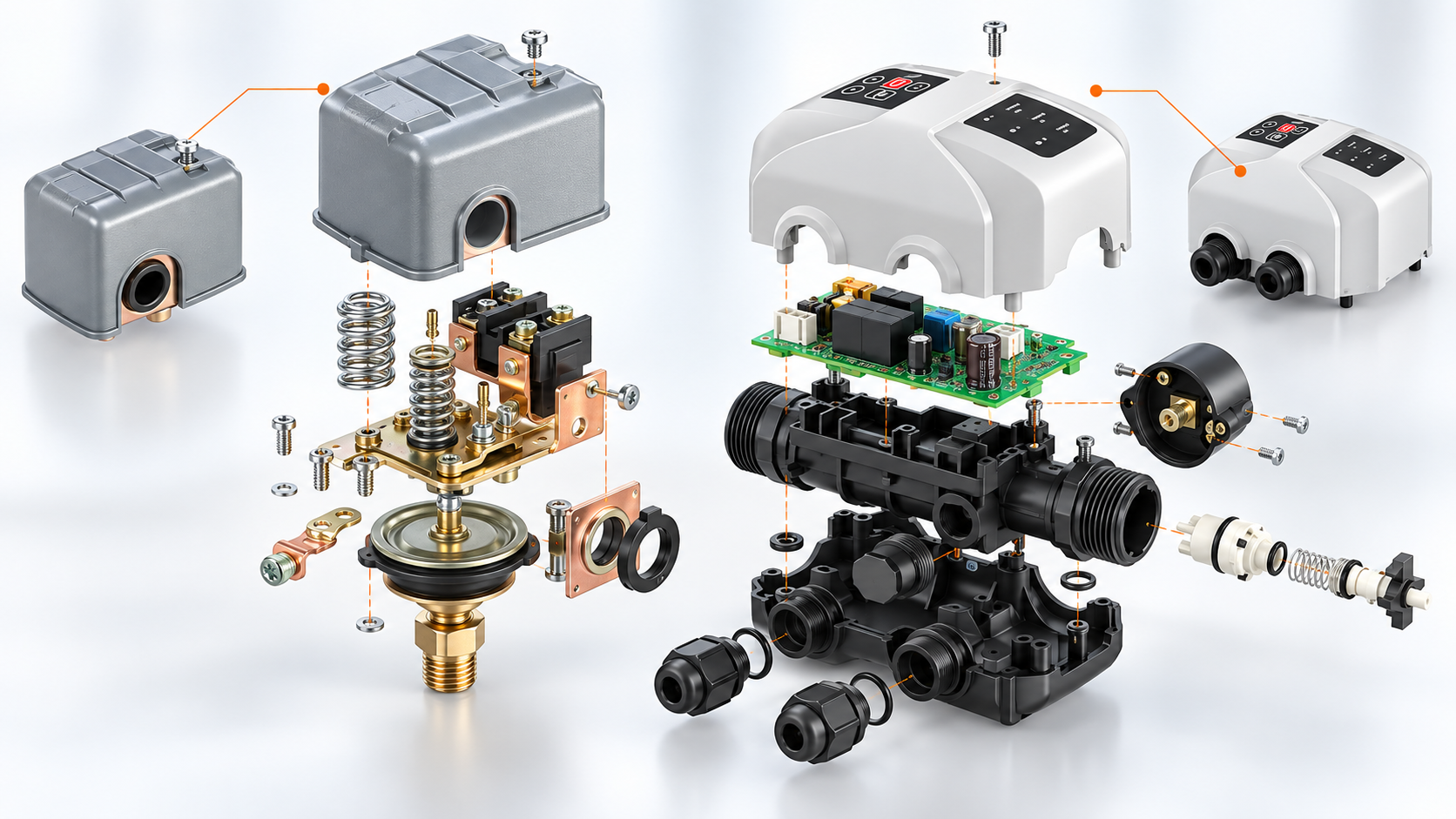
The part of a mechanical pressure switch that feels pressure does just that. Most home models have a diaphragm that is bendable and moves up and down as the water pressure changes. Some types use a piston to sense pressure, especially when they need to be built with stronger parts. For the switch to work at a certain pressure, the diaphragm or piston needs to move easily and be properly sealed. The pressure at which the switch works could change if it gets worn down, dirty, or leaks.
2. Electrical Contacts and Spring Settings
The pressure sensor part is linked to electrical contacts by a spring mechanism. It is when the pressure drops to the cut-in point that the contacts close. When the pressure rises to the cut-out point, they open. Most mechanical switches that can be adjusted have two springs, one for the main pressure range and one for the pressure difference. However, the way to adjust each model is different. When you’re judging a product, don’t just look at the pressure range. Pressure consistency, electrical heating, and service life are all affected by the size of the contact, the accuracy of the spring, and the quality of the terminal.
3. Housing and Connections
The housing keeps dust, water, and accidental contact away from the springs, contacts, terminals, and other parts inside. Another part of the switch is an electrical terminal for the power and pump wiring, a pressure port for connecting to the water system, and a ground connection. If you’re selling to places that have different BSP or NPT standards, you need to make sure that the connection size and thread type work with the pipe system. For installations that will be outside or in wet conditions, you also need a good protection rating and good cable sealing.
4. Pressure and Flow Sensors
A flow sensor checks to see if water is moving, and a pressure sensor or pressure sensing element checks to see how much pressure is needed. Pressure data tells the controller when to start the pump, while flow data tells it when to stop pumping water. The controller may also be able to find no-flow events that a simple mechanical switch can’t find on its own by using both inputs. Sensor range, minimum measurable flow, and water quality can all change how well the controller works.
5. Electronic Control and Protection
The sensor data are processed by the control board, which also has a relay or some other kind of switching device that turns the pump on and off. The model may have the same control board that handles dry-run protection, delayed stopping, automatic restart, and warning lights or messages on the screen. Each of these tasks should be looked at on its own, since two controllers that look alike may have different ways of stopping or starting up. It doesn’t matter how many features a pump has if the control logic doesn’t work with the water system you want it to work with.
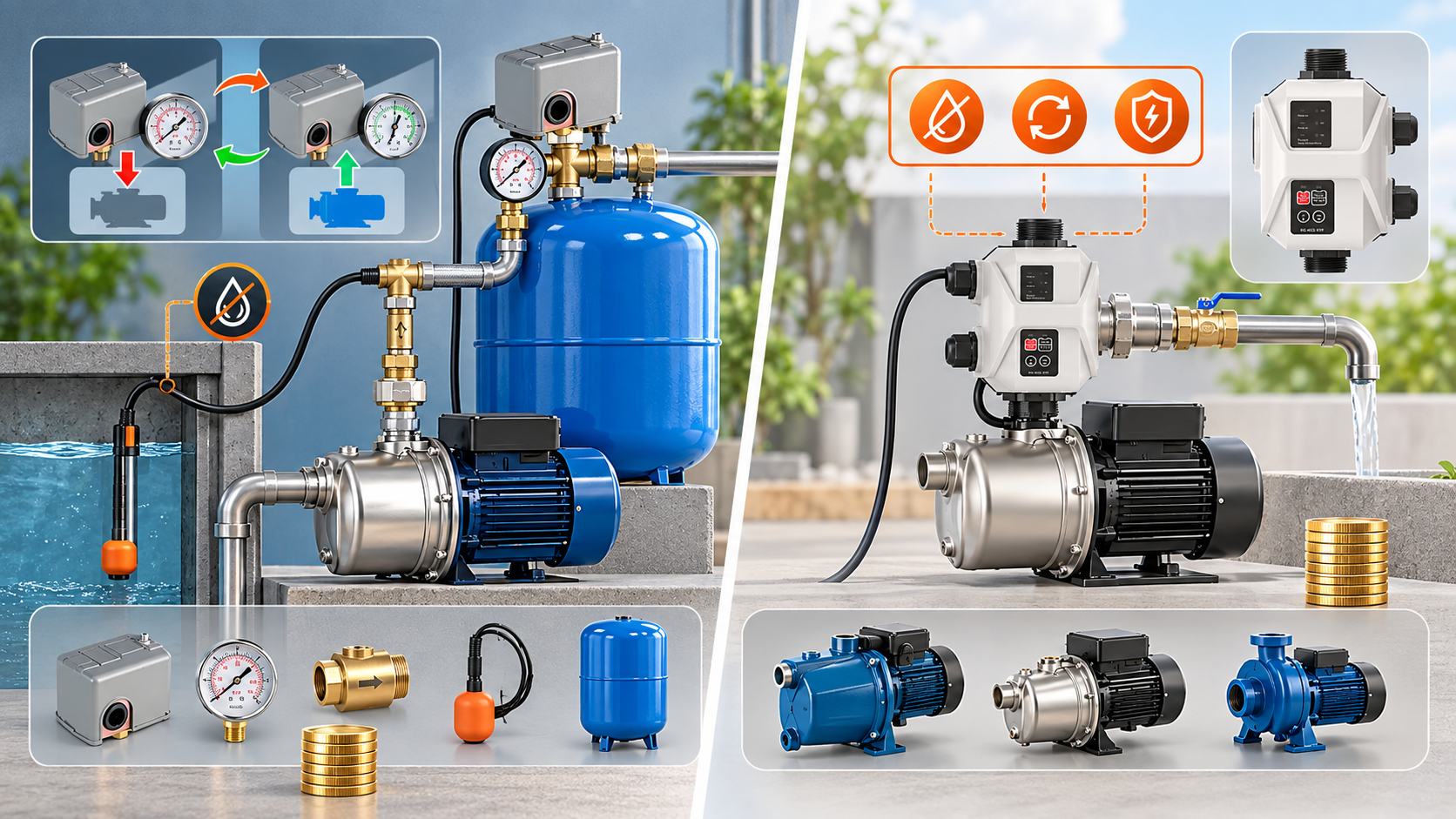
V. Mechanical vs. Automatic Pump Pressure Switch
1. System Parts
A pressure tank system, pressure gauge, check valve, and linking parts usually have a mechanical pressure switch as part of it. This means picking out and putting in more parts, but many installers are familiar with the system, and each part can be changed on its own. In well-established markets where pressure tanks and spare switches are easy to find, this is a workable option.
An automatic pump pressure switch does a lot of control tasks in one piece, so many home systems don’t need a big separate pressure tank. A small tank may still be used in some situations to lessen the impact of small leaks or changes in pressure. The simplified layout can cut down on the number of different parts in the box, which makes it easier for customers who want a ready-to-use system for your pump products to put them together.
2. Start and Stop Control
At two different pressure levels, a mechanical switch turns the pump on and off. The difference in pressure between the cut-in and cut-out points is what lets the pressure tank empty and fill up again between cycles. This means that users notice some changes in the pressure during normal use. The pump may have to start too often if the tank is too small or the pre-charge is too low.
Most of the time, an automatic switch turns on the pump when the pressure drops and turns it off when the water flow stops. Some models let you choose the pressure when they first turn on, but a normal automatic pressure switch doesn’t change the motor speed or really manage the pressure at a constant level. You need to decide whether you need a variable speed pump or a VFD pressure system for your project if the demand changes but the pressure stays the same.
3. Protection Functions
A mechanical pressure switch controls start and stop mostly by pressure. Because it doesn’t always know when the water source is dry, it might need a separate float switch, dry-run safety, or level controller. The product is simple and cheap because of its simple design, which could be a plus if your clients already have other safety gear.
As part of the same unit, an automatic pump pressure switch can be made that protects against dry runs and performs an automatic restart. Some types can also show problems or react by starting over and over again, which is caused by small leaks.
4. Installation and Daily Use
In a mechanical system, the switch, tank, gauge, and other parts that go with them have to be put together and adjusted at the same time. It needs more space and a proper pre-charge for the tank, but many technicians know how it works and can change one part without having to change the whole thing. That can make it easier to fix mechanical switches in places where a network of repair shops has grown.
The automatic switch combines the main controls into a small unit, so the water system usually needs fewer separate parts. As long as the electrical, inlet, and outlet connections are correct, daily operation is easy because the controller starts and stops the pump on its own. This means it can be used for complete self-priming pump, jet pump, and small centrifugal pump packages that are sent to homes to provide water or raise the pressure.
5. Purchase Price and Total System Cost
Most of the time, mechanical pressure switches are cheaper per unit. But the price of the whole system also includes a pressure tank, a pressure gauge, fittings, wires, and the time it takes to set up. If you only look at the price of the switch, the mechanical option may seem less expensive than the whole system that is installed when you put together a pump package.
Because it has sensors, electronics, and safety features, an automatic pressure switch costs more per unit. It can fill in some of the gap because it has fewer outside parts and is easier to put together. When buying for a business, you should compare the total cost of the package plus the time it takes to install it, as well as the expected level of service and the type of customer you want to serve.
6. Suitable Pump Packages
It’s possible to use mechanical pressure switches in systems with pressure tanks, residential supply systems, and replacement markets where customers already have tanks and gauges set up. As an economical option, they also give people who want simple automatic control and like the idea of parts that can be fixed on their own a clear choice.
Automatic pump pressure switches can be used with certain types of self-priming, jet, and centrifugal pumps to provide water for homes and raise the water pressure. These come in handy if your product package needs to start and stop automatically, protect against dry runs, and only require a small installation. There are still things that the pressure switch needs to do to match the voltage, current, starting load, pressure range, and pipe connections of the pump.
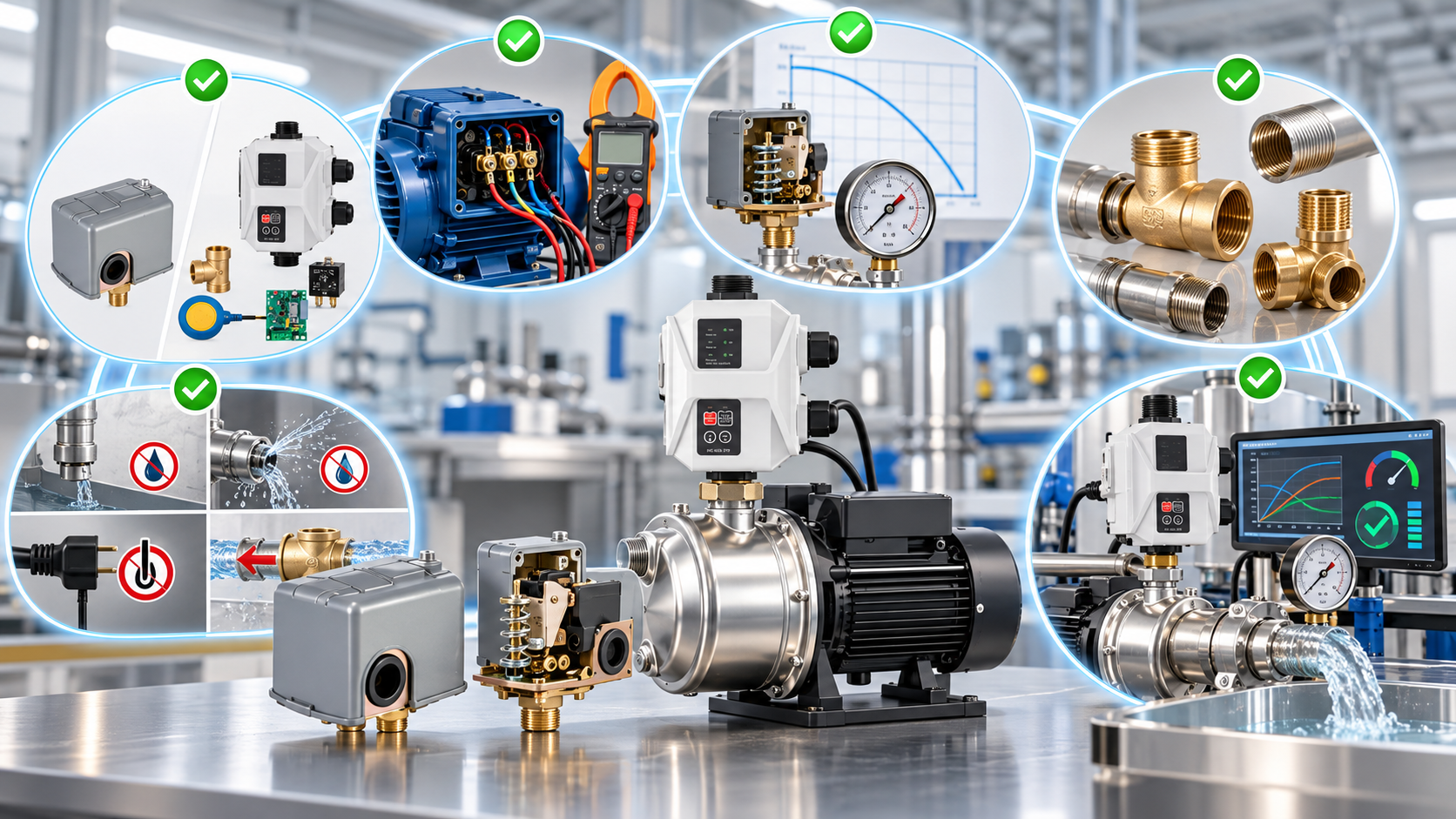
VI. Choosing the Right Pressure Switch
1. Decide the Complete Pump Package
Choose whether the package is a new switch or a full pump set. When switching over an existing pressure-tank system, the new switch usually needs to have the same cut-in and cut-out range, connection, and electrical rating as the old switch. A new home pump kit with an automatic pressure switch may be easier to set up if you want automatic safety and fewer outside parts. You can also keep the right spare parts and tools in stock for each product line because of this choice.
2. Match the Motor Load
Check the voltage, phase, rated current, and starting current of the pump against how much current the pressure switch can actually handle. Saying the switch can handle any motor up to 2.2 kW does not mean that it can handle any motor with that much power. This is because different motors have different starting currents and types. Don’t just match things based on motor power; use an official list of pump-and-switch compatibility instead. It’s safer and makes it easier for your sales staff to give quotes.
3. Confirm the Pressure Settings
Make sure you know the cut-in pressure, cut-out pressure, adjustment range, and allowed pressure difference for a mechanical switch. For an automatic switch, make sure you know the minimum flow needed for correct detection, the stopping method, the starting pressure, and the maximum working pressure. If the pump can’t reach the needed pressure at the current flow rate, changing the controller won’t help. If the pump is too small, it won’t be able to stop.
4. Check the Pipe Connection
Check a mechanical switch’s cut-in pressure, cut-out pressure, adjustment range, and the largest difference in pressure that it can handle. For an automatic switch, check the minimum flow needed for proper detection, the maximum working pressure, the way the switch stops, and the starting pressure. The pump has to be able to give the right amount of pressure at the right flow rate. If the pump is too small, changing the controller won’t be able to get it to the stopping point.
5. Review the Protection Logic
Try it out with low flow, small leaks, power outages, and water going back to the source. The clear protection logic makes it easier to understand how the controller normally works and stops people from mistaking protective shutdowns for product failures.
6. Test the Pump and Switch Together
Test everything at the same time, including the controller with the real pump. You should do a sample test to see if it starts up normally, keeps pumping water, shuts off, has low flow, loses power, and starts up again and again. Write down the voltage, operating current, pressure, and controller response during these tests. A proven compatibility list helps you make reliable pump packages, train your sales staff, and avoid problems after the sale that happen because of combinations that aren’t allowed.
VII. Conclusion
Classic pressure tank systems use switches on the water pumps that work by pressure. The unit price is lower, they have simple pressure-based control, and they are easy to replace. Automatic pump pressure switches that control both pressure and flow and have safety features that depend on the model work well with small home pump packages. The best choice depends on the pump’s load, the pressure setting, the system’s parts, how it is installed, and what kind of service is expected in your market.
When importing or selling water pumps, HunGerät lets you test the pump, pressure switch, voltage, current, pressure range, and pipe connection all in one package. Let us know what kind of pump you have and what kind of control you need, and we’ll give you choices, technical details, and wholesale prices.
VIII. FAQ
1. Which Is Better: a Mechanical or Automatic Pump Pressure Switch?
On its own, neither type is better for every system. A mechanical switch is a good choice for standard pumps and tanks. For smaller setups, an automatic switch with flow-based stopping is built in for safety.
2. Does a Mechanical Pump Pressure Switch Need a Pressure Tank?
Most of the time, a pressure tank is needed for a mechanical pump pressure switch to work properly. The pump doesn’t start when a small amount of water is used because the tank is full of pressurised water.
3. Does an Automatic Pump Pressure Switch Need a Pressure Tank?
A lot of automatic pump pressure switches can work even if they don’t have a big pressure tank. If the controller and system are set up right, a small tank might still be able to help with multiple starts that are caused by small leaks or very little water use.
4. Can an Automatic Pump Pressure Switch Maintain Constant Pressure?
A normal automatic pump pressure switch doesn’t really control the pressure all the time. A variable-speed pump (VFD) system is usually needed to control the motor speed when the flow rate changes but the pressure stays the same.
5. Does Every Automatic Pump Pressure Switch Have Dry-Run Protection?
No, not every automatic pump pressure switch has protection against dry runs. Check the product information to see how the controller knows when the pump is running without water, stops it, and starts it up again.
6. Can One Pressure Switch Work with Different Water Pumps?
Yes, one pressure switch can be used for more than one pump as long as the electrical load, pressure range, connection, and control needs are all the same. Make a list of the types that can be used instead of assuming that all pumps with the same power can use the same switch.
7. How Do You Match a Pressure Switch to the Pump Motor Current?
Check that the switch contact or relay can handle the pump’s rated current and its starting current. The controller specs must also work with the voltage, phase, motor design, and way the motor is started.
8. Why Is Motor Starting Current Important?
The current at start-up may be several times the current at runtime. The contacts or internal relay of the switch could overheat and burn out or fail before they should if it is not rated for that load.
9. Can a Pressure Switch Control a Single-Phase Pump Directly?
Yes, a lot of pressure switches are made to directly control single-phase pumps that are suitable. Instead of just relying on the motor power, check the actual motor current and starting load.
10. What Is the Difference Between Cut-In and Cut-Out Pressure?
The mechanical switch starts the pump at cut-in pressure, and it stops the pump at cut-out pressure. The pressure difference is what makes them different.
11. Can the Starting Pressure Be Adjusted?
A lot of the mechanical and automatic types have a starting pressure that can be changed, but not all of them do. Make sure that any changes you make are within the range of the switch, pump, tank, and pipe system.
12. Why Does an Automatic Pressure Switch Use a Flow Sensor?
The controller can tell if water is still being drawn in by the flow sensor. It also lets you stop based on flow and, depending on the model, may help the controller figure out when there is no water.
13. What Happens When the Water Source Runs Dry?
The pump may keep going if the system pressure is below the setting that stops it. It is possible for the automatic type to stop the pump if it runs dry, but the sensing time and restart process need to be checked.
14. Will an Automatic Pressure Switch Restart After Water Returns?
Some types restart themselves after a certain amount of time, while others need to be reset by hand. Check the restart program before choosing a controller if the pump can run without being watched.
15. Can a Small Pipe Leak Cause the Pump to Start Repeatedly?
If there is a leak, the pressure can drop, or there may be short-lived small flows that start the pump again. Check the pipes and see if the controller has a feature that stops the cycle or warns you when there is a leak.
16. Does an Automatic Pressure Switch Increase Pump Pressure?
That switch is only for turning the pump on and off. It doesn’t make the pump’s maximum head higher. Still, the available pressure is based on the pump curve, the system’s resistance, and the flow that is being used.
17. What Is the Minimum Flow Requirement of an Automatic Pressure Switch?
The sensor and controller architecture determines the lowest flow rate that can be picked up. This number should be checked for systems that have low-flow faucets, filtering equipment, or very little water use.
18. How Do You Choose Between BSP and NPT Connections?
Pick out the thread standard for the pipe system you want to use. Please keep in mind that BSP and NPT threads have different shapes and shouldn’t be used interchangeably, even if their sizes seem close.
19. Can a Pump Pressure Switch Be Installed Outdoors?
It can only be put up outside if its rating for protection and the way it is put up are good enough for rain, dust, heat, and sunlight. Also, places where cables enter and pipes join must be sealed. The controller needs to be put somewhere that can’t get flooded.
20. What Information Should You Provide When Ordering a Pump Pressure Switch?
Model of the pump, voltage, phase, rated current, starting current (if available), pressure settings you want, pipe connection, and the right safety features. Also, let us know if you need a new switch or a pump and controller set as a whole.