I. Introduction
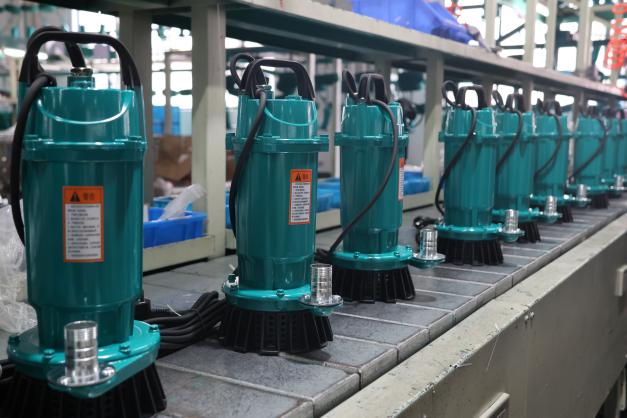
Centrifugal pumps are widely used, but if you use the wrong materials or parts, they can break down quickly and cost a lot to fix. You can be more sure about choosing the right pump, cut down on downtime, and make better choices for real-world uses when you know how the key parts work together.
II. The Parts That Handle the Water
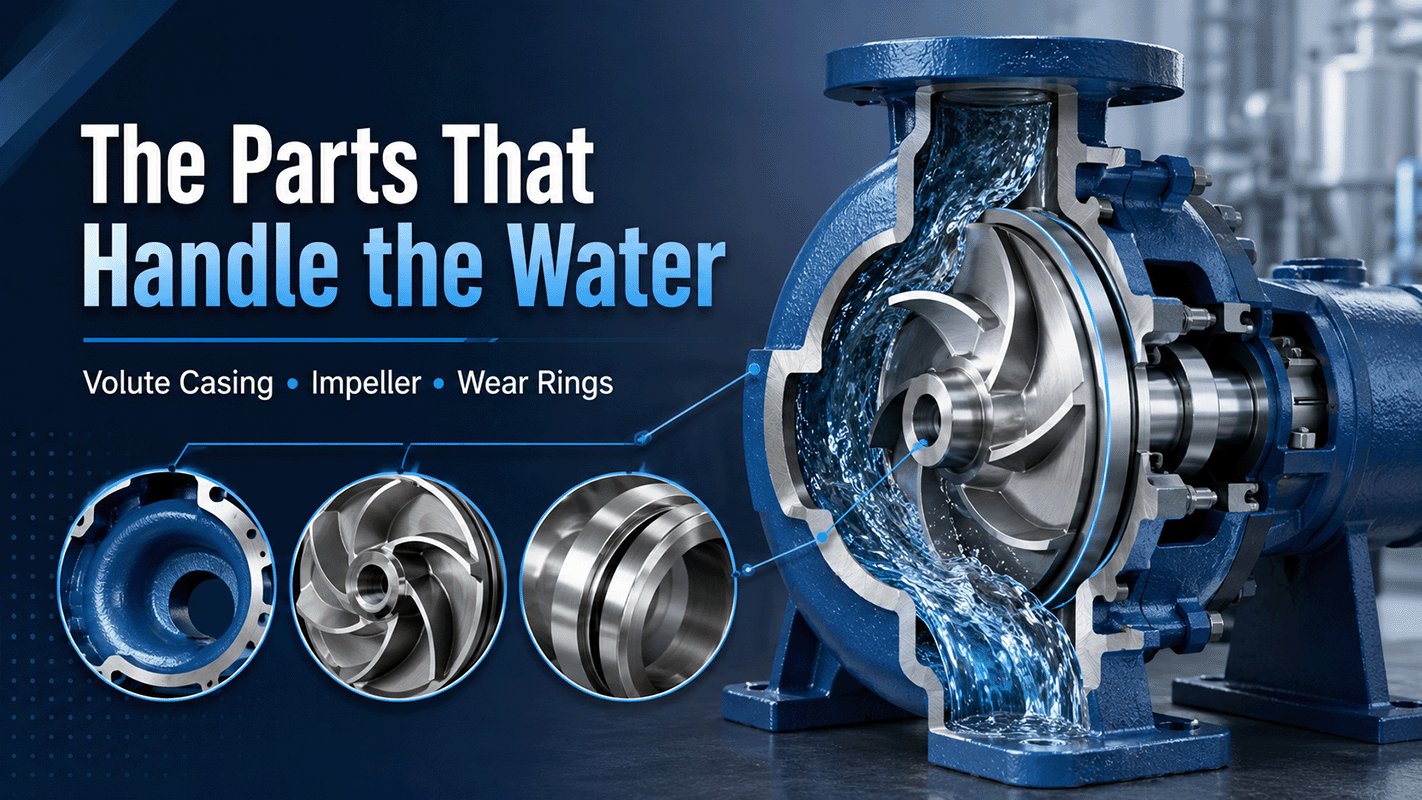
These are the parts that stay in direct contact with the liquid, the choice of material is more important than you think. If the wrong material is used, problems like rust, wear, or poor performance may appear much earlier than planned.
The Volute Casing (Pump Body)
The outside of the centrifugal pump is called the volute case. It goes around the impeller and makes up the main space where the liquid moves.
Its job is to catch the fast-moving liquid that is leaving the impeller and change its speed into a steady release pressure. In simple words, this is what makes it possible for the pump to move water through the system smoothly and quickly.
Most of the time, cast iron is the most cost-effective choice for normal clean water uses. But stainless steel is generally the better long-term choice for harsher environments, corrosive liquids, or saltwater because it is more resistant to corrosion and lasts longer.
The Impeller (The Heart of the Pump)
The part of the centrifugal pump that turns and moves the liquid directly is called the impeller. It is generally attached to the pump shaft and spins very fast when the pump is running.
Its major job is to make centrifugal force, which pushes the liquid outward and makes the flow and pressure that the pumping process needs.
There are different types of impellers for different uses. Most of the time, closed impellers are used for clean water because they work better. When the liquid is a little dirty or has small bits in it, semi-open impellers work better. When there are bigger solids in the liquid, open impellers work better because they don’t get clogged as easily.
Wear Rings
Wear rings are parts that can be changed and are put between the centrifugal pump’s rotating impeller and its fixed casing. Even though they look like small parts, they are very important for safety.
Their job is to make sure that there is enough space inside between moving and set parts so that metal doesn’t touch metal and wear happens less quickly.
Wear bands can be thought of as parts that are given up for free. The wear rings take the damage instead of expensive parts like the impeller or casing wearing out first. They can be changed more quickly and for less money.
III. The Mechanical Core: Power Transmission
For water, the part that is in touch with water is in charge, and the mechanical body is in charge of power. These are the parts that make sure the pump works well and doesn’t break down over time.
The Pump Shaft
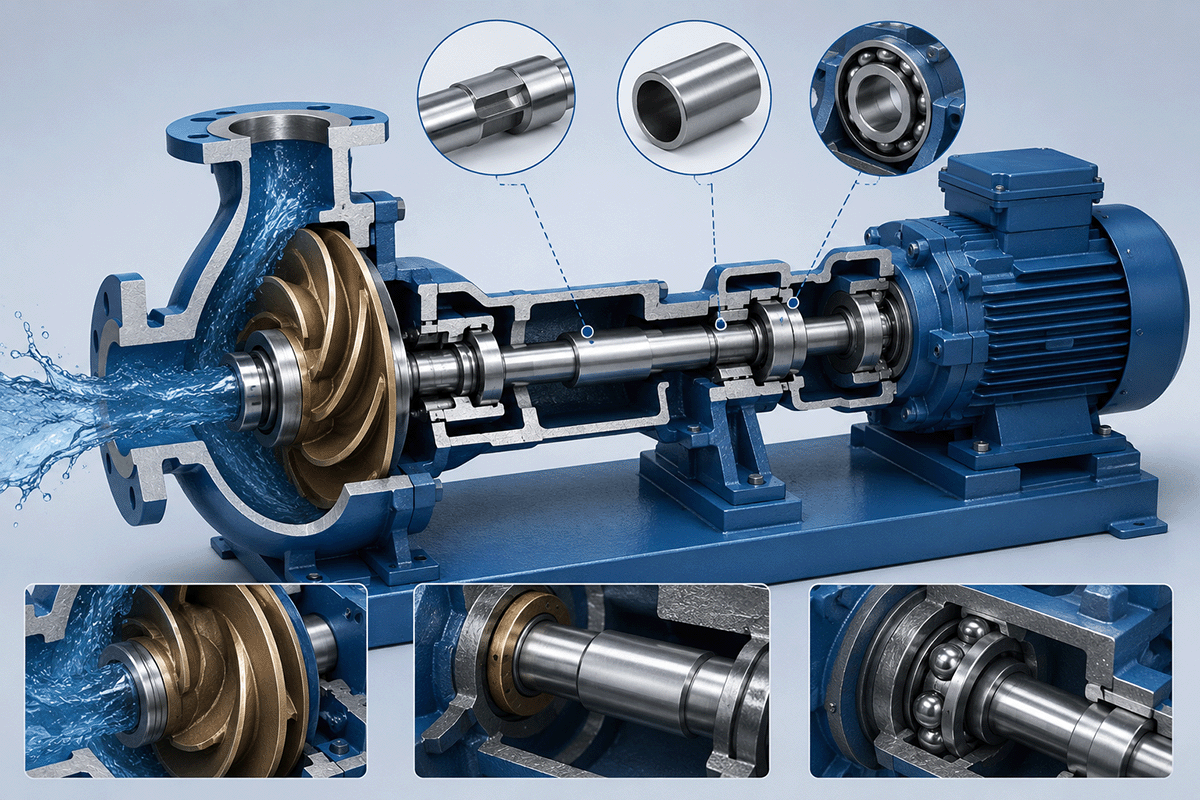
The pump shaft is what holds the centrifugal pump together. It only has to do one thing: tell the motor to move the rotor, which moves the water through the pump. Things go wrong very quickly, though, if the shaft isn’t strong enough. If the load is too much for a weak shaft, it can bend. This can make noise, shake, work less well, or even break the seal. When things get tough, pump parts are made of iron, steel (304 or 316), and other stiff, strong materials.
The Shaft Sleeve
It can be expensive to buy a new shaft, that’s why the shaft cover is important. Rust, wear, and pressure can damage this metal tube that goes over the main shaft and can be swapped out. It keeps the shaft safe where the mechanical seal meets it.
Bearings and Bearing Housing
Bearings inside the centrifugal pump do all the hard work. It is always being used, and loads are going on both sides of the shaft. Bearings that are made well take that stress and keep the shaft moving easily and in the right place.
Things will shake more, and the seals inside might break quickly if the bearings aren’t good or wear out too quickly. The shaft might shake. For long-term safety, it is very important that the bearing cage keeps everything stable and in the right place.
IV. Sealing Parts
Most of the time, leaks are what go wrong with pumps in real life. What’s wrong most of the time is the closing method. You should know about these parts so that the pump doesn’t break down for no reason and run up service bills.
Mechanical Seals
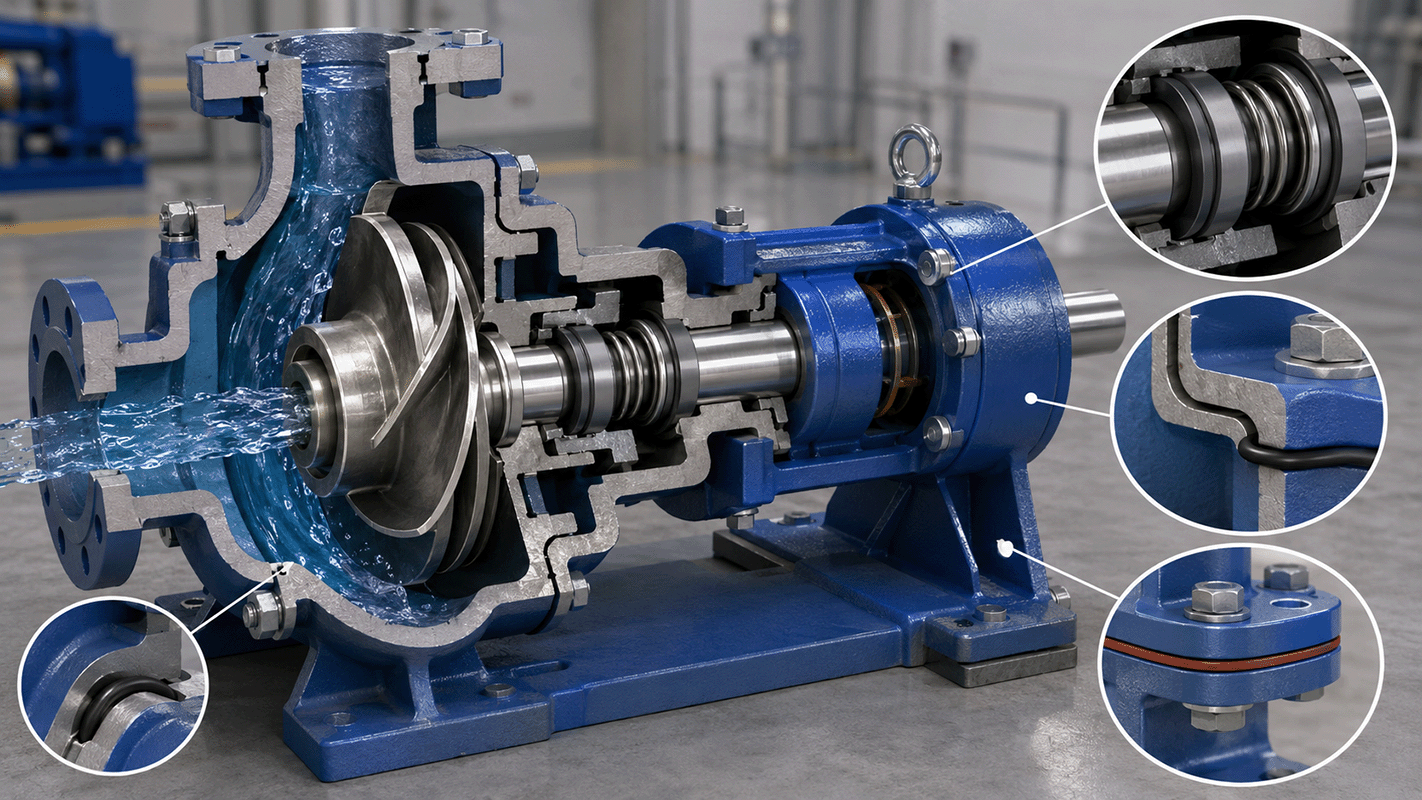
In modern centrifugal pumps, mechanical seals keep water from leaking where the spinning shaft goes through the pump casing that stays still. This part of the pump is one of the most important ones, even though it sounds easy.
When there is a good mechanical seal, there is a solid barrier that keeps things out while still letting the shaft turn easily. Carbon, ceramic, and silicon carbide are all common materials for seal faces. The best one to use depends on the job. Simple combinations may work well in cleaner water, but tougher materials are usually needed for longer life in rougher or more demanding circumstances.
Leaks usually happen quickly if the seal isn’t good or if the material isn’t the right match. This can cause downtime, customer complaints, and repair costs that could have been avoided.
O-Rings and Gaskets
In a centrifugal pump, not every seal moves. O-rings and gaskets seal the static places, like where the casing connects to the body and where the two parts meet.
So long as pressure builds up inside the system, their job is simple: keep the pump completely dry. Even though they look like small, cheap parts, the whole pump can leak if one of them breaks. Since this is the case, good material and a good fit are more important than most people think.
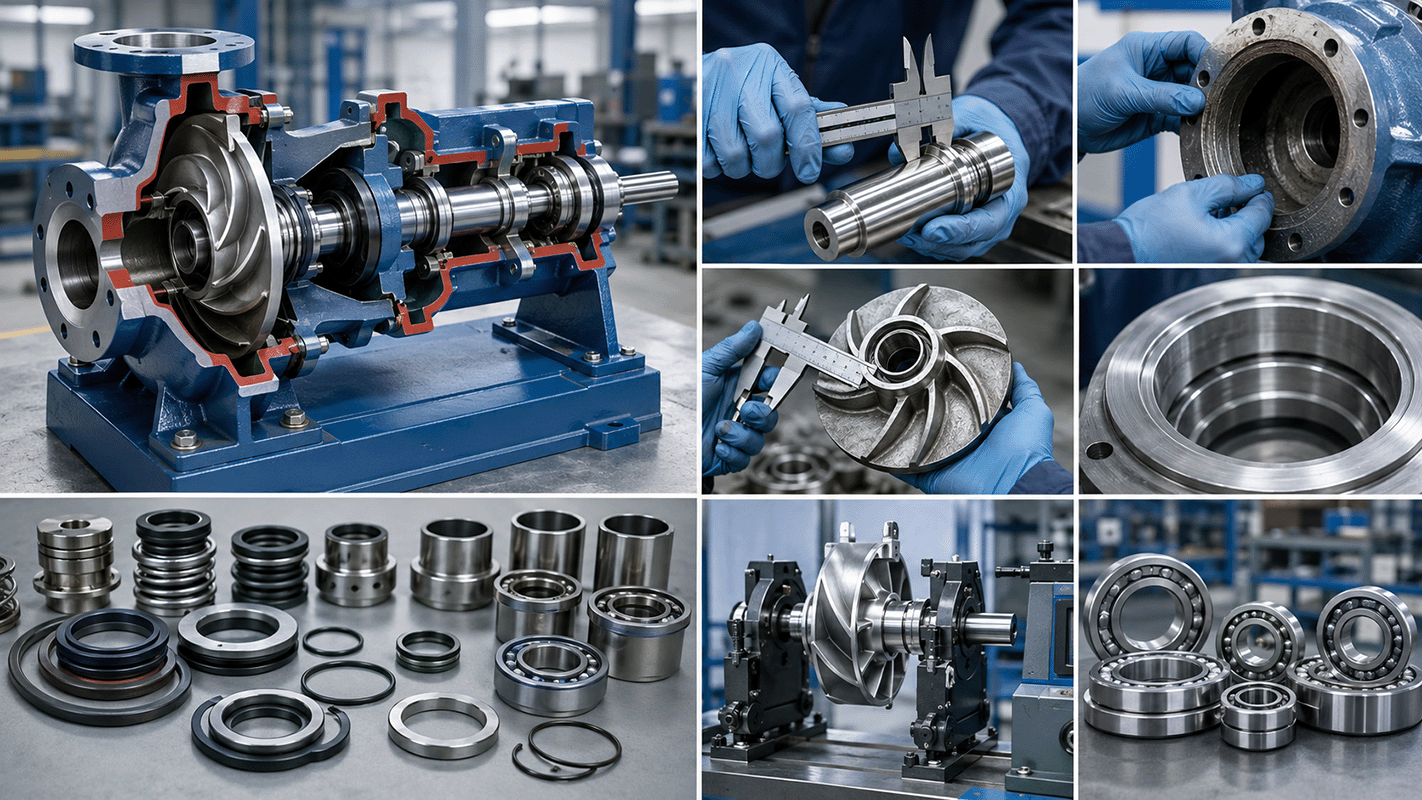
V. How to Evaluate Centrifugal Pump Component Quality Before You Buy
It’s easy to compare centrifugal pumps based on price, but the quality of the internal parts is what really matters for long-term performance. The problem is that not all differences in quality are clear at first glance. How can you tell if a pump is made to last?
Check the Material Specifications
Start with the materials that are used to make important parts. For instance, is the fan made of cast iron, stainless steel, or a different metal? Is the shaft made of 304 or 316 stainless steel, which is stronger and less likely to rust?
Choosing the right materials has a direct effect on how long they last, especially in harsh settings. If a supplier can’t clearly explain the materials that make up a part, that’s generally a red flag.
Look at the Seal and Bearing Quality
Two of the most common places for centrifugal pumps to break are the mechanical seals and bearings, so quality is important here.
Find out what kind of seal material is being used—carbon, ceramic, or silicon carbide—and make sure it works for the job. For bearings, choosing a good name and the right load rating makes a big difference in how stable the pump is and how long it lasts.
On the outside, two pumps may look the same, but seals and parts of lower quality often break down quickly.
Ask About Spare Parts Standardization
Not only should a good pump work well at first, but it should also be easy to keep up.
Check to see if replacement parts like bearings, seals, wear rings, and shaft sleeves are common and easy to find. If you have to make custom parts for every repair, you may have more downtime and have to pay more for upkeep.
Evaluate Manufacturing Consistency
Choosing the right parts is important, but consistent output quality is even more important. How well a pump works in real life depends on how well it was machined, how well it is balanced, and how stable the building standards are.
Poor quality control during production can’t be made up for by using good materials.
VI. Conclusion
For the most part, the parts inside a centrifugal pump are what make it work. It’s the difference between long-term operation that goes smoothly and problems that keep happening in the field that a strong design, the right materials, and reliable parts make.
HunGerat is ready to help you if you’re looking for a production partner who gets this. We sell centrifugal pumps that are made with long-lasting parts, consistent quality, and solutions that are meant to work well every time. This will help you give with more confidence to your market.
VII. FAQs
1. Which part of a centrifugal pump fails most often?
A mechanical seal will usually fail because of friction, dry running, a bad fit, contamination, or picking the wrong seal material for the liquid that will be used.
2. What causes a centrifugal pump to leak?
Most leaks happen because of worn-out mechanical seals, broken O-rings, gaskets that don’t work, too much vibration, or bad fitting when the pump is being fixed or put together.
3. What causes excessive vibration in a centrifugal pump?
Most of the time, it’s because the bearings are worn or broken, the shaft is out of alignment, the impeller is out of balance, there is cavitation, the mounting is loose, or there are worn parts inside the pump that make it less steady.
4. Why does a centrifugal pump lose pressure?
Pressure loss can happen if the impellers are worn out, the seals are leaky, the internal clearance is off, the suction lines are clogged, cavitation happens, or you choose the wrong pump.
5. Why is the impeller important in a centrifugal pump?
The rotor creates centrifugal force, which moves the liquid through the pump. This changes the flow rate, output pressure, pump efficiency, and how well it works in general.
6. Open impeller vs closed impeller: which is better?
It is best to use closed impellers in clean water because they work better. Things move more easily with open impellers. Choose the best one based on the liquid and how it will be used.
7. What is the function of a wear ring in a centrifugal pump?
Worn-out pump parts stay safe with wear rings because they keep the right amount of space inside and keep moving and still parts from touching each other.
8. What do bearings do in a centrifugal pump?
Bearings help keep seals and other important pump parts safe, hold the moving shaft in place, and take in radial and axial loads.
9. What is the purpose of a mechanical seal?
Liquid can’t leak when the spinning shaft goes through the pump casing because of the mechanical seals. This makes the pump work better and makes it less likely to need repairs.
10. Which mechanical seal material is best?
Carbon, clay, or silicon carbide are what most people pick. Which seal material is best depends on how much corrosion there is, the temperature, the working pressure, and how rough the liquid is.
11. Cast iron vs stainless steel pump: which is better?
It doesn’t cost much, and cast iron works well in clean water. Stainless steel doesn’t rust as easily when it’s exposed to chemicals, salt water, and rough environments.
12. What causes centrifugal pump cavitation?
When there is low suction pressure, vapour bubbles form inside the pump and burst. This is called cavitation. This makes noise, shakes the motor, hurts it, and makes it work less well.
13. How do you choose the right centrifugal pump material?
Things to think about are the type of liquid, the temperature, the amount of solids, the risk of rust, and the climate where you work. If you match the parts correctly, the pump will last longer and cost less to keep.
14. Why do some centrifugal pumps fail early?
Early failures are often caused by low-quality parts, choosing the wrong materials, bad installation, dry running, cavitation, or not doing enough upkeep.
15. Why is spare parts availability important?
When it comes to business pumps, having replacement parts on hand quickly cuts down on downtime, speeds up maintenance, lowers repair costs, and makes customers happier in the long run.
16. What should buyers check before sourcing centrifugal pumps?
Before you buy, make sure you know what materials were used to make the parts, how good the seals are, what the bearings are made of, how consistent the production process is, if spare parts are available, and If you can trust the seller.
17. How do you choose a reliable centrifugal pump manufacturer?
Choose companies that have strong quality control, clear technical support, standard extra parts, certifications, and a track record of making centrifugal pumps.