I. Introduction
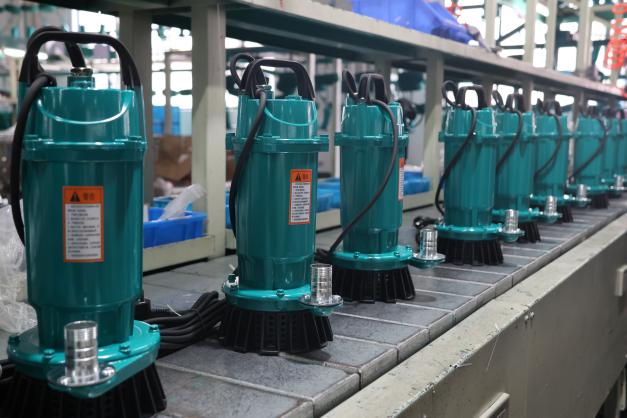
A pump pressure switch is a small accessory, but if it has the wrong voltage or current rating, pressure setting, or thread, it may not work with the pumps you already sell. A good product range should be easy to stock, explain, and match for distributors and importers. Learn about what pump pressure switches do, what each design can do for you, and how to select the right options for home water pumps.
II. What Is a Pump Pressure Switch?
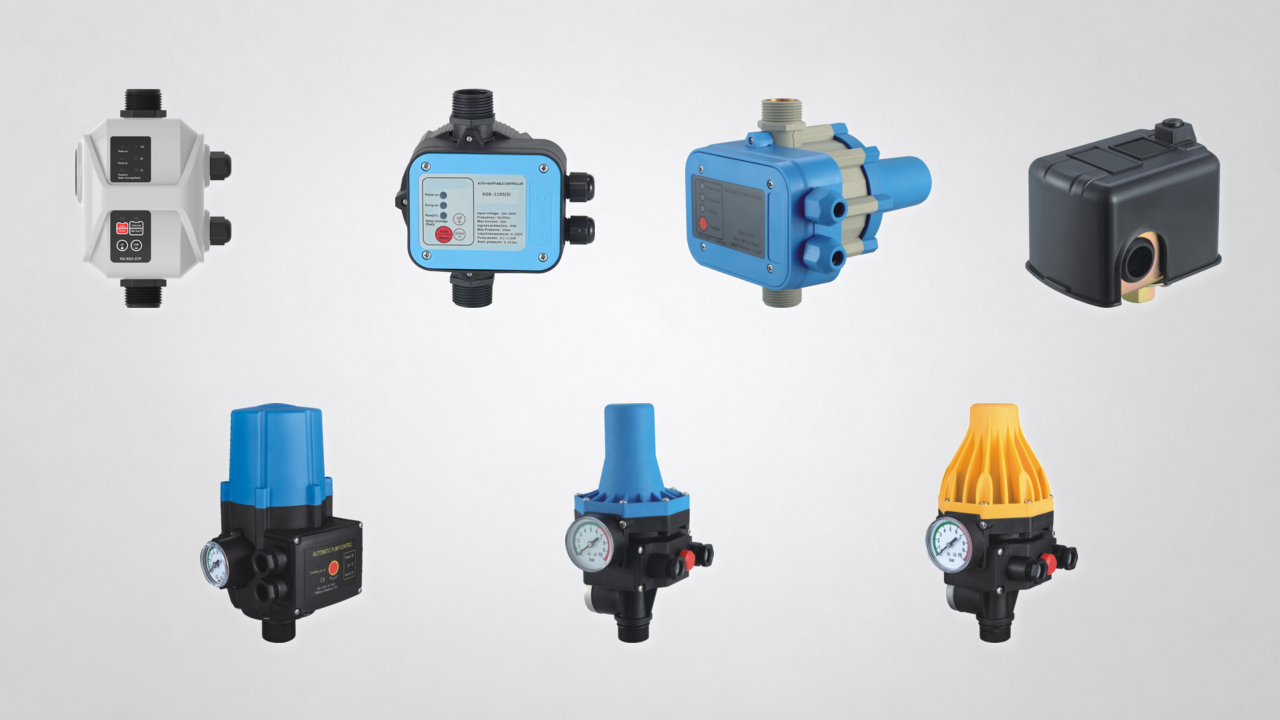
Pump pressure switch – a control part that turns a water pump on and off when the pressure or flow of water in the system changes. It can be sold with a pump, pressure tank, pressure gauge, check valve, and other components, or it can be offered as a single replacement part for the setup of an automatic water delivery system.
III. How Does a Pump Pressure Switch Work?
1. Step-by-Step Operation Process
A traditional mechanical pump pressure switch and pressure tank normally complete the following operating cycle:
- System Standby: The pressure tank keeps pressure in the pipeline while the water pump remains off.
- Water Demand: When a faucet or another water outlet opens, stored water leaves the pressure tank, and the system pressure slowly drops.
- Pump Start: When the pressure reaches the cut-in setting, such as 30 PSI, the diaphragm moves, the electrical contacts close, and the pump starts.
- Water Supply and Pressure Recovery: The running pump supplies the open outlet while restoring pressure in the pipeline and pressure tank.
- Pump Stop: When the system reaches the cut-out setting, such as 50 PSI, the diaphragm pushes against the spring mechanism, the contacts open, and the pump stops.
- Cycle Reset: The pressure tank keeps the normal pressure until the next water demand begins the cycle again.
30/50 PSI is a 20 PSI difference. Actual settings vary depending on the switch and system. An Automatic Pump Pressure Switch does the same basic start-and-stop function electronically, commonly using a pressure sensor to detect demand and a flow sensor to confirm when water use has ended.
2. Common Matching Components
A mechanical pump pressure switch is used with a home water pump, pressure tank, pressure gauge, check valve, five-way fitting, and related piping. All these parts work together to keep the pressure and manage the pump automatically.
IV. What Are the Main Parts of a Pump Pressure Switch?
1. Pressure-Sensing Mechanism
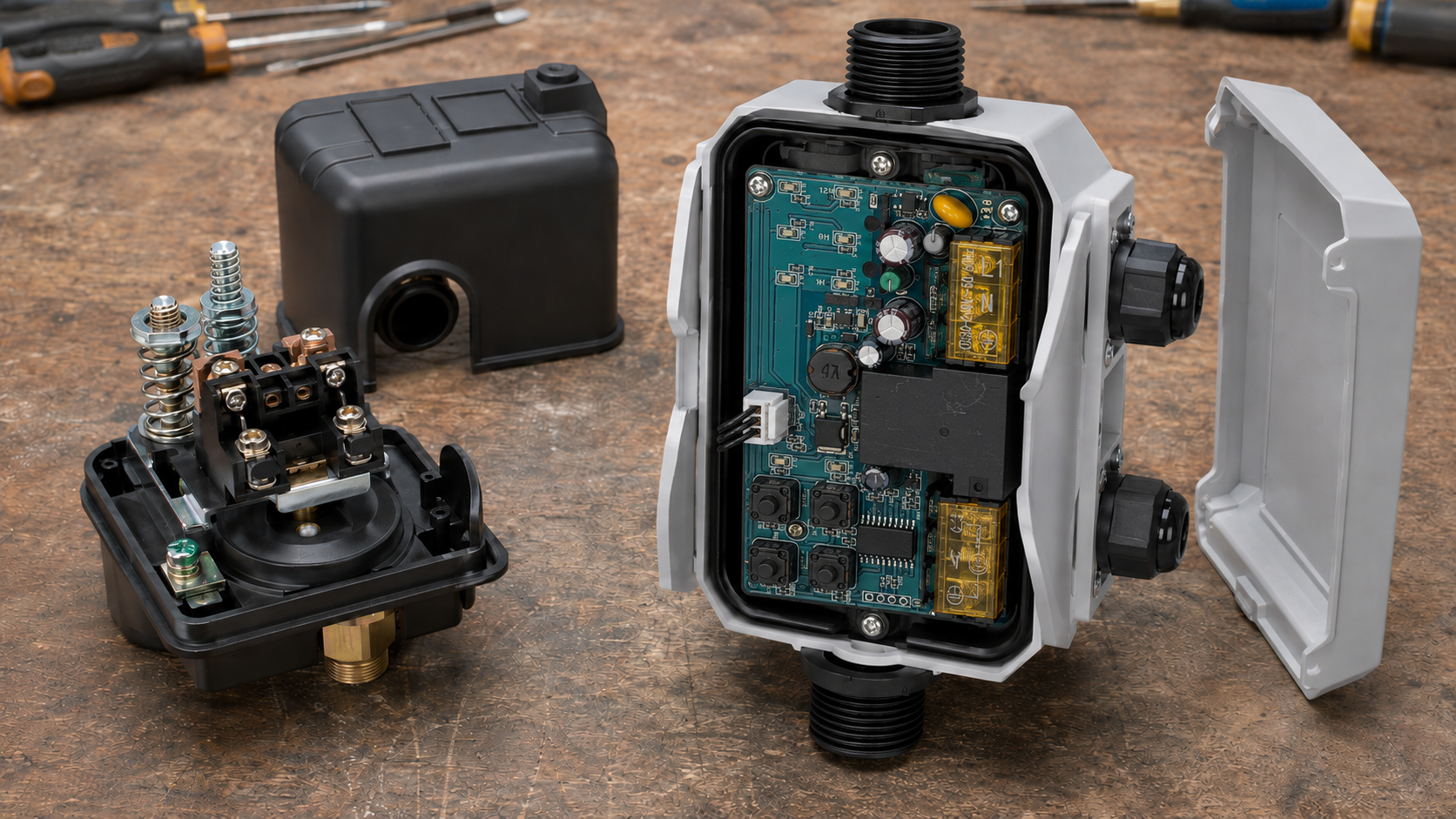
Mechanical pump pressure switches usually use a flexible diaphragm to measure water pressure. As pressure goes up or down, the diaphragm moves and causes this movement to be passed to a spring and contact mechanism. Some models with higher pressure may use a piston.
Once you know the sensor structure, you’ll be able to compare the pressure range and strength of different products. “Nor do you judge quality by the look of the housing.
2. Electrical Contacts and Spring Settings
The electrical contacts are moved by the diaphragm or piston through a calibrated spring mechanism. The contacts close to start the pump and open to stop it, with spring tension determining the cut-in pressure, cut-out pressure, or pressure differential.
Some adjustable switches allow you to change the range and the differential separately, although not all models have the same adjustment mechanism. Confirmation of the design so that you can give clear setup instructions and reduce after-sales issues due to incorrect adjustment.
3. Housing and Connections
Usually, the internal mechanism is protected by a housing made of metal or engineering plastic. The protection from moisture and dust is not just an appearance but also a function of the enclosure design and stated IP rating.
Typical connections are the pressure port, pump and power terminals, grounding terminal, and cable entry. Pressure ports can be ¼-inch NPT, BSP, or other thread specifications, so choose the version most common with the pumps and fittings in your market.
4. Pressure and Flow Sensors
An automatic pump pressure switch is usually a combination of a pressure sensor and a flow sensor. The pressure sensor measures changes in pressure in the pipeline, and the flow sensor checks if water is still flowing through the system.
The controller uses both signals for pump start and stop, and some protection actions. By checking the sensor’s accuracy, the minimum flow it can detect, the direction it must be installed in, and the water quality it can handle, you can compare automatic controllers and avoid wrong uses.
5. Electronic Control Board and Relay
The pressure and flow sensors send data to the electronic control board. Depending on the model, it can handle auto start and stop, dry run protection, auto restart, and pressure setting functions.
The internal relay switches the pump circuit, and its electrical capacity should match the motor load. By looking at the control features and relay rating, you may decide if the higher-priced model is worth the cost for the pumps you offer.
V. Which Type of Pump Pressure Switch Should You Offer?
A. Types by Control Method
1. Mechanical Pump Pressure Switches
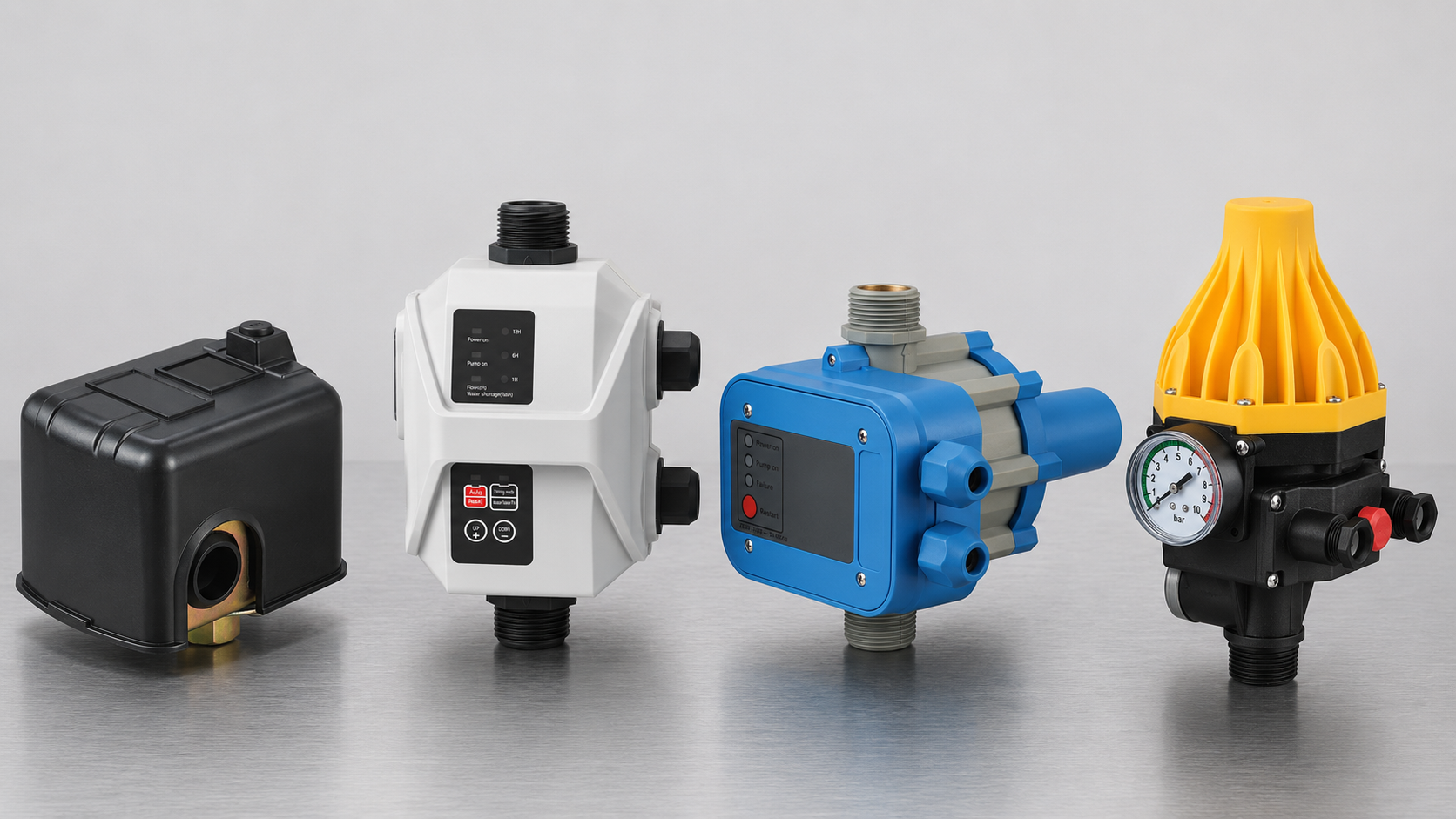
Mechanical Pump Pressure Switches. They use a diaphragm, spring, and electrical contacts to give automatic start/stop based on pressure. They contain fewer electrical components, a simpler structure, and a generally cheaper purchase price, making them suitable for price-sensitive markets, traditional pressure tank systems, and replacement part sales.
Their limits are fewer protection functions, a normal need for a pressure tank, slow contact wear after frequent switching, and they also usually lack flow detection, dry-run protection, automatic restart, and digital display. You can sell mechanical models as simple, high-volume products, but you should limit pressure settings, electrical capacity, and connection standards to the most commonly used options in your market.
2. Automatic Pump Pressure Switches
Automatic Pump Pressure Switches use pressure and flow sensors along with an electronic control board to control pump operation. Depending on the model, features include automatic start and stop, dual-sensor detection, dry-run protection, automatic restart, pipeline-pressure recognition, and automatic adjustment of the control setting. They can be paired with many common single-phase home water pumps in the correct voltage, current, power, and pressure range (for example, selected models support pumps up to 2.2 kW, AC 100–240 V at 50/60 Hz, with a maximum working pressure of 10 bar).
Their functions are more complete and can support a higher product position, but also cost more and require higher requirements for sensor accuracy, electronic quality, installation direction, water cleanliness, and power stability. The automatic adjustment feature adjusts the controller’s operating setting instead of increasing the pump’s rated head; thus, you need to explain this function correctly in your sales material.
B. Types by Pressure Setting
3. Fixed-Setting Pump Pressure Switches
Fixed-Setting Pump Pressure Switches are factory-set for start, stop, or control values and usually require no adjustments at installation. They offer consistent configuration, easy installation, and fewer operating problems caused by wrong pressure adjustment, suitable for standard pump packages with stable sales volume.
The biggest limitation is less flexibility since different pump ranges or markets may require different fixed settings. They can be used as core SKUs matched to some pump series for simpler product labelling, manuals, compatibility lists and sales training.
4. Adjustable Pump Pressure Switches
The differential or electronic control setting of adjustable pump pressure switches may be changed within an allowed range of cut-in pressure and cut-out pressure. One adjustable model may meet a number of pump types and supply-pressure requirements, which makes it suitable for markets with different demands, wider pump ranges, or project orders.
The trade-off is often higher cost and greater risk of wrong adjustment, which may lead to repeated cycling, low supply pressure, or failure to shut off. Adjustable models can help reduce the number of SKUs with fixed settings, but they should be provided with clear adjustment limits and an approved pump compatibility list.
| Comparison | Mechanical | Automatic | Fixed-Setting | Adjustable |
| Main control | Mechanical pressure sensing | Pressure and flow sensing | Factory-set values | Adjustable values |
| Automatic start/stop | Yes | Yes | Yes | Yes |
| Dry-run protection | Normally unavailable | Available on selected models | Depends on control type | Depends on control type |
| Pressure adjustment | Available on selected models | Available on selected models | Normally unavailable | Available |
| Product complexity | Lower | Higher | Lower | Higher |
| Relative price | Lower | Higher | Generally lower | Generally higher |
| Main advantage | Simple and economical | More functions and protection | Consistent and easy to use | Covers more pressure requirements |
| Main limitation | Fewer functions | Higher cost and more electronic parts | Limited flexibility | Requires correct adjustment |
| Suitable position | Basic and replacement range | Upgraded product range | Standard pump packages | Flexible or project-based range |
VI. How Do You Match a Pump Pressure Switch to a Water Pump?
1. Match the Voltage, Frequency, and Phase
The voltage, frequency, and phase of the pressure switch, water pump, and local power supply should be compatible. Although a controller marked AC 100 – 240 V has a wide input range, this does not change the voltage needs of the pump motor or make a single-phase controller compatible with all motors.
You need to be ready with several electrical options based on the country you are selling to. This reduces wrong shipments and prevents visually similar controllers from being mixed in your warehouse.
2. Match the Rated Power and Motor Current
The rated pump power is only a guide for the first selection. Also, check the rated current and starting current of the pump, as two motors with the same kilowatt rating can put different loads on the controller.
A switch rated for pumps up to 2,2 kW is not automatically approved for every 2,2 kW motor. Having a tested compatibility list for the pumps you sell provides a more reliable selection standard for your purchasing, sales, and after-sales teams.
3. Match the Cut-In and Cut-Out Conditions
Check the cut-in pressure, cut-out pressure, and differential on a mechanical pressure switch. Make the pressure and flow signals start and stop an Automatic Pump Pressure Switch.
The pump should be able to meet these control requirements under its real working load If it cannot create the needed stopping pressure, the system may run continuously, cycle wrongly, or go into a protected state.
4. Check the Maximum Working Pressure
Maximum working pressure is not the regular stopping setting of the controller – it is the maximum pressure the controller is designed to handle. A maximum working pressure of 10 bar does not mean that the pump will stop at 10 bar or that it should be run continuously at this pressure.
Keep the controller, pump, tank, valves, and piping within their correct pressure ratings. The difference also makes clear the incorrect performance promises in product catalogues and dealer listings.
5. Match the Pressure Connection
Confirm connection size, internal or external thread, BSP or NPT standard. Threads of the same nominal size may have different profiles or sealing processes and should not be assumed to be directly compatible.
By selecting the most common connector for your target market, you will reduce the need for adapters and low-turnover stock. It also reduces the risk of leaks, thread damage, and returns from forced installation.
6. Check the Pressure Tank Requirement
Mechanical Pump Pressure Switches usually work with a pressure tank that stores pressurised water and limits pump cycling. The tank working pressure and pre-charge rating must match the chosen pressure settings.
Some automatic pump pressure switches use pressure and flow signals and can function without a traditional large pressure tank. But that varies with the controller design, so don’t use one tank rule for all automatics.
7. Check Water Quality and Installation Conditions
Check maximum liquid temperature, Ambient temperature, water quality, installation direction, and IP rating. Automatic models with flow sensors can be affected by dirt, scale, reverse installation, or an unsuitable minimum flow.
The housing is rated IP65, protecting it against dust and water sprays, but not immersion. Clear installation limits let your downstream customers use the controller correctly and avoid warranty claims from incorrect conditions.
VII. Conclusion
Mechanical Pump Pressure Switches are a basic, low-cost solution for traditional systems and replacement sales. Automatic Pump Pressure Switches provide pressure and flow detection, automatic operation, and selected protection functions. Fixed-setting models take standard pump packages, while adjustable types may handle a wider range of pressure requirements.
Knowing these differences helps you to build a clearer product range, match controllers to the pumps you already offer, and reduce incompatible inventory and after-sales problems. HunGerät can match the controller to your pump type, voltage, frequency, motor load, pressure requirements, and connection standard.
VIII. FAQ
1. Which Water Pumps Can Use an Automatic Pump Pressure Switch?
Automatic Pump Pressure Switch is often suitable for clean-water surface pumps, self-priming pumps, centrifugal pumps, booster pumps, and some submersible pumps. For each model, you must confirm the voltage, motor current, starting characteristics, pump pressure, minimum flow, and valve arrangement.
2. Can One Pump Pressure Switch Be Used with Several Pump Models?
A single pressure switch may be used for a number of pump models if they are compatible in terms of electrical load, pressure range, control logic, and connection requirements. Instead of only matching products by motor power, make a list of approved compatibility.
3. Can a Pressure Switch Rated for 2.2 kW Control Every 2.2 kW Pump?
No, 2.2 kW rating does not mean it will work with any 2.2 kW motor. Check the rated current, starting current, phase, voltage and relay capability before approving the combination.
4. What Is the Main Difference Between Mechanical and Automatic Pump Pressure Switches?
A mechanical switch uses a diaphragm, springs and contacts. An automatic type usually uses pressure and flow sensors with an electronic control board. Machinery products are easier and cheaper. Automatic products can provide more control and protection functions.
5. Why Is an Automatic Pump Pressure Switch More Expensive?
A pressure and flow sensor, an electronic control board, a relay, and other safety logic are generally part of it. The extra cost must be worth it if it adds features and electrical power that help the pumps and the customers you serve.
6. Which Functions Justify the Higher Cost of an Automatic Pump Pressure Switch?
Dual pressure-and-flow detection, dry-run safety, automatic restart, adjustable starting pressure, and pipeline pressure recognition are all useful features. Choose only the features that your market needs. Adding electronics that aren’t needed will raise the cost of the pump without making it work better.
7. Should You Stock Fixed-Setting or Adjustable Pressure Switches?
Keep fixed-setting types on hand when most of your volume needs standard pumps and pressures. When you sell different types of pumps or work on projects that need different pressure settings, you should add models that can be adjusted.
8. Can an Adjustable Pressure Switch Help Reduce the Number of SKUs?
It is possible for one adjustable model to replace several fixed-pressure models as long as the electrical and pressure ranges are the same. Before putting all of an application’s needs under one SKU, test each one with a representative pump.
9. Does an Automatic Pump Pressure Switch Need a Pressure Tank?
Some automatic controls use pressure and flow signals to control the pump, so you don’t need a big pressure tank. The need still depends on how the controller is built, how big the pipeline is, how much leaking there is, and how the cycle should behave.
10. How Do Pressure and Flow Sensors Work Together?
When the pressure in the pipeline drops, the pressure sensor usually sends the signal to start the engine. The flow sensor then checks to see if water is moving and tells the controller when demand is over or when dry running may be happening.
11. Can an Automatic Pump Pressure Switch Detect Dry Running?
Some automatic models can turn off the pump if they see that the water flow isn’t high enough or that pressure isn’t building up. Because it’s not built into all automatic controllers, the dry-run protection has to be checked from the control code itself.
12. How Does Automatic Restart Work After Dry-Run Protection?
After a certain amount of time, some controllers will try to start the pump up again after a dry run. Check the restart time, the number of tries, and the final lockout because they vary by model.
13. Does Automatic Pressure Adjustment Increase the Pump’s Maximum Head?
No, automatic pressure adjustment doesn’t change the pump’s hydraulic limit. Instead, it changes how the system works. Maximum head depends on the type of pump, the speed of the motor, the voltage of the source, and how the pump is being used.
14. Can an AC 100–240 V Pressure Switch Cover Both 110 V and 220 V Markets?
It should be able to handle both 100 V and 240 V if it were made for that power range. Still, the motor for the pump, the amount of current it can handle, the frequency, the plug and cable, and the electrical needs of the area must all be matched separately.
15. Does a 50/60 Hz Rating Mean the Switch Can Control Every Water Pump?
There is no need for that. The 50/60 Hz label only means that the controller can work with any frequency. The water pump motor must also be rated for the frequency in the area, and the pump’s electrical load must not be more than what the controller can handle.
16. What Happens If the Pump Cannot Meet the Required Stopping Condition?
Even if the pump fails to hit the cut-out pressure, the mechanical system can still work. Check the pump curve, for leaks, for suction problems, and for incorrect controller settings. Depending on how it was built, an automatic controller can keep working, stop on flow logic, or go into safety.
17. Can a Small Pipeline Leak Cause Repeated Pump Starts?
Yes, a leak or a broken check valve can cause the pressure to drop slowly, which will set off the controller over and over again. If the engine keeps starting, don’t think the pressure switch is broken. Fix the leak and make sure the tank and valve are in good shape.
18. Does Water Quality Affect the Flow Sensor?
Sand, scale, rust, and other deposits can block the path inside or stop the sensor from moving properly. When giving automatic controllers, make sure to filter the water properly and follow the standards for water quality.
19. Does Installation Direction Affect an Automatic Pump Pressure Switch?
Yes. A lot of them that have a flow monitor or an internal check valve need to be put in the direction of flow that is marked. If you install it backwards or in a way that isn’t supported, it could mess up the start and stop detection, so make sure you follow the arrow and mounting directions.
20. Can BSP and NPT Pressure Connections Be Used Together?
No matter how much they look alike, BSP and NPT threads shouldn’t be connected directly. Avoid threads that are broken, poorly sealed, and leaks. Use the right thread version or an adapter that works with it.
21. What Does IP65 Mean for Pump Pressure Switch Installation?
IP65 means that the housing doesn’t let dust in and can handle water jets but not soaking. For outdoor use, cable sealing, UV exposure, temperature, drainage, and mounting location are also important factors.
22. Which Specifications Should You Confirm Before Adding a Pressure Switch to Your Product Range?
Look at the type of control, the voltage, the frequency, the phase, the rated power, the rated current, the starting current, the pressure range, the maximum working pressure, the thread, the IP rating, and the protection functions that are needed. You should also compare these specs to pumps you already sell so you don’t end up with too much or the wrong kind of stock.