I. Introduction
Two solar pumps, having similar motor power and the same panel size, can give different results in the morning, when clouds are moving, and throughout the full working day. One important point is whether the pump is MPPT-controlled. In this article, we explain the effect of MPPT on the performance of solar pumps, the benefits it brings compared to a non-MPPT system, and what to look for when buying these pumps for your market.
II. What Does MPPT Mean for a Solar Water Pump?
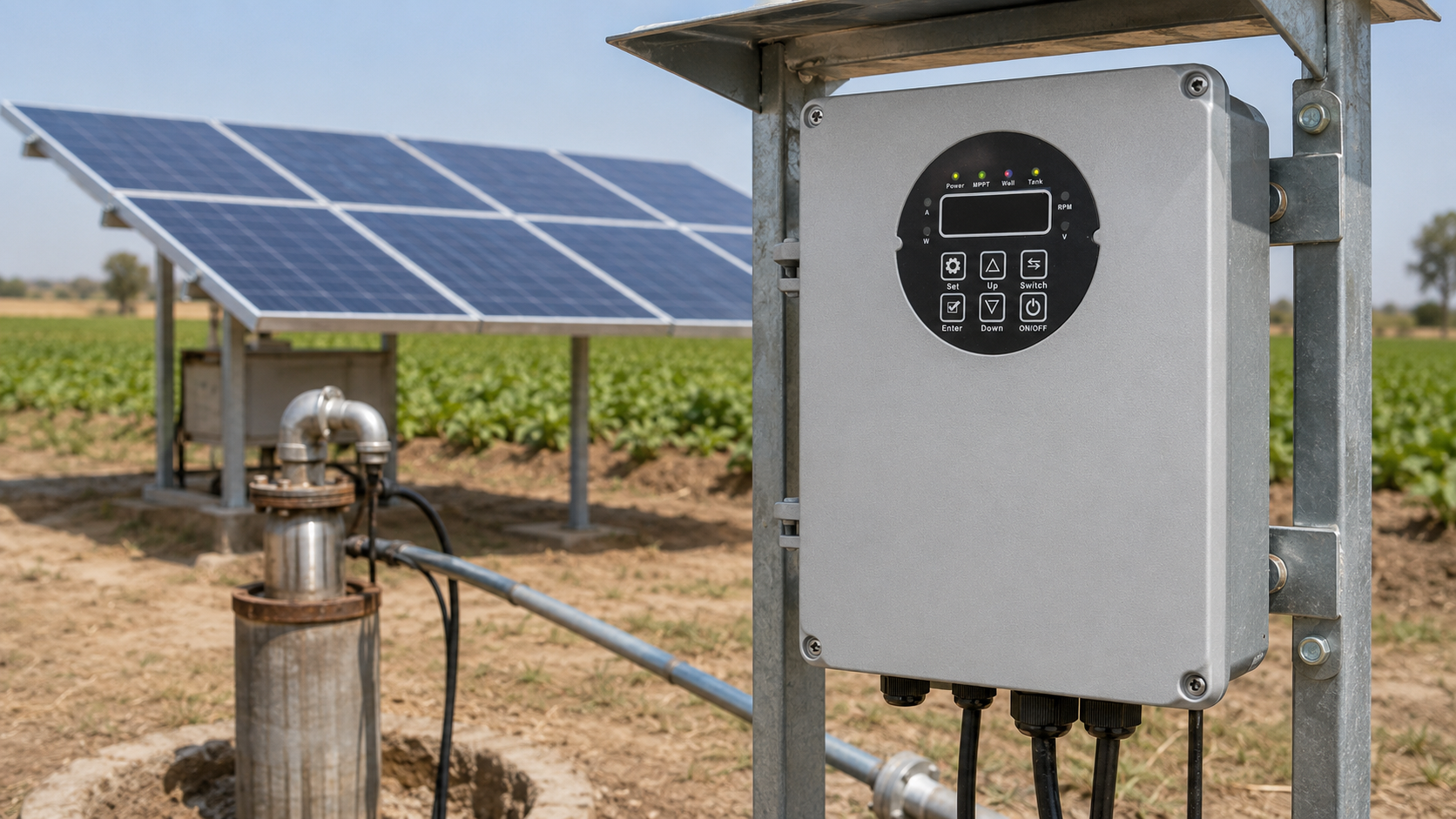
MPPT stands for Maximum Power Point Tracking. It is a control function that checks the voltage and current from a solar array constantly and varies the operating point to be near the highest possible power with the changes in sunshine and panel temperature. This function is provided by a controller in the solar water pump system by controlling the power sent to the pump.
III. How Does an MPPT Solar Pump Work?
1. It Reads the Solar Input
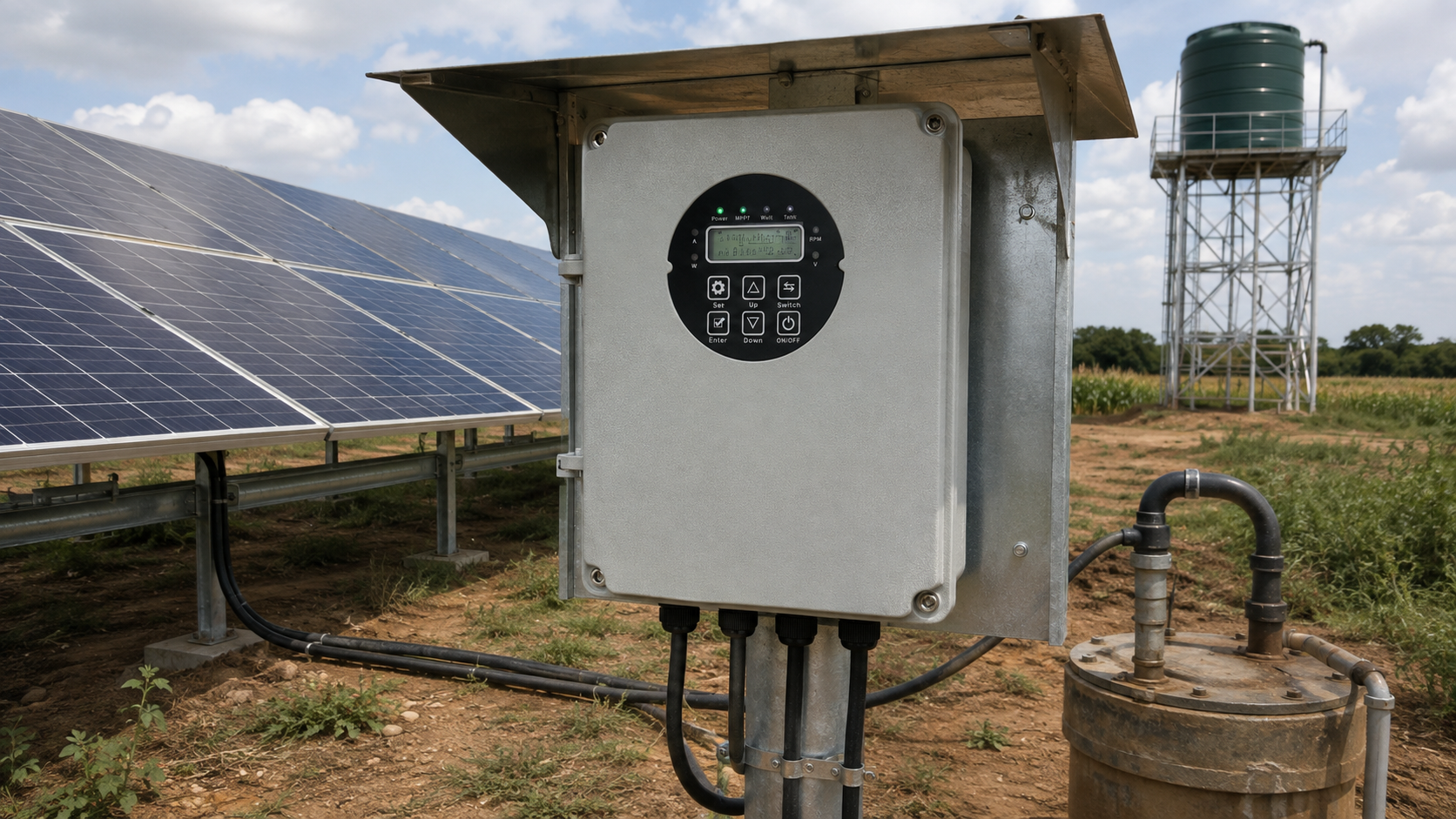
The solar panel’s voltage and current will vary throughout the day. The MPPT controller reads these values constantly so that it can detect changes caused by sun strength, panel temperature, shadows, and pump load.
2. It Finds the Maximum Power Point
The controller adjusts the electrical load on the solar array, looking for the voltage and current combination that delivers the highest possible electricity. The maximum power point changes with the solar conditions; therefore, the process repeats itself while the pump is running.
3. It Controls Pump Operation
The controller turns the pump on and off and controls the electricity going to the motor if enough solar power is available. The pump can be varied to run at a different speed or output as solar input rises or falls within the allowed range, in place of a constant input level.
4. It Responds to Low Power and Faults
The controller is set to turn off the pump when the available solar power is too low to run the pump, and to restart the pump when enough power is available. Depending on the model, it can also stop the pump in case of dry running, overload, blocked rotor, unusual voltage, or too high a temperature.
IV. What Are the Advantages of a Solar Pump with MPPT?
1. Better Solar Power Use Improves Product Value
Using an MPPT solar pump, you can get a more effective performance for your dollar by using more of the energy available from the solar array you chose, not just adding to the motor rating or number of panels. This delivers a clear product advantage in places where the consumer compares the initial cost of the system with real pumping performance.
2. Longer Effective Operation Helps You Win More Projects
If the available power is in its working range, the MPPT solar pump may usually start effective pumping earlier in the morning and continue later in the afternoon. The more pumping hours, the more water you produce each day, the more your product becomes suitable for more irrigation, livestock watering, and storage-tank projects. That means you can bid on jobs based on daily water output, not just pricing.
3. Stable Operation Reduces After-Sales Work
MPPT controllers can adjust the pump’s operation if clouds, shadows, or changing sun angles reduce the solar input, to avoid unexpected stops and unstable restarts. More stable operation means fewer complaints, fewer unnecessary site visits, and a better reputation for the product, all of which help to get repeat business and long-term partnerships with distributors.
4. Controlled Starting Helps Protect Your Profit Margin
Reduced repeated starts, current spikes, and quick pressure shifts with low solar input can be achieved with controlled start and built-in soft start control. Lower electrical and mechanical stress can prevent early failures and warranty claims while avoiding replacement expenses that cut the profits of otherwise successful orders.
5. Protection Functions Expand Your Application Range
Depending on the model, a number of protective features may be available, such as dry-run, overload, blocked rotor, overvoltage, undervoltage, and overtemperature, plus automatic restart when conditions return to normal. These functions help you to reduce unnecessary pump damage in remote and unattended installations, allowing you to power agricultural and off-grid projects that would otherwise require more control equipment or more frequent inspection.
6. Matched Systems Simplify Purchasing and Technical Support
The matched solar pump and MPPT controller combination avoids the dangers of mismatched parts and mismatched voltage, current, or control settings. It helps you to generate bids faster, stock full systems, reduce delivery of wrong accessories, simplify installation instructions, and solve after-sales problems without having to look through components from many different suppliers.
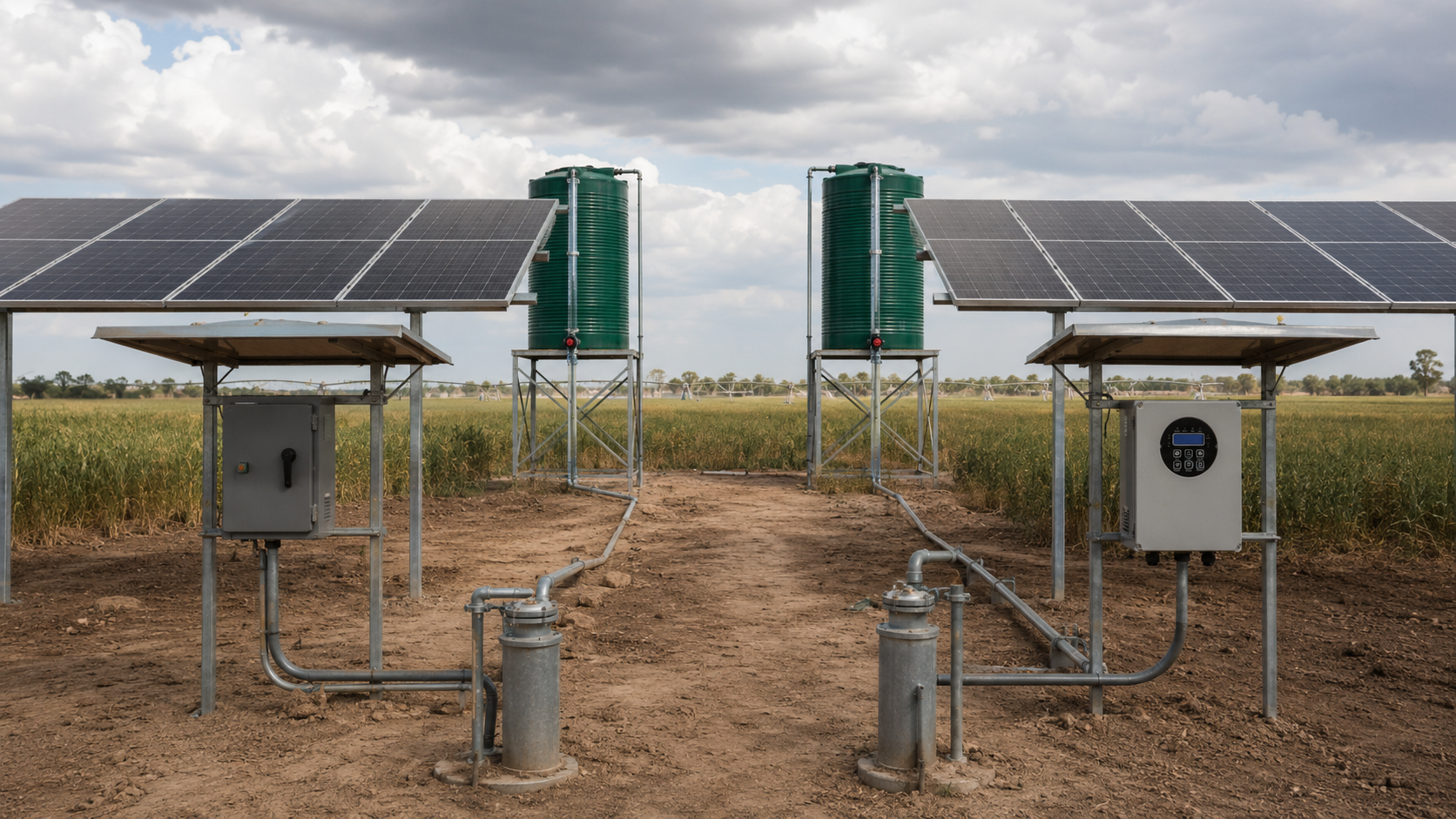
V. Solar Pump with MPPT vs. Solar Pump without MPPT
1. Use of Available Solar Power
In comparison, a solar pump without MPPT runs based on a set control point or direct connection, so it can work normally when the strong and stable sunshine keeps the panel output near the voltage and current required by the pump.
The MPPT on a solar pump constantly moves the operating point of the array as sunlight and panel temperature vary. This lets the pump use more of the available power during the day.
2. Performance Under Weak or Changing Sunlight
A non-MPPT pump may start late, stop suddenly, or make repeated start attempts when solar input is weak or changing quickly, since it cannot so effectively adjust the power provided to the motor.
The MPPT solar pump may start up and vary its output as power allows, but it will also turn off if the solar input is below its minimum working requirement.
3. Peak Performance and Daily Water Output
So, the correctly matched MPPT and non-MPPT versions of the same pump can achieve the same maximum flow and head under high midday sunshine, because both are still limited by the pump curve.
The difference is usually clearer in total daily water output since the MPPT system may make better use of morning, afternoon and changing sunshine rather than relying mostly on the strongest time of the day.
4. Control and Protection Functions
A regular non-MPPT system has a simpler control structure, and dry-run protection, automatic restart, overload protection, or fault displays may need to be added on their own.
The MPPT solar pump controllers also combine power tracking with a range of operating and protective features based on the specific model, which may include external water-level sensors.
5. Initial Cost and Suitable Applications
A solar pump without MPPT often has a lower starting cost and is suitable for basic, price-sensitive applications with steady sunlight, accurate panel matching, and regular manual inspection. If you have a wide choice of products, non-MPPT pumps can be used for consumers whose major concern is the lowest purchasing price under stable working conditions.
An MPPT solar pump is more expensive due to tracking, control, and protection functions, but is better suited to variable sunshine, remote installations, unmanned operation, and projects with a set daily water consumption. MPPT solar pumps are a higher-value choice for customers who demand increased daily production, operating stability, protection functions, and lower long-term service risk.
VI. What Should You Check When Sourcing an MPPT Solar Pump?
1. Check the MPPT Voltage Range
The combined Vmp of the panels should be within the MPPT operating range of the controller. The Voc of the array at cold temperatures should be less than the maximum input voltage of the controller. By preparing a correct series-and-parallel panel connection for each pump model, you may prevent wrong installations and technical questions in your market.
2. Check the Recommended Solar Array Power
The power of the solar array is usually chosen to be about 1.3 to 1.5 times the rated input power of the pump, to account for the losses caused by the temperature of the panels, the variable sunshine, cable losses, and the actual working conditions. This is only a first guide; the final setup of the panels must follow the recommendation of the manufacturer and stay within the limits of voltage, current, and input power of the controller.
3. Match the Pump Curve to the Daily Water Requirement
Maximum flow is usually at a very low head and is not typical of the amount of water the pump will provide after installation. You should calculate the total dynamic head from the vertical lift, the pressure needed at the outlet, and the pipe friction loss, and then use the pump curve and local solar conditions to calculate the volume of water per day and avoid the danger of over- or undersizing the system.
4. Confirm the Protection Functions and Sensors
Don’t rely on unclear protections such as “full protection”, but ask the supplier to list the protection features provided. To prevent a dry run, check that the controller is able to detect pump load variations or requires a water-level sensor, and check that the sensor, cable, and mounting hardware are present to estimate the total system cost.
5. Choose Between an Integrated and External Controller
An integrated MPPT controller reduces external parts and can simplify packaging, wiring, and installation; so, it is ideal for standard pump packages and markets that want easy installation.
An external controller normally gives access to displays, settings, problem records, and spare parts faster, but needs a proper installation location and extra wiring. If your projects are easier to monitor, update, or serve locally, then it might be more suitable.
6. Check the Installation Environment
Consider the IP rating, operating temperature, cooling needs, mounting position, and cable sealing requirements of the controller – even a protected enclosure may still need shade and ventilation in hot or outdoor conditions. Also, long or poor cables can lead to voltage loss, and a cable-size recommendation for common pump powers and installation distances will help to avoid performance complaints related to the installation rather than the pump.
VII. Conclusion
The MPPT solar pump offers the combined advantages of better solar energy use, controlled operation, useful protective functions, and easier system matching. These features can help you cover more projects, reduce your warranty risk, simplify technical support, and compete on daily pumping results, not simply pump price. All HunGerät solar pumps come with matching MPPT control, and you provide us with the required flow, total head, daily water target, panel specs, and installation conditions for a suitable system recommendation.
VIII. FAQ
1. How Much More Water Can an MPPT Solar Pump Deliver per Day?
Usually, an MPPT solar pump may provide 10-30% more water per day than a standard pump, for the same panel power and pumping head. For example, 10 m 3 /day could be increased to about 11-13 m 3 /day based on sunlight and system matching.
2. Can an MPPT Solar Pump Start Earlier in the Morning?
MPPT solar pumps tend to start earlier since they are better able to use little solar input and are better at handling the start-up process. The actual start time depends on the minimum power requirements of the pump, panel size, weather, season, and controller settings.
3. Does an MPPT Solar Pump Continue Running on Cloudy Days?
If the solar power is still above the minimum working level for the controller, it can keep pumping at a lower output. Normally, if the input falls below this level, the controller will turn the pump off and restart it when there is enough sun again.
4. Can MPPT Increase a Solar Pump’s Maximum Flow or Head?
No, the MPPT cannot increase the maximum flow or head over the power of the pump and the hydraulic performance curve. Its key advantage is that it uses the solar electricity for the pump more efficiently during the day.
5. Does an MPPT Solar Pump Need Batteries?
No. Most MPPT solar pumps can operate directly from solar panels without batteries. Only use batteries supported by the controller with the above battery voltage, charging method, and discharge limits.
6. Can a Solar Pump Run Directly from Panels without an MPPT Controller?
Some solar pumps can be powered directly from panels if they are designed for direct solar input and are well suited to the array. Never remove an MPPT controller from a pump kit unless the manufacturer says the pump can be used directly.
7. Can a Non-MPPT Solar Pump Be Upgraded with an MPPT Controller?
However, the pump may not always be electrically compatible with the controller in terms of output voltage, current, power, and drive method. An upgrade may also require changes to panel connection, wiring, sensors, and protective settings.
8. Can Any MPPT Controller Be Used with Any Solar Water Pump?
The MPPT controller is not always required to meet the voltage, rated current, starting requirements, power, and control method of the pump. Replace with an approved controller model or get written compatibility data.
9. What Happens When Solar Power Drops Below the Pump’s Minimum Requirement?
When the power is not enough for stable operation, the control system normally reduces the pump output until the pump is switched off. Most models have an auto-restart when the solar input returns. Restart timing and settings are set by the controller.
10. Why Does a Non-MPPT Solar Pump Start and Stop Repeatedly?
The panels may have enough open-circuit voltage to get it going, but not enough power to run the motor under load. Then the voltage drops, the pump stops, and the cycle continues as the panels recover.
11. Does MPPT Reduce Solar Pump Starting Current?
Many MPPT solar pump controllers use soft-start control to raise the motor speed and current slowly. The real limit of the starting current depends on the design of the controller and the pump and so it should be checked in the specifications of the model.
12. How Does MPPT Affect Daily Water Output at Different Heads?
And as the total pumping head grows, the daily water production drops. That is, the pump has to do more work to pump the same amount of water. MPPT can increase the usage of the available solar power at each working point, but the final output still has to be calculated from the pump curve and local solar conditions.
13. Can an MPPT Solar Pump Use Both Solar and Grid Power?
Grid or generator backup may only be safely used with a hybrid MPPT controller built for solar & AC input. Do not connect an AC supply to a solar-only controller unless the manufacturer has clearly allowed this.
14. How Much Solar Panel Power Does an MPPT Solar Pump Need?
A common rule of thumb is to first use about 1.3 to 1.5 times the rated input power of the pump to allow for temperature, sunshine, cable, and operating losses. The final array must be as recommended by the manufacturer and within the voltage, current, and maximum input limits of the controller.
15. Can Too Many Solar Panels Damage an MPPT Controller?
Yes, too many panels can damage the controller if you go above the max input voltage or current for the array. Calculate the cold-weather Voc, working Vmp, total current, and total input power. Decide the number of panels.
16. How Do Vmp and Voc Affect an MPPT Solar Pump?
Vmp is the voltage of the panel during regular power generation. Voc is the voltage when there is no electrical load connected. The total Vmp must be in the MPPT range of the controller and the cold weather Voc must not exceed the maximum input voltage of the controller.
17. Does MPPT Dry-Run Protection Need a Water-Level Sensor?
Depends on the controller. Some have dry running detection based on changes in motor load. Others require separate water level sensor. Check detection method, restart delay, sensor cable length and included equipment before purchase.
18. Is an Integrated MPPT Controller Better Than an External Controller?
The right design depends on the application, as integrated controllers simplify wiring, yet external controllers are easier to check, change, and replace. Select according to installation access, local conditions, monitoring requirements, and local service conditions.
19. Does a Long Cable Reduce the Advantage of MPPT?
Yes, long or undersized wire will produce voltage loss and cut down on the power that actually makes it to the pump or controller. Choose the cable size according to voltage, current, and distance. Many systems are designed to keep voltage drop to about 3% or less.
20. How Does High Temperature Affect MPPT Solar Pump Performance?
High panel temperature usually leads to lower solar panel voltage and available power. High controller temperature may lead to a drop of output or a protective shutdown. Use within the allowed temperature range and give shade, ventilation, and enough mounting space to the controller.
21. How Long Does an MPPT Solar Pump Controller Normally Last?
A properly installed and matched MPPT controller may work for about 5 to 10 years. Actual life depends on temperature, moisture, electrical stress, dust, and voltage spikes. Instead of just relying on the expected service life, you should compare the supplier’s guarantee, protective design, housing rating and replacement support.
22. What Information Should You Provide When Ordering an MPPT Solar Pump?
Please provide information on: Flow, Total Dynamic Head, Daily Water Volume, Water Source, Installation Location, Cable Length, Working Temperature. If the panels are already selected also the wattage, Vmp, Voc, current and planned series-parallel connection.