I. Introduction
Some pond customers prefer the pump hidden underwater; others want to be able to go to the pump from the bank to clean and check it. These choices will guide you to what products you should be selling as a distributor or importer. Circulation, submersible, and external pond pumps, fountains, and waterfalls. The proper one depends on where the pump is to be used, how it starts, how easy it is to clean, and how much flow it gives at the required head.
II. Submersible and External Pond Pumps
1. Submersible Pond Pumps
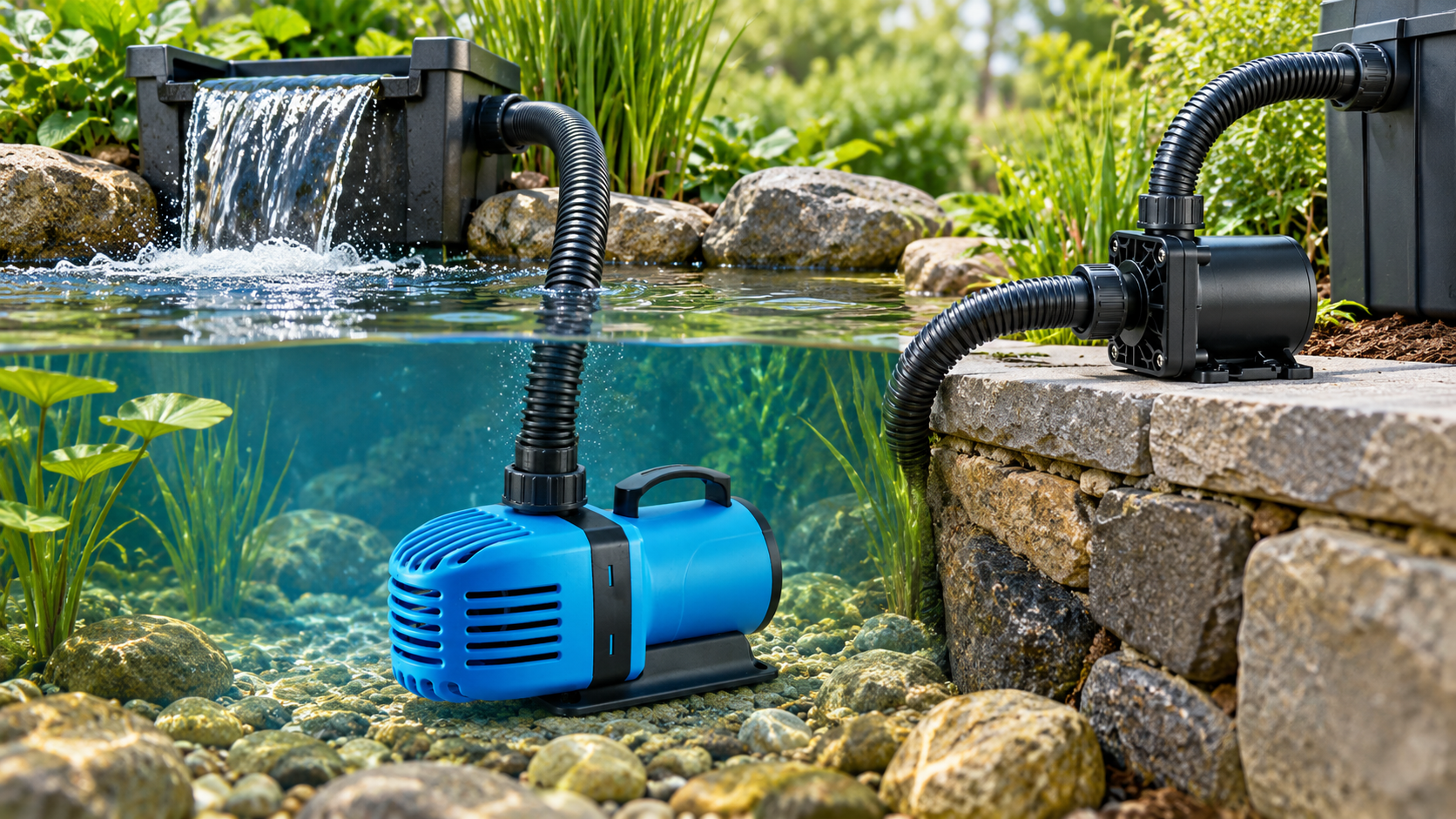
It is a submersible pond pump – this means it is designed to be used underwater. In many designs, the water is drawn via a protective intake cover or cage before reaching the impeller. The cover stops anything larger than the openings from getting into the pump inlet. The water then flows through an outlet which is attached to a hose pipe or a fountain attachment. From small water feature pumps to bigger ones for pond circulation.
2. External Pond Pumps
An external pond pump is located outside the pond. An inlet pipe feeds water into the pump, and an outlet pipe feeds the water back to the pond or other part of the water feature. The pump body and motor are not in the water.
III. Key Differences Between Submersible and External Pond Pumps
1. Water Intake and Priming
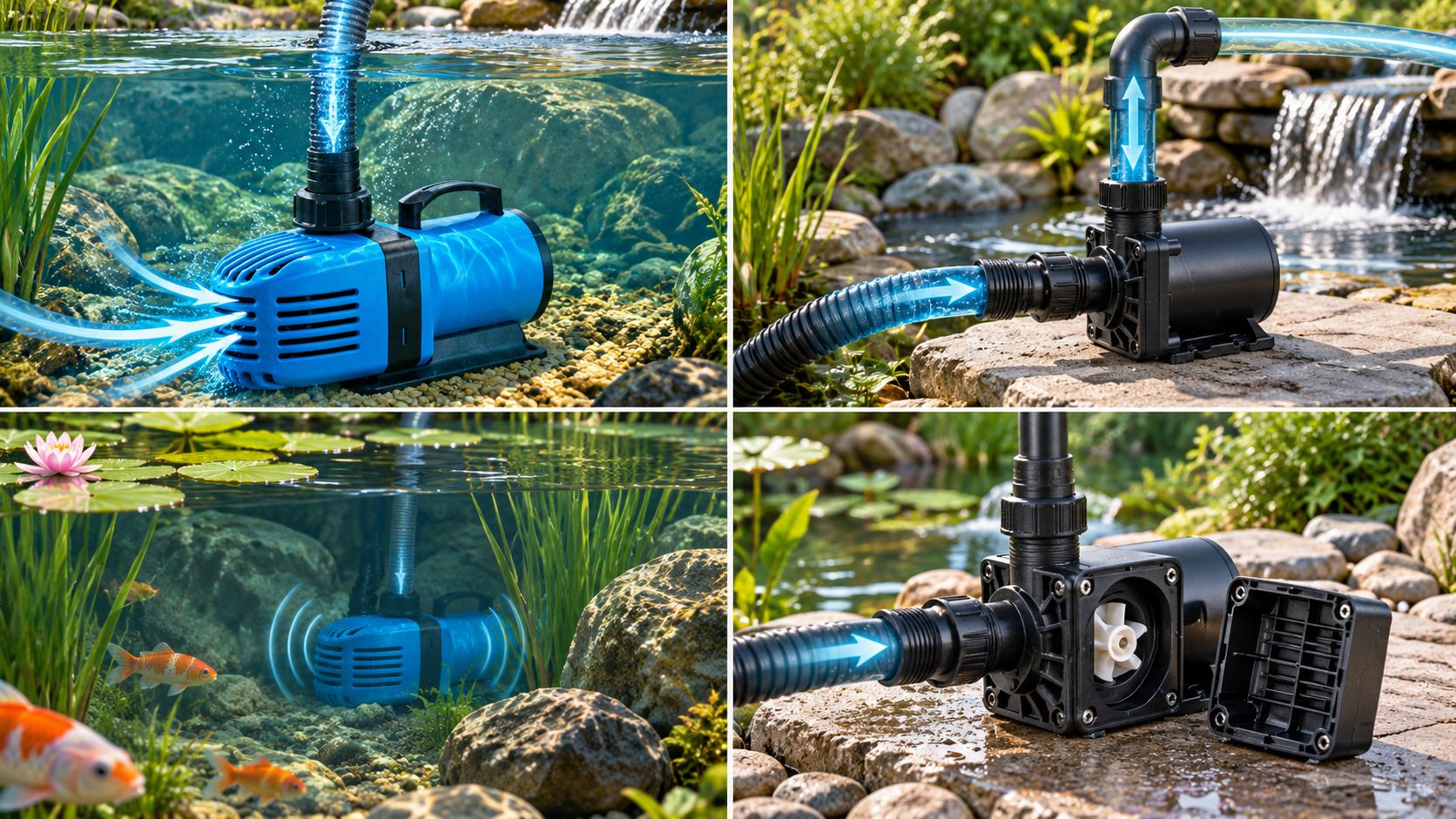
A submersible pond pump draws water directly into its intake openings. When submerged, it fills its pumping chamber with water as instructed, thus typically no manual filling is needed. Do not begin normal flow until all trapped air has been released according to the instructions.
Water comes in through the inlet pipe of an external pond pump. If you place a non-self-priming model below the level of the pond water, water can flow in by gravity as long as air can get out. Proper priming setup of the pump and suction pipe above the water level is required. The self-priming model may still require an initial fill. The startup conditions depend on the pump design and the location of the pump relative to the water.
2. Pump Position and Appearance
A submersible pond pump is placed inside the pond or in a suitable water-filled pump housing. This keeps the pump body off the bank, making it easier to hide in the water feature. But it still needs adequate room in its intake for water to get in freely.
External pond pumps need another place outside the water. Unless put behind the water feature or in an appropriate enclosure, its body and connected pipes may be seen. The advantage is direct access to the equipment. The motor also requires the ventilation and protection from floods required for that model.
3. Operating Noise
Running a submersible pump underwater can help make the motor noise less noticeable above the pond. But vibration can still get into a stiff pipe or a surface nearby. Submersible doesn’t necessarily mean quiet. A motor’s design, mounting, and operating state all affect sound.
The motor of an external pump is exposed to the air, so you may hear it better. Some models also come with a cooling fan. Quiet external types are available. Lower motor speeds are used in the designs. So, the kind of installation does not suffice to rank noise levels.
4. Cleaning and Access
Cleaning the intake cover and checking the impeller usually means taking a submersible pond pump out of the water. The ease of use is location, weight and cover design dependent of the pump. A hidden pump may not be as accessible on a routine basis.
The external pond pump is located on the bank, which means you can get to the pump body and pumping chamber without having to remove it from the pond. This is good if regular inspection and cleaning are high priorities. The debris collects and needs cleaning, but the advantage is simpler access to the pump.
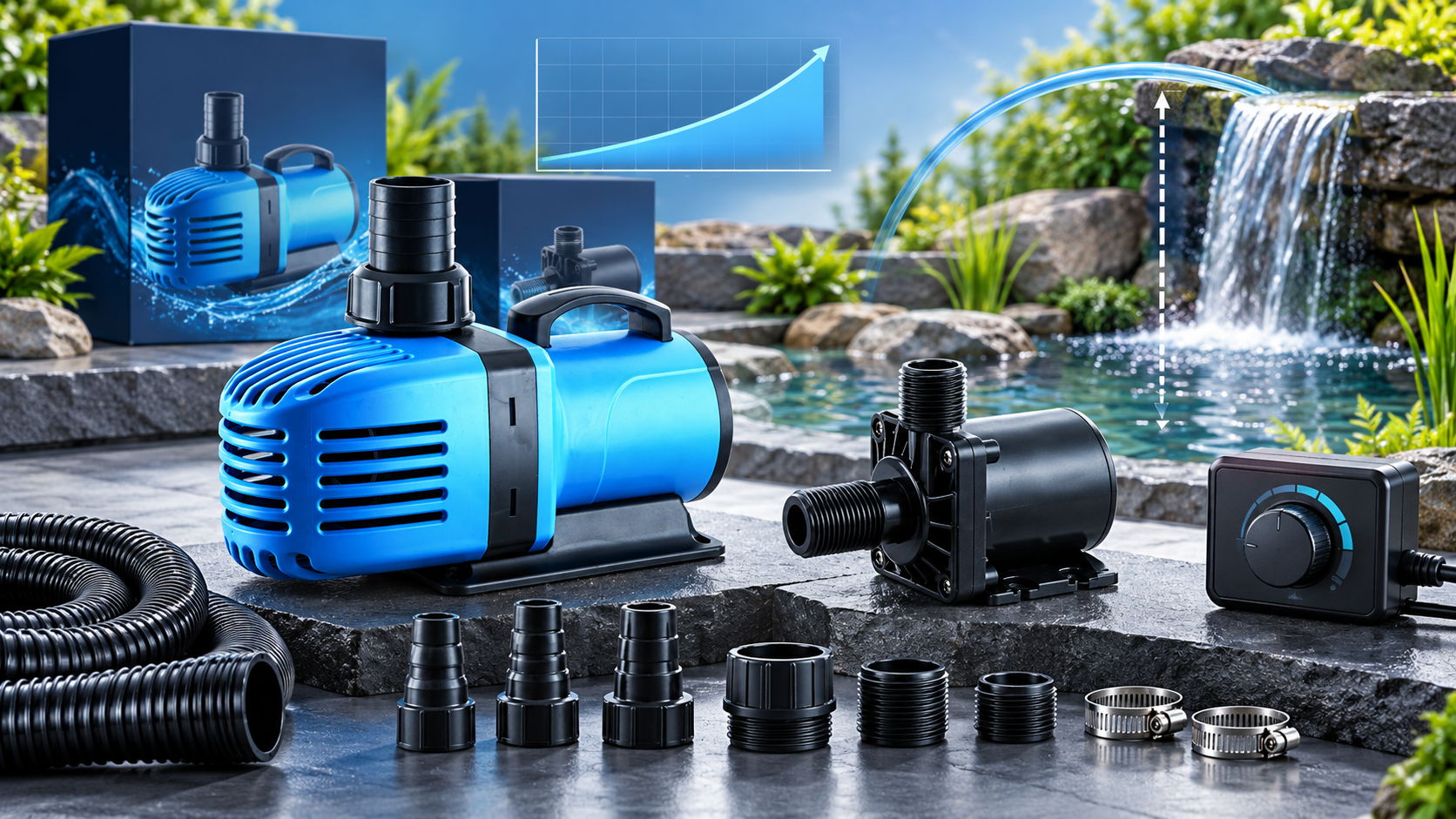
IV. Choosing the Right Type for Your Product Range
1. Match Pump Type to Your Sales Channel
If you supply garden centers or retailers that sell decorative ponds and fountains, compact submersible pumps are a good place to start for clients wanting hidden equipment. External models are for clients who wish the pump to be accessible above ground. These preferences can help you decide which type should get greater room in your range. Keep performance categories separated from installation type: both ranges have different flow and head options, so a submersible unit shouldn’t automatically be considered an entry-level product.
2. Cover Different Flow and Head Requirements
Fountains, pond circulation, and elevated waterfalls need different combinations of flow and head. You’ll want to cover these demands when you’re choosing models to stock. For example, a demand of 4000 L/h at 2 m total head requires a pump that has that point on its performance curve; a maximum flow label of 4,000 L/h does not prove this. Total head is the lift above the pond surface, including the resistance of hoses and equipment. If you add a number of models with various maximum flows but comparable head limits, you may find your range short on options for higher water features.
3. Build Clear Configuration and Price Tiers
The fixed speed models are appropriate for applications that need a constant water flow. Customers who purchase variable-speed models can adjust the flow of the fountain or waterfall to suit their needs within the pump’s range. These features allow you to establish pricing tiers with a clear reason for the price difference. Compare quotations first on flow at a given head, then check specified controls. If a model needs a matched controller to run, compare the pricing of the whole pump and controller package. “A price for pumps alone would be missing an important part.
4. Check Connection Compatibility Across Your Range
Look at the actual connection for each type, whether it is a hose fitting, threaded port, or flange. For hose fittings, check the hose’s supported inside diameters. For threaded ports, check the thread size and standard. You can then select models that match the most commonly offered connectors in your market. If one pump can be supplied with adapters for many typical sizes, then it may be possible to decrease the requirement to stock duplicate versions of the pumps. For external models, check the inlet and outlet individually, as they may have different sizes. Also check whether connection fittings are included in the stated package.
V. Conclusion
The submersible pond pumps are easy to hide in the water feature to keep the pump body off the bank. External pond pumps are easy to reach for inspection and cleaning. Your range of products should be in line with these preferences and include the flow, head, control choices, and connectors you require. Installation type is just one part of the choice.
Inform HunGerät of the pond applications, flow and head requirements, and connection sizes you want to cover. Please ask about suitable pond pumps and performance curves for your distribution or import business.
VI. FAQ
1. Does Pond Depth Count as Pump Head?
When pumping from an open pond, you do not directly add the depth of a submersible pump below the surface to the static lift. Measure the discharge height above the surface of the pond, then account for hose and equipment resistance.
2. Can a Submersible Pond Pump Supply a Raised Waterfall?
Yes, if it will give the required flow at the total head of the waterfall. Check the performance curve with hose and equipment losses built in, not the maximum head.
3. Does a Longer Hose Reduce Pond Pump Flow?
Yes, a longer hose adds resistance and can limit flow from either pump type. The loss also depends on the hose diameter and the needed flow; therefore, by the hose length alone, a set percentage reduction cannot be given.
4. Can Two Pumps with the Same Wattage Deliver Different Flow Rates?
Yes, different motor efficiencies and impeller designs can provide varying flow and head for the same electrical input. Instead of matching models only by wattage, compare their performance curves at the same head.
5. Does a Larger Outlet Always Mean Higher Flow?
No, the flow capacity of the pump is not determined by the size of the outlet. A bigger suitable hose will lower resistance, but the flow supplied is still determined by the pump curve and the system attached.
6. Can Pond Pumps Be Used in Saltwater?
Use only models specially approved for saltwater. Just make sure you check the recommended water conditions by the manufacturer as some models are for freshwater and others are for saltwater.
7. Can a Pond Pump Handle Leaves and String Algae?
Some pond pumps may handle small particles within stated limits, but whole leaves and long strands of algae can still clog the intake or catch around the impeller. Check the debris-handling rating and keep the intake free.
8. Does Dry-Run Protection Allow a Pond Pump to Run Without Water?
No, dry-run protection is to turn the pump off when it senses low water. It decreases the risk of damage. It does not allow dry operation as an allowed usage.
9. Can a Controller Be Added to Any Pond Pump to Adjust Its Speed?
No, the motor and any electronics on board must be compatible with the controller being used. Use a combination approved by the pump maker. Instead of taking a stock controller and putting it on a motor whose characteristics are unknown.
10. Can Both Types of Pond Pumps Run Continuously?
Yes, if the particular model is rated for continuous use. They require a continuous water supply and must function within the manufacturer’s temperature, cooling, and load limits.
11. Does a Larger Pond Always Need an External Pond Pump?
No, a good high-flow submersible pump can handle a bigger pond. Don’t select an external model based on pond size alone. Select an external model when it performs and has access from the bank to meet the demand.
12. Are All External Pond Pumps Self-Priming?
No, an external pond pump is not necessarily self-priming. Check the manufacturer’s start-up requirements, e.g., the requirement to fill the pump and suction line with water before start-up.
13. Can an External Pond Pump Operate Above the Pond’s Water Level?
Yes, if the model is intended for use in a suction-lift situation and is primed within the limits mentioned. A pump designed for gravity-fed intake just requires the water level to be above its inlet.
14. Can a Pond Pump Work Close to Its Maximum Head?
Only if that point is within the allowed operating range of the pump and still provides the required flow. Flow is almost zero at the maximum head on a typical centrifugal pump curve.
15. What Does a Pond Pump’s Solids-Handling Rating Mean?
It usually defines the maximum particle size the pump is designed to pass. This does not mean that it is capable of dealing with whole leaves or long fibers, which are different from small solid particles.
16. Can One Adjustable-Speed Pond Pump Replace Several Fixed-Speed Models?
Sometimes, if it has an allowed speed range that includes each needed flow and head. Compare the curves at different speeds, since the reduction in head due to reduction of speed may also leave some applications outside its range.
17. How Should You Compare Pond Pump Noise Ratings?
Compare ratings obtained by the same test method and under the same operating conditions. For sound pressure ratings, also note the measuring distance. It is not correct to compare sound pressure with sound power ratings.
18. Can BSP and NPT Pond Pump Connections Be Used Together?
Although BSP and NPT look comparable at the nominal size, the thread shapes are different, and they shouldn’t be joined directly. Use matching connectors or an appropriate conversion adaptor.
19. Does a Pond Pump’s Performance Change Between 50 Hz and 60 Hz?
It can. When the motor speed varies, the flow and head of the pump change. Check the voltage and frequency of the allowed pump supply and use the performance curve for that supply.
20. What Should You Check When Comparing Pond Pump Quotations?
Compare the flow at equal head and then check the control functions, electrical ratings, and connection standards. Make sure you include essential controllers and connection fittings so you can compare complete products on a common basis.