I. Introduction
When consumers ask for a pond pump, they generally give the pond size or the motor power necessary. This is not enough to select with accuracy. A pump can have a high maximum flow, but will provide significantly less water after it is hooked up to pipes, filters, fountains, or waterfalls. Knowing the flow, head, and filter requirements helps you quote the proper model and minimize complaints after installation.
II. Identify the Pond Pump Application
1. Pond Filtration
A pond filtration pump pulls water from the pond through a filter and returns it to the pond. Required flow depends on pond volume, desired turnover time, filter capacity, and total system resistance. If your market is mostly koi ponds and decorative fish ponds, your product line should include pumps that are built for continuous operation and water with a minimal quantity of dirt.
2. Waterfalls and Streams
The waterfall or stream pump must deliver sufficient water at the desired lift to create the anticipated visual effect. The needed flow relies on the width of the fall, the vertical rise, the length of the pipe, and the desired water thickness. These pumps are commonly purchased by customers who need a lot more flow than a conventional pond filter needs. You should not propose a model based on pond volume alone.
3. Fountains and Decorative Water Features
Fountain nozzles need a specified flow and pressure to provide the desired height and spray pattern. Therefore, the nozzle specification should be examined before selecting the pump. If you supply full fountain packages, it is easier to get quotations and to prevent complaints about performance. You must supply popular pump and nozzle combinations in advance.
4. Combined Pond Systems
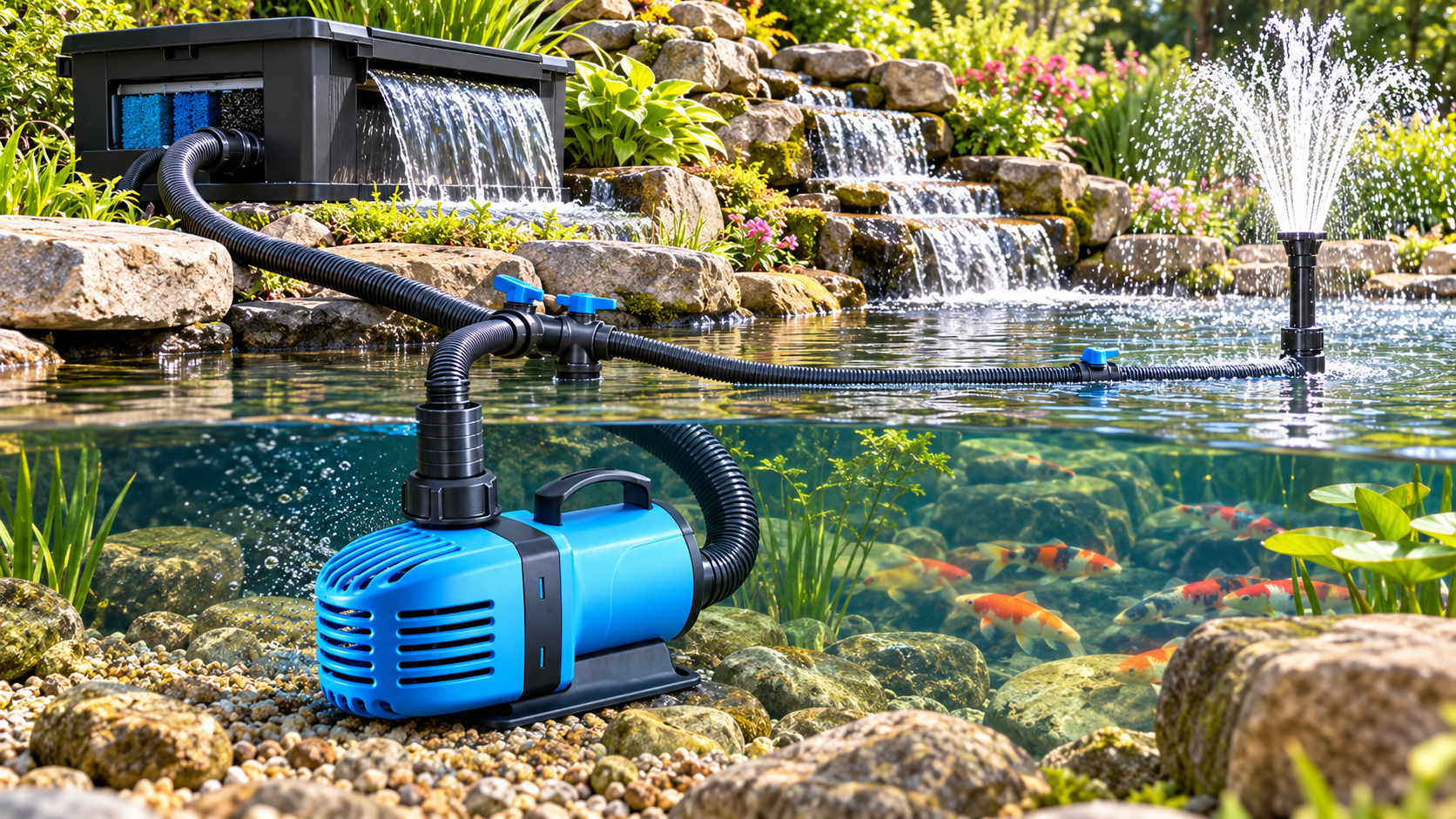
One pond pump can feed a filter, a waterfall, and a fountain, but the way the piping is laid out will influence how that flow is used. If the water goes through the filter and then to the waterfall, the same water does both duties. If the exit is divided into many branches, the pump flow is divided across those branches. If filtration and water features have extremely different flow rates, it may be more feasible to use separate pumps.
III. Calculate the Required Pond Pump Flow Rate
1. Calculate the Pond Volume
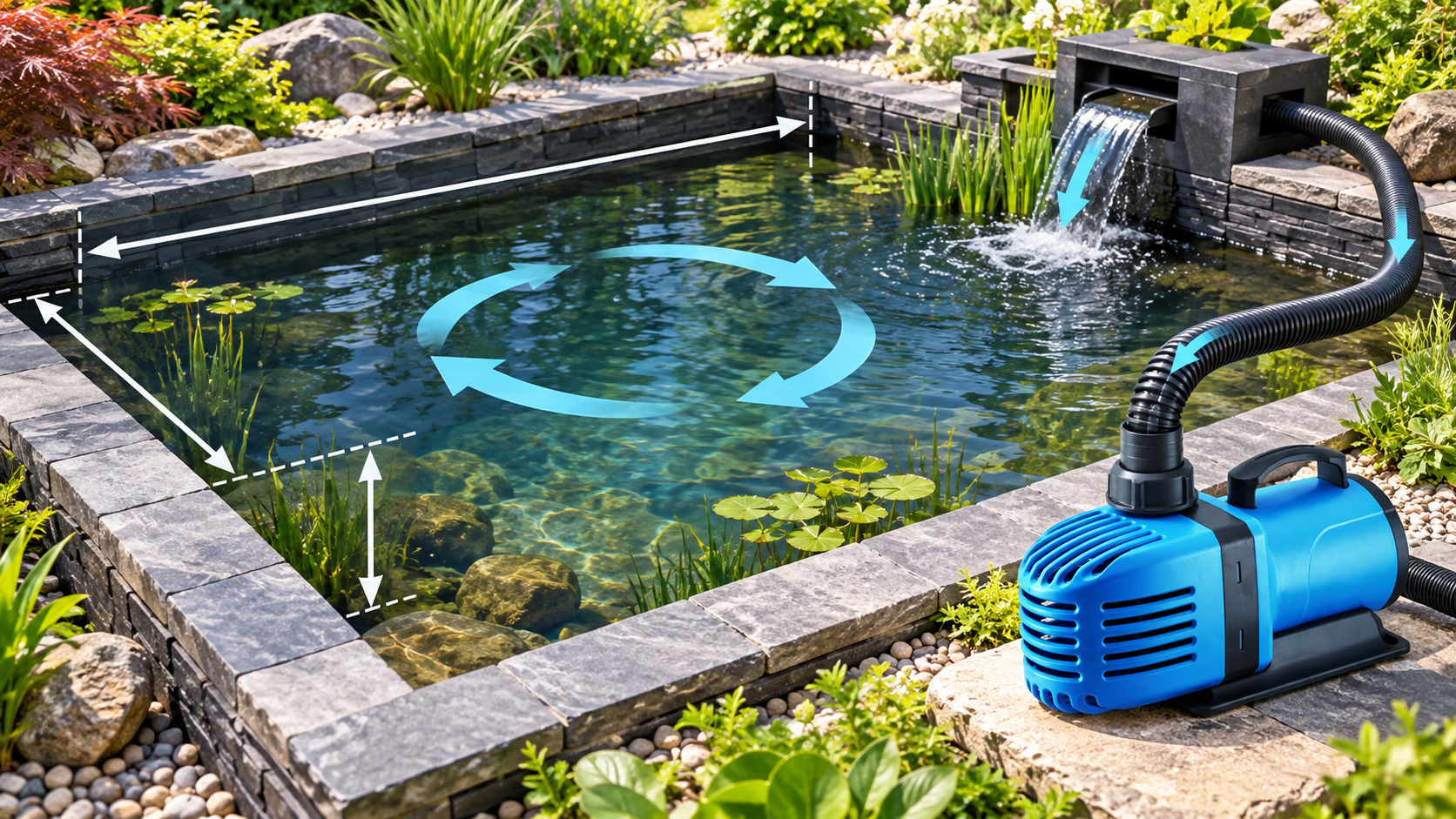
For a rectangular pond, you can estimate the volume with the following formula:
Pond volume (L) = Length (m) × Width (m) × Average depth (m) × 1,000
Average measurements of an irregular pond, or the actual amount of water utilized to fill it. The pond volume gives you a starting place to choose flow, so ask clients for dimensions rather than using motor power as the only need.
2. Select the Turnover Time
The turnover time is how long it takes the pump to push through the circulation system a volume of water equal to the complete pond volume. Many decorative ponds can be started with the goal of one turnover every one to two hours. Koi ponds, small ponds or systems with a heavy load of fish may demand faster circulation. In the end, the flow must remain within the rated range of the filter.
Use this formula:
Required flow = Pond volume ÷ Turnover time
For example, if a 6,000 L pond needs one turnover every 1.5 hours:
6,000 L ÷ 1.5 hours = 4,000 L/h
The pump must deliver about 4,000 L/h at the actual system head. A pump with a maximum flow of 4,000 L/h will usually be too small because its flow falls as the head increases.
3. Include Waterfall and Fountain Requirements
The figure is based on basic pond circulation and may not be enough for a large waterfall or tall fountain. Independent verification of required flow in the water feature. If the same water goes through the filter and then to the waterfall, then you don’t have to add the total flow again. You need a pump that delivers the higher necessary flow after all system losses.
4. Check Flow Distribution
If the discharge pipe divides into many branches, then each filter, fountain, or waterfall will get only a fraction of the total pump flow. The required branch flows are added, and the pump is checked to see if it can supply the total at the proper head. Valves can balance the branches but cannot provide more flow from a pump that is too small.
5. Use Flow Ranges to Plan Your Product Line
Pond pumps can be split into small, medium, and big pond flow ranges. But within each range there should still be more than one option of head. Two pumps with the same maximum flow can behave quite differently with pipes and filters attached. By arranging your range according to flow and head, you give your sales staff a better basis for selection than motor power alone.
IV. Calculate the Actual Pump Head
1. Measure the Vertical Lift
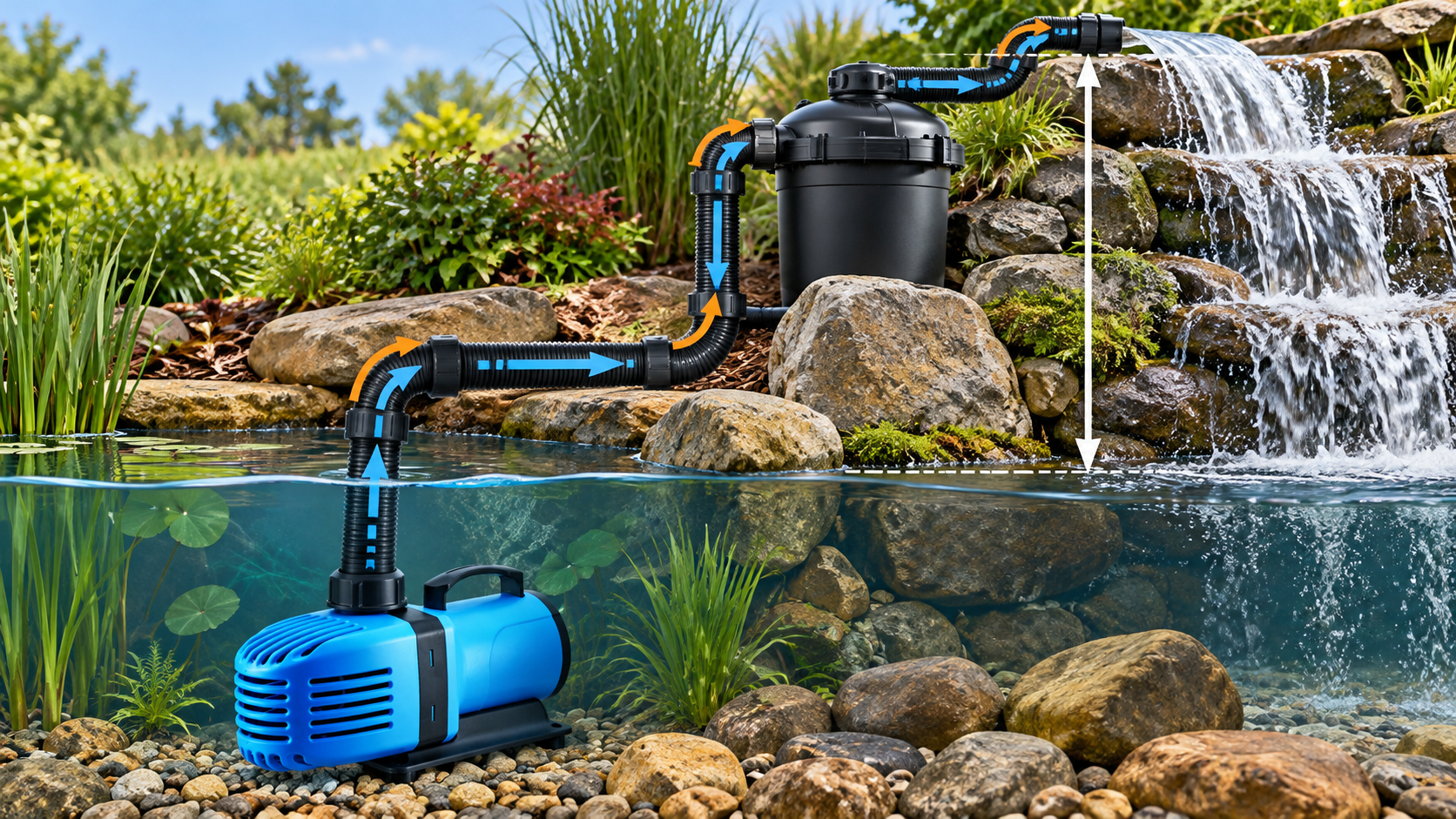
For a submersible pond pump, measure from the typical pond water level to the highest discharge point. Just because the pump is sitting on the bottom of the pond doesn’t mean you measure from the bottom of the pond. The discharge point for waterfall systems is often the top of the waterfall, and for filter systems it can be the filter inlet.
2. Add Pipe and Fitting Loss
Water drops pressure when it flows through pipes, elbows, valves, and connectors. Long pipe runs, tiny dimensions, and plenty of bends exacerbate this loss. By asking for the pipe length and diameter before quoting, you don’t end up delivering a pump that looks big enough in the catalog but can’t provide the installed flow you need.
3. Include Filter and Equipment Loss
Pressure filters, UV lights, fountain nozzles, and control valves also add resistance. In the head calculation, use the pressure loss amount from the equipment provider. As a basic rule of conversion, 1 bar of pressure equals 10.2 m of water head.
4. Calculate the Total Dynamic Head
Use the following relationship:
Total dynamic head = Vertical lift + Pipe loss + Filter and equipment loss
Assuming a vertical lift of 2 m and an anticipated pipe and equipment loss of 1 m, the total dynamic head is approximately 3 m. You need to examine how much flow the pump gives at 3 m, not its greatest flow at 0 head.
5. Read the Pump Curve
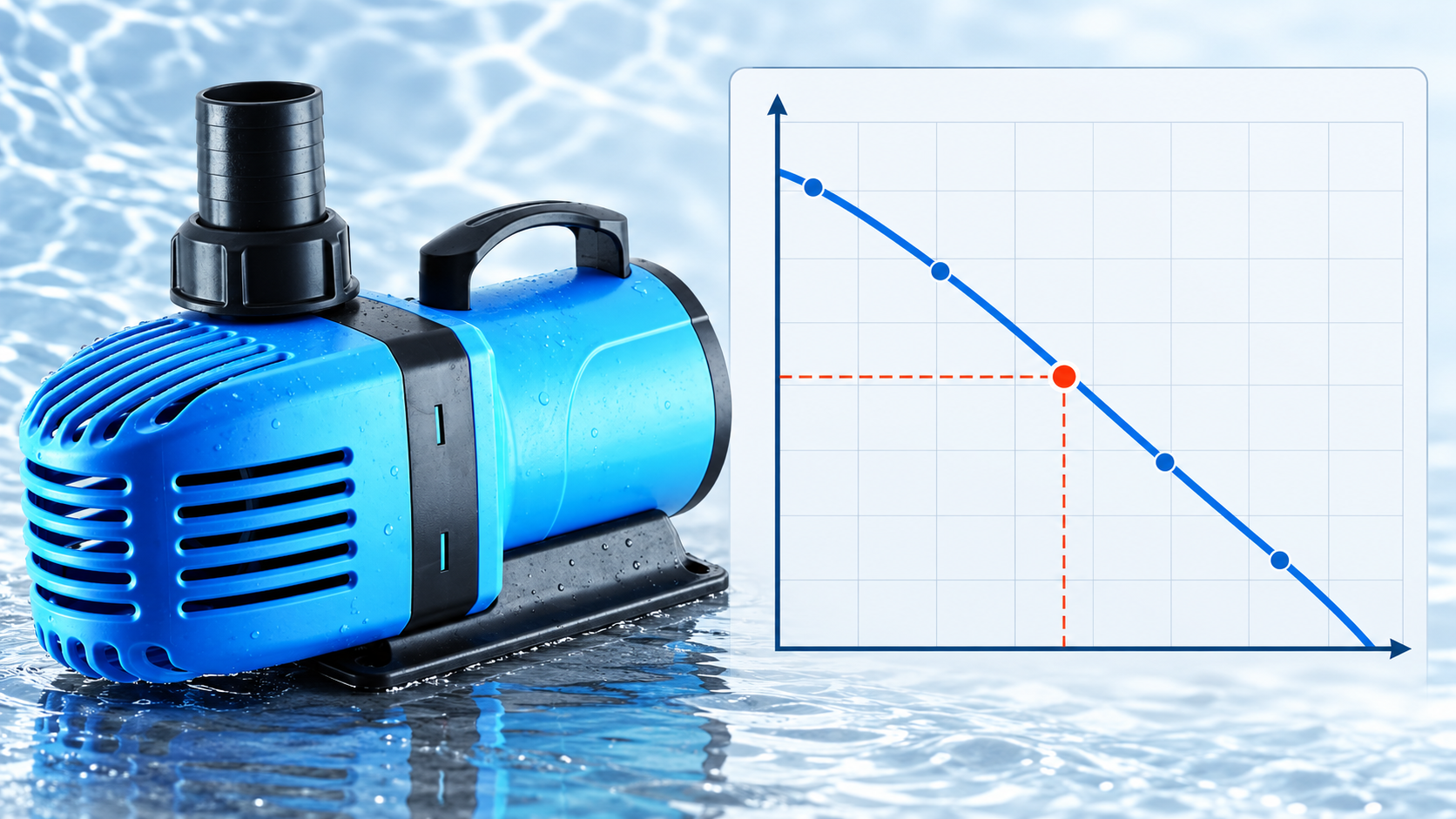
The pump curve is a graph of flow vs. head, and it demonstrates that as the head increases, the flow drops. Check the flow at that point and get the appropriate head from the curve. If the operating point is outside the curve’s appropriate area, select another model. Clear performance curves also enable your consumers to make proper pump comparisons instead of simply comparing catalog maximums.
V. Match Flow and Head on the Pump Curve
1. Read Maximum Flow and Maximum Head Separately
Maximum flow and maximum head are opposite ends of a pump’s performance curve. At very low head, the maximum flow is attained, and at maximum head the flow approaches zero. You should not be giving these values as performance at the same time. To make the comparison more realistic, the flow at the required head at the client is shown.
2. Check Flow at the Required Head
After you have determined the flow and total head needed, check the pair of values on the pump curve. If a pond requires 4,000 L/h at 3 m, the pump must be rated for that working point and not only have a maximum flow rate of over 4,000 L/h. For your standard models, measuring flow at numerous common head levels allows you to discover which pumps are appropriate for low-lift circulation and which can provide elevated waterfalls.
3. Avoid Unnecessary Oversizing
Select a pump that can achieve the appropriate operating point within its recommended operating range. A much bigger model is not necessarily a safer bet; it can give too much flow and need to be adjusted. If the project does not require this extra capacity, you can supply a properly sized model at a reduced purchase price instead of losing the deal with unduly expensive advice.
4. Compare Running Costs at the Same Performance
Compare electrical input power only when pumps deliver similar flow at the same head. A 30 W difference is roughly 263 kWh a year if it runs all the time. By multiplying this with the local electricity price, you have a tangible means to justify the higher purchase price of a more efficient model, rather than a general “energy saving” claim.
VI. Choose the Suitable Pond Pump Design
1. Submersible Pond Pumps
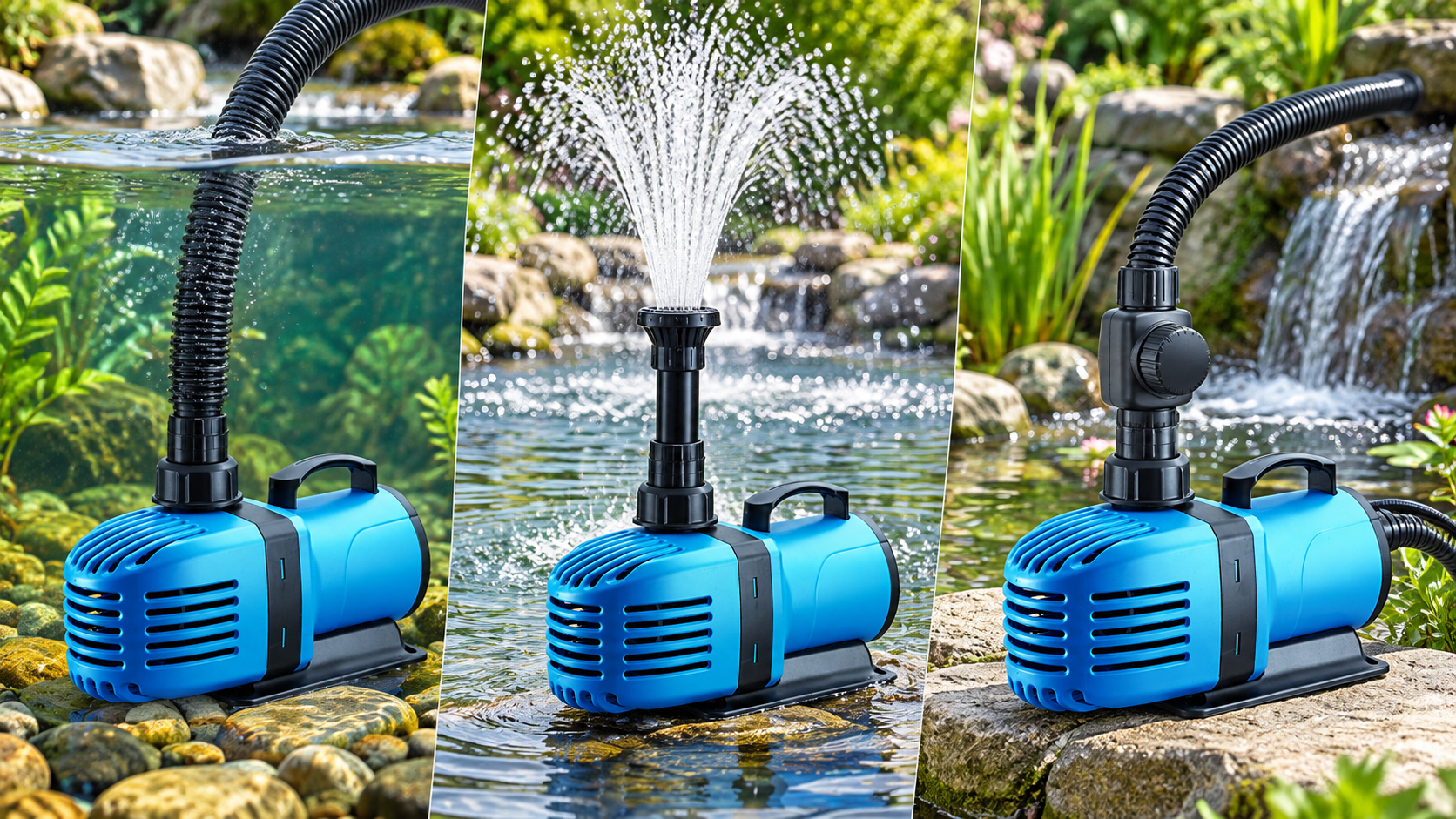
Submersible pond pumps go directly into the water. They are compact, easy to install, and great for garden ponds, small koi ponds, fountains, and waterfalls. For retail and distribution, you can build models with a variety of flow ranges, outlet sizes, and cable lengths to suit popular local installations.
2. External Pond Pumps
External pond pumps are located outside of the water, which makes them easier to check and maintain. They are commonly utilized for larger ponds, commercial filtration systems, and installations requiring higher continuous flow. Before you quote, verify that the model requires a flooded suction or is self-priming. An incorrectly installed suction can prohibit the pump from operating properly.
3. Clean-Water and Solids-Handling Pumps
Clean-water pumps are intended for use with pre-filtered water, fountains, and beautiful water features. Pond pumps capable of handling solids are better for fish ponds and filtration systems where small particles may reach the impeller. This difference can be used to distinguish lower-cost water feature types from pumps suited for more demanding pond conditions.
4. Fixed-Speed and Variable-Speed Pumps
When the flow rate stays the same, a fixed-speed pond pump works well. With a variable-speed model, the flow can be slowed down when it’s cooler outside or sped up for filtration and water features. Customers have more control with variable speed, but the higher price is easier to explain in systems that need to run for a long time or have a lot of different settings.
5. Continuous-Duty Operation
Pond filtration pumps can run for many hours, or continuously; therefore, duty rating is more significant than short-term maximum flow. Check motor temperature, bearing design, seal, cable, and stated operational duty before adding a model to your range. A drainage pump with equivalent flow and head might not be set up to run 24/7 for pond circulation.
VII. Pond Pump Selection Example
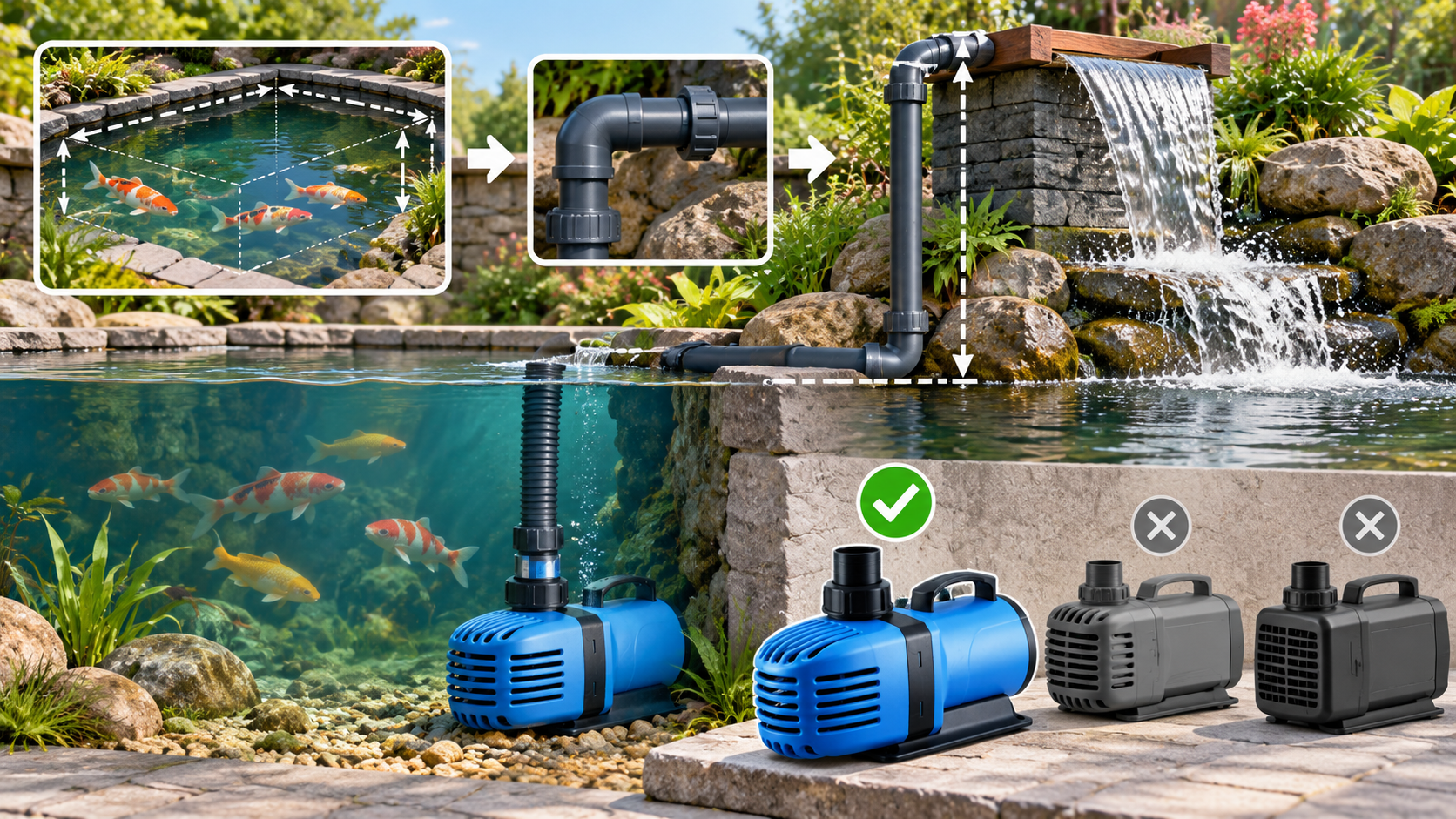
Assume a customer needs a pump for a 6,000 L pond, with a target turnover time of 1.5 hours. The required flow is:
6,000 L ÷ 1.5 hours = 4,000 L/h
The discharge point is 2 m above the pond surface. For this example, assume the pipe and fittings add another 1 m of head at the required flow:
Total head = 2 m + 1 m = 3 m
So you need to choose a pump that will deliver about 4,000 L/h at 3 m head. So the flow diminishes with the rise of head. A model with max flow 4000 L / h can not match this criterion. First look at your pump curves to see what you have available and eliminate any models that are below this operating point.
If numerous models satisfy the criterion, compare the input power at this operating point and the purchase prices of the models. A lower-priced model may be more appropriate for a price-sensitive order, while a lower-power model may be better value for continuous use. There’s no reason to recommend a bigger motor unless the project needs the extra horsepower.
Maximum flow only is not acceptable; please quote the basis of selection as “about 4,000 L/h at 3 m total head,” backed up with a pump curve. This makes the recommendation easy to compare. And records the installation conditions on which your claimed performance depends.
VIII. Conclusion
Choosing a pond pump is more than simply determining the motor power, outlet size, or maximum flow. First, you need to check the application, calculate the circulation flow, including waterfall or fountain requirements, establish the total dynamic head, and match the pump with the filter. The final model should also match the water condition, installation technique, power supply, and running time.
HunGerät can support you in finding suitable pond pumps for filtration, koi ponds, waterfalls, fountains, and entire water feature systems. Send us the pond capacity, needed flow, total head, filtration details, voltage, connection size, and installation method to get a suitable model recommendation and performance chart.
IX. FAQ
1. What Information Should You Ask for Before Quoting a Pond Pump?
Please include pond volume, desired turnover time, filter requirements, water feature needs, total head, pipe size, voltage, and installation type. These details are more useful than just the motor power.
2. How Do You Calculate the Required Pond Pump Flow?
Divide the pond volume by the desired turnover time. For a 6,000 L pond with a 1.5-hour turnover, the basic circulation flow required is around 4,000 L/hr, before system losses.
3. How Often Should Pond Water Pass Through the Filter?
Many ornamental ponds have a turnover rate of around once every one to two hours. A varied rate may be required depending on fish load, water temperature, pond depth, and filter type.
4. Does a Koi Pond Need More Circulation Than an Ornamental Pond?
Koi ponds usually need more rapid turnover because the fish generate more waste. Check the fish load and the filter capacity before setting the turnover rate.
5. Why Should You Not Select a Pond Pump by Motor Power Alone?
Motor power does not indicate how much water the pump delivers at the actual head. Compare the desired operating point to the pump curve.
6. Why Is Maximum Flow Not the Actual Installed Flow?
Maximum flow is usually taken at very low or zero head. Once installed, pipes, vertical lift, filters, valves, and fittings decrease the flow.
7. How Do You Calculate the Total Head of a Pond Pump?
Add the pipe friction and losses from filters and other equipment, and the vertical lift. Check the available flow on the pump curve with the total.
8. Where Should the Vertical Lift Be Measured?
Measure from the highest discharge point to the normal pond water level for a submersible pond pump. Do not measure from the bottom of the pond automatically.
9. How Does Pipe Diameter Affect Pond Pump Flow?
A smaller pipe will have greater friction and less flow provided. A bigger pipe of the proper size can reduce resistance, especially on long lines of pipe.
10. How Do Filters Reduce the Actual Pump Flow?
Water loses pressure when it flows through filter media, internal piping, valves and UV units. Use filter pressure loss data if available.
11. Can a Pond Pump Be Too Large for the Filter?
Yes. If the flow is too high, you may have overflow, high pressure, or bad filtration, depending on the filter design. Keep the actual flow of the pump within the rated range of the filter.
12. How Do You Match a Pond Pump with a Pressure Filter?
Check the recommended flow and pressure drop for the filter. Select a pump that will provide the flow needed after adding the filter and pipe resistance to the head.
13. Can One Pond Pump Run a Filter and Waterfall?
Yes, assuming the pump can supply enough flow at the whole system head. Verify that the filter and the waterfall are in series or have independent power branches.
14. When Should You Use Separate Pumps for Filtration and Water Features?
Separate pumps are useful when the filter and water feature demand substantially different flow rates or run times. They can also be used to run one function while the other is down for maintenance.
15. Which Models Should You Stock for Small, Medium, and Large Ponds?
Offer more than one flow and head choice within each pond-size range. The final model mix should be based on local pond sizes, filter types, voltage, and common water features.
16. Is a Submersible or External Pond Pump Easier to Sell?
Submersible pumps are generally easier to package for small and typical pond installations. External pumps are better suited for professional installers, bigger ponds, and advanced filtration systems.
17. Can a Clean-Water Pump Be Used as a Pond Filter Pump?
Only if the water is pre-filtered, and the pump is designed for continuous duty. Leaves, algae or fish waste that gets to the intake of a clean water pump might clog it.
18. When Is a Variable-Speed Pond Pump Worth the Higher Price?
It is good for clients that need seasonal flow modification, several operation modes or lower power consumption for lengthy daily operation. For a simple system with steady requirements, a fixed speed model may be sufficient.
19. Can a Pond Pump Run Continuously?
It can run continuously only if the motor, bearings, seals and cooling design are rated for continuous duty. Check the product specification and don’t just assume that all submersible pumps can run all day!
20. What Details Should Be Included in a Pond Pump Performance Sheet?
Add the full pump curve, rated power, Voltage, Frequency, Outlet size, Maximum particle size, Cable length, working temperature, Installation, and operating duty. This information assists your consumers to make the right choice of product and eliminates unnecessary after-sales claims.