I. Introduction
If you select the wrong whole house water pump, you may be left with low pressure, the pump turning on and off frequently, noise complaints, and greater pressure after the sale. A good pump should be easy to explain and easy to have in stock, and it should work in real life. This guide will help you choose the best whole-house water pump for your business.
II. Calculate the Required Pressure
1. Match Pressure with Building Height
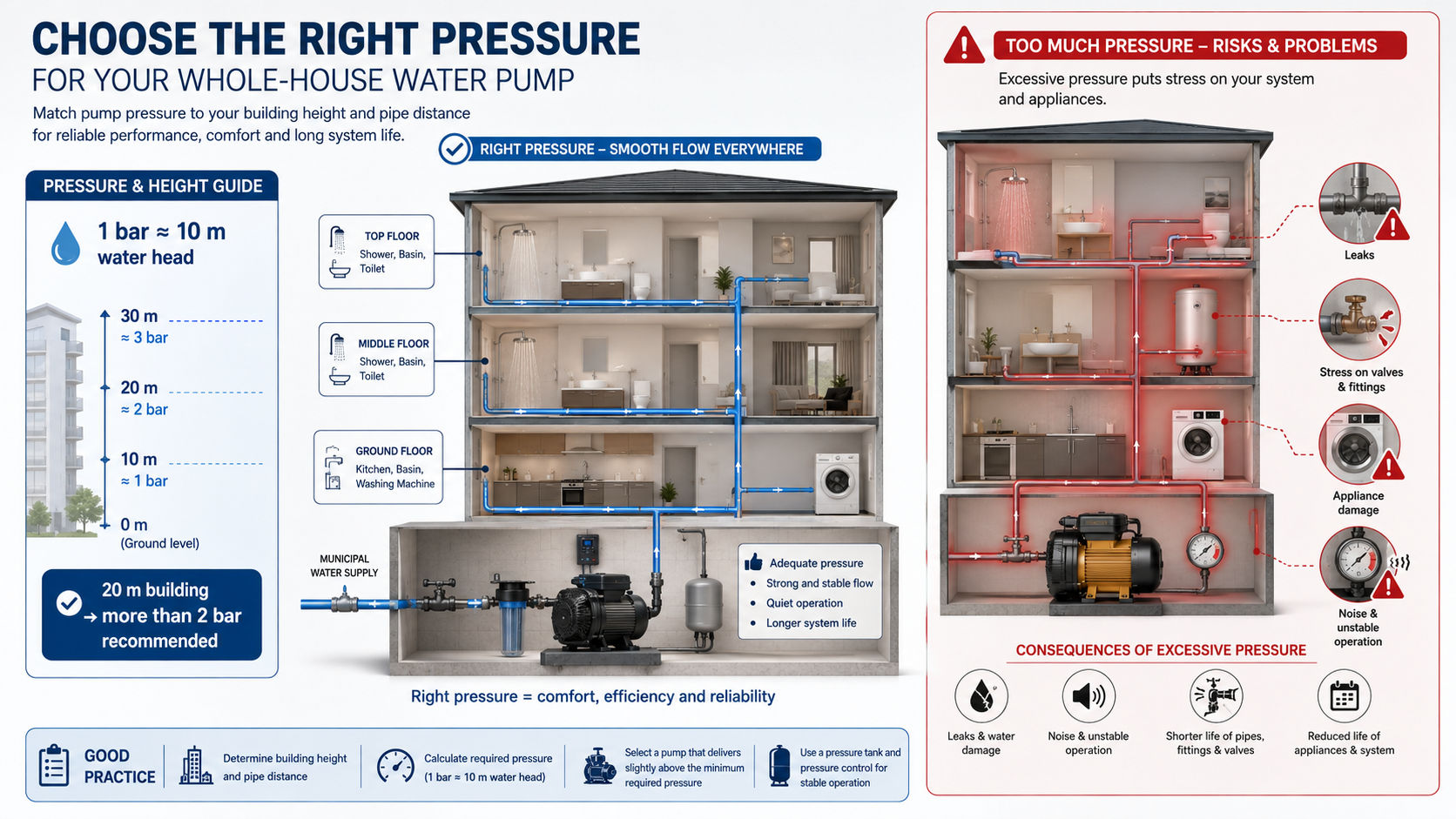
To choose the right pressure, you should think about how tall the building is, how far the pipes are, and how much pressure is needed at the end outlet.
One bar is equal to ten meters of water head as an easy guide. You can pick a pump with more than 2 bar if the building is about 20 meters tall. There are HunGerät whole house water pump choices that can handle up to 10 bar of pressure, so you can find one that works with your needs.
2. Avoid Excessive Pressure
If you pick a whole-house water pump with a lot more power than the system needs, it could make things worse.
Pipes, valves, taps, water heaters, and home products can be put under extra stress by too much pressure. This can lead to leaks, noise, unstable operation, or a shorter life for the water system. Adding this can also raise the cost of the pump and make it harder to use in everyday life.
III. Calculate the Required Flow Rate
A. Use Simultaneous Water Points to Estimate Flow
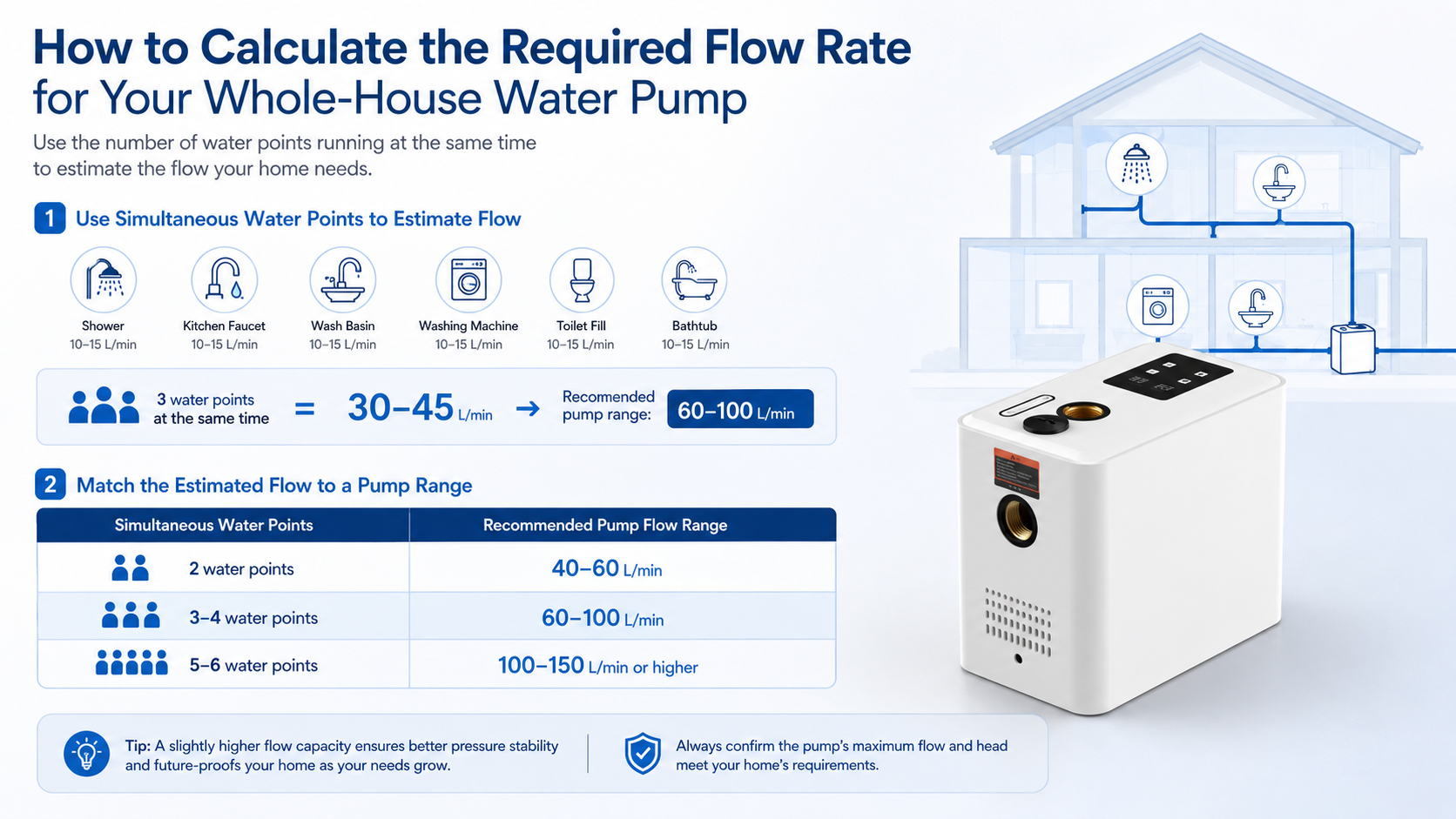
Before you figure out the flow rate, you need to estimate how many water points can be used at the same time. Then, use 10 to 15 L/min per water point as a guide. So, 30 to 45 L/min is thought to be the right flow rate for three water points that can work together. A 60–100 L/min whole-house water pump is more likely to work in this case.
B. Match the Estimated Flow to a Pump Range
As a general rule, two water points at the same time can usually work with a 40–60 L/min pump, three to four water points can work with a 60–100 L/min pump, and five to six water points may need a 100–150 L/min or higher pump. The flow range chosen should be a little higher than the expected demand but not too much higher. This keeps the model range easy to manage and makes sure there is enough water when it’s needed most.
IV. Confirm the Water Source and Choose the Right Pump Type
A. Municipal Water Supply
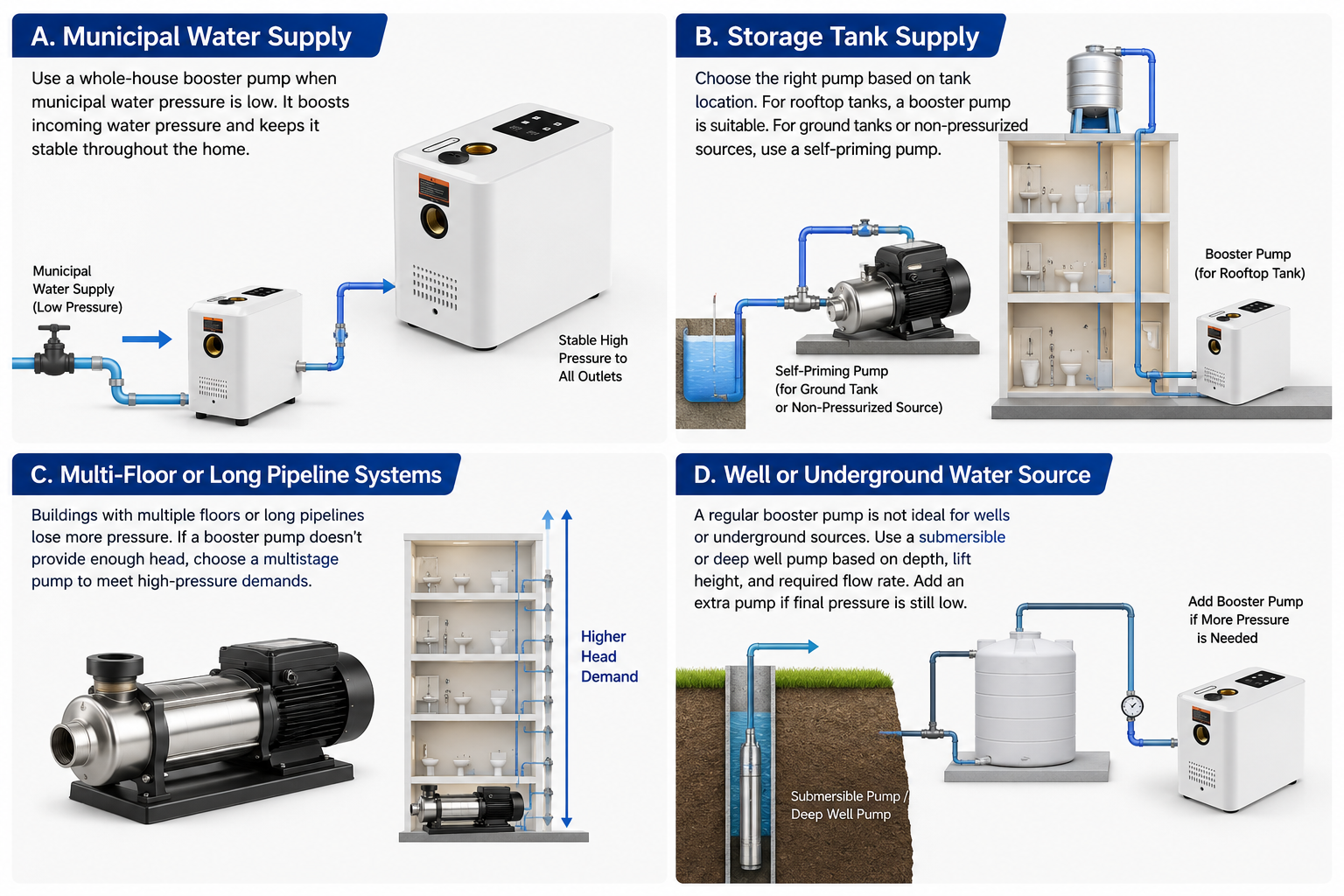
It is best to use a whole-house booster pump when the system already has water coming in, but the pressure is low. This happens a lot in home lines that don’t have much pressure to begin with and in city water systems that raise the pressure at the outlet of a rooftop tank. The pump doesn’t have to dig deep to get water; its main job is to raise the pressure in the whole water system and keep it steady.
B. Storage Tank Supply
If the water comes from a storage tank, the type of pump is based on where the tank is located. For situations where the tank is on the roof, a booster pump can be used. Instead of a pump that needs to be primed, it is better to use a self-priming pump that gets water from a lower tank or a source that is not under pressure.
C. Multi-Floor or Long Pipeline Systems
Most of the time, buildings with more than one floor or long pipeline systems lose more pressure. If a normal booster pump can’t give you enough head after you figure out the pressure, you might want to try a multistage pump instead. A high-pressure demand is the main reason to choose this type.
D. Well or Underground Water Source
Typically, a regular whole-house booster pump is not the best choice when the water comes from a well or somewhere underground. First, decide whether you need a submersible pump or a deep well pump based on the depth of the water, the height of the lift, and the flow rate you need. An extra pump can be added if the final pressure is still not enough after the water has been lifted to the building or storage system.
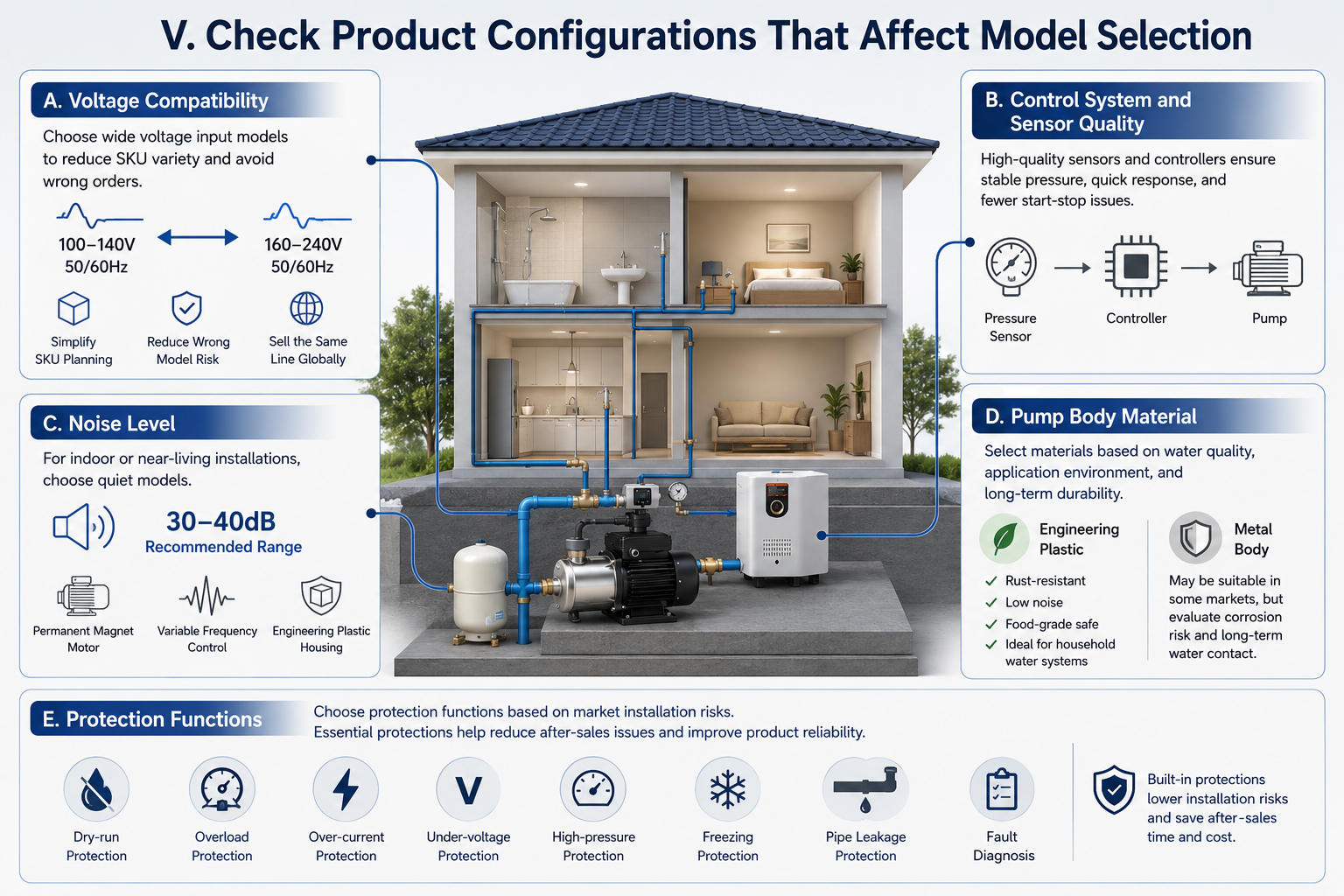
V. Check Product Configurations That Affect Model Selection
A. Voltage Compatibility
After pressure and flow are confirmed, the voltage should be checked before large orders are made. If the power standards in your market are different, a whole-house water pump with a wide voltage input can cut down on the need for many models that are only compatible with a certain voltage. For instance, models that can handle 100–140V and 160–240V, 50/60Hz can make SKU planning easier, lower the risk of getting the wrong model, and make it easier to sell the same line of pumps in different parts of the world.
B. Control System and Sensor Quality
If stable pressure is very important to the market, pick a better control method. The pressure sensor and controller tell the whole house water pump when to start, stop, and change the flow. If the control software is slow or the sensor isn’t working right, the pump may cause changes in pressure, start-up delays, or a lot of start-stop problems. This is the reason why the quality of the control system should be checked when choosing the model and not just after samples have been tested.
C. Noise Level
If you want to put the pump inside or close to a living space, you should think about how loud it is while it’s running. 30–40dB is a good range to use when looking for quiet whole-house water pumps. Models with permanent magnet motors, variable frequency control, and engineering plastic housing are better if your market is sensitive to noise inside. Noise might not need to be the most important factor when choosing a pump if it will mostly be used in separate pump rooms.
D. Pump Body Material
The material of the pump’s body should be chosen based on the quality of the water, where the product will be used, and how long it is expected to last. For clean household water systems, engineering plastic housing is a good choice because it lowers the risk of rust and noise. It’s also easy to place food-grade engineering plastic for water use around the house. There are still some markets where metal pump bodies might work, but the risk of corrosion and long-term water contact should be looked at before choosing one.
E. Protection Functions
The risks of installation should guide the choice of protection features. If there are a lot of problems with dry running, voltage fluctuations, cold weather, or pipeline leakage in the market, the whole house water pump should have protections against these things: dry-run, overload, over-current, under-voltage, high-pressure, freezing, pipe leakage, and fault diagnosis. These features aren’t just extras that help sell something; they also help lower the stress that comes after the sale that comes from bad installation.
VII. Avoid Common Selection Mistakes
A. Comparing Only Maximum Flow or Maximum Head
One common mistake is comparing pumps only comparing pumps by their highest flow or head. The facts are that these two numbers won’t be present at the same time. A pump may show high flow at low pressure, or high head at very low flow. Check to see if the pump can still give enough flow at the pressure your system needs before you buy a whole-house water pump.
B. Ignoring the Pump Curve
A pump curve is a more accurate way to see how well a pump works than a single catalogue number. It shows how flow changes when the pressure goes up. If you only look at the rating data and not the working range, the pump you choose might look good on paper but not be able to supply enough water in the real world.
C. Treating Peak Demand as Constant Demand
It’s not all day that needs the most water. If you choose the pump as if the highest demand happened all the time, it might be too big, too expensive, and hard to connect to most home systems. It’s better to cover a reasonable peak demand while keeping the pump in a good working range.
D. Ignoring Low-Flow Operation
A whole-house water pump shouldn’t just work well when there is a lot of water use. It should also be able to handle small amounts of water use, like when one tap is opened for a short time. If the low-flow operation is bad, the pump might start and stop too often, make the pressure unstable, or cause problems after installation that aren’t required.
E. Not Checking Real Installation Limits
The pump still has to fit in the space where it will be installed, even if the pressure and flow are right. Before confirming the model, you should look at the pipe connection size, the direction of the inlet and outlet, the size of the pump, the length of the cable, the position of the controller, the air flow, and the ease of maintenance. These things can affect how easy it is to sell and install the pump as a whole-house water pump option.
VIII. Conclusion
There is a clear way to choose a whole-house water pump: Check the source of the water, figure out the pressure and flow rate, pick the right type of pump, and make sure the keys are in the right place. This helps cut down on matching the wrong model, SKU confusion, and pressure after the sale. HunGerät can help with choosing a whole house water pump, OEM branding, and bulk supply. Get in touch with us to get the right specs and quotes for your range of products.
IX. FAQ
1. How do you know if a whole-house water pump is necessary?
If the water comes into the building, but the pressure lowers while in use, a whole house water pump may be needed to maintain the complete system steady.
2. Should you choose one whole house booster pump or several small booster pumps?
A whole house booster pump is better when the whole system needs more power. Small booster pumps work better when there is a problem with just one water point.
3. Can a whole house water pump solve pressure drops at peak hours?
Sure, as long as the pump you pick has enough flow and pressure to handle a lot of work. Still, the safety of the water coming in inlet should be checked first.
4. Why does a pump look strong on paper but perform poorly after installation?
The data that was rated might only show the highest numbers and not the real work. Make sure that the flow and pressure always fit what is going on in the system.
5. Can the same pump be used for both low-rise and high-rise houses?
Not all the time. For taller buildings, you may need more pressure support, while for low-rise buildings, you may need a smaller, more efficient form.
6. What is a good pump choice for two bathrooms?
Choose a whole house booster pump with flow bigger than 30L/min. Or you can choose 24v booster pump for each bathroom.
7. Should you choose a pump based on horsepower?
No, It only tells you how strong a motor is. You should look at the real pressure, flow, head, and working range of each one to make a better choice.
8. What does “working point” mean when choosing a water pump?
When the system is really used, the working point is the amount of flow and pressure that the pump can give at the same time.
9. Why is the pump curve important for selection?
A pump curve shows how flow changes when pressure rises. It keeps you from picking a model that only looks good based on its catalogue number.
10. Can a whole house water pump improve shower pressure?
If the low system pressure is what’s causing the low shower pressure, then yes. If the problem is a pipe that is clogged or a device that won’t work, the pump might not fully fix it.
11. Can a whole house water pump support water heaters?
Yes, but the pump should keep the inlet pressure fixed within the range that the water heater can handle. This way, there won’t be any issues with flow or ignition.
12. What causes a whole house water pump to start and stop too often?
It could be because of low flow, leaks, the wrong pressure setting, no pressure tank, bad control logic, or a pump that isn’t matched right.
13. When should a pressure tank be added to the system?
When only a small amount of water is used often or when the system needs more starts and better pressure buffering, a pressure tank can help.
14. Can a whole house water pump be installed outdoors?
The level of protection, the rain shelter, the temperature, the flow, and the safety of the electricity all play a role, please check them. It is usually safer to do the work in a covered area or inside.
15. What should be checked if the selected pump makes too much noise?
Check the size of the pump, the base it’s installed on, the vibration of the pipes, the speed it runs at, the state of the water supply, and see if the pump is too big for the system.
16. What should be checked before replacing an old whole house water pump?
Check the old pump’s voltage, flow rate, pipe size, pressure, installation space, reason for failure, and to see if the right model was chosen the first time.
17. How do you avoid choosing a pump that is difficult to install?
Before you check the model, make sure you look at the inlet and outlet sizes, installation direction, pump size, cable length, controller position, and maintenance space.
18. What is the simplest way to choose a whole house water pump?
First, make sure you know where the water comes from. Then, figure out the pressure and flow, see what the real working point is, and pick a pump that can handle the real system demand.