I. Introduction
Selecting a solar borehole pump by well depth or maximum head alone could result in a project with too little water, recurring controller problems, or an excessive solar array. The actual outcome depends on the dynamic water level, total head, daily water demand, borehole diameter, panel voltage, and cable length. In this guide, you will learn how the system works and how to match each section appropriately.
II. What Is a Solar Borehole Pump?
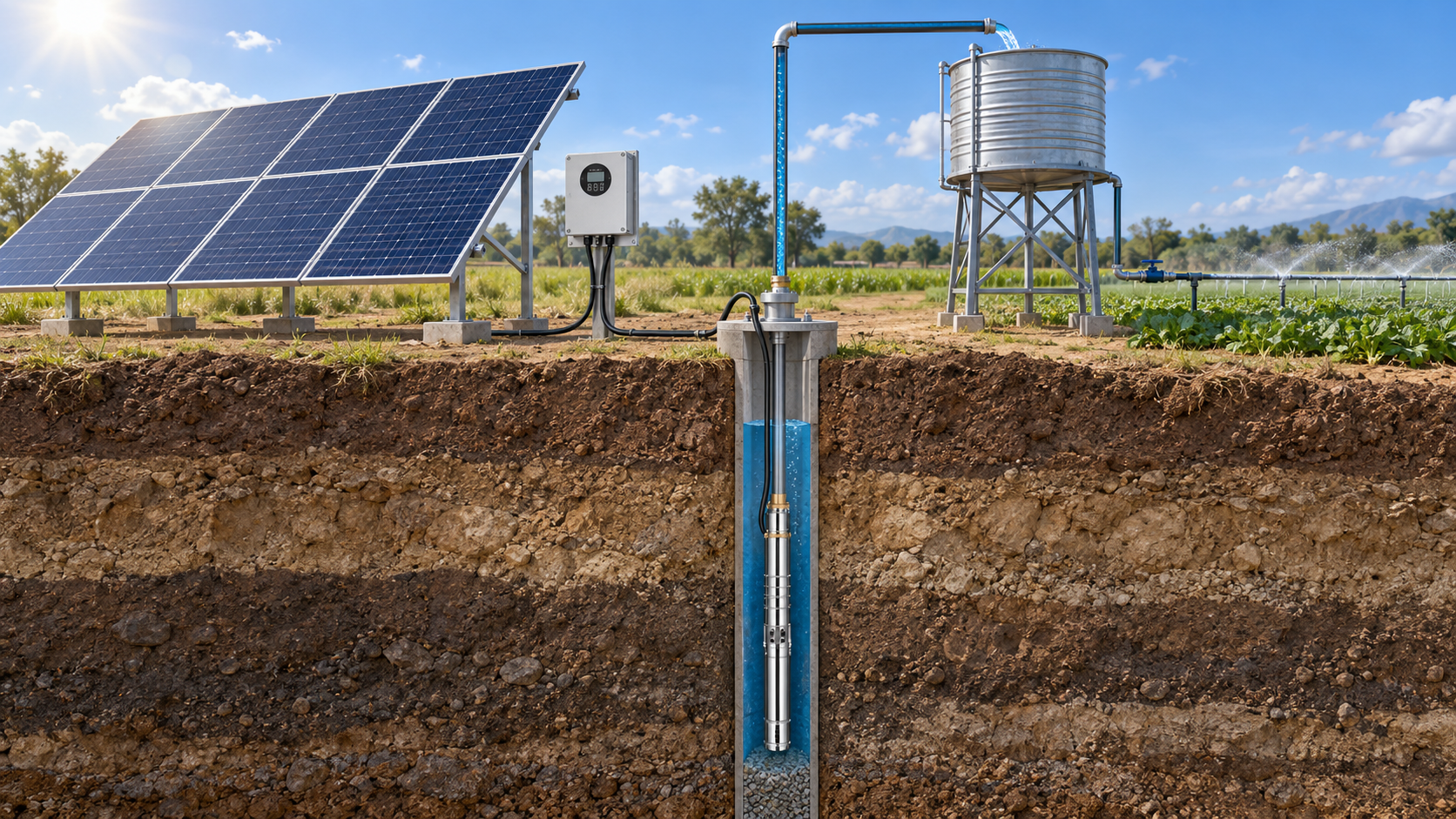
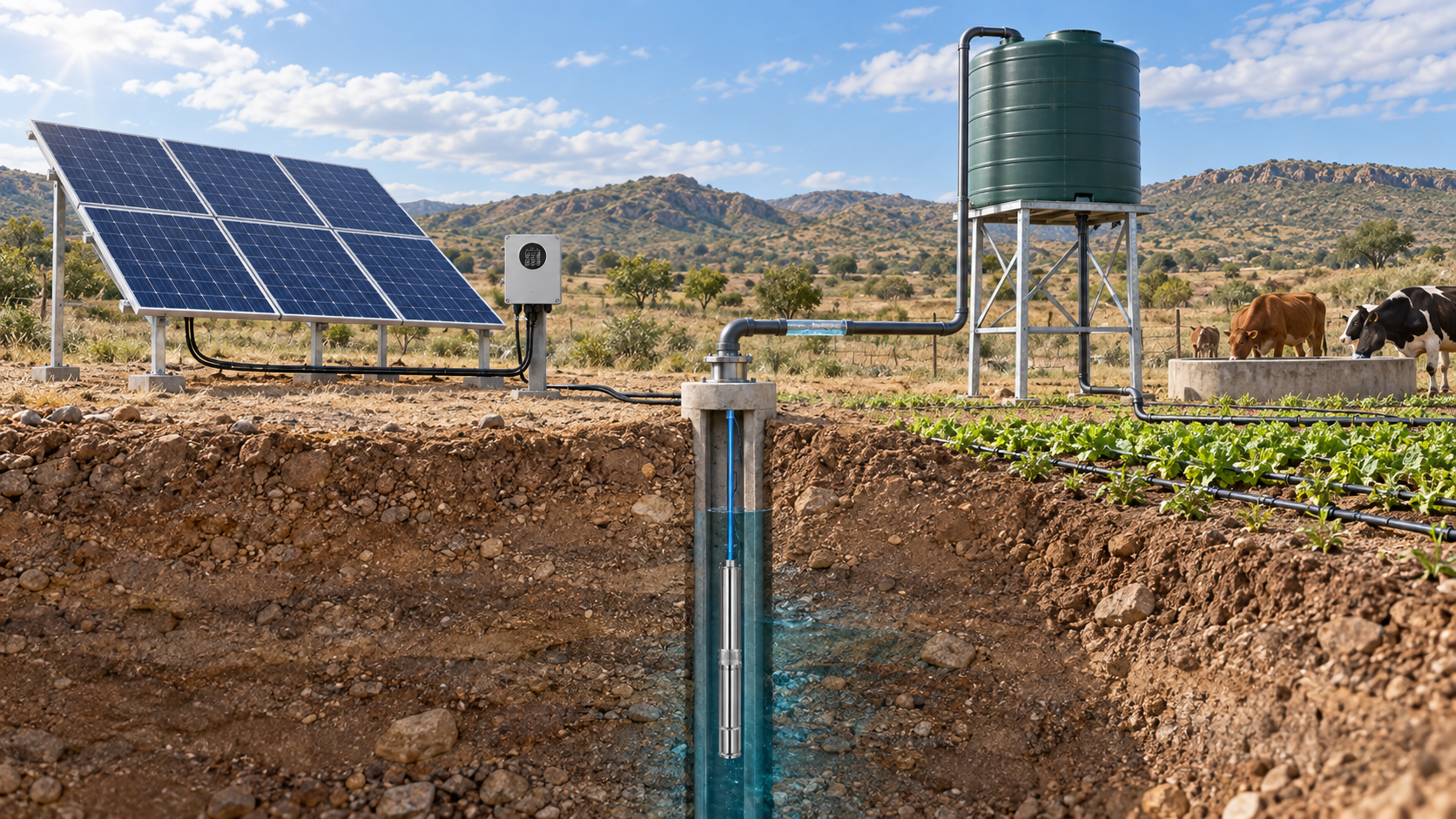
A solar borehole pump is a multistage submersible pump located below the water level in a dug well, powered mostly by solar panels. A complete solar borehole pump system typically comprises the pump, brushless motor, solar pump controller, solar panels, borehole cable, delivery pipe, water-level sensors, and a storage tank. It is widely used for agricultural irrigation, animal watering, rural water delivery, and other projects without stable grid power.
III. How Does a Solar Borehole Pump Work?
1. Solar Power Conversion
Solar panels produce DC power; however, the voltage and current vary throughout the day. This input is controlled by the solar pump controller, and the power required by the motor is supplied by the solar pump controller. If the controller has MPPT, it changes the operating point based on the available sunlight so the pump can operate for a longer part of the day.
2. Water Lifting Process
A submersible motor rotates a stack of impellers inside the pump. Each stage increases the pressure, enabling the pump to transfer water from the dynamic water level up the delivery line to a tank, irrigation system or other point of release. The pump has to overcome the whole system head and not only the overall depth of the borehole.
3. Daily Operating Cycle
When the solar array generates the minimum voltage and power needed by the controller, the pump starts up. It may go more slowly in the morning, give more water around mid-day then slow down again as the sunlight lowers. Most solar pumping systems do not need batteries because water can be stored in a tank and provided at night.
IV. Main Types of Solar Borehole Pumps
A. Types by Power Supply
1. DC Brushless Solar Borehole Pumps
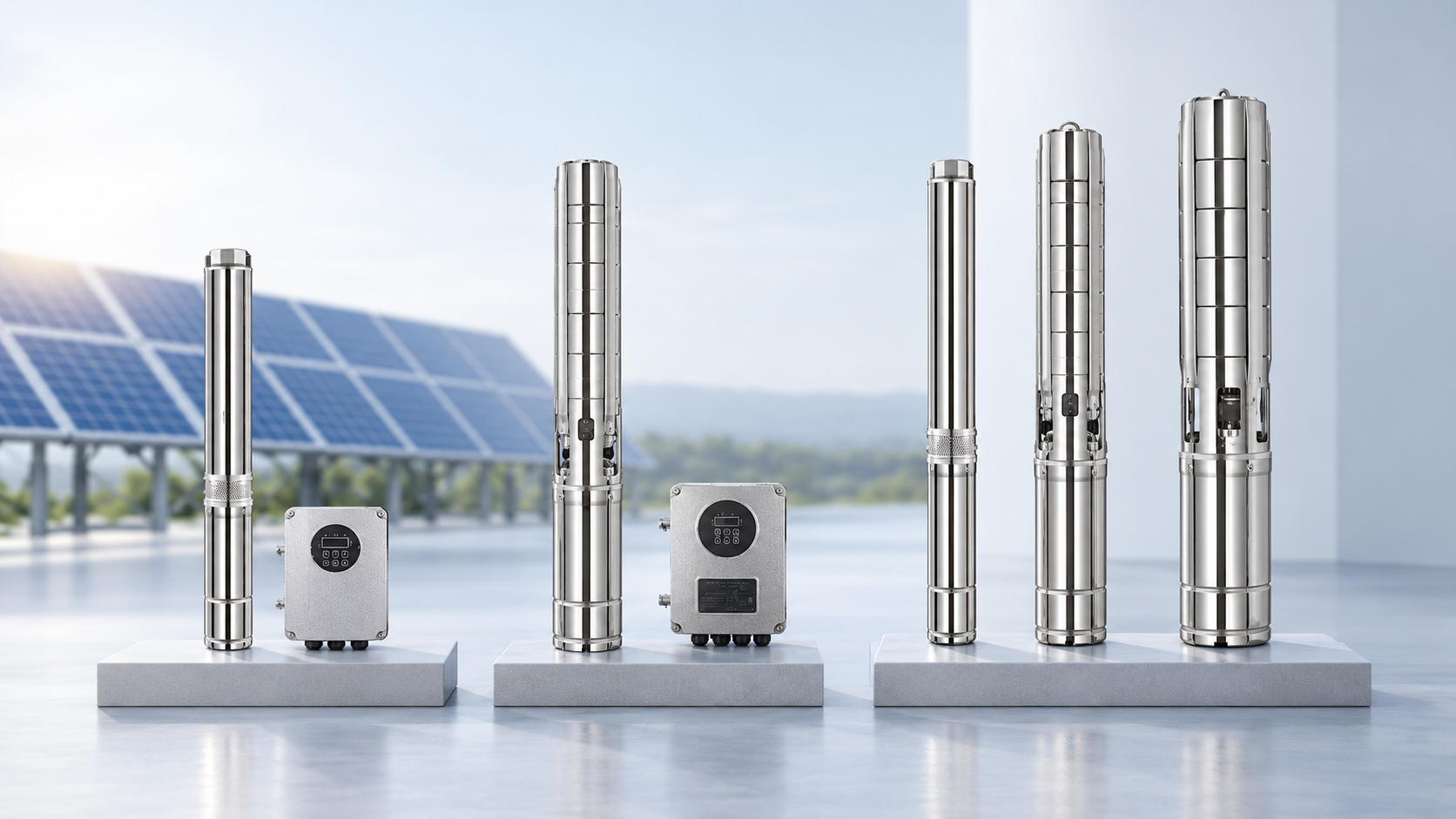
A DC brushless solar borehole pump is primarily meant to be driven directly from solar panels through a matching controller. The brushless motor does not require the replacement of any carbon brushes and is ideal for isolated farms, livestock projects, and rural water systems. These models give a practical benchmark in markets where customers generally want daylight pumping and water storage.
2. AC/DC Solar Borehole Pumps
An AC/DC solar borehole pump may run on solar power during the day and on a compatible grid or generator supply when there is insufficient solar power. This type is more expensive than a standard DC system but is excellent for projects that need water in long cloudy periods or outside of usual daylight hours. By adding some of the selected AC/DC models, you can handle backup-power applications without stocking a totally separate pump line-up.
B. Types by Borehole Diameter
3. 3-Inch Solar Borehole Pumps
The 3-inch solar borehole pump has a slim design that can fit in small boreholes where a regular 4-inch pump would not. These models are often utilised for low to medium water demands such as domestic supply, livestock watering, and light irrigation. If narrow boreholes are common in your market, they are a helpful addition to your assortment.
4. 4-Inch Solar Borehole Pumps
The 4-inch solar borehole pumps are used widely for household water supply, agriculture, livestock, and irrigation due to their wide range of flow and head requirements. They also have the same borehole size, making it easier to acquire installation parts and replacement pumps. In fact, the 4-inch range can constitute the core of a solar borehole pump product line for many distributors.
5. 6-Inch Solar Borehole Pumps
In larger boreholes, six-inch solar borehole pumps are common and are generally employed for projects with increased flow. They are more suited to commercial agriculture, community water supply, and larger storage systems than to tiny home initiatives. Due to the wide range of system sizes, these pumps are better provided on a proven duty point rather than stocked on the motor power alone.
V. Main Advantages of Solar Borehole Pumps
1. Water Supply without a Stable Grid
A solar borehole pump allows you to raise water where grid power is not accessible, unreliable or too expensive to extend. This makes the product ideal for use in remote farms, livestock operations, settlements, construction sites, and more. It opens up initiatives for your business that are not easily supplied by traditional AC borehole pumps.
2. Better Use of Changing Sunlight
An MPPT solar pump controller varies the functioning of the pump with the variation in solar input. This can allow the system to start earlier, stop later, and run more smoothly with small fluctuations in sunshine. MPPT will not enhance the rated maximum flow or head of the pump, but it can increase the daily water output and eliminate complaints about starting and stopping repeatedly.
3. Water Storage without Batteries
Most solar borehole pump systems store water, not power. The pump fills a tank during the day, and stored water is used as and when required. With no batteries in the system, you lower the initial cost, prevent replacing batteries, and make installation and after-sales support easier for you.
4. Lower Daily Operating Cost
Once built, a solar borehole pump eliminates the need to buy diesel every day and utilises less electricity from the grid. This is especially useful for irrigation and livestock projects that pump water on a regular basis over many years. The real payback period depends on local fuel price, power price, daily running time and the full system cost; thus it should not be provided as a fixed amount.
5. Motor and Controller Protection
Depending on the model, a solar pump controller may incorporate dry run, overcurrent, undervoltage, overheating, overheat or locked rotor safety. These functions can stop the system in case of harmful operating conditions. A properly matched protection system lowers motor damage and helps you to discriminate between installation difficulties and real product failures.
VI. How to Choose the Right Solar Borehole Pump
1. Confirm the Required Daily Water Volume
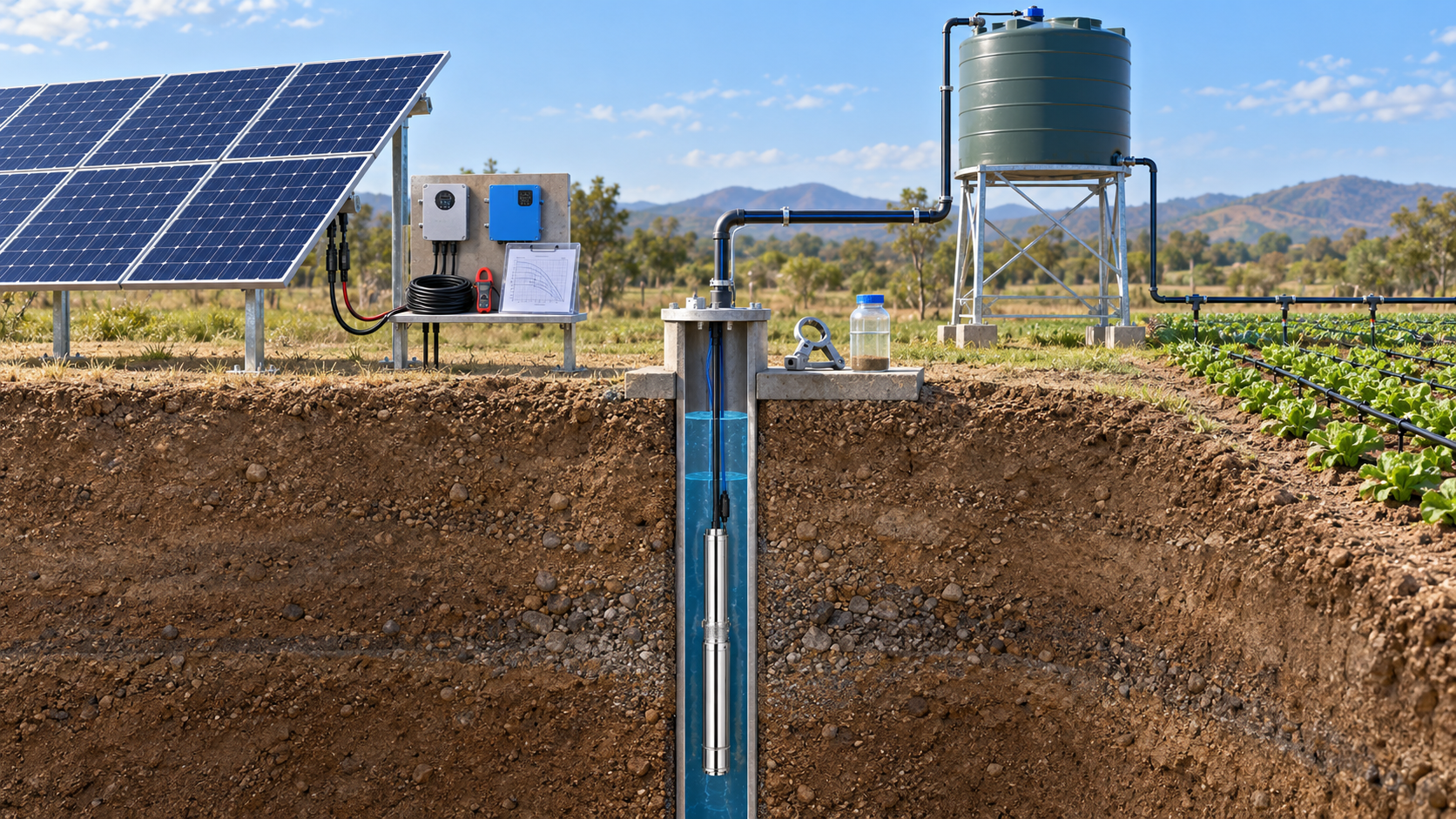
Instead of deciding on the pump based on horsepower, start with how much water the project needs on a daily basis. The daily demands of household supplies, livestock watering, drip irrigation, and large‐field irrigation are highly diverse. If you know the volume required and the useful hours of pumping, you may estimate the flow that the pump must deliver in daylight.
2. Check the Static and Dynamic Water Levels
The static water level is the water level while the pump is off, and the dynamic water level is the lowest water level obtained during pumping. Pump selection should be based on the lowest projected dynamic water level, since this is how high the pump will have to lift water when in operation. Using simply the overall borehole depth can cause an overly high-head pump or a model which cannot satisfy the true duty point.
3. Calculate the Actual Total Head
The total head should be the sum of the lift from the dynamic water level to the discharge point, the height of the storage tank, any outlet pressure necessary, and the friction loss in the pipe and fittings. A lengthy horizontal pipeline does not convert into vertical head in a fixed manner as the loss varies with pipe diameter, flow, length and number of fittings. Be sure to double-check these specifications before quoting to avoid poor flow once installed.
4. Check Flow at the Actual Working Head
Maximum flow and maximum head are at opposite ends of a pump curve and cannot occur at the same time. The greatest head occurs when the flow is almost zero, and the maximum flow is usually recorded at very low head. You need to locate the head that the project needs on the pump curve, and then make sure that the flow at that head matches the customer’s requirements.
5. Match the Pump Diameter to the Borehole
Compare the maximum outside diameter of the pump to the inside diameter of the casing of the borehole. A “4-inch” pump may have an exterior diameter that almost fills the area available in a nominal 4-inch casing, and the cable needs space next to the pump as well. By checking the real dimensions, there are no delays in the installation and no returned pumps that cannot go into the borehole.
6. Choose between DC and AC/DC Power
If you have a project that is highly solar-powered and can save water for later use, then a DC brushless pump is your best bet. Choose an AC/DC system if the customer wants grid or generator backup during low light or after dark. This distinction allows you to avoid adding extra expenditure to simple projects, but still provide solid backup for projects that cannot tolerate interrupted water delivery.
7. Match the Solar Panel Voltage and Power
Before choosing how to connect the panels check the minimum starting voltage, MPPT voltage range, maximum input voltage and current limit of the controller. A rule of thumb is that the power for the solar array is typically in the range of 1.3 to 1.5 times the pump motor power, but the final configuration must be consistent with the controller restrictions and the local sunshine conditions. If there is too little panel power the operation may be weak. If there is too much open-circuit voltage, the controller may be damaged.
8. Check Cable Length and Voltage Drop
The length of cable required is the depth of the pump installation + the distance to the controller + any extra cable necessary above the borehole. Too long or too little a cable will increase the voltage drop and create symptoms such as slow starts, reduced speeds, heating and controller fault codes. By knowing the cable length and conductor size before manufacture, you can deliver a full system without expensive cable adjustments at the site.
9. Match the Pump Materials to the Water
For more demanding applications, engineering-plastic impellers are a cost-effective solution for clean water, while stainless-steel hydraulic parts give you superior strength and corrosion resistance. Do not select any material without testing the temperature of the water, chemical composition and the amount of sand. Stainless steel pumps are not necessarily sand-proof. You need to check the permitted sand content for the individual type.
10. Plan the Water Tank and Protection Sensors
The storage tank needs to be big enough to supply water when the pump is not operating or there is not enough sunlight. A borehole water-level sensor may turn off the pump if the level in the source falls and a tank sensor can turn off pumping when the tank is full. The right sensors with the controller avoid damage due to dry running, overflow and installation problems.
VII. Conclusion
A solar borehole pump should be selected as a full system and not as a pump only. The daily water demand, dynamic water level, total head, borehole diameter, pump curve, solar panel design, cable length and water quality all play a role in the final outcome. Knowing these things can help you design a product variety that meets local borehole circumstances, avoid unsuitable stock and provide your customers more accurate model suggestions.
If you are importing or distributing solar borehole pumps, please send HunGerät your target market, common flow and head ranges, voltage requirements, preferred materials and projected order quantity. We can enable you to prepare a matched product range, pump curves, solar panel configurations, OEM alternatives and a quotation for your market.
VIII. FAQ
1. Can a Solar Borehole Pump Run without Batteries?
Yes Most solar borehole pumps may run straight from the solar panels through a controller. Usually, a water tank is used to store water for the night or for weak sunlight periods.
2. How Many Solar Panels Does a Solar Borehole Pump Need?
The number relies on the pump power, panel wattage, controller voltage range and local solar light. If the array is sized at 1.3 to 1.5 times the motor power, a 750 W pump may typically require roughly 975 to 1,125 W of panel capacity.
3. Can Too Many Solar Panels Damage the Pump Controller?
Yes, the controller can be damaged if the open-circuit voltage of the array is greater than the maximum input voltage of the controller. You might be able to get more panel power as long as it doesn’t exceed the voltage and current limits of the controller, but check those limits before you install.
4. How Do Vmp and Voc Affect a Solar Borehole Pump?
Vmp is the voltage of the panel during near-normal operation; Voc is the greatest voltage produced while the circuit is open. The combined Vmp should be within the controller’s functioning range, and the combined Voc should be lower than its maximum input limit, also under cold weather conditions.
5. Should Solar Panels Be Connected in Series or Parallel?
Increase voltage in series; increase current in parallel. The final arrangement should deliver enough initial voltage without exceeding the maximum voltage or current of the controller.
6. Can a Solar Borehole Pump Work on Cloudy Days?
This can function as long as there is still sufficient voltage and electricity from the solar array but the pump may run slower and pump less water. If there is very little sunlight, the controller will switch the pump off until there is enough electricity.
7. Can a Solar Borehole Pump Start Early in the Morning?
A well-matched system can start when the array reaches the minimum beginning requirements of the controller. A proper MPPT controller and sufficient panel capacity can improve morning operation, but the exact time still depends on sunshine, shading and panel orientation.
8. Can MPPT Increase a Solar Pump’s Maximum Flow or Head?
No, an MPPT can not over-boost the pump beyond its hydraulic limits. It maximises the utilisation of available solar electricity and possibly increases the total daily water production over a non-MPPT system poorly matched.
9. What Is the Difference between DC and AC/DC Solar Borehole Pumps?
The DC solar borehole pump is mainly driven by solar panels. The controller in an AC/DC type can also be powered from a compatible grid or generator source, making it more appropriate for projects requiring backup pumping.
10. Can an AC/DC Solar Borehole Pump Use a Generator?
Yes, assuming the controller has a compatible AC input and the generator can deliver the necessary voltage, frequency and start capacity. The generator should be sized for the whole electrical load rather than from pump horsepower.
11. Is Borehole Depth the Same as Pumping Head?
No, the depth of the borehole is the whole physical depth of the well, whereas the pumping head is measured from the dynamic water level. The total ultimate height must also include the height of the discharge, the needed pressure and the pipe friction.
12. How Does the Dynamic Water Level Affect Pump Selection?
The lower the dynamic water level, the greater the vertical lift, and hence, the greater the head required. When assessing the pump curve, you should use the lowest expected pumping water level, not the static level.
13. Does a Long Horizontal Pipe Increase the Required Head?
Yes, a long pipe will create friction loss even on flat ground. There is no one fixed horizontal-to-vertical conversion. It is contingent upon pipe length, internal diameter, water flow, pipe material, valves, and bends.
14. Does Cable Length Affect Solar Borehole Pump Performance?
Yes, a longer cable will cause more voltage drop and may affect starting and running performance. The conductor size should be selected according to current, voltage, installation depth and total cable length.
15. What Borehole Diameter Is Required for a 4-Inch Solar Pump?
The diameter of the casing should be bigger than the maximum outside diameter of the pump and have space for the cable. For example, a pump with an outer diameter of 98 mm requires more than 98 mm of clear space inside (depending on the manufacturer’s installation requirements).
16. Can a Solar Borehole Pump Handle Sand?
Maximum up to the sand limit provided for the particular pump model. Sand can wear the impellers, diffusers, bearings and motor seals even if the hydraulic elements are manufactured from stainless steel.
17. Does Dry-Run Protection Require a Water-Level Sensor?
Some controllers measure dry running by changes in current or load, others employ a separate water-level sensor. A sensor generally provides more direct protection in boreholes with fluctuating recovery rates.
18. How Large Should the Water Storage Tank Be?
The tank should be able to hold the water required at night, on cloudy days and during peak demand. It should be sized based on daily water demand and estimated daily pump output, not pump power.
19. Can a Solar Borehole Pump Run 24 Hours a Day?
A direct solar pump often switches off at night unless an AC backup is compatible. Continuous functioning requires adequate borehole recovery, proper motor duty, proper cooling and a pump operating within its rated current.
20. What Information Should You Provide When Ordering a Solar Borehole Pump?
Borehole diameter, static water level, dynamic water level, installation depth, discharge height, horizontal pipe distance, pipe size, daily water demand, water quality, cable length, available backup power. This information allows the supplier to pick the pump at its actual operating point and correctly match the controller and solar array.