I. Introduction
You can’t just ask for a 4-inch underground pump and expect to get a good price. As long as the width of the impeller is the same, you can get either a centrifugal or a screw pump. The pumps can be run by either electricity or the sun. What if you choose the wrong type? It could lead to slow flow, tools that don’t work together, extra costs, or stock that moves slowly. This page explains the main types of borehole pumps and what they are used for.
II. Borehole Pump Basics
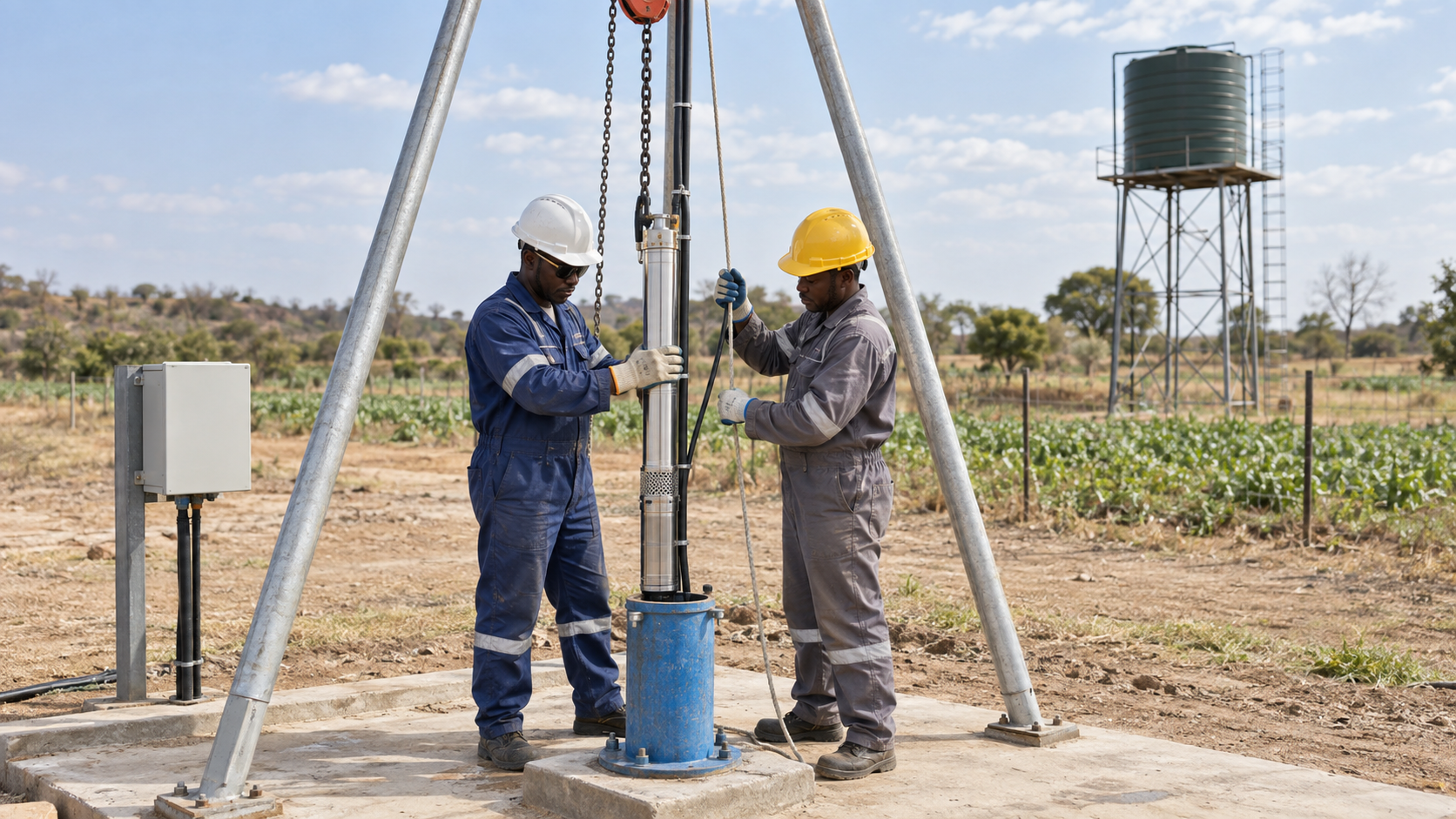
It is a long, thin underwater pump that is put below the water level in a well that has already been dug. This part works because of the motor. Instead of pulling water from the surface, the pump sends it up the pipe and into the tank. Each system comes with a pump, motor, power wire, delivery pipe, check valve, and any controls that are needed. Because it is above ground, a surface Jet pump is not the main type of borehole pump we will talk about here. However, it can get water from a small borehole.
III. Understanding Borehole Pump Type Names
There could be more than one kind of underground pump at the same time. For example, “4-inch DC multistage stainless steel borehole pump” tells you how wide it is, how it pumps, what kind of power it has, and what it is made of. Of course, these are not four separate groups of products; they are separate parts of the product description. Your catalogue, website, and quote sheet will all be easier to find if they all use the same naming structure. This will also keep your sales team from mixing up pumps based on a single feature.
IV. Borehole Pump Types by Pumping Design
1. Multistage Centrifugal Borehole Pumps
A multistage centrifugal groundwater pump has a lot of paddles and spouts. The water flows at the same speed through each stage, but there is more head at each end. With this design, you can pick from a range of flow and head options for use at home, for irrigation, to water animals, to fill tanks, and for commercial water systems. There are many companies that sell this kind of borehole pump, so you don’t have to stock models based on motor power or number of stages. Instead, you can base your core range on the flow and head needed for different uses in your market.
2. Screw Borehole Pumps
A screw well pump moves water with a screw that spins. It has a pretty high head for a low flow rate, which makes it good for small solar systems, homes, barns, and wells that don’t give off much water. That being said, it might be cheaper for people who don’t need a lot of water every day because it’s easy to dig. It shouldn’t be used instead of a centrifugal drilling pump, though, since the fast flow and rough sand can quickly damage the screw and shaft.
V. Borehole Pump Types by Power Supply
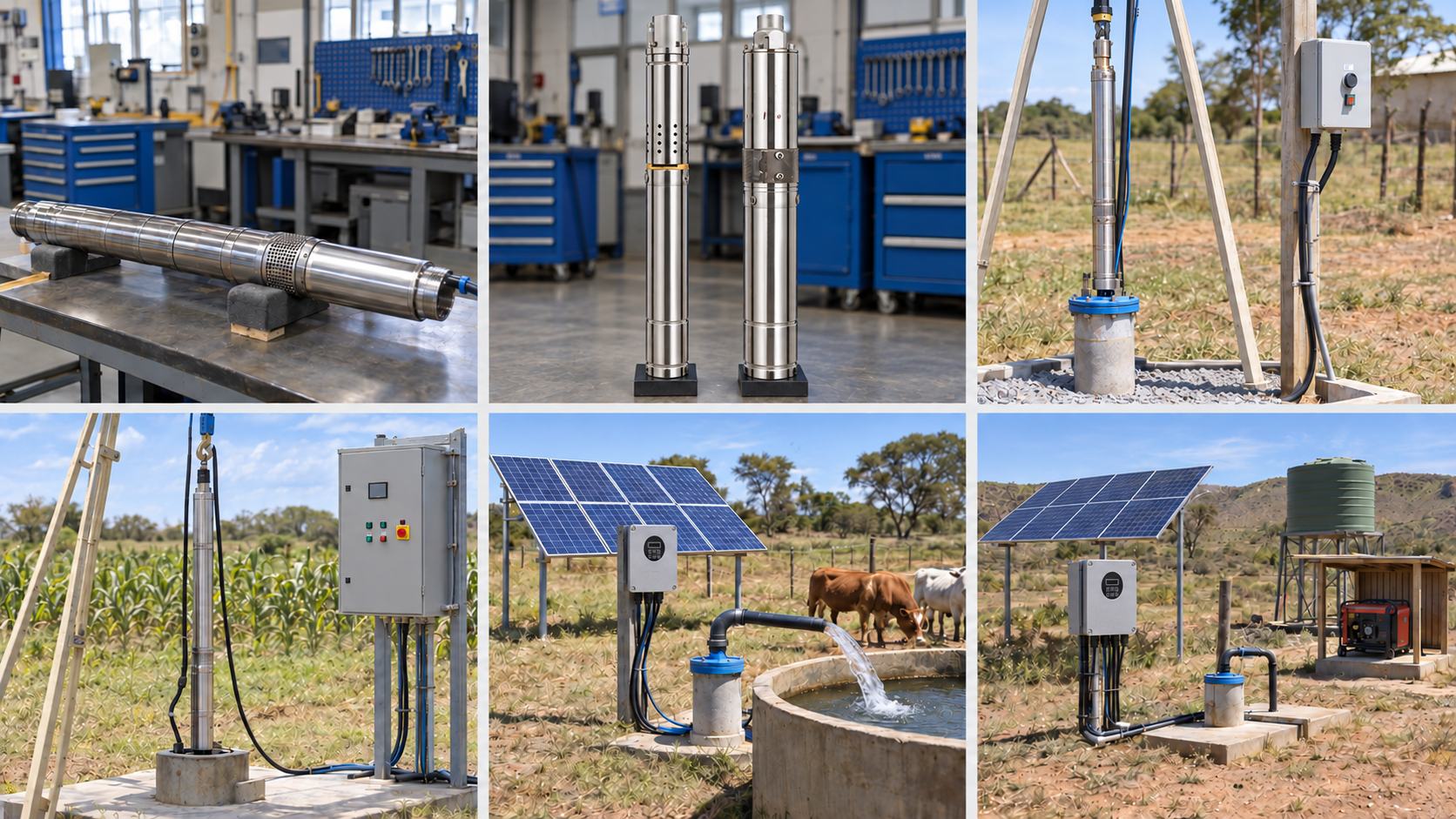
1. Single-Phase AC Borehole Pumps
When three-phase power is not available, single-phase AC borehole pumps are often used for home water systems, small farms, gardens, and light commercial systems. In most markets, you can choose between 110 V, 220 V, and 230 V. Parts for starting can be put inside the motor or in a control box outside the motor. If most of your customers are families and small farms, single-phase types might be something you need to keep in stock. But the voltage, frequency, cable link, and control box must be changed to fit the rules in the area.
2. Three-Phase AC Borehole Pumps
Three-phase AC borehole pumps are used on bigger farms, in commercial buildings, for industrial water supplies, and on projects that need more motor power or longer daily running times. Voltages in the market are usually 380V, 400V, and 415V, but you should always check the source. Most of the time, these pumps come with a control panel, a VFD, a starter, and overload protection. Think of them as things for farming or projects. If you send the pump without the matched electrical controls, it might take longer to install and need more maintenance than it needs to.
3. DC Solar Borehole Pumps
Solar panels feed power to the DC solar borehole pumps through a controller that works with them. A lot of devices use MPPT to get the most out of the changing solar power. They are great for farms, places with lots of animals, towns, and outlying areas that don’t have stable power from the grid. Most of the time, batteries are not needed for daylight pumps. When choosing the right size solar pump package, you need to think about the voltage of the panels, the input range of the controller, the pump’s power, the working head, and the amount of water that you need every day. Just matching the general power of the panel can cause it to start or stop badly over and over in dim sunlight.
4. AC/DC Solar Borehole Pumps
AC/DC solar borehole pumps operate on solar DC power and grid or generator power as a backup (depending on the controller). This enables the system to run longer each day when the sunshine is weak, or there is a demand for water after dusk. Where off-grid projects are combined with unreliable grid power, an AC/DC range can serve a wider range of applications without the need to develop separate solar and AC pump packages. You will still need to verify the allowable AC and DC input ranges, as not all hybrid controllers accept the same power sources.
VI. Borehole Pump Types by Motor and Control Setup
1. Oil-Filled and Water-Filled Motors
The oil-filled submersible motor employs sealed dielectric oil to assist cool and lubricating the internal parts. The water-filled motor uses a water-based liquid for cooling and lubrication. Some of the larger motors that are filled with water can be opened up and rewound. It all depends on the model. Neither name alone can tell you which motor will survive longer. More useful questions for your product line are: can local specialists fix the motor? Are spare seals and bearings available? Is the motor rated for the expected running time?
2. Internal and External Starting Components
In some single-phase borehole pumps, the capacitor and starting parts are inside the motor, reducing the amount of above-ground elements. Other variants have an external control box. This makes it easy to check or repair the capacitor, relay, and overload protector. These are frequently called two-wire and three-wire pumps; however, different providers may count the ground wire differently. When the wiring schematic, cable cores, and control parts included are clearly shown in your quote, it prevents the customer from getting a pump that they cannot connect to.
3. Integrated and External Solar Controllers
The integrated solar controller minimises the amount of discrete components and connections, which makes the pump package easier to transport and install. It is easy to wire, test, cool and replace an external controller without removing the pump out of the borehole. Neither is usually preferable, so check on local installation expertise and availability of spare parts. Many varieties of controllers are offered and are hard to match after purchase, and it can be less helpful to keep spare controllers for your main solar models.
VII. Borehole Pump Types by Hydraulic Material
1. Engineering-Plastic Impeller Borehole Pumps
Engineering plastics impellers are light and generally less expensive than stainless steel impellers. They are frequently utilised in borehole pumps for clean home water, light irrigation, livestock watering, and price-sensitive markets. Plastic doesn’t always indicate low quality, but the result depends on the grade of the material, the quality of the moulding, the temperature of the water, and the amount of sand in the water. These pumps can provide you with a competitive standard range if the permissible water conditions are explicitly indicated.
2. Stainless-Steel Impeller Borehole Pumps
Stainless-steel impellers and diffusers offer improved corrosion resistance and strength for long-term water supply and more demanding projects. They can also maintain a higher product level for business consumers who need more stainless-steel hydraulic parts. However, a stainless steel pump is not automatically sand-proof, as sand can still wear down the impellers, diffusers, bearings, and mechanical parts. The allowable sand content should be obtained from the specification of the real model.
3. Mixed-Material Borehole Pumps
The outside casing and shaft of many borehole pumps are made of stainless steel; the impellers are made of engineered plastic, cast iron output or other materials. This design is a compromise between cost, weight, corrosion resistance, and production. Please do not identify these goods as a ‘stainless-steel borehole pump’ in the only material info. Listing the material of the outer casing, outlet, impeller, diffuser and shaft will give your customers a clear comparison and minimise disagreements about whether the pump is totally stainless steel.
VIII. Borehole Pump Types by Diameter
The nominal diameter indicates the size group of the pump, although it may not be the actual outer diameter of the full assembly. The physical pump body, motor, cable, splice, and borehole casing must provide adequate space for installation and water movement around the motor. If you merely look at the nominal inch size, the pump can get stuck during installation.
1. 3-Inch Borehole Pumps
Three-inch borehole pumps are built for tight spaces, designed for narrow wells and installations where a regular 4-inch pump cannot fit. They are typically used for home water, small solar systems, livestock irrigation, and low-flow applications. The small body does not mean they always have a low head, as a multistage 3-inch pump might have multiple impellers. This category is handy if you have a lot of narrow boreholes in your market. However, the potential flow range is usually limited by the smaller pump diameter.
2. 4-Inch Borehole Pumps
Four-inch borehole pumps are available with a wide array of motor powers, flow rates, heads, materials, and power options. They are frequently utilised for home water supply, farm irrigation, solar pumping and commercial systems and therefore a realistic core category for many pump distributors. You can separate this range into single-phase AC, three-phase AC, DC solar, and AC/DC models, then add plastic or stainless-steel impeller alternatives depending on local price levels and water conditions.
3. 5-Inch and 6-Inch Borehole Pumps
When a system requires flow rates higher than what smaller pumps can supply, a five-inch or six-inch borehole pump is typically utilised. They are utilised on larger farms, irrigation systems, commercial water delivery, and filling enormous tanks. These varieties tend to have more motor powers and hydraulic combinations; thus, carrying every model could tie up too much money. Typical agricultural duty points can be stocked, with the less common high head or high flow variants available for confirmed orders.
4. 8-Inch and Larger Borehole Pumps
Most of the time, 8-inch or bigger borehole pumps are used for large-scale irrigation systems, public water systems, private water systems, and other high-flow jobs. Often, they need energy with three phases, bigger control panels, heavier power lines, lifting gear, and more complex plans for installation. These pumps are cheaper when bought as part of a larger job than when bought separately based on their motor power. Checking the pump curve and system setup before production also cuts down on the need for costly repairs.
IX. Information Needed to Identify the Right Borehole Pump Type
Before giving a quote, you need to get the following information: the inner diameter of the borehole casing, the dynamic water level, the installation depth of the pump, the delivery height, the length of the horizontal pipe, the required flow, the daily water volume, the outlet pressure, the voltage, the frequency, the phase, the quality of the water, the amount of sand in it, the length of the cable, and the control method. The total head should include the vertical lift from the level of the water being pumped to the point where it is discharged, the pressure that needs to be released, and the pipe losses. You can get this information from the standard enquiry form, which will help you choose the right diameter, pumping design, power supply, and material without having to send back a lot of models that don’t work.
X. Conclusion
One way to group borehole pumps is by the type of hydraulic material they use, how they are powered, how they are set up, and their width. Multistage centrifugal pumps are used for a lot of different flow and head needs. When there is a lot of head and not much flow, screw pumps are used. There are AC, DC, and AC/DC versions that work with different types of power. The price, fit, and type of water that the pump can handle depend on the material and width.
Send HunGerät the diameter of the borehole, the changing water level, the flow rate you need, the total head, the power supply, the quality of the water, and the control requirements for a borehole pump range or a unique project. We can help you compare pump curves, motor types, controllers, cables, and material choices that are right for the people you want to sell to.
XI. FAQ
1. Can a Multistage Centrifugal Borehole Pump Replace a Screw Pump with the Same Maximum Head?
Because the two pumps can give very different flows at the same working head, it’s not just based on the highest head. Before you choose one pump over another, you should look at the whole pump curves, the borehole diameter, the power supply, the water quality, and the amount of water you need every day.
2. Why Do Borehole Pumps with the Same Motor Power Have Different Flow and Head?
Flow and head can be different for the same motor power if the impeller width, number of stages, motor speed, and hydraulic design are all changed. Don’t think that similar kW ratings mean the same performance; instead, look at the operating point needed on each pump curve.
3. Does Adding More Stages Increase the Flow of a Borehole Pump?
No, the main reason for the rise in head is the addition of stages. The water is moving through each impeller at the same speed. Adding more steps doesn’t make the water bigger. The pump curve and system resistance show how much flow there is.
4. Is a Screw Borehole Pump Suitable for High-Flow Irrigation?
In most cases, a screw pump is not the best choice for a watering system that needs a lot of water every day. A multi-stage centrifugal borehole pump would usually offer more flow, but this one works better for jobs with lower flow and higher head.
5. Can a 3-Inch Borehole Pump Be Installed in a 4-Inch Well?
Yes, you can put a 3-inch pump in a 4-inch well as long as there is enough water flow around the motor to keep it cool. You should also look at where the cable is, where the pump is centred, how low the water level is, and how big the inside of the casing is.
6. How Much Space Is Needed Between the Pump and Borehole Casing?
There isn’t a single space that works for all pumps because each motor has a different diameter, cord, casing, and cooling needs. A lot of 4″ motors have an outside diameter of about 3.75″ or 95 mm. But before you install one, make sure you know the exact pump specs.
7. Can a 4-Inch Borehole Pump Be Installed in a 6-Inch Well?
Yes, as long as the motor is submerged enough and enough water flows over the pump. If the bigger bore lets water get to the pump without going down the motor body, you may need a cooling sleeve.
8. When Does a Borehole Pump Need a Cooling Sleeve?
A cooling sleeve is often needed, like when the tank is open, the well is very deep, the installation is horizontal, or there is some other reason why water won’t flow naturally past the motor. Most motor guides list minimum cooling water speeds between 0.08 and 0.16 m/s, but you should check the exact number for the motor you choose.
9. Should You Choose a Single-Phase or Three-Phase Borehole Pump?
Choose single-phase if the spot only has home-type electricity and the motor load doesn’t exceed the supply. Three-phase is better if the motor is big, runs for a long time, or needs a control panel or VFD. Before you order, make sure you know what the power is where you are.
10. What Is the Difference Between Two-Wire and Three-Wire Borehole Pumps?
For a two-wire system, the starter parts are usually inside the motor. For a three-wire system, the control box is outside the motor. If the name isn’t enough, look at the control box and wiring diagram because some service providers don’t count the ground wire.
11. Can an AC Borehole Pump Be Used with a VFD?
A lot of 3-phase borehole pumps can work with a VFD as long as the motor’s insulation, cooling, bearings, and frequency range are all good. Based on the motor data, set the maximum current and minimum speed. Running too slowly could make the motor less cool.
12. Can a Solar Borehole Pump Run from Grid Power or a Generator?
It is not possible to connect a solar pump that only works with DC to an AC grid or generator. You will need an AC/DC driver or another approved power converter that has the same voltage, current, motor type, and safety settings as the pump.
13. What Is the Difference Between DC and AC/DC Solar Borehole Pumps?
The DC solar borehole pump is mostly made to work directly from the solar panels by using its controller. An AC/DC type can also be used with a backup source of enough AC power, which makes it more useful when water is needed when there isn’t much sunlight or when the sun goes down.
14. Can Any MPPT Controller Be Used with Any Solar Borehole Pump?
That’s not right. The controller has to be right for the motor type, rated power, voltage, current, and control software. For the solar array to work, the voltage should be in the MPPT range, and for the array to be open, the voltage should be less than the controller’s highest input limit.
15. Is an Integrated Solar Controller Better Than an External Controller?
An integrated controller might be easier to set up because it has fewer separate parts. An external controller is generally easier to check out and replace. Which is better depends on who can do the installation in your area and how you plan to handle spare parts.
16. Are Plastic Impellers Suitable for Deep Borehole Pumps?
Yes. Engineered plastic impellers can be used in deep borehole pumps as long as the stage design provides enough head and the water level meets the standards. Besides the depth of installation, the type of water, sand, temperature, and the form of the pump all play a role in choosing the material of the impeller.
17. Can a Stainless-Steel Borehole Pump Handle Sandy Water?
It’s not always true that a stainless steel well pump will work with sandy water. You need to look at the model’s rated sand content because sand can still hurt the impellers, diffusers, bearings, and other parts inside the machine.
18. How Much Sand Can a Borehole Pump Handle?
For underground pumps, there isn’t a single sand limit. The maximum amount that can be used should be stated in g/m³, ppm, or some other clear unit. If the provider doesn’t say otherwise, use the device as a clean water pump and don’t think that values like 50 or 100 g/m³ are right.
19. Does a Long Power Cable Affect Borehole Pump Performance?
Yes. A voltage loss from a long or too-small wire could cause the motor to overheat, start weakly, draw too much power, or have problems with the controller. Voltage loss should be kept to 3% or less in many electrical designs. However, the final cable size will depend on the motor current, the length of the cable, the local code, and the manufacturer’s instructions.
20. What Information Should You Provide When Ordering a Borehole Pump?
Name the width of the borehole, the dynamic water level, the installation depth, the flow that needs to happen, the total head, the length of the pipe, the voltage, the frequency, the phase, the water quality, the amount of sand in the water, the length of the cable, and the control method. For orders for new pumps, you need to send in the old pump’s nameplate, its curve, information about the cables, and pictures of the control equipment that is already in place.