I. Introduction
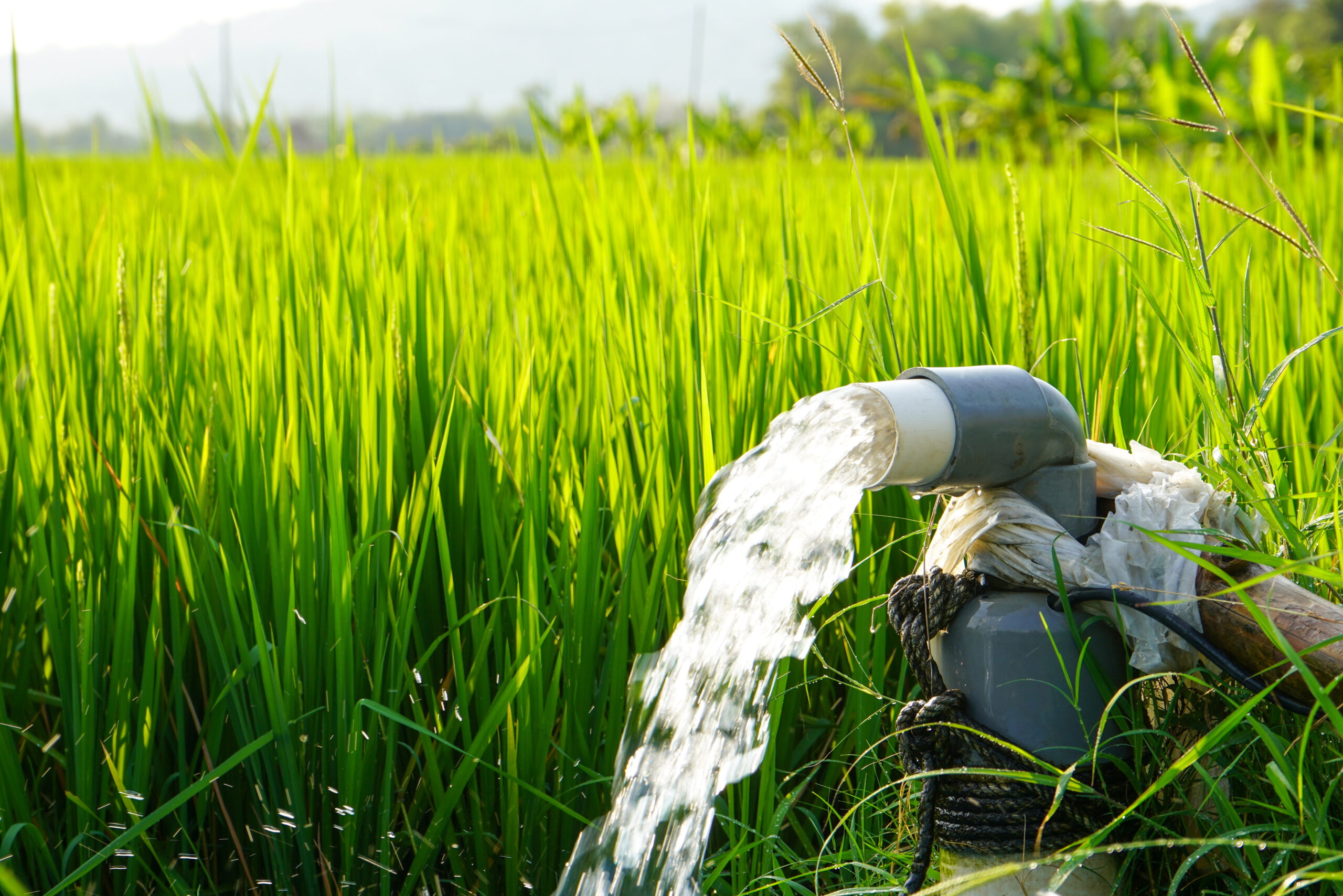
More stages are not necessarily an improvement. If your market is mostly for irrigation and water transfer pumps, too many multistage models can mean higher price tags and slow-moving inventory. Too large a pump may lead to leaks or broken fittings if the shut-off pressure of a multistage pump exceeds the system pressure rating. Single-stage pumps may not produce enough pressure for tall buildings or long pipelines. This guide helps you avoid both of those problems.
II. Single-Stage and Multistage Pump Basics
1. Single-Stage Pumps
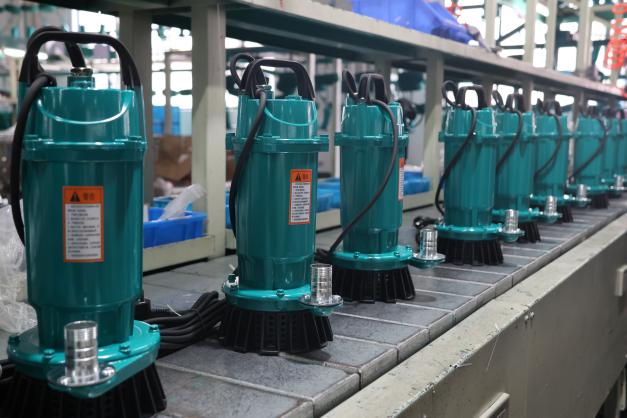
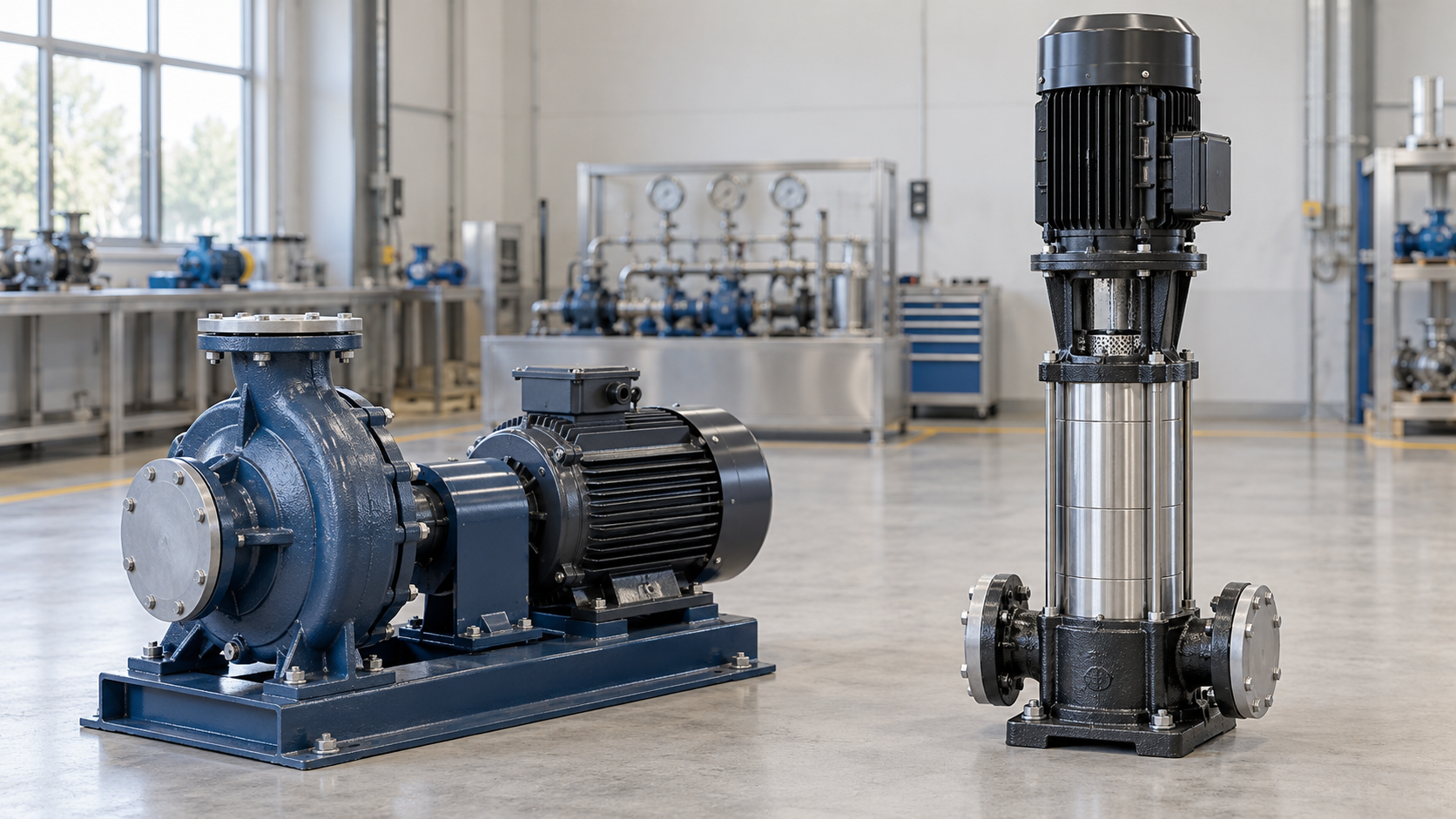
A single-stage pump has one impeller. Water enters the middle of the impeller and is pushed by the impeller rotation and leaves the pump at a greater pressure. Many sewage pumps, small domestic pumps, end-suction pumps, inline pumps, self-priming pumps, and split-case pumps are single-stage pumps. “Single-stage” refers to the number of impellers and does not mean the pump has limited power or low flow.
2. Multistage Pumps
A multistage pump has two or more impellers in series. Each stage uses the same water and each impeller increases the pressure of the water before it reaches the outlet. Multistage pumps are available in horizontal, vertical, and submersible versions. Adding stages raises head, not so much flow, and the actual pressure will still depend on impeller diameter, motor speed, and internal pump design.
III. Key Differences Between Single-Stage and Multistage Pumps
1. Impeller Number and Pressure Build-Up
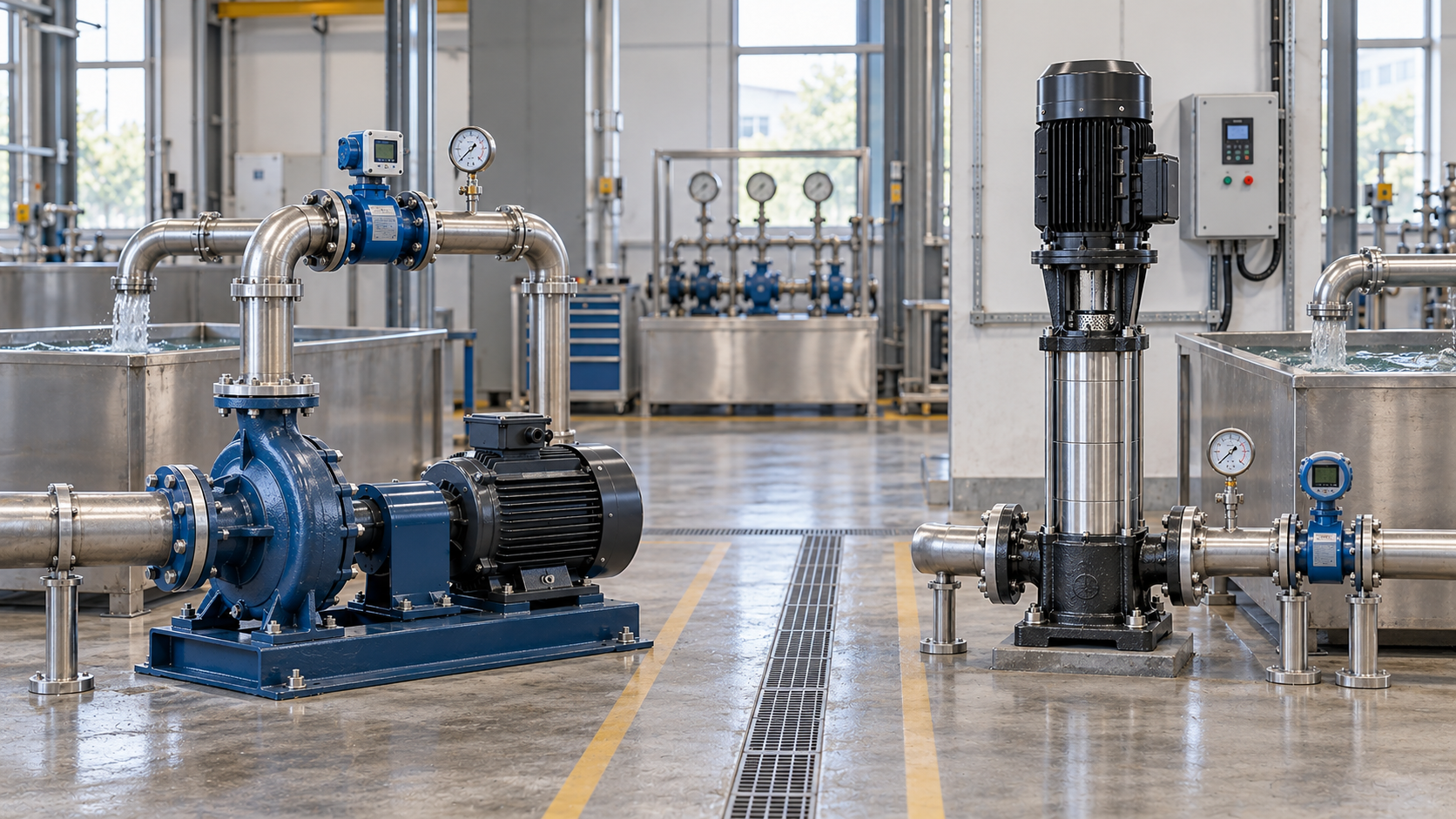
All the pressure of a single-stage pump is developed by one impeller. The shape of the performance curve is determined by the impeller diameter, the motor speed, and the pump casing. This simple design is appropriate when the system needs moderate pressure, and it allows you to have a useful pump without adding parts not needed by the application.
A multistage pump increases the pressure in stages, with the water going through a number of impellers. Each stage adds pressure to the next stage. There is some loss of pressure inside the pump. This allows a small pump diameter to produce high pressure, but you need to check the final shut-off pressure against the ratings of the pipes, valves, filters and pressure tanks. More stages are only useful if the system can safely use the extra pressure.
2. Flow and Head Performance
Single-stage pumps generally can deliver more flow at low or medium head. Their bigger water passages and simpler flow paths make them widely used in irrigation, water transfer, circulation, and drainage. If most of your sales are through these applications, a well-engineered single-stage range may fill more orders at a cheaper selling price.
Multistage pumps are generally used when a higher head at a given flow is required by the system. As the water moves through the stages, there is no multiplication of flow, just an increase in pressure. Multistage pumps are useful for applications such as building pressure boosting, deep wells, and industrial pressure systems. So your sales team should be comparing pumps based on working flow and head, not simply offering a multistage pump because it has the same kW rating as the needed single-stage unit.
3. Efficiency at the Working Point
A single-stage pump can be very efficient if its duty point is near the best efficiency area on the pump curve. Problems start when a big pump is selected, and most of its flow is throttled down by a valve. This allows the pump to draw more power, make more noise, and add load to its bearings and seal.
When high pressure is required, a multistage pump can be a better option. Several smaller impellers share the load. But it is not automatically more efficient in a low-head system. If it produces more pressure than needed and has to be throttled down, its higher purchase price will not provide a real energy advantage. When comparing operating costs for your clients, use the efficiency at the actual operating point and the expected daily running hours.
4. Suction Performance and Cavitation
The suction performance of a single-stage pump depends on the inlet design, impeller, speed, water temperature, and available inlet pressure. Some single-stage pumps are fitted with a self-priming chamber which may pump out air from the suction pipe, while a standard centrifugal pump generally needs a flooded suction or requires manual priming. Not all surface pumps can draw water from below, so you should check the actual suction configuration.
Adding extra stages to a multistage pump does not increase its suction performance. The first impeller receives the water and is generally the first part to be damaged by low inlet pressure or cavitation. The pump may be able to pump water to a great height, but it may not be able to draw it from a deep source. Many wrong replacements can be avoided if you keep the suction lift and discharge head separate in your quotes.
5. Water Quality and Solid Handling
Single-stage pumps can be made with different impellers and can handle many types of water. Closed impellers are normally used with clean water; semi-open, channel, vortex or cutting impellers are used with dirty water and sewage. This doesn’t mean that all single-stage pumps are suitable for solids, but you still need to check the allowed solid size and kind of water for each model.
Standard multistage pumps generally have smaller internal channels and tight clearances between impellers and diffusers. Sand, fibres, and bigger particles are not suited to multistage pumps as they can clog the stages or wear several parts at the same time. By asking about water quality before quoting, you can avoid problems from supplying a high-pressure clean water pump for a dirty water application and reduce future warranty claims.
6. Pump Size and Installation
Single-stage pumps are generally shorter in length and easier to open as they have fewer internal pump parts. End suction and inline designs also offer different piping layouts for the pump room and for replacement work. Physical size can still be a problem with large-flow single-stage pumps. So dimensions and connection points should be checked rather than only judging by the number of stages.
Horizontal multistage pumps require a longer floor length, while vertical multistage pumps require less floor space but enough height for installation and service. Long and thin, submersible multistage pumps can be put into a borehole. In case of replacement orders, you need to ask for the installation drawing, pipe centre height, connection standard, and base dimensions. If these details match, there is less need to change pipelines or pump bases on site.
7. Purchase Cost, Maintenance and Spare Parts
A single-stage pump usually has fewer impellers, diffusers, and stage seals, so the purchase price and service work is often easier to manage. This makes it a useful core product for budget-sensitive markets and applications where local technicians prefer basic pumps. You can also keep a smaller stock of spare parts by using common seals, bearings, and connection sizes.
A multistage pump has more internal parts and needs careful assembly so all the stages stay in proper alignment. That doesn’t mean it’s more prone to failure, but it can take longer to fix if the pump has to be fully opened. You may be better off stocking the common multistage models for regular booster and deep-well demand and ordering the rare high-pressure models for confirmed projects for your product line.
8. Speed Control and Operating Range
A variable frequency drive may be used on a single-stage pump if the motor and the pump are rated for speed control. Slowing down cuts flow and head and allows the pump to follow the changing demand. This can be handy for irrigation zones, circulation systems, and booster sets. However, the chosen pump still has to work within its allowed range.
A multistage pump can also be of variable speed, especially for constant-pressure applications. Because it can produce high pressure, a change in speed can greatly affect the final outlet pressure. Check minimum flow, motor cooling, seal pressure, and controller settings. Providing the pump, motor, and controller as a matched system gives a more reliable product than assuming one VFD setup will work for all multistage models.
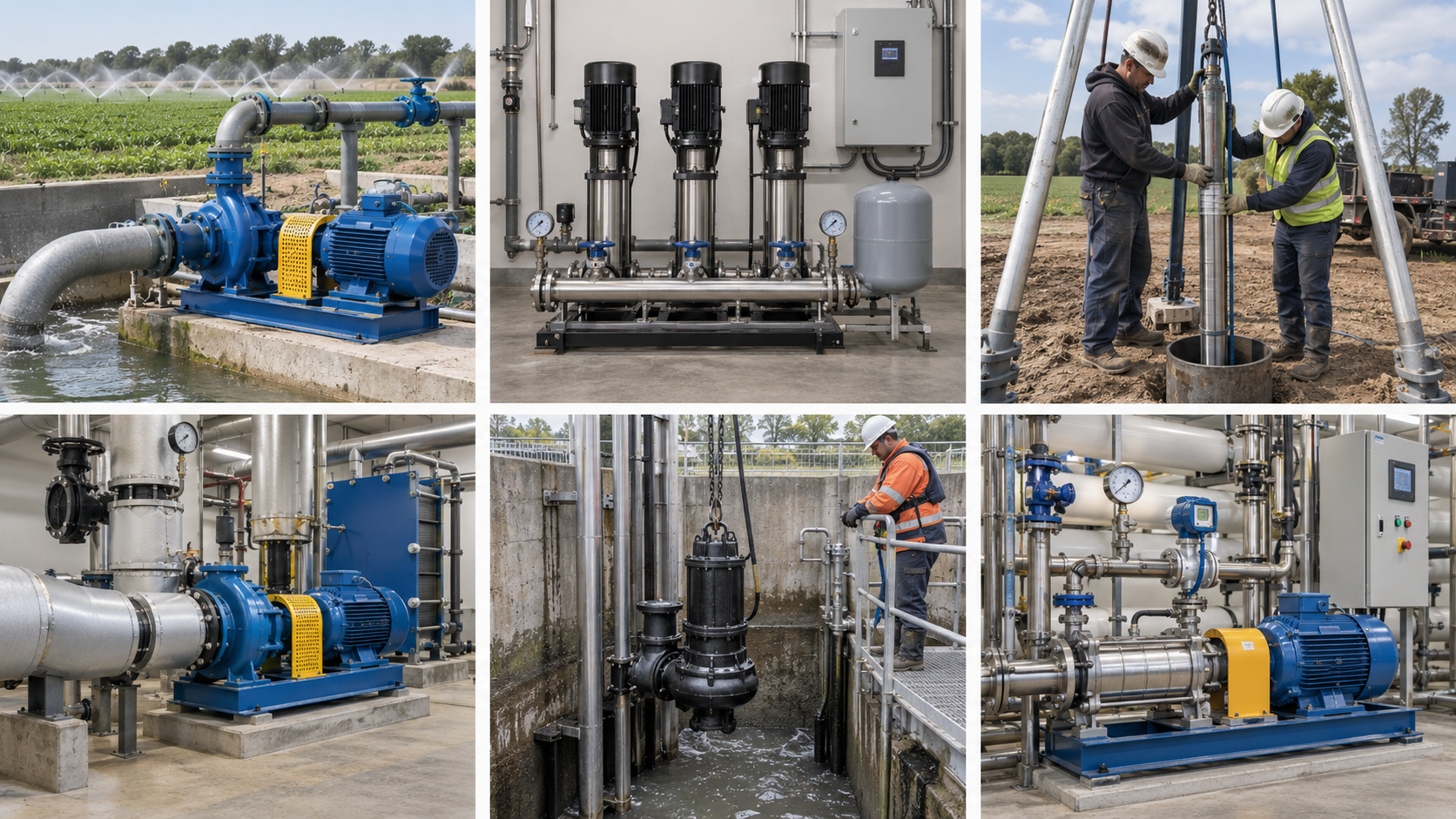
IV. Typical Applications
1. General Water Transfer and Irrigation
Single-stage pumps are often used for transferring water between tanks, for lifting water from shallow sources, and for supplying field irrigation systems requiring large quantities of water at moderate pressure. They are easier to sell and support in farming markets because of their simpler construction and lower prices. If the same irrigation project contains steep ground, a long rising pipeline, or high-pressure sprinklers, you should check whether a multistage pump is more efficient in providing the pressure you need.
2. Building Pressure Boosting
Multistage pumps are widely used in apartment complexes, hotels, commercial properties, and other systems where steady water pressure is needed on upper floors. The required pressure can be provided in several stages without using one very large impeller. Then the output can be adjusted when the demand for water changes through variable speed control and parallel pump sets. To give you a quote, you must add the maximum inlet pressure to the pump shut-off pressure and compare that to the pressure rating of the total system.
For a small facility or a moderate pressure rise, a one-stage pump could still be enough. Adding a multistage pump to each booster application can increase the project costs and make your quote less competitive. Building height, incoming pressure, peak flow, and target outlet pressure should determine the pump type.
3. Deep Well Water Lifting
Deep-well pumps typically have many impellers. This is because a narrow pump has to produce enough pressure to push water up a long rising pipe. Every stage adds head, yet the pump is still small enough to be in the well. The number of stages needed depends on the dynamic water level, the drawdown, the delivery height, the loss in the pipe, and the required output pressure.
The well depth alone is not enough for selection. Two wells of the same depth may have very different pumping water levels and flow requirements. The dynamic water level and needed daily water volume should be collected before quoting to choose the correct stage count and avoid low water production and overly expensive pumps.
4. HVAC and Water Circulation
Single-stage inline and end-suction pumps are typically used for heating, cooling, and circulation systems. In a closed system, the pump has to work mostly against the resistance of pipes, valves, and heat exchangers and does not usually have to lift the full building height on each cycle. This is why typically a single-stage properly sized pump will produce enough head.
The multistage pump is used when there is a very high resistance in the circulation system or the process requires a large pressure difference. But defaulting to stocking multistage pumps for every tall building can lead to extra stock. Building height and circulation head are not the same thing. This difference will help your technical staff in providing more accurate HVAC quotes.
5. Sewage and Dirty Water
Sewage pumps are often single-stage because wastewater needs bigger channels between the impeller and casing. Vortex, channel and cutting designs can handle different types of materials, fibres and domestic waste. When selecting these pumps, you should match the impeller and solid passage to the water, rather than only selecting the pump by outlet size.
Standard multistage pumps are not ideal for sewage as the water has to go through a number of small stage passages. One blocked or damaged stage may affect the operation of the full pump. In your sales system and brochure, keeping sewage pumps and clean-water multistage pumps clearly apart prevents wrong orders and unnecessary warranty work.
6. High-Pressure Industrial Water Systems
Multistage pumps are commonly used for reverse osmosis, boiler feed, high-pressure cleaning and industrial process water. These applications require a steady flow at a pressure higher than a typical transfer pump can give. The multistage design allows for multiple pressure levels to be offered in one product family.
These systems also require more technical information before a quote can be prepared. Check inlet pressure, required output pressure, water temperature, material, seal type, minimum flow and daily running hours. High-pressure industrial pumps are generally best treated as project orders and not only stocked by motor power.
V. Conclusion
A single-stage pump consists of a single impeller and is normally the easier option for water transfer, irrigation, circulation, drainage, and other low or medium-head applications. A multistage pump has multiple impellers all passing the same flow so the pressure builds up. This makes them better suited for building boosting, deep wells and high-pressure industrial systems. Neither design is suitable for all applications.
Knowing the difference saves you from the expensive multistage pumps that sit in markets that only require basic water transfer. It also prevents single-stage pumps from being supplied to systems when they are unable to achieve the needed pressure. If you are considering Single-Stage and Multistage Pumps for your product line or a project, HunGerät can review the needed flow, total head, suction conditions, water type, voltage and installation layout and provide suitable pump curves and model options.
VI. FAQ
1. Does a Multistage Pump Increase Flow or Head?
A multistage pump improves head because the same flow of water is given increased pressure by each impeller. The actual flow still depends on system resistance, motor power, and pump curve.
2. How Much Head Does Each Pump Stage Add?
It is a result of the impeller diameter, speed and internal design. No constant head per stage. As a general guide, total head is approximately the head of one stage times the number of stages, less internal losses.
3. Why Can Two Multistage Pumps with the Same Number of Stages Have Different Heads?
Their impeller diameters, motor speeds, diffuser designs and stage sizes could be different. Use the pump curve as the main guide. Compare their full performance curves.
4. Can a Multistage Pump Replace a Single-Stage Pump with the Same Motor Power?
Not automatically, since the two pumps could have very different flow and head for the same kW rating. The replacement has to be matched with the working point, connection size, voltage and maximum system pressure.
5. Can a Single-Stage Pump Reach the Same Head as a Multistage Pump?
Some single-stage pumps can provide high head by increasing the impeller size or the speed. You still have to compare the required flow, efficiency, motor load and pump size at that head.
6. Can One Multistage Pump Replace Two Single-Stage Pumps Connected in Series?
It may replace them if its flow, head, pressure rating and materials are compatible with the system. But then you lose the backup and separate maintenance options that you get with two pumps.
7. What Is the Difference Between Pumps Connected in Series and in Parallel?
Series connection of pumps increases the head mainly with the same flow through both pumps. Parallel pumps add flow at a shared head. The final result must be checked on the combined pump and system curves.
8. Does a Multistage Pump Have Better Suction Performance?
No, suction performance does not automatically improve when adding discharge stages. The design of the inlet and first-stage impeller sets the suction demand and cavitation tendency.
9. Which Part of a Multistage Pump Is Most Affected by Cavitation?
Cavitation usually starts around the inlet and the first-stage impeller since this is the lowest pressure point. The available NPSH must be kept higher than the required NPSH of the pump with the margin specified by the manufacturer.
10. Can a Multistage Pump Be Self-Priming?
Some specially designed multistage pumps can self-prime, but most standard models cannot. Check whether the pump needs flooded suction, manual priming or a separate priming system.
11. Can a Multistage Pump Handle Sand or Small Solids?
A standard multistage clean water pump is not designed for continuous handling of sand or solids. Check allowed particle size and sand concentration. Abrasive water will wear any impeller and diffuser.
12. Why Does a Multistage Pump Need a Minimum Flow?
At very low flow, internal water recirculation, heat buildup, and unstable forces inside the pump can occur. A bypass line or controller may be needed to maintain the pump above its specified minimum flow.
13. Can a Single-Stage or Multistage Pump Be Used with a VFD?
Both types can be used with a VFD if the motor, bearings, cooling, and pump operating range are suitable. Check the minimum/maximum frequency, rather than assuming that all pumps can operate safely across the whole VFD range.
14. What Is the Difference Between Horizontal and Vertical Multistage Pumps?
Horizontal models take up more floor space but often make it easier to access internal stages. Vertical models are used in pressure-boosting applications and take up less space, but require enough vertical height for installation and maintenance.
15. Does a Multistage Pump Need More Mechanical Seals?
Not always, because many multistage pumps have several impellers on one shaft with one main mechanical seal. The number of seals is a result of the entire pump design, not the number of stages.
16. Can Pump Stages Be Added or Removed to Change the Head?
Only if the pump series is designed for a different number of stages. Changing stages may also require a different shaft, casing, motor power, and balancing check, and should be checked with the manufacturer.
17. Can a Multistage Pump Damage a Low-Pressure Pipe System?
Yes, the pump shutoff pressure + inlet pressure can exceed the weakest part of the system and create leaks or broken fittings. Before installation, check pressure controls, relief devices and pipe ratings.
18. How Should Maximum Pressure Be Checked for a Multistage Pump?
Take the maximum inlet pressure and add the maximum pressure increase of the pump (usually checked near shut-off). All pump casings, seals, valves, tanks and pipes should be rated for this worst-case pressure.
19. Is a Multistage Pump Always More Energy-Efficient?
No, the efficiency depends on how well the selected pump matches the flow and head needed. A properly sized single-stage pump will be more energy efficient than an oversized multistage pump in a low-head system.
20. What Information Should You Provide When Ordering a Single-Stage or Multistage Pump?
Provide needed flow, total head, suction conditions, liquid, temperature, voltage, frequency, phase, pipe size, operating time per day. For replacement orders also include the old pump curve, nameplate, connection dimensions and installation drawing.