



Borehole Submersible Pump Product Highlights
● Broad Borehole Submersible Pump Range from Slim-Well to Large-Flow Series
● Multi-Stage Design for Deep-Well and High-Head Water Delivery
● Stainless-Steel Pump Components Available Across Multiple Series
● Single-Phase and Three-Phase Motor Options for Different Markets
● 50Hz Standard Models with 60Hz Options Available on Request
● OEM Branding, Packaging, Nameplate and Bulk Supply Support
Borehole Submersible Pump Supplier for Deep Well Water Systems
HunGerät Borehole Submersible Pumps are designed for water supply from wells where a surface pump cannot provide sufficient head. The pump works below the water level and pushes water upward through the delivery pipe, making this structure suitable for deep wells, farms, irrigation systems, domestic water supply, civil projects, and industrial water transfer.
For you, the range covers compact slim-well models as well as 4-inch, 5-inch, 6-inch, 8-inch, and 10-inch product families. The catalogue includes SD, SP, SR, SCM and other Borehole Submersible Pump series, allowing a product line to be built around different well diameters, rated flows, heads, motor powers and market voltage requirements.
Borehole Submersible Pumps by Type
 Slim Borehole Submersible Pumps
The 2SD, 2.5SD and 3SD series are ideal for applications where limited installation space and a slim pump body are required. They provide a reasonable solution for narrow boreholes, home water supply, and light irrigation.
 4 Inch Borehole Submersible Pumps
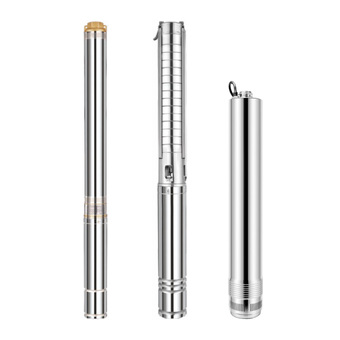
4SD, 4SP and 4SCM families cover one of the most typical sizes of Borehole Submersible Pumps for residential, agricultural and light commercial water supply. The 4-inch series is available in a variety of stage numbers and hydraulic capacities to suit the buyer’s needs for low-flow/high-head jobs or higher-flow applications. The 4SCM models are selected for wells with a well diameter greater than or equal to 4 inches.
 5 Inch Borehole Submersible Pumps
The 5SR and 5SCM series are intended for larger well applications requiring higher flow rates than ordinary 4-inch applications, but yet retain the vertical multi-stage construction used in deep-well pumping. They can be used for water delivery from wells or reservoirs, for civil and industrial systems, for garden use, and for irrigation.
 6, 8 and 10 Inch High-Flow Borehole Submersible Pumps
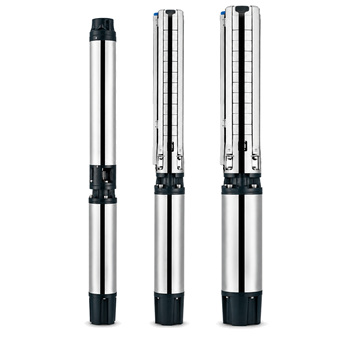
For projects with increased capacity, HunGerät offers 6SR, 6SP, 8SP and 10SP series. These larger Borehole Submersible Pumps are intended for agricultural irrigation, major water-supply systems, industrial transfer, and project applications when both the flow and head requirements are beyond the practical range of smaller Borehole Submersible Pumps.
Why Choose HunGerät as Your Borehole Submersible Pump Factory
For over 25 years, HunGerät has been producing water pumps. For Borehole Submersible Pumps, long-term production experience is important. Model consistency, motor matching, sealing, performance testing, and solid repeat-order standards impact your installation reliability.
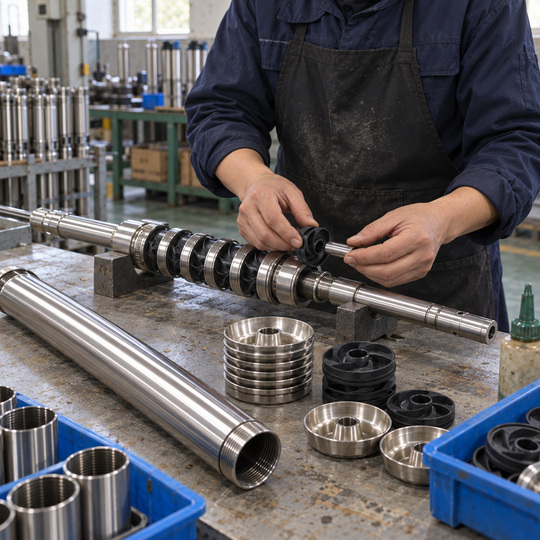
HunGerät manufactures copper-winding motors in-house, allowing us to manage motor power, winding uniformity, heat resistance, and production matching between the pump and motor. This is especially true for Borehole Submersible Pumps that are continuously operating under water.
We support OEM & Private Label requirements like Brand Logo, Carton Design, Nameplate, Manual, Cable Configuration, etc. This allows you to develop a variety of Borehole Submersible Pumps to suit local market positioning.
Our team is ready to assist you with model matching, quotations, confirmation of performance data, production follow-up, packing information, and shipping coordination. With project orders and repeat container orders, faster technical confirmation will assist in reducing the likelihood of picking the wrong pump for the duty point required.
Wide Borehole Submersible Pump Series for Different Well Diameters
The Borehole Submersible Pump range should not be developed only around the motor power. Well diameter limits what pump body can be fitted, while needed flow and total head determine the hydraulic series. The range of HunGerät has small SD models, 4-inch SD/SP/SCM models, 5-inch SR/SCM models, and bigger 6-inch, 8-inch, and 10-inch SP/SR models. This provides a more complete line for home wells, farms, irrigation, industrial water supply, and larger project applications.


Multi-Stage Hydraulic Design for Higher Head
In borehole submersible pumps, several impeller stages are used to generate pressure in water as it passes through the pump. The more stages you have, the more head you can get, generally, for a given hydraulic family. This makes multi-stage Borehole Submersible Pumps useful for deep installations, raised storage tanks, long discharge lines, and systems where pressure must still be available once static lift and pipe losses are addressed. Therefore, the model selection should be based on the needed operating flow at the required total dynamic head and not on maximum head only.
Motor, Voltage and Control Options
Selected HunGerät Borehole Submersible Pump series are equipped with rewindable motors and run on single-phase 220-240V/50Hz or three-phase 380-415V/50Hz. Other voltages or 60Hz versions for supported models are available on request for markets with different power standards. Selected models can also be combined with a control box or float switch. Please confirm the local voltage, phase, frequency, cable needs, and control configuration before bulk orders.


Materials and Operating Conditions
Borehole Submersible Pump materials should be chosen according to water quality, installation depth, estimated running hours, and market positioning. The catalog features stainless-steel components within several product families, with certain ranges combining stainless steel with plastics, cast iron, or aluminum parts depending on the model. For example, some 4SCM catalog models specify a maximum fluid temperature of 35°C, a maximum sand concentration of 0.15%, a maximum immersion of 50 m, and a minimum well diameter of 4 inches. Since operating limits differ by series, you must review the specific model data sheet before final selection.
Reliable Factory Support for Borehole Submersible Pumps


Borehole Submersible Pumps are often installed tens or hundreds of meters below ground, so model errors and inconsistent production can create much higher service costs than with an easily accessible surface pump. You therefore need more than a competitive unit price: you need stable model specifications, clear performance curves, compatible motors, consistent materials and spare-parts support.
HunGerät supports you with model matching based on flow, head, well diameter, power supply and installation conditions. Performance data, motor options, OEM requirements, packing details, and specifications can be confirmed before production, helping you build a more stable Borehole Submersible Pump product line and reduce after-sales problems caused by incorrect selection.
Borehole Submersible Pump Application Areas

Borehole Submersible Pumps can provide water from private wells to homes, villas, storage tanks, and small residential systems. Selection of the right model according to the well diameter, pumping water level, home flow requirement, delivery height, and pressure at the outlet is important.
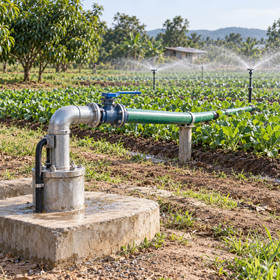
Borehole Submersible Pumps bring groundwater to farms, orchards, greenhouses, and field irrigation for irrigation networks and storage reservoirs. Higher flow 4″, 5″, 6″ and bigger series can be adapted to the irrigation flow demand and overall system head.

Borehole Submersible Pumps are usually used in rural water supply, community water systems, construction sites, public facilities and other civil projects where groundwater is the major or additional source of water. Project buyers should check continuous-duty needs, motor protection, cable length, control equipment, and availability of spares.

Borehole Submersible Pumps can be used in factories and industrial facilities to handle process water, raw water transfer, cooling-water makeup, storage-tank filling, and general utility water delivery. The larger SP and SR series may also be able to handle applications with higher flow requirements; however, the actual duty point should always be confirmed from the pump curve.

The garden irrigation and transfer of water from wells or reservoirs can be carried out using selected series of Borehole Submersible Pumps. For these applications, the buyer should match the pump to the water source available, delivery pipe size, vertical lift, horizontal distance, and expected daily operating time.
Normally, the pump should be located below the lowest expected dynamic water level so that it is entirely submerged during operation, but not immediately on the bottom of the borehole. Ensure sufficient clearance above built-up sand or sludge.
A Borehole Submersible Pump is a kind of pump that is built for narrow and deep wells, and it usually adopts a vertical multi-stage hydraulic structure to produce higher head. Other submersible pumps are mainly for tanks, pits, wastewater, or open water, such as drainage or sewage pumps.
The pump needs to be properly submerged when the borehole is pumping at its typical pumping rate. Installation should be based on the lowest expected dynamic water level, not on the static water level recorded when the pump is stopped. Actual submergence varies with the pump model, the borehole yield, and seasonal water-level changes.
If the pump is oversized, it may pump water at a rate greater than the borehole can recover, causing excessive drawdown or the pump to run dry. It can also run outside its preferred duty range, increasing power consumption and generating unneeded pressure in the piping system.
TDH = Vertical Lift + Required Outlet Pressure + Pipe and Fitting Losses
Use the dynamic pumping water level instead of the total borehole depth. For reference, 10 m of water head is roughly 1 bar pressure, so a system needing 3 bar at outlet will need about 30 m of pressure head in addition to lift and friction losses.
If the dynamic water level is close to or below the pump inlet, water supply may drop, and the pump may eventually run dry. The solution to be chosen should therefore be matched to the sustainable yield of the borehole, and dry-run protection can be used where water levels fluctuate.
The desired flow should be a function of the application water demand and the borehole sustainable yield. For example, an irrigation system requiring 10 m³/h should not normally be pumped continuously at 10 m³/h without temporary water storage from a borehole that can only sustainably yield 6 m³/h.
Yes. A lot. In general, it is possible to install a pump in a borehole bigger than its minimum necessary diameter, subject to adequate installation, cable protection and motor cooling conditions.
Yes. Borehole Submersible Pumps can be connected with float switches, level sensors or control panels so that the pump starts and stops depending on the water level in the storage tank. The control arrangement should also take into account borehole water level and dry-run protection to prevent the pump from running when there is insufficient water.
Sand can slowly wear impellers, diffusers, bearings and other hydraulic components, lowering flow, pressure and service life. Each series of pump has a different sand tolerance; therefore, you need to check the actual water quality against the allowed sand content for your selected model.
Do not assume that a 50Hz pump may be directly connected to a 60Hz source without evaluating the motor and hydraulic design. Voltage, frequency, and pump curve should be confirmed together. Frequency affects the motor speed and pump performance.
For smaller residential and other installations where three-phase power is not available, single-phase models are typically used. For higher power and for commercial, agricultural, or industrial systems, three-phase motors are typically selected as they are better suited to higher load applications.
It is dependent on the motor and the starting arrangement. Some types are available with a start control box or a digital automatic control box. Other installations can be equipped with an external starter, protection panel, or inverter.
The cable length is important since the pump is located underground and the cable needs to reach the control point without any improper joints. Long cables also need to be sized properly for voltage drop. Before production, you should confirm the installation depth, supply voltage, motor power, and needed cable length.
Yes. A pressure tank, pressure switch, controller, or variable-frequency system can be used depending on the water-supply design. The control method should be matched to the motor, required pressure stability, expected starting frequency and local installation practice.
Yes. Depending on the configuration of the water supply, a pressure tank, pressure switch, controller or variable-frequency system may be used. The choice of control method depends on the motor, the needed pressure stability, the expected start frequency and the local installation practice.
Dry-run protection is done by water-level sensors or probes and by using proper pump controllers or protection panels, depending on the system design. This is especially important for boreholes where water levels are variable as running continuously without enough water might damage the pump and motor.
No, not really. Stainless steel is corrosion resistant, but its suitability is still dependent on the water chemistry, salinity, chloride levels, and other corrosive chemicals present in the borehole. So, the material and hydraulic components should be selected according to the real water conditions.
The recommended list of spare parts depends on the series of the pump and the local service needs, but you should typically consider frequently replaced electrical, sealing, and hydraulic components. Providing after-sales support is easier if compatible spare parts are available.
Only if the needed operating flow and total dynamic head are within the appropriate performance range of the pump. Even two wells of the same diameter may require different pump models, since the dynamic water levels, discharge heights, pipe losses, and required outlet pressures vary.