I. Introduction
A fountain pump can spray water nicely, but it’s not enough to make a big waterfall. At a low head, a fish pond pump might have a lot of flow, but when the head goes up, the flow goes down. Read this guide to learn about the different types of pond pumps and how to install, use, and control their speed. This way, you can help your clients choose products that meet their needs.
II. Pond Pump Basics
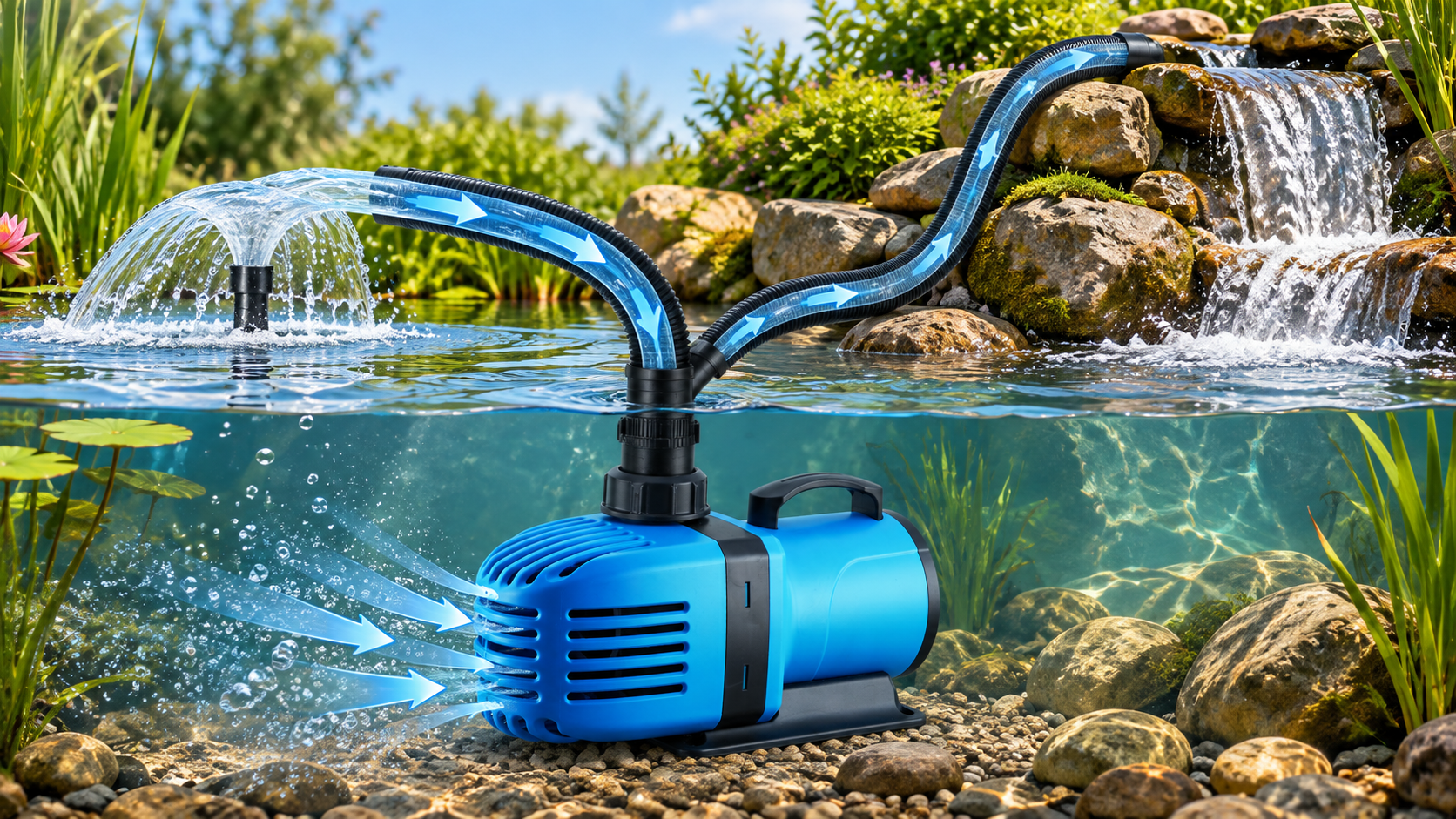
Pond pumps transport water for pond circulation, fountains, waterfalls, and streams. It could be a decorative outlet, part of a circulation system, or a water source for a higher feature depending on its use.
Pond pumps are classified by where they work, what they provide, and how their speed is controlled. These classes overlap. For fish pond circulation, a submersible pump can also have an adjustable speed. When you compare pumps, these descriptions are telling you different things about the same pump.
III. Pond Pump Types by Installation
1. Submersible Pond Pumps
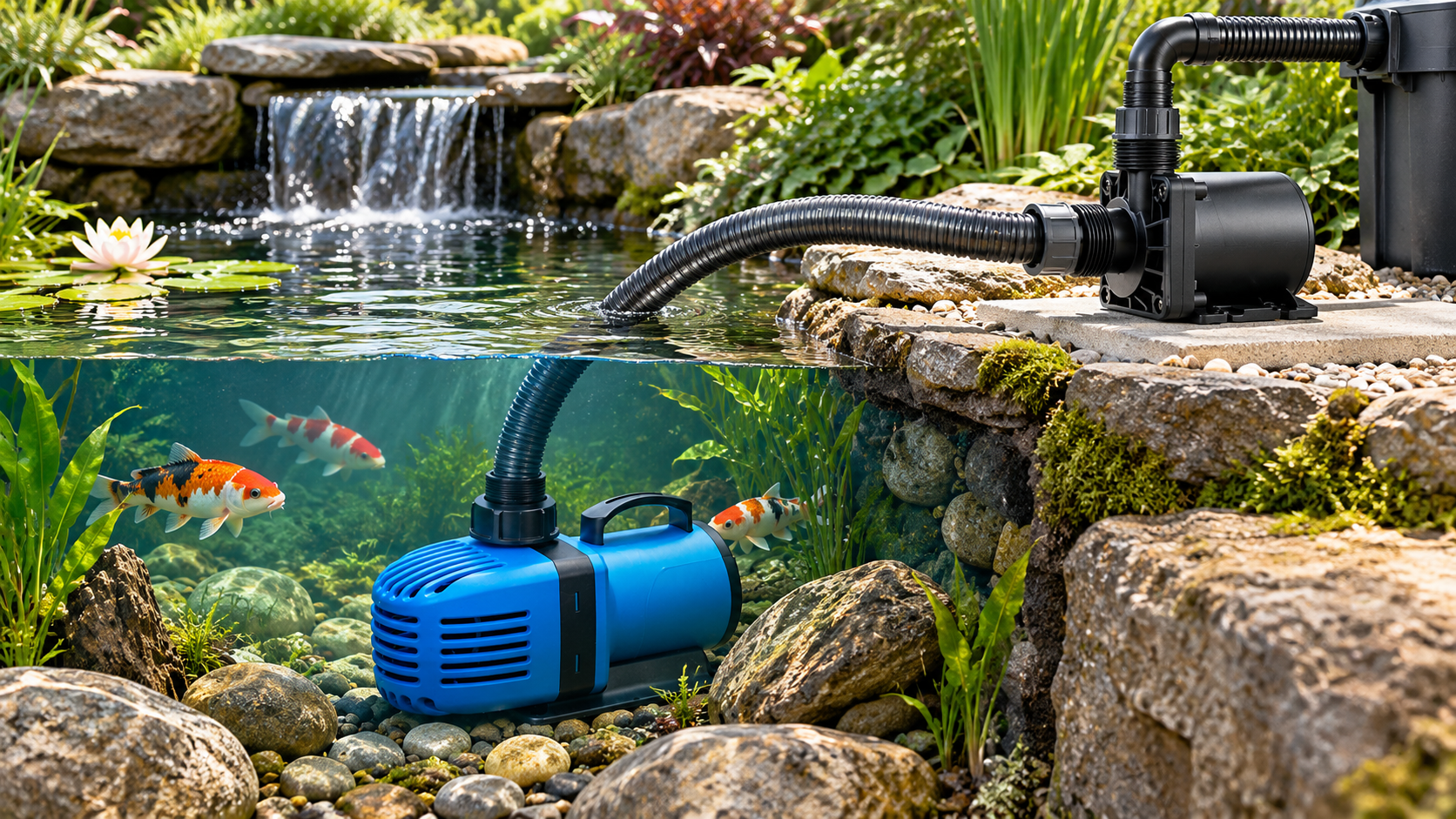
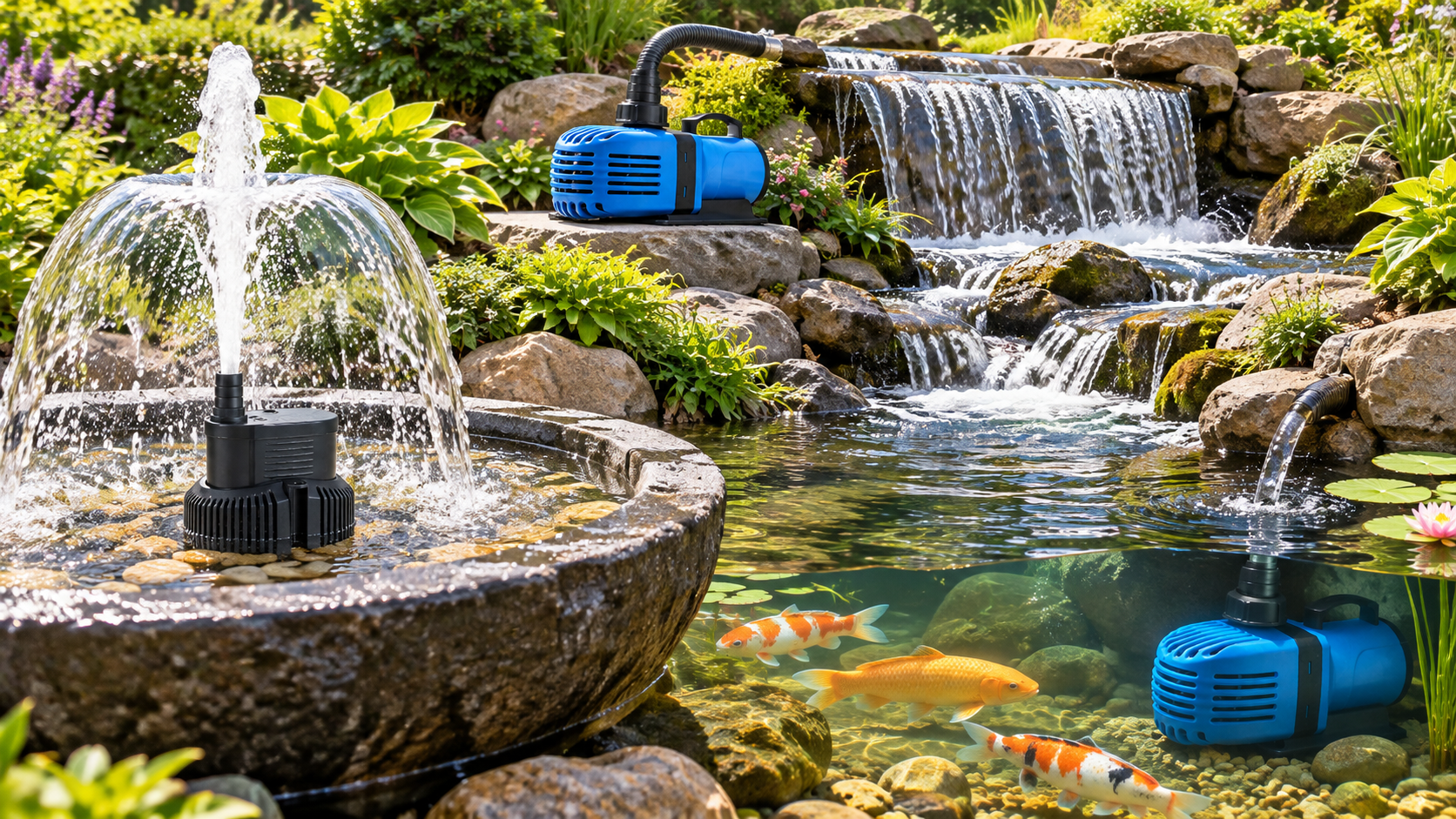
Submersible pond pumps work by drawing water straight through an intake guard or inlet. Because they are small, they can be hidden in a pond or other water feature without having to put a separate pump next to the water. A lot of people use them to make outdoor fountains, waterfalls, and water flows through fish ponds. This type of installation works with items that are meant to hide the pump.
2. External Pond Pumps
The water is pulled out of the pond by external pond pumps, which are placed outside of the pond. It’s easier to check and clean an above-ground pump than a submerged pump, which needs to be taken out of the water. They work well in systems where the pump is in a separate location and getting to the pump is important.
IV. Pond Pump Types by Application
1. Fountain Pumps
Fountain pumps deliver water to spray nozzles, fountain heads and decorative outlets. Many have small, compact bodies that fit inside little ponds, ornaments or basins of water features. Their main advantage is that they can build a defined water display, such as a jet, bell or spray pattern with an appropriate nozzle.
The nozzle determines how the flow and pressure given are transformed into a visual display. If you have a fountain pump with a nozzle set, check the performance of the combination. The maximum head of a pump is when the flow goes to zero, which means it can not be taken as the height of an operating fountain jet.
2. Waterfall and Stream Pumps
Waterfall and stream pumps deliver a steady flow of water to high-level outlets, rock features and artificial streams. Their main job is to keep a sheet or channel of water moving. The required pump performance relies on the volume of water required and the height to which it is to be raised.
For a wide, low waterfall, you should compare pumps that provide high flow at low head. If you want a higher waterfall, consider a design that will still provide you with enough water flow at the higher head. This is important because two pumps with the same max flow rates can have very distinct results at a raised output.
3. Fish Pond Circulation Pumps
Fish pond circulation pumps are used for circulating water through fish ponds and koi ponds, generally as part of a filtration circuit. Typical designs feature a big input guard and large outlet, with high flow at relatively low head. Their advantage is to deliver circulation volume where a strong spray or high lifting pressure is not the main need.
Some types can pass fish waste and small detritus within the specific limitations. If you are supplying pumps for this purpose, check the allowed particle size and kind of debris, and continuous-duty rating. Two pumps with a similar outer barrier are no indication that their inner channels are the same or that they can be used for the same material.
V. Pond Pump Types by Speed Control
1. Fixed-Speed Pond Pumps
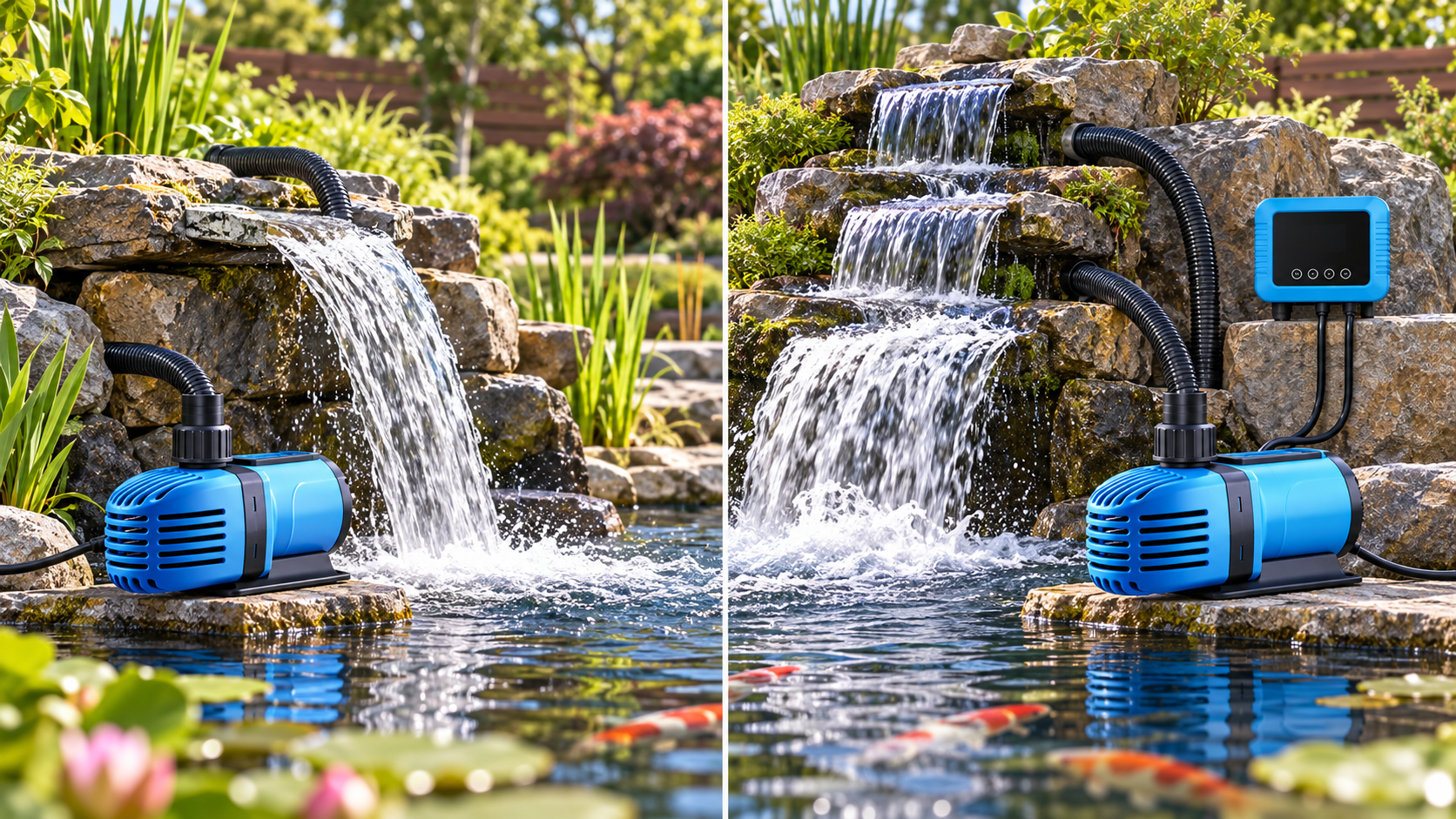
Fixed-speed pond pumps run at the speed they are designed for and do not have user control of the motor speed. The advantage they have is simple operation where the output required stays nearly the same. This is a good choice for situations where you want a steady circulation or a set water display, without adding a speed controller that has no meaningful use.
2. Variable-Speed Pond Pumps
Variable-speed pond pumps are designed to allow the user to adjust the motor speed to an appropriate level. This affects the flow and head available, so the same pump can have different fountain effects, waterfall flows, or circulation outputs. Their biggest advantage is the ability to be adjusted to changing water production.
If you are comparing pumps, then you should consider the usable speed range and performance at different settings. A display screen does not mean the speed is customizable. Likewise, “variable frequency” refers to a drive system, but not necessarily that the user can select the working speed.
VI. How to Choose a Pond Pump
1. Match the Pump Type to the Application
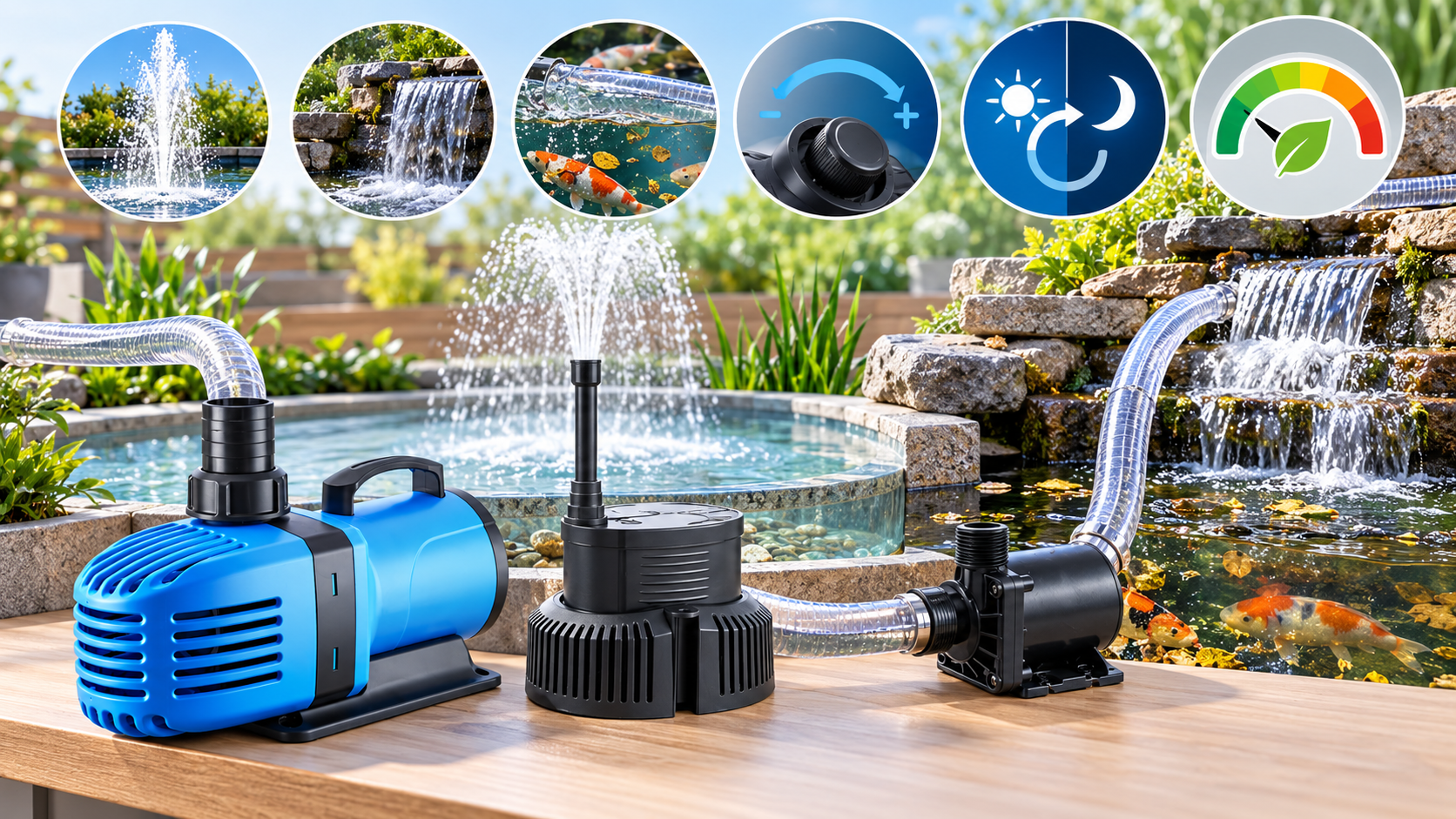
Start with the main use, such as a fountain display, waterfall supply or fish pond circulation. Then confirm whether the installation required is submersible or external. This offers you a good product category before you can compare performance. For example, you shouldn’t use a little fountain pump instead of a high-flow circulation pump just because they are both called pond pumps.
2. Match Flow to the Required Head
Check flow from the pump curve at the total head required, including lift and losses in piping and connected equipment. If you need 5,000 L/h at 3 m total head, you want a pump whose curve exceeds that point. But a machine rated at a max flow of 5,000 L/h is not going to deliver that flow as head rises. So that max figure is not enough to select it.
3. Check Water and Debris Conditions
A visually clean water feature requires different tests than a fish pond with little waste particles. For water with debris, check the pump’s material handling capacity and the allowable particle size. Guard openings, impeller, and internal channels affect the movement through the pump. Do not utilize outlet diameter or intake-guard size for this information.
4. Choose Fixed or Adjustable Speed
When the result you need is stable, choose fixed speed. If you want to change the water display or circulation flow, you have to pick a speed that you can change. If the model is adjustable, find out what its operating range is and what controller goes with it. Instead of a long list of settings that can’t reach the outlet, you need settings that still give you useful flow at the right head.
5. Check Continuous Duty and Power Use
Make sure the pump is rated for continuous operation under the given conditions if you want to keep the water moving in the fish pond. Check the input power at the same flow and head when you compare how much power is used. A smaller wattage is only helpful if the pump can still supply enough water. The slowest speed setting may use little power but not enough water.
VII. Conclusion
Different types of pond pumps are used for different things. There are two types of installations: submersible and external. The main uses are fountains, waterfalls, and fish pond circulation. The control types are set speed and variable speed. First, make sure these features match, then look at the flow, head, trash handling, and running conditions that are needed.
Get in touch with HunGerät to get pond pump specs and performance curves. You can compare models that are right for your market if you share the uses you offer and the flow, head, and control features that are needed.
VIII. FAQ
1. Can One Pond Pump Be Used for Both a Fountain and Pond Circulation?
Yes, as long as the pump and outlet can provide enough water for both uses. When choosing a model for mixed use, don’t count the pump’s full flow twice, but instead look at the flow that can come out of each outlet.
2. Are All External Pond Pumps Self-Priming?
No, some external pumps need water to feed into the inlet or require filling before startup. Check self-priming capability separately from installation type when you compare models.
3. Can a Pond Pump Be Connected to Different Fountain Nozzles?
Yes, as long as the connections are correct and the flow and pressure levels are what are needed. If you sell a fountain package, make sure to check the display with the nozzles that come with it, since different nozzle designs have different effects on the same pump.
4. Do Fountain Pumps Always Include Nozzles?
No, you can get a fountain pump without a set of nozzles or with one. The packing list will help you compare prices for the same things that were sent.
5. Can Pond Pumps Handle Fish Waste?
Models made to handle solids properly can move fish waste and small debris up to the limits they say they can. Before you pick one for the fish pond, make sure you know what kind of trash and particle size are allowed.
6. Can Pond Pumps Handle Sand and Gravel?
You shouldn’t think that standard pond pumps can handle continuous sand or gravel pumping. It is not enough to just look at the particle-size rating if you need to use this. You should also get specific approval for the abrasive material.
7. What Does the Maximum Particle Size Mean for a Pond Pump?
It gives the particle size that the manufacturer permits the pump to pass under certain conditions. Also check the allowed material, since stones, stringy waste, and soft trash will not pass a pump in the same way.
8. Why Do Two Pond Pumps with the Same Maximum Flow Have Different Heads?
The impellers and passages inside them may be made to create different pressures. Look at the change in flow at the same working head to see what it means.
9. Does Higher Wattage Always Mean More Water Flow?
No, the amount of power going into a pump does not show how much water it provides. Check the flow and power at the same working head when you compare models.
10. Can a Pond Pump Deliver Maximum Flow at Maximum Head?
Not at all. These are two different limits on a normal centrifugal pump curve. The curve will help you find the right operating point because flow stops at zero at maximum head and starts again at very low head.
11. Does Variable Frequency Always Mean Adjustable Speed?
No, drive technology with variable frequency does not always come with a speed setting for the user. Before you list a model as changeable, make sure it can be adjusted.
12. Is Flow Adjustment Always the Same as Speed Control?
No, a valve or other mechanical blockage can change the flow without changing the speed of the motor. When you compare features, make sure you don’t mix up flow control and motor speed control.
13. Do Variable-Speed Pond Pumps Need a Separate Controller?
Some have separate controllers, while others have controls that are built in. If the matched external controller is needed for operation, make sure that the configuration that was given includes it.
14. Can All Pond Pump Controllers Be Installed Outdoors?
No, the controller needs to be protected in a way that makes sense for where it will be used. If you have a submersible pump, that doesn’t mean the controller is waterproof. You should check its security rating separately from the pump’s rating.
15. Are Pond Pump Controllers Interchangeable?
No, the controller has to work with the electricity and motor-drive needs of the pump. Because similar plugs don’t mean they will work together, choose a combination that was allowed by the manufacturer.
16. Does Running a Pond Pump at Lower Speed Reduce Power Use?
Most of the time, yes, but the flow and head also drop. Check out the power settings that will still give you enough water for the job.
17. Can Reducing Pump Speed Stop Water from Reaching a Waterfall?
Yes, if the lower head isn’t enough to beat the lift and system resistance. When you compare adjustable pumps for waterfall use, make sure you look at how well they work at slower speeds.
18. Does Dry-Run Protection Mean a Pond Pump Can Run Without Water?
No, dry-run protection is meant to stop or slow down activity when there isn’t enough water. Before you list this as a product feature, make sure that the model in question has this feature.
19. Can All Pond Pumps Be Used in Saltwater?
No, the type and its water-contact materials determine whether it can be used in saltwater. Before you buy a pump for saltwater use, make sure it has been approved for that model.
20. Can Pond Pumps Run Continuously?
Models that are rated for continuous duty can keep running as long as they stay within their stated limits of operation. For continuous fish pond circulation, check the product specification for the duty rating and the conditions that must be met for the system to work.