I. Introduction
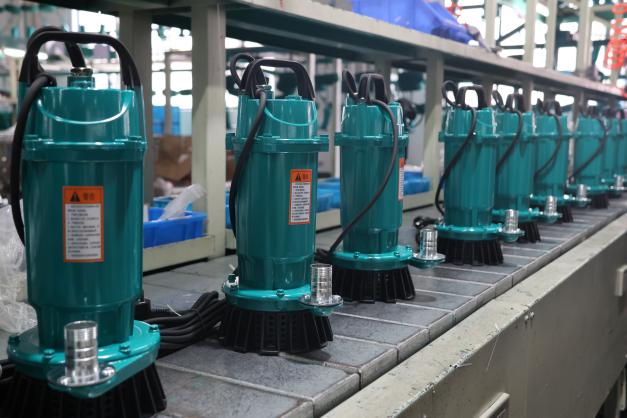
The single-phase induction motors are used in water pumps, air compressors, fans, refrigeration equipment, small machine tools, and agricultural machines. But two motors of the same power can have very different starting and operating behaviour. If you select them on kW or price alone, the driven machine may start poorly or run hot. This article covers the key types and how to fit them to your product range.
II. Single-Phase Induction Motor Basics
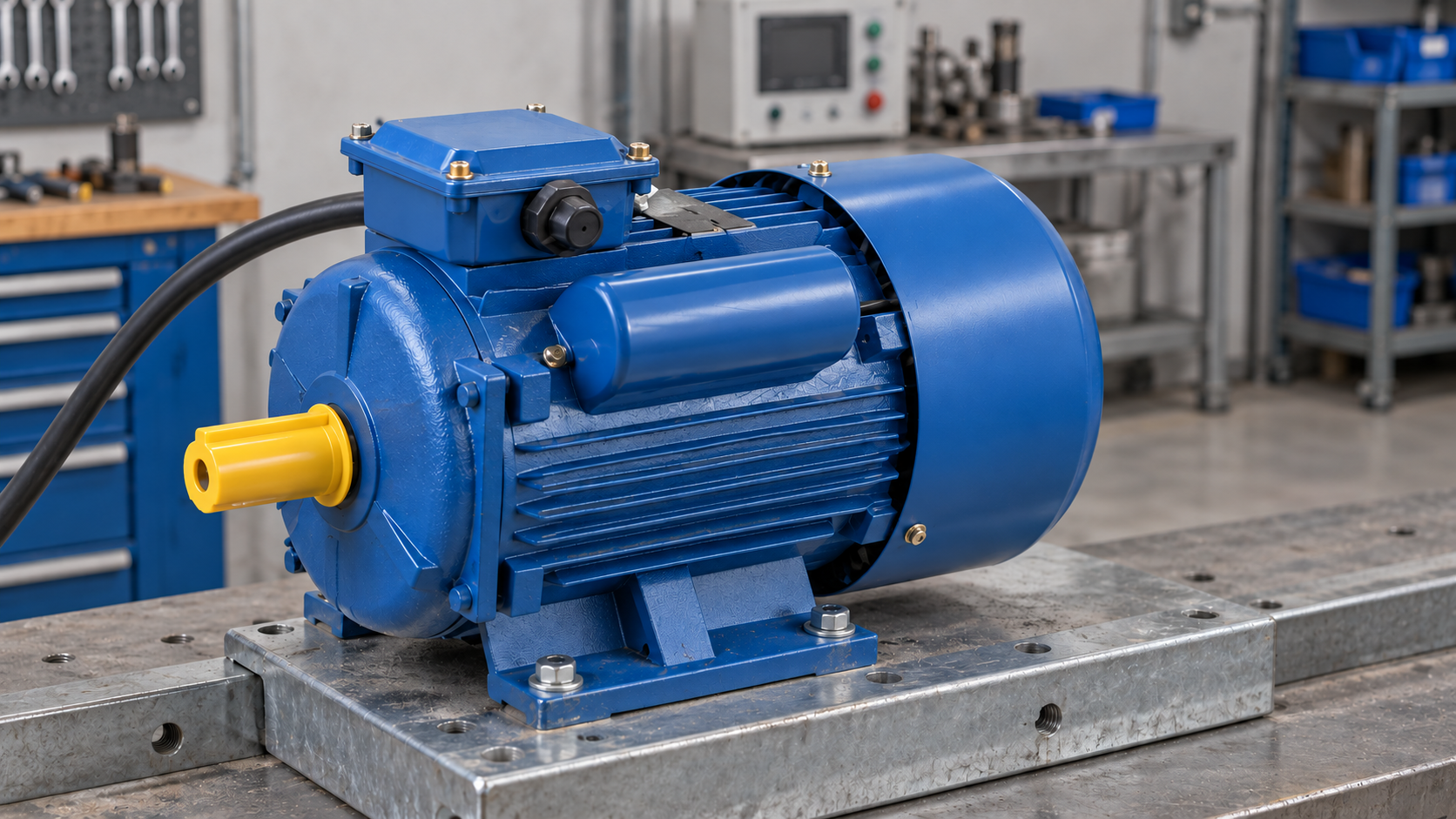
A single-phase induction motor is used to convert AC electricity to rotary power to operate standard drive devices. It is often used where three-phase electricity is not available or not required, especially for small and medium machines. The motor is a relatively basic construction and requires little maintenance, as there are no brushes or a commutator between the stator and the rotor.
III. Starting and Running Process
1. Starting the Motor
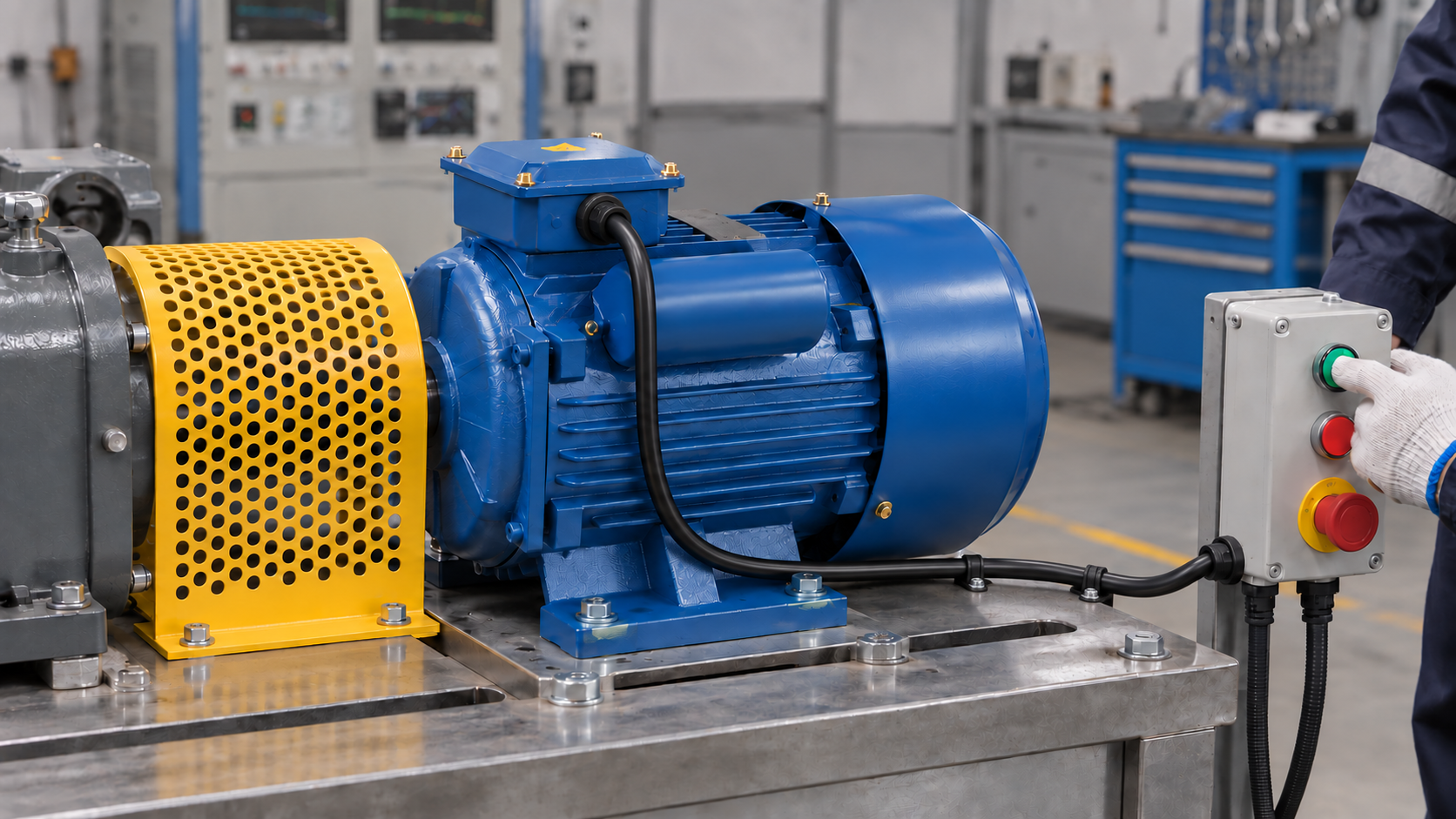
An induction motor driven by a single-phase power supply cannot produce enough starting torque regularly. So the motor uses an extra winding and either a resistance, a capacitor or a shaded pole design to produce the phase shift needed to start the rotor. The method used determines how successfully the motor can start a pump, compressor, fan or other load.
2. Changing to Normal Operation
Some single-phase motors have a centrifugal switch or starting relay that disconnects the start winding and start capacitor after the motor reaches a certain speed. Other designs have a run capacitor and an auxiliary winding powered during normal operation. This difference will affect the starting torque, running current, noise, efficiency, product cost, and the replacement parts you need to stock.
IV. Main Single-Phase Induction Motor Types
1. Split-Phase Induction Motors
A split-phase motor has a start winding with increased resistance and no capacitor, along with a main winding. Normally, the start winding is disconnected by a centrifugal switch after the motor reaches operating speed. This design costs less but has only moderate beginning torque. It is better suited to fans, grinders, tiny machines and other equipment that begins with a light load.
Split-phase motors can offer a cheaper cost option in situations where good starting performance is not required. They should not be used as a general replacement for motors used on loaded compressors, self-priming pumps or machines that are hard to start.
2. Capacitor-Start Induction-Run Motors
Capacitor Start Induction Run Motor Start capacitor is used to increase the phase difference between the main and start windings. This gives it a higher starting torque than a simple split-phase design. Once the motor has reached speed, the start winding and start capacitor are separated and the motor runs on the main winding.
These motors are often used in water pumps, air compressors, tiny drilling machines and other equipment that require more energy to start. Generally less expensive than dual-capacitor motors, so you can handle high-starting-load applications without having to move all customers to the most expensive form of motor.
3. Permanent Split Capacitor Motors
A permanent split capacitor motor (or capacitor-run motor) has its run capacitor and auxiliary winding connected in both startup and normal running. Most designs do not require a centrifugal starting switch, reducing the number of moving electrical parts inside the motor.
PSC motors run smoothly and quietly and are well suited for long run periods. The starting torque is generally less than capacitor start motors. They are often used for fans, blowers, ventilation equipment and other light beginning loads, giving you a good product choice when quiet operation is more important than great starting torque.
4. Capacitor-Start Capacitor-Run Motors
A capacitor-start capacitor-run motor uses a start and a run capacitor. Both capacitors help the motor to start up . The start capacitor is disconnected once the motor reaches speed and the run capacitor stays in the circuit.
This design with dual capacitor provides strong starting torque, smoother operating, improved power factor and consistent output under load. It is designed for pumps, compressors, refrigeration equipment and small machines with higher starting requirements. It costs more, and it has more electrical parts, but it lets you cover cases where a standard capacitor-start motor may not deliver the running performance you need.
5. Shaded-Pole Motors
Shaded-pole motors have a little copper ring around a part of each stator pole that creates the starting field. The construction is simple, compact and cheap, but the beginning torque is very low, and the application is often limited to low power equipment.
Common uses include compact fans , ventilation systems and light home equipment. This is a separate low-power product group and should not be considered as a replacement for capacitor motors used with pumps, compressors or workshop machines.
| Motor Type | Typical Starting Torque | Normal Running Design | Relative Cost | Common Applications |
| Split-phase | Moderate | Start winding disconnects | Low | Fans, grinders, light machines |
| Capacitor-start | High | Start capacitor disconnects | Medium | Pumps, compressors, drilling machines |
| PSC or capacitor-run | Low to moderate | Run capacitor stays connected | Low to medium | Fans, blowers, ventilation equipment |
| Dual-capacitor | High | Start capacitor disconnects; run capacitor remains | Medium to high | Pumps, compressors, refrigeration equipment |
| Shaded-pole | Very low | Shading coil remains active | Low | Small fans and light appliances |
These are broad differences, not absolute performance levels. Still check each model for starting torque, current, duty and efficiency data before adding to an equipment setup.
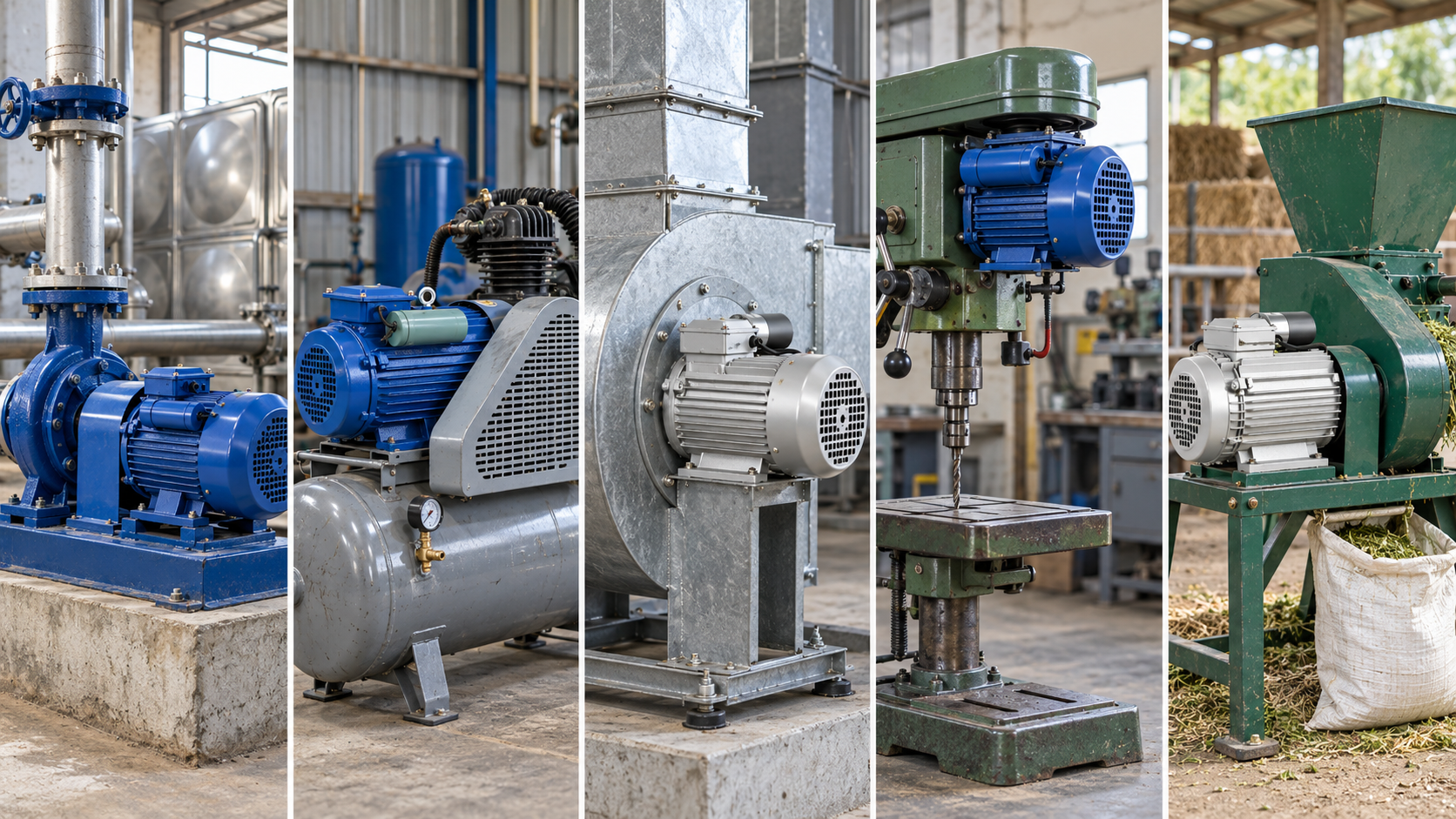
V. Matching Motor Types to Actual Equipment Loads
1. Water Pumps
Many clean-water centrifugal pumps may not require the maximum starting torque available, and a properly matched capacitor-start motor might be more affordable. If the pump has larger rotating parts, more mechanical resistance, or is being used in a market that has frequent drops in voltage, it may need the extra starting torque provided by a twin capacitor motor. You should approve the motor at the real load of the pump and lowest allowed voltage so you can use lesser cost motors where they are enough without increasing no-start complaints.
2. Air Compressors and Refrigeration Equipment
If the compressor bleeds out pressure before starting back up, then the correct motor is very important. A capacitor-start motor may be enough if the unloading valve is working well, but for hot restarts, short restart gaps, or higher pressure remaining, a dual capacitor motor may be required. Check working pressure, unloading method, restart delay and lowest supply voltage before picking a model, so you don’t pay for an unneeded configuration or supply a motor that stalls after the first working cycle.
3. Fans and Blowers
Many direct drive fans can use PSC motors, which have lower beginning torque, quiet operation and no centrifugal starting switch, because fan load generally increases with speed. Large fan wheels or belt drives or parts with more spinning weight may need a capacitor-start motor, as they take longer to accelerate. Separating direct-drive fan motors from high-starting-torque motors allows you to keep the right speed, the right direction of rotation, and the right mounting options for fan makers while reducing extra capacitors and switches.
4. Small Machine Tools and Workshop Equipment
Capacitor-start motors are used with many small drills, grinders, and other devices that frequently start without a cutting load. If the equipment has huge pulleys or heavy wheels, makes frequent starts or the material is already in touch with the tool, you may need a dual-capacitor motor or a motor with a greater starting-torque ratio. Ask for driving speed, pulley ratio, starting condition, starts per hour and mounting dimensions before quoting. Same motor power give same result on different machines.
5. Agricultural and Processing Equipment
Feed-processing equipment, crushers and grass cutters can have material within at start-up and can have fast load changes during operation. Such applications are more suitable for a specific high starting torque motor, proper overload protection, and a shaft and housing made for the machine. If the equipment starts frequently, has heavy shock loads, or needs more power than the local single phase supply can deliver, a three phase motor may be a better choice than simply increasing the capacitor or motor size. Setting this limit will help you avoid selling a general purpose motor for work it cannot reliably handle.
VI. Single-Phase Induction Motor Selection Guide
1. Starting Load and Starting Torque
First, find out if the gear starts without a load, with a full load or against pressure. The catalogue may state the beginning torque as a ratio Tstart/Tn. For example, a number of 2 means the rated starting torque of the motor is twice the rated running torque. It is more useful to compare this value with the actual starting requirement of the equipment than to compare motor power alone.
2. Rated Power, Current, and Actual Load
Rated motor power is mechanical output available at the shaft. Electrical power drawn from the supply is not the same as rated motor power. Also check rated current, efficiency and power factor, as two motors with equal output may place different loads on the cable, switch, capacitor and overload protector.
Check the motor at the normal operating point of the driving device. If the working current continues to exceed the nameplate figure, simply increasing the motor without checking the mechanical load may only be hiding a wrong equipment match.
3. Motor Speed and Number of Poles
A two-pole induction motor has a rated speed of about 2,800 rpm at 50 Hz while a four-pole motor has a rated speed of about 1,400 rpm. The motor speeds are greater at 60 Hz. Induction motors always operate slightly below synchronous speed. The rated speed must be read from the motor nameplate.
Changing the motor speed can directly change pump flow, fan airflow, compressor speed and machine output. Before giving a replacement check pole number, rated speed and shaft power.
4. Voltage and Frequency
The motor voltage and frequency must match to the power supply in the final market. A motor built for only 220 V and 50 Hz should not be assumed to be suitable for all 230 V, 240 V or 60 Hz systems unless the nameplate or manufacturer says so.
Planning the voltage and frequency versions before you place a large order will prevent you from having mismatched motors in the same inventory. It also reduces complaints of poor torque or high current or overheating or wrong running speed.
5. Duty and Starting Frequency
An S1 rating means the motor is designed for continuous duty at rated load under the specified conditions. It does not mean the motor can take unlimited starts or bad cooling or overload or voltage outside the rated range.
Frequent starting causes extra heat in the windings, capacitor and starting switch. For automatic pumps, compressors or manufacturing equipment check the expected starts per hour and test the motor when it reaches its typical operating temperature.
6. Frame, Shaft, and Mounting
Frame number provides a useful reference for motor height and main mounting dimensions but should not be used as a complete dimensional drawing. Check shaft diameter, shaft length, key size, bolt spacing, flange diameter and total motor length before accepting a replacement.
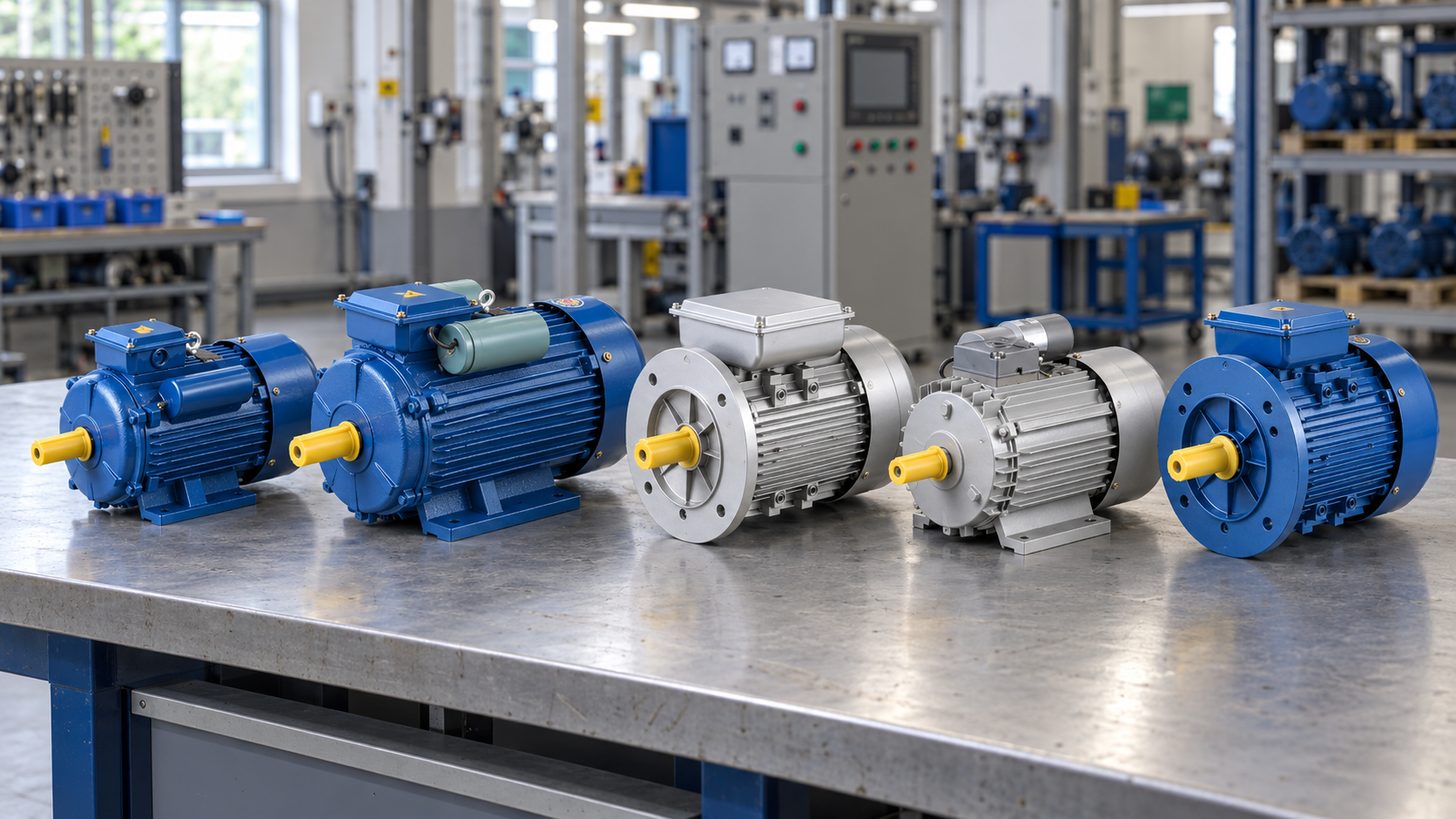
B3 motors are foot mounted, B5 motors are flange mounted and B35 motors have feet and a huge flange. Keeping the main mounting styles across your product range helps reduce the number of special models you have to store, and make replacement orders easier to confirm.
7. Enclosure, Cooling, and Insulation
The enclosure and IP rating are a measure of how well the motor is protected against solid objects, dust and water. It is based on the cooling method, the insulation class, the ambient temperature and the height of installation whether the motor can control its temperature during a long operation.
Aluminium motor frames save weight and ease of handling. Cast-iron frames are commonly used for equipment that needs a heavier and stronger enclosure. Neither material will on its own provide greater motor performance, so you should check the overall electrical and mechanical design.
8. Capacitors and Starting Parts
Start capacitors are meant for short use at starting, run capacitors are meant to stay connected. They seem the same but are not interchangeable on the basis of size or terminal shape alone.
For each motor model, record the capacitor type, capacitance, voltage, tolerance and connection method. It’s important to have the right centrifugal switches, relays and capacitors as spare parts so you can solve typical beginning difficulties without having to replace the full motor.
9. Testing with the Driven Equipment
A good motor test should include cold start, hot restarter, loaded start, operating current, speed, temperature rise, vibration and noise. When possible, the test should be made on the real pump, compressor, fan, or machine, since a no-load motor test will not show that the full equipment will start and run properly.
After testing, prepare an approved list of motors and equipment with voltage, current, temperature and starting time limits clearly defined. This makes model selection a repeatable process for the purchasing, sales, assembly and after sale teams.
VII. Conclusion
The right single phase induction motor depends on more than power and price. [5] Match the beginning method: starting torque, speed, current, voltage, duty, frame, shaft, and mounting form to the driven equipment. HunGerät can help you in selecting motors and matching equipment for pumps, compressors, fans, small machinery, and agricultural equipment suited to your load needs, power supply, installation dimensions, and target market.
VIII. FAQ
1. Why Can Two Single-Phase Motors with the Same Power Have Different Starting Torques?
They use different windings, capacitors, rotors, and starting systems, so their starting torques can be different. same kW or HP does not translate to the same starting performance. Compare the Tstart/Tn value and check the actual driven load.
2. Can a Capacitor-Start Motor Be Replaced with a Dual-Capacitor Motor?
It can only be replaced if voltage, power, speed, current, direction of rotation, frame, shaft, and mounting dimensions are the same. The run capacitor can change the operating current and motor performance, so the replacement should be checked in the equipment.
3. Does a Dual-Capacitor Motor Always Use Less Electricity?
A dual-capacitor design can increase power factor and running performance but does not guarantee lower energy use in every motor. Compare input power, efficiency, current and output under the same load before making an energy claim.
4. What Happens If the Start Capacitor Does Not Disconnect?
The start capacitor and start winding are not meant to run continuously and can overheat quickly. Check the centrifugal switch or the beginning relay before putting in another capacitor or the new one will fail the same way.
5. Can a Higher-μF Capacitor Increase Motor Power?
A higher-μF capacitor does not increase the rated shaft power of the motor. Use the recommended capacitance and tolerance, as an incorrect capacitance might increase current, create heat and harm the winding or starting components.
6. Why Does a Single-Phase Motor Hum but Fail to Start?
Common causes are low voltage, blown capacitor, bad starting switch, blocked shaft, too much load or bad windings. Disconnect electricity before replacing motor and check shaft, voltage, capacitor, switch and driven equipment.
7. How Can You Check Whether a Motor Has Enough Starting Torque?
Compare the starting-torque ratio of the motor with the torque needed to get the equipment moving from a stop. Run both cold and hot loaded-start tests, as some pumps and compressors are tougher to restart after running.
8. Can the Rotation Direction of a Single-Phase Induction Motor Be Reversed?
In many single-phase motors the change can be made by switching the connections of the auxiliary winding to the main winding. Do not simply swap the two supply wires in an attempt to reverse the motor, as this will not generally work; use the motor wiring diagram.
9. Can a Single-Phase Capacitor Motor Be Used with a VFD?
A normal three-phase VFD will not work with a standard capacitor motor in most cases. Use a controller that is approved for that specific single-phase motor, or choose a three-phase motor and matching VFD for variable-speed operation.
10. How Does Changing from 50 Hz to 60 Hz Affect Motor Speed?
60 Hz increases synchronous speed by 20% for the same pole count. For example, a two-pole motor would run at 3,600 rpm instead of 3,000 rpm. The actual loaded speed is slightly lower and both motor and driven equipment must be rated for the new frequency.
11. Can a 220 V Motor Operate on a 230 V or 240 V Supply?
It can run only if the higher supply voltage is within the motor’s nameplate or manufacturer’s limits. Don’t assume every 220 V winding has the same voltage tolerance; measure the running current and temperature under load.
12. Why Is the Actual Motor Speed Lower Than the Synchronous Speed?
Induction motors need a slight difference between the speed of the rotor and the speed of the stator. This difference is known as slip. Slip allows current to be induced into the rotor which produces torque. Two-pole motors at 50 Hz commonly run near 2800 – 2900 rpm and four-pole motors near 1400 – 1450 rpm. The nameplate value is final.
13. Does the Same IEC Frame Number Guarantee the Same Shaft Size?
General reference dimensions are usually given by the same IEC frame number although design and market versions might still differ. Check the shaft diameter, shaft length, key, bolt spacing, flange and overall motor length from the drawing.
14. Can a B3 Motor Be Replaced with a B5 or B35 Motor?
The replacement is allowed only when the equipment is able to take the new form of mounting and that the shaft is kept in the right position. B3 utilizes feet, B5 uses a flange, B35 uses both feet and a flange so they are not automatic drop-in replacements.
15. Can an Aluminum-Frame Motor Replace a Cast-Iron Motor?
It can replace one when the electrical performance, mounting dimensions, shaft, cooling and operating environment are suitable. And while the housing material is not the only factor in compatibility, it does affect the mechanical strength and weight of the motor.
16. What Is the Practical Difference Between IP44 and IP54 Motors?
Both grades provide splash water protection. IP54 provides stronger protection against the entry of dust into the enclosure. Neither rating means that the engine can be submerged or left outdoors without proper rain, drainage, and terminal-box protection.
17. How Do High Temperature and Altitude Affect Motor Output?
A common reference condition is an ambient temperature up to 40 °C and an installation altitude up to 1,000 m. Above these conditions, cooling is less effective and the motor may require lower output or a design approved by the supplier.
18. Why Does a Motor Run Hot Even When Its Current Is Normal?
Poor airflow, high ambient temperature, frequent starts, bearing friction, or wrong capacitor might cause high surface temperature. Do not judge the motor by touch simply, check the cooling fan, ventilation path, duty cycle, bearings and winding temperature.
19. What Tests Should Be Completed Before Ordering Motors in Bulk?
Test cold start, hot start, loaded start, current, speed, temperature rise, vibration, noise, direction and mounting dimensions. Approve a sample on actual driven equipment and set suitable limits to be used for batch inspection.
20. What Information Should You Provide When Ordering a Single-Phase Induction Motor?
Driven equipment, starting condition, needed output, speed, voltage, frequency, duty, frame, mounting form, shaft dimensions, rotation direction, operating environment. If you are considering a replacement motor, please include the nameplate, dimensions design, capacitor information, wiring diagram and clear pictures of the current motor.