I. Introduction
A family pool, a hotel pool, a spa, and a solar pool all require water circulation, but they don’t all use the same pump. Their running hours, flow requirements, power supply, controls, and piping systems might all be highly different. Knowing the main swimming pool pump types helps you develop a product range that meets real market needs without stocking many pumps that do nearly the same task.
II. What Is a Swimming Pool Pump?
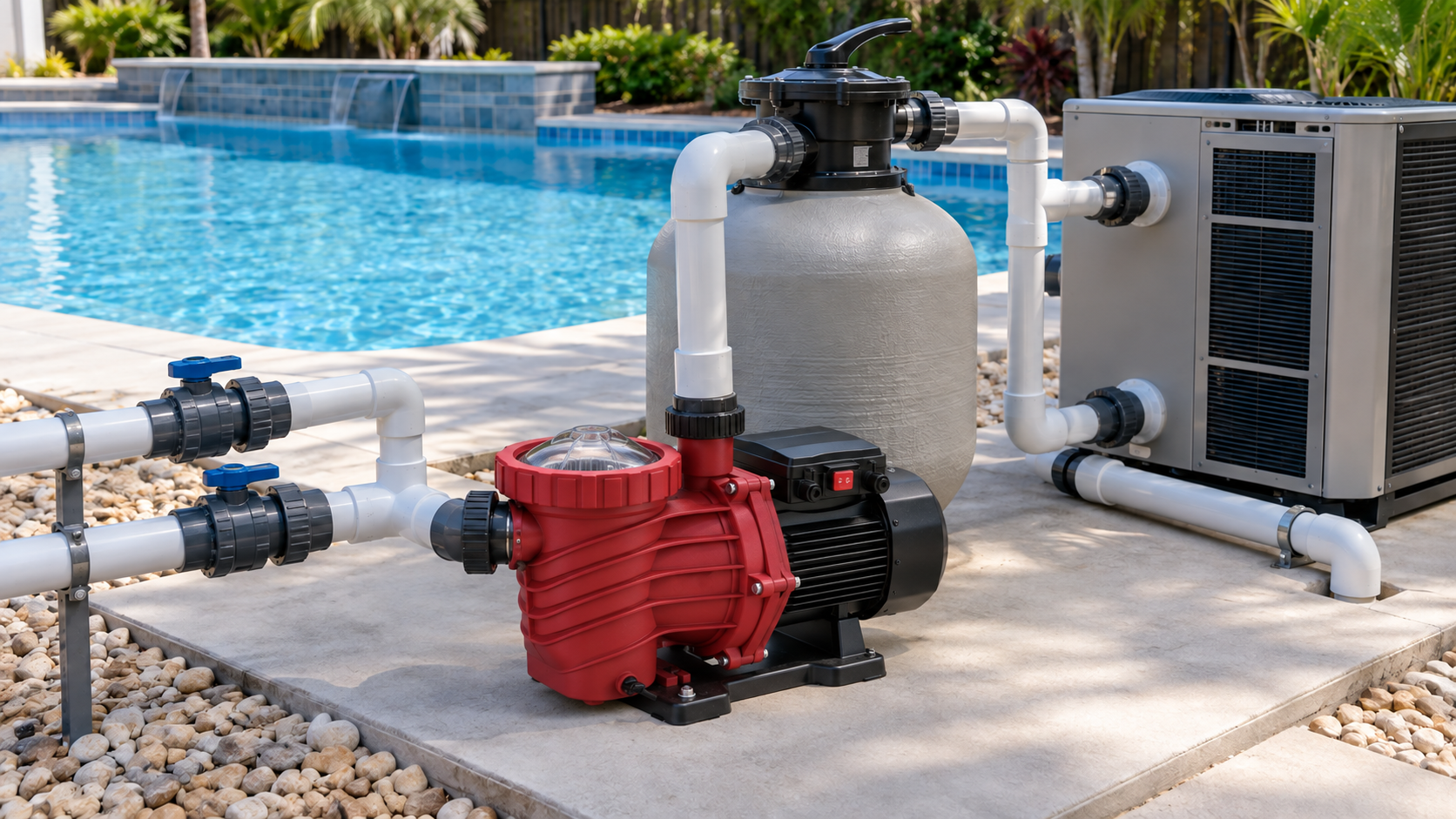
A swimming pool pump moves water through the pool circulation and filtration system. It draws water through the skimmer and main drain, traps larger dirt in the strainer basket, pushes the water through the filter, heater, or other treatment equipment, and returns it to the pool. It is not a general water transfer pump and is designed for long daily operation, treated pool water, and regular filter circulation.
III. Main Types of Swimming Pool Pumps
1. High-Performance Motor Pool Pumps
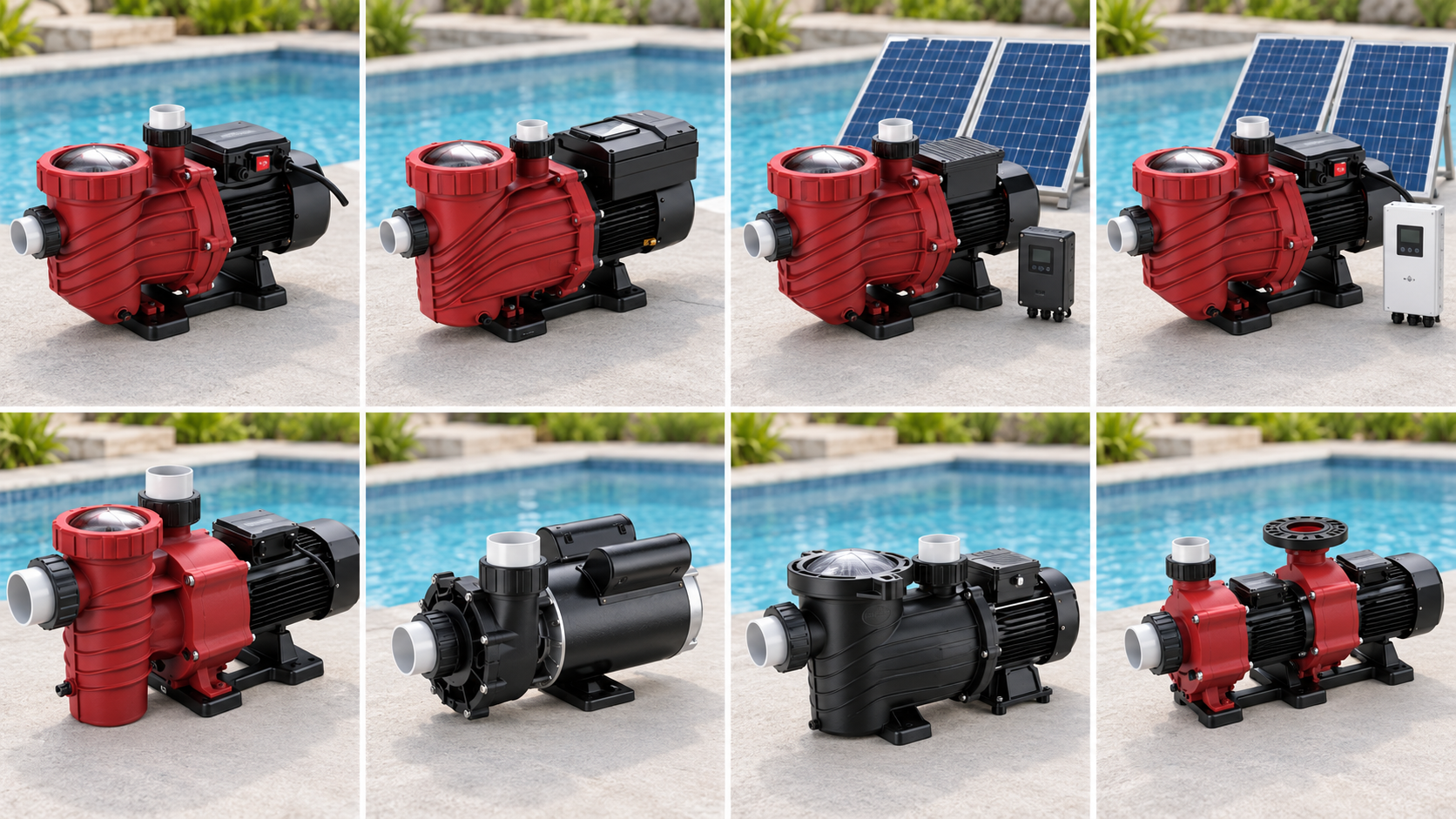
High-performance motor pool pumps are common circulation pumps used to circulate water through the pool filter and back into the pool. They usually use a fixed-speed induction motor, a pump body made for treated pool water, and a filter basket that catches leaves and other larger debris before they can make it to the impeller.
This model is simple to use, has common wiring, and is simple to replace, making it a good main product for average residential and smaller commercial swimming pools. When comparing models, look at the flow available at the actual system head, and don’t assume a bigger motor would give better filtering.
2. Variable-Speed Permanent-Magnet Pool Pumps
Variable-speed pool pumps use an electronic controller to adjust the motor speed depending on the work being done. Daily filtering can be done at a lower speed, and backwashing, heating, cleaning or water features at a higher speed.
Slowing down reduces flow and pressure, but may also reduce power use and noise. The result will depend on the piping system and the daily schedule, so this type is best used when the pool can run for longer periods at a lower flow. Variable-speed pumps are a good choice for markets where the lowest purchase price isn’t quite as important as running cost, quiet operation and automatic control.
3. DC Solar Pool Pumps
DC solar pool pumps are powered by solar panels with a matching controller. They are usually used where there is no grid power or the power is unreliable or expensive, e.g. at remote resorts, farms, holiday cottages, and outdoor swimming pools.
The pump, controller, and solar array are to be considered as a system. Panel voltage determines if the controller will start, and total panel power determines the length and strength of the pump run. If we give you a matching solar system, then you don’t have to worry about what happens when you have a good pump and a wrong panel layout.
4. AC/DC Solar Pool Pumps
AC/DC solar pool pumps can use solar power during sunny periods and change to an AC supply when the solar input becomes too low. This gives the system more stable running hours than a DC-only setup.
This type is useful for pools that need regular filtration even when the weather changes. Before selecting it, you should confirm whether the project needs solar-only operation, automatic AC backup, or scheduled operation. This prevents customers from paying for a dual-power system when solar-only circulation would already meet their needs.
5. Large-Flow Commercial Pool Pumps
Large flow commercial pumps are used for public pools, hotels, water parks, large aquariums, and other systems that require a large volume of water moved within a certain turnover time. They usually have wider water channels, pipe connections, motors, and filter baskets than those in household pumps.
A high maximum flow rate does not always mean a pump is right for a commercial pool. The pump must be able to provide the needed flow after allowing for the resistance of the pipes, filter, valves, heater, and other equipment. For larger projects, two or more pumps may also be used to provide backup and allow part of the system to continue running during repair.
6. Spa and Leisure Pumps
Spa and leisure pumps are made for massage jets, hot tubs, and other systems that need a high flow of water. Their hydraulic design is to provide the flow and pressure needed by the jet system, not just to move water through a pool filter.
Never buy a spa pump based on horsepower or size of outlet alone. The choice depends on the number of jets, the flow needed for each jet, the pipe layout, the temperature of the water and the expected running time. You will want to separate the spa pumps from the regular filtration pumps so you can quote the right curve and not have weak jet performance.
7. Small Household Pool Pumps
Small household pool pumps are small circulation pumps for family pools and other small filtration systems. They often run on house power and have simpler controls, making them easier to install and replace.
This type gives you an entry-level range without using a large standard or commercial pump. The pump still has to be sized for the pool volume, the filter flow limit and the pipe size. Oversized pumps can be louder and create more pressure, and won’t improve the pool’s water quality.
8. Multifunctional Plastic Pool Pumps
Multifunctional plastic pool pumps are suitable for a range of water circulation setups and can be supplied with different inlet, outlet or mounting layouts. Their plastic wet-end sections also prevent pool water from coming in close contact with various outside metal items.
These pumps are helpful if the normal home layout is not the same as the pipe layout of the project. But “multifunctional” doesn’t mean that one pump will be perfect for every pool. You should still check the pump curve, connection drawing, water treatment method, material limits, and installation space before you give a model.
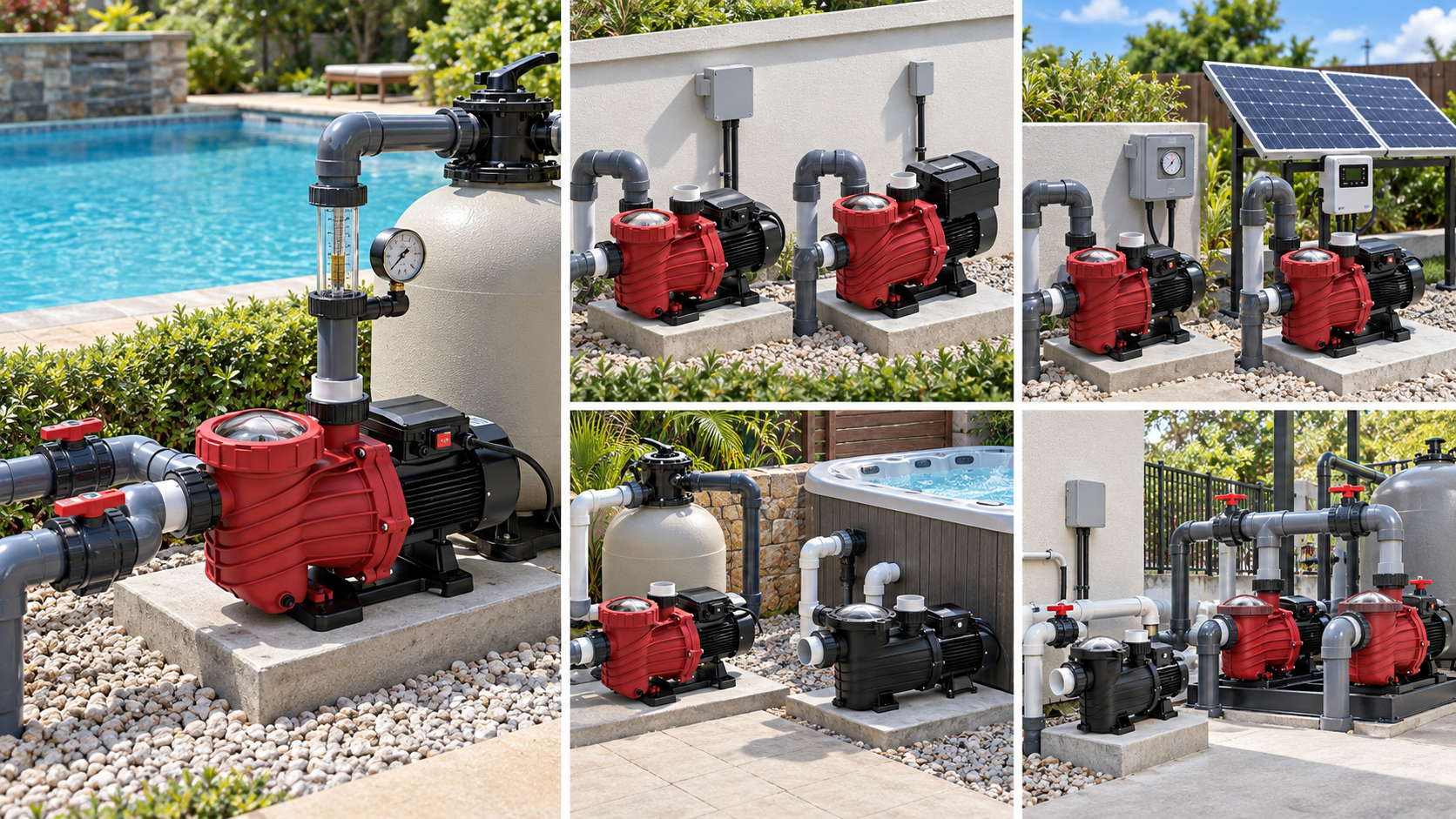
IV. Comparing Different Swimming Pool Pump Types
1. Filtration Flow and Pool Turnover
Start with the volume of the pool and the required turnover time:
Required flow = Pool volume ÷ Turnover time
A pool of 60 m³, which needs to be turned over in six hours, requires an average filtration rate of roughly 10 m³/h. The chosen pump must be able to deliver this flow at the real system head, not under the low-resistance conditions used for the maximum-flow figure.
This calculation allows you to compare household, standard and commercial pump types on equal terms. It also stops you from relying on motor power for your main means of selection.
2. Fixed-Speed and Variable-Speed Operation
When a fixed-speed pump is started, it runs at one motor speed. It is easy to install and is often enough for systems with a steady flow demand and a set filtration schedule.
A variable-speed pump can run at different speeds for filtration, backwashing, heating, and water features. Also more expensive and has to be programmed correctly, but provides the system more control over the daily running time, the noise and the power use.
3. Grid and Solar Power
Where reliable grid power is available, the direct choice is a regular AC pool pump. Usually compatible with standard timers, switches, and pool control panels.
A solar pump is more useful if daylight solar power can do most of the filtration. DC solar models depend mainly on available sunlight, while AC/DC models work with another power source when longer or more reliable operation is needed.
4. Filtration and Spa Circulation
A filtration pump circulates a constant flow of pool water through the filter. Its selection is mainly based on pool volume, turnover time, filter capacity, and system head.
A spa pump provides massage jets that can require a variable combination of flow and pressure. Using the same motor power, the same selection method for both systems can lead to bad filtration or weak spa jets.
5. Household and Commercial Systems
For one pool, household pumps are often used for a shorter piping system and simpler controls. Very high maximum flow is usually not as useful as a compact size and quick replacement.
Commercial systems may have larger pipes, many filters, heaters, water treatment equipment, and long daily running hours. They need more attention to pump curves, motor workload, backup capacity, pipe size, and access for maintenance.
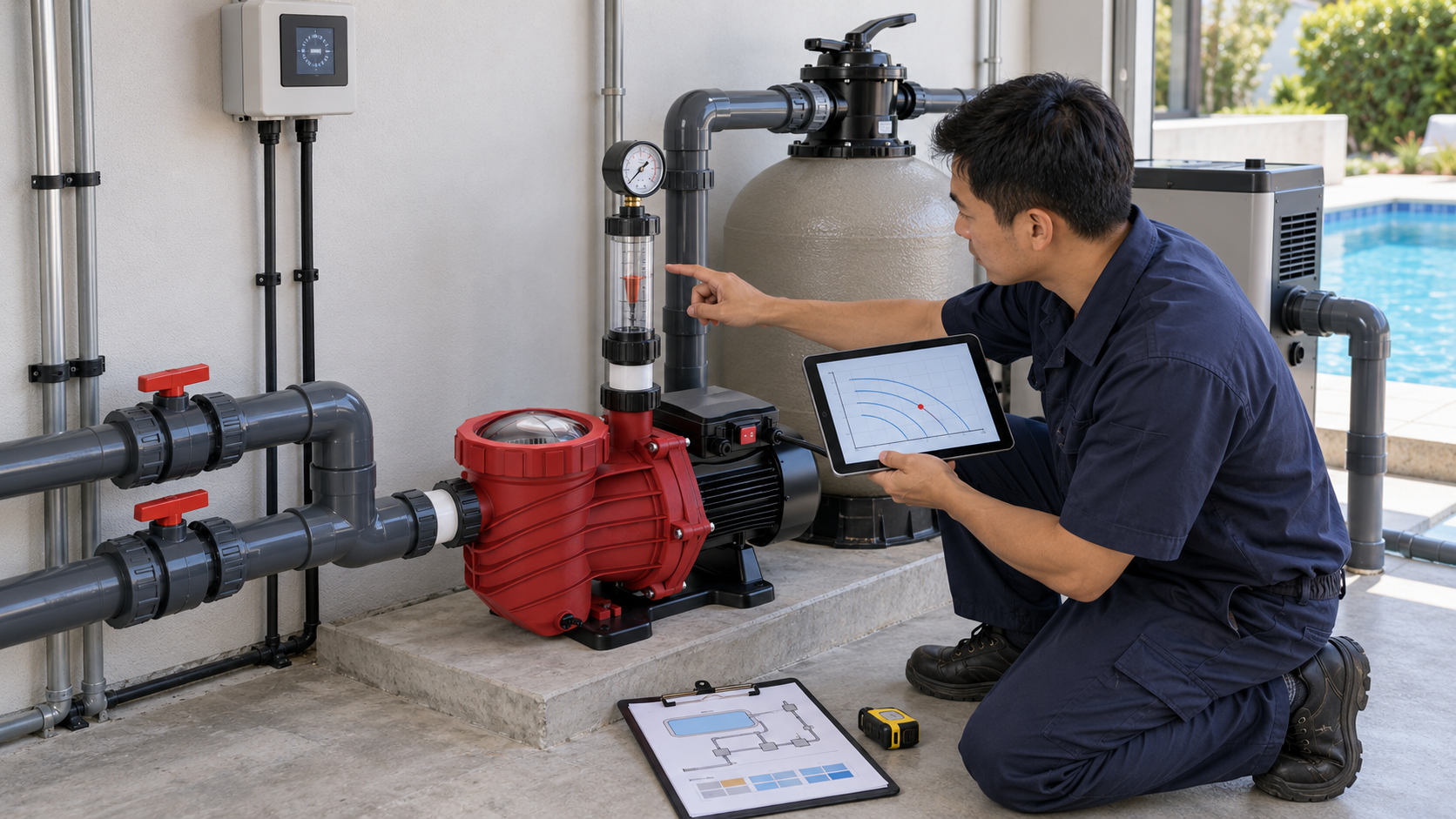
V. Key Points When Choosing a Pool Pump Type
1. Use the Working Point, Not the Maximum Figures
Max flow and max head are at opposite ends of the pump curve. You have to find the required flow and total head together and then look at where that point is on the curve.
This means that the comparison of models becomes a more reliable process and reduces complaints about poor flow after installation.
2. Match the Pump and Filter
Every pool filter has an allowed flow range. Too much water going through the filter increases pressure and lowers filtering performance.
By combining the pump curve and filter rating, you may provide a full circulation system, not two suitable products that do not perform well together.
3. Check the Pipe Size and Layout
Long pipes, tiny pipe diameters, many bends, and extra pool equipment add resistance. If a pump is put in such a system, it may deliver less water than planned.
Ask for pipe size, rough length, and key equipment before choosing a commercial or spa pump. These details matter less for a small household system, but can make a huge difference for a bigger installation.
4. Confirm the Daily Running Pattern
A pool that is used only sometimes may need a simple, fixed-speed pump. A hotel or public pool that runs year-round would be better off with speed control, set running times or more than one pump.
Knowing the day’s plan allows you to compare the cost of purchase with the long-term power use and maintenance needs.
5. Separate Standard and Special-Use Pumps
Most normal filtration requests can be filled by standard circulation pumps. Only select solar, spa, variable-speed, large-flow, and multifunctional pumps where there is a clear power, control, hydraulic, or installation need.
It allows you to keep a practical stock core and deal with special types through planned orders or project quotes.
VI. Conclusion
Swimming pool pumps can be divided by motor type, control method, power source, pool size, and main use. Standard motor pumps handle regular filtration, variable-speed pumps provide more control, solar pumps serve solar-powered systems, commercial pumps handle higher circulation needs, and spa pumps are designed for jet systems.
Knowing these differences helps you build a product range around actual applications rather than collecting models with similar power ratings. If you need help comparing pool pump types, HunGerät can review your required flow, head, power supply, pipe size, pool use, and control needs and provide suitable pump curves and model options.
VII. FAQ
1. Is a Larger Pool Pump Always Better?
No. An oversized pump can increase noise, system pressure, and power use without increasing water quality. The flow of the pump should be equal to the pool turnover requirement and the filter capacity.
2. What Is the Main Difference Between a Pool Pump and a Spa Pump?
A pool pump mainly helps with filtration, but a spa pump provides the flow and pressure for massage jets. Their motor power may be the same, but their pump curves may be different.
3. Can a Household Pool Pump Be Used for a Commercial Pool?
Only if it can deliver the needed flow at the actual head of the system and is rated for the expected operating time. Larger commercial systems use pumps designed to run longer and larger pipe systems.
4. Can a Commercial Pool Use Several Smaller Pumps?
Yes. You can have a number of pumps as backup. The system can vary the number of pumps in action to suit demand. The pipe and control system must be built to fit this layout.
5. Does a Variable-Speed Pump Always Use Less Power?
It can operate at a lower speed using less electricity for parts of the filtration cycle that need it. The savings are based on the setting of the speed, the running time, and the resistance in the system.
6. Can a Variable-Speed Pump Run at Full Speed All Day?
It can, if the motor and controller allow it, but that removes much of the use of speed control. Full speed should only be used when the system requires a higher flow.
7. Can a Solar Pool Pump Work on Cloudy Days?
It might continue working at a slower speed if there is still plenty of solar energy remaining. An AC/DC system is a better option when weak sunlight requires constant circulation of the pool.
8. Can a DC Solar Pool Pump Be Connected Directly to AC Power?
Not at all. Requires a suitable controller or power converter system. Hooking it directly to AC power could ruin the motor and controller.
9. Does a Solar Pool Pump Need Batteries?
Not always. Many systems are designed to run straight off the solar panels during daylight hours, with batteries or AC backup only being used when operation is required outside of sunlight hours.
10. How Is the Required Pool Pump Flow Calculated?
Take the pool volume and divide it by the needed turnover time. Then choose a pump that will deliver this flow at the actual total head.
11. Why Is Actual Pump Flow Lower Than the Maximum Flow?
Resistance is added to the system via pipes, filters, valves, heaters, and height differences. The usual measure of maximum flow is with minimum resistance.
12. Can the Pump Flow Be Higher Than the Filter Rating?
Normally, this should not exceed the flow allowed by the filter. Too much flow can boost pressure and lower the time water spends in the filter.
13. Does a Larger Pipe Improve Pool Pump Flow?
Correctly sizing a bigger pipe can reduce resistance, especially for long runs. But still the pipe must meet the pump connection and system design.
14. Are All Pool Pumps Self-Priming?
No. The self-priming ability is a result of the pump design and installation method. If the pump is located above the pool water level, see if it can remove air from the suction pipe.
15. Can a Spa Pump Run Continuously?
Only if the motor and pump are rated for continuous duty. Some spa systems are made for shorter jet cycles, so you have to check the allowed duty.
16. Can a Pool Pump Handle Hot Spa Water?
Only if seals, pump body, and other wet end parts are rated for the actual water temperature. Check the temperature limits for each spa application.
17. Can a Plastic Pool Pump Be Used with Salt Water?
Plastic parts add useful corrosion resistance, but seals, shafts, and other internal parts must match the salt level as well. Check the whole list of materials, not only the pump body. Check the material.
18. Can the Same Pool Pump Work at 50 Hz and 60 Hz?
Only if the motor or the electronic controller is made for both frequencies. Changing frequency can affect motor speed, flow, head, and power demand.
19. How Often Should a Pool Pump Run?
The pump should be operated long enough to provide the required daily volume of water and water treatment. The actual time varies with pool size, pump output, usage, season, and local rules.
20. What Information Is Needed to Choose a Pool Pump Type?
Provide the pool volume, required turnover time, total head, pipe size, filter rating, voltage, frequency, phase, water temperature, daily running time, and main use. These details allow the pump type and operating point to be selected together.