I. Introduction
A peripheral pump and a centrifugal pump may have the same motor power and similar connection sizes, but their actual performance can be significantly different. Peripheral pumps often deliver less flow at higher pressure, while ordinary centrifugal pumps are better suited to transport water in larger volumes. Understanding this distinction will help you to create a clearer product range, prevent duplicated SKUs, and match each pump type to the demand in your market.
II. Peripheral Pump and Centrifugal Pump Basics
1. What Is a Peripheral Pump?
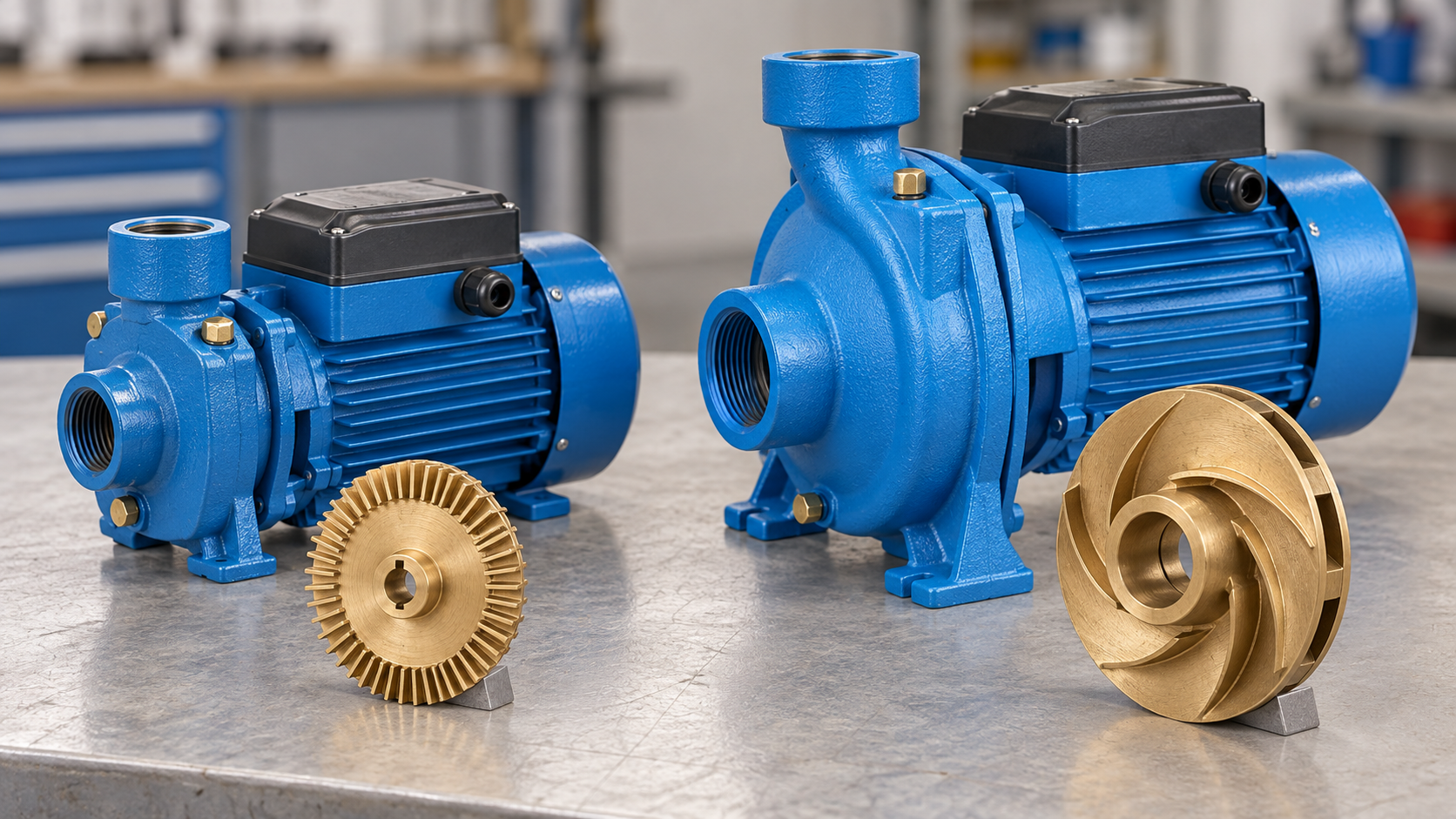
Peripheral pumps have an impeller with multiple tiny blades on the outside edge. Water is moved back and forth between the blades and the tight channel in the pump casing, collecting energy before it reaches the outlet. This design provides a relatively high pressure at a limited flow rate from a small pump.
Peripheral pumps are often used for clean-water delivery, small pressure-boosting systems, equipment water supply, and other applications where greater pressure than flow is needed. They tend to be small and inexpensive at lower power levels.
Some manufacturers include Peripheral pumps in the broader category of centrifugal pumps since both types have a rotating impeller. However, in product catalogs, peripheral pumps are usually listed separately from typical centrifugal pumps because the impeller design, pump curve, flow range, and applications are distinct.
2. What Is a Centrifugal Pump?
For this comparison, a conventional surface pump with a radial-flow impeller is defined as a centrifugal pump. Water is drawn into the center of the impeller and is thrown outward as the impeller turns. Next, the volute or diffuser converts some of the velocity of the water into pressure.
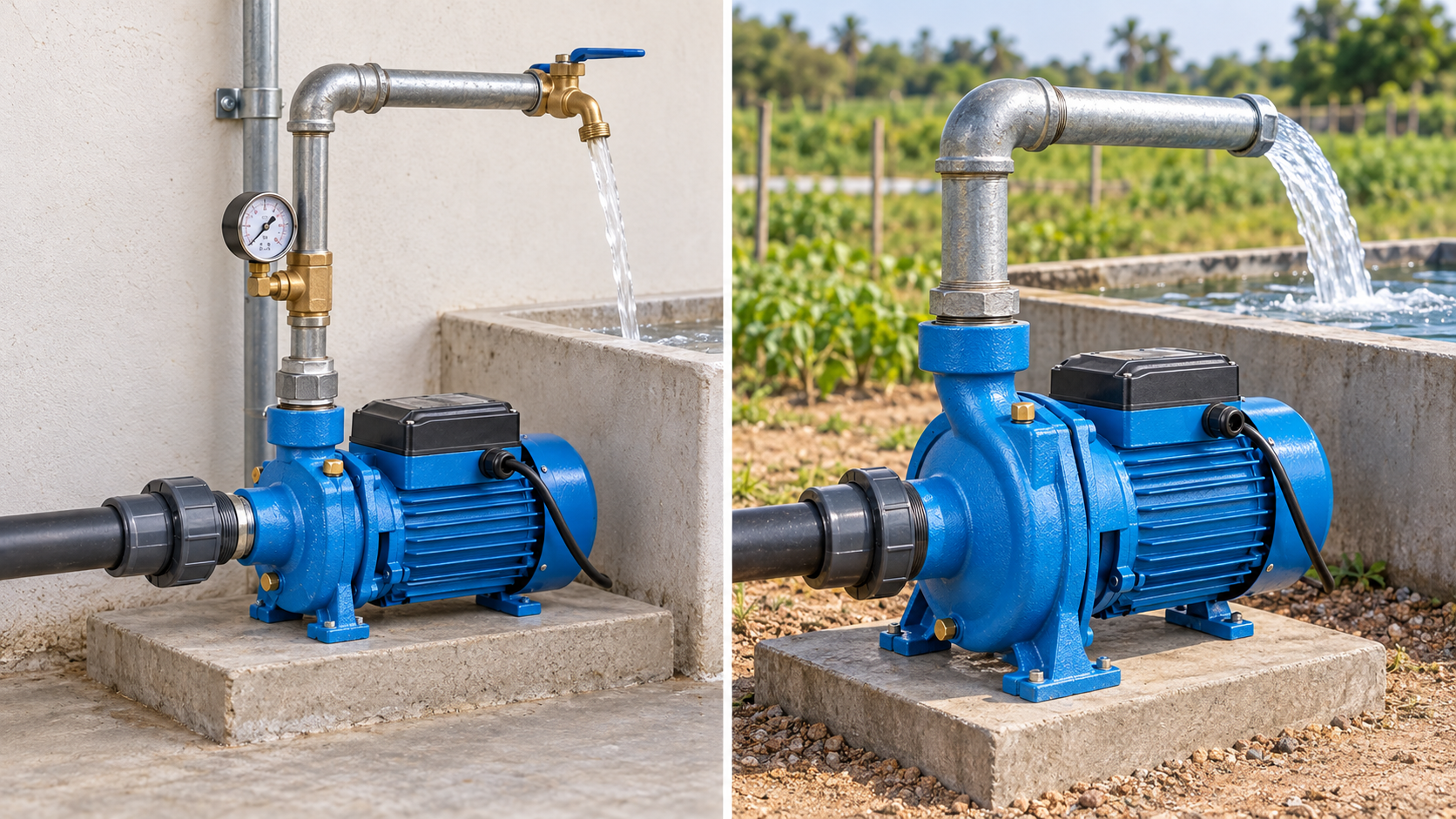
A standard centrifugal pump will normally move more water than a peripheral pump with the same motor. This is often used for tank filling, clean water transfer, irrigation, circulation, and general water supply if the system requires a greater flow at moderate head.
Centrifugal pumps are offered in a broader range of sizes and performance levels. This makes them ideal for the primary water-transfer category in many product lines. Peripheral pumps occupy a more specific niche of limited flow and high pressure.
III. Key Differences Between Peripheral and Centrifugal Pumps
1. Flow and Head Performance
The biggest difference between a centrifugal pump and a peripheral pump is the trade-off between flow and head. A peripheral pump often produces less water but greater head with a small motor. A centrifugal pump will usually deliver more flow but may have a lower maximum head at the same power level.
For example, two 0.75 kW pumps should not be compared by the power rating. The peripheral pump can be used for a small water supply when pressure is needed, and the centrifugal pump can be used for filling a tank or moving water over a field.
You must compare the pumps at the required operating point, not just their maximum values. Maximum flow is generally at extremely low head, and maximum head is with little or no water delivery by the pump. Neither figure alone shows real installed performance.
2. Impeller and Internal Flow Passage
A peripheral pump has many tiny blades around the edge of its impeller. The blades interact with a tiny passage in the pump casing, so the water gets energy numerous times before leaving the pump.
The typical centrifugal pump generally has fewer, bigger impeller blades and wider internal flow passageways. This design allows more water to go through the pump, which is one reason why centrifugal pumps often provide higher flow.
The distinction also extends to product positioning. A peripheral pump is not a small centrifugal pump, and a centrifugal pump is not always a lower-pressure peripheral pump. Different working needs are met by using different hydraulic structures.
3. Efficiency and Running Time
A standard centrifugal pump running near its best efficiency point is usually more efficient than a small peripheral pump. This is important when the pump is running for many hours, or pumping a large amount of water every day.
If the motor and pump are suitable for continuous duty, a peripheral pump can run continuously. It moves less water, however; therefore, one may need longer running time for a large-flow application. A lower purchase price does not necessarily indicate a lower total operational cost.
You should compare duty-point efficiency, motor current, temperature rise, and allowable running time for markets where pumps run for long periods of the day. This way you can distinguish between pumps designed for occasional delivery of tiny amounts of water and those for regular, high-volume transfer.
4. Water Quality Requirements
Peripheral pumps are made for clean water. Due to their limited impeller clearances and narrow internal passages, they are more prone to sand, rust, scale, and other particles. Contaminated water might block the flow channel or wear the impeller and pump casing.
They are standard clean water peripheral pumps, not sewage pumps. However, depending on the type and impeller design, their narrower internal flow passageways may make them more susceptible to very fine particles.
Your market has wells, ponds, or storage tanks that often contain sand or sediment; you must check the allowed particle size before choosing any type. A strainer may keep heavier debris out of the suction line, but it won’t turn a clean-water pump into a dirty-water pump.
5. Priming and Suction Performance
Most ordinary peripheral and centrifugal pumps have to be filled with water before the initial start. The impeller needs to pump water correctly, so the pump casing and suction line must be clear of air.
A higher max head does not guarantee that a peripheral pump is better at suction or self-priming. Head is a measure of the pressure that the pump can generate on the discharge side, but suction is affected by the design of the pump, the water level, the pipe resistance, the airtightness, and the atmospheric conditions.
A model should not be sold as an alternative to a jet pump or self-priming centrifugal pump unless it is explicitly built as a self-priming model. This distinction is particularly essential in markets where pumps are mounted above wells, tanks, or ponds.
6. Size, Cost, and Product Position
Peripheral pumps are usually compact because they can generate useful pressure from a small hydraulic design. They are frequently sold as a low-cost choice in lower-power clean-water applications for consumers who want pressure but not a high flow.
Centrifugal pumps come in a greater variety of body sizes, outlet diameters, materials, and motor powers. The price depends a lot on the pump design and needed performance. So a centrifugal pump is not necessarily more expensive than a peripheral pump.
When comparing prices, be sure you are comparing models with identical motor quality, materials, protection, and duty ratings. Otherwise, the difference may be the motor or construction, not the pump type.
| Comparison | Peripheral Pump | Centrifugal Pump |
| Main performance | Lower flow and higher head | Higher flow and moderate head |
| Impeller design | Small blades around the impeller edge | Radial-flow impeller |
| Internal passages | Relatively narrow | Generally larger |
| Suitable liquid | Clean water | Clean water |
| Common applications | Small water supply and pressure boosting | Water transfer, irrigation, and tank filling |
| Priming | Usually required | Usually required |
| Typical position | Compact, pressure-focused pump | General water-transfer pump |
IV. Common Applications
1. Small Water Supply and Pressure Boosting
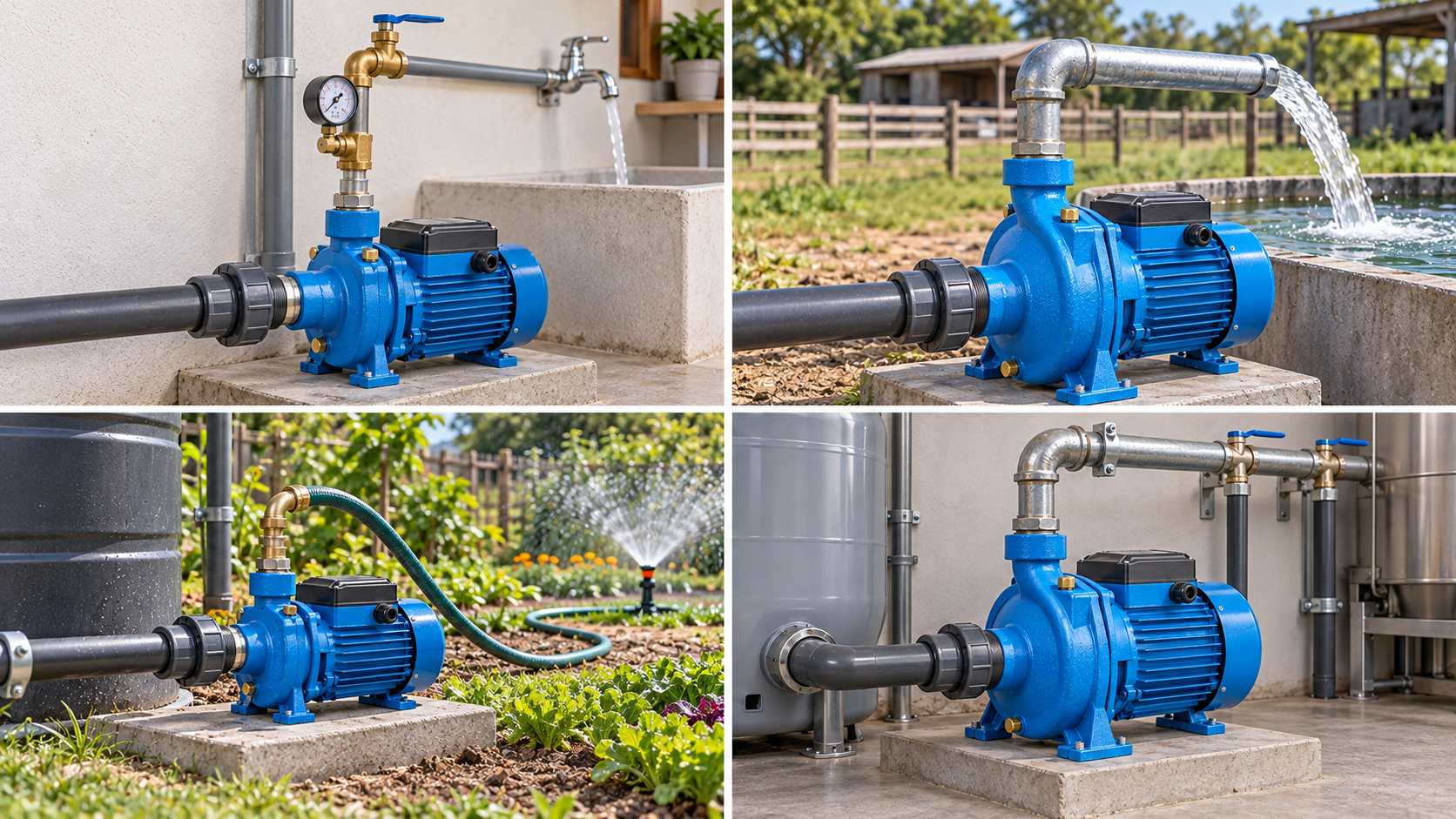
Peripheral pumps are used for small clean water systems that demand pressure but not high flow. Typical examples include providing fewer outlets, pushing water through smaller pipes, and providing water to light equipment.
Their tiny size and pressure-oriented performance might be a useful entry-level category in markets with a regular need for small household and light commercial pumps. But the required flow should be checked anyway. High pressure does not compensate for a lack of water volume.
In areas where demand is predominantly from small properties, water tanks, and simple pressure systems, peripheral pumps can offer a distinct price and performance level that does not directly compete with bigger centrifugal pumps.
2. Tank Filling and General Water Transfer
For filling tanks and moving bigger amounts of water, centrifugal pumps are often the better choice. They pump more water per hour than peripheral pumps of the same motor power, at a given operating head.
The higher the flow, the less time it takes to fill up a tank or transport a set volume of water. This makes centrifugal pumps more suited to product lines aimed at agricultural water transfer, commercial supply, and regular tank filling applications.
Compare models for this market using the required lift and pipe loss data. A pump with a high maximum-flow number may pump far less water than you need after it is installed.
3. Small Irrigation and Garden Watering
A peripheral pump can be used for small irrigation systems where the application requires a moderate pressure and the number of outlets is limited. Its actual flow at the required sprinkler or hose pressure must still be enough for the working outlets.
For wider areas of irrigation, a centrifugal pump is usually a better compromise between flow and head. If many sprinklers are working at the same time, or if the system has a long delivery pipe, high-head centrifugal or multistage pumps may be necessary.
This distinction can help you avoid marketing every high-head pump as an irrigation option. A high maximum head is useless if the pump cannot produce the flow necessary at the sprinkler operating pressure.
4. Light Commercial and Equipment Water Supply
Peripheral pumps may be suitable for light equipment that requires a small, pressurized supply of clean water. Before selecting the pump, the equipment manufacturer’s necessary flow, pressure, liquid temperature, and operation time must be checked.
Centrifugal pumps are better suited to equipment that demands a bigger circulation or supply flow. They also have a greater range of performance, making it easier to fit them to a variety of commercial activities.
We separate these applications by needed flow and pressure to give a clear function to each product type. It also reduces direct pricing comparisons of pumps designed for different operating points.
V. Choosing Between a Peripheral Pump and a Centrifugal Pump
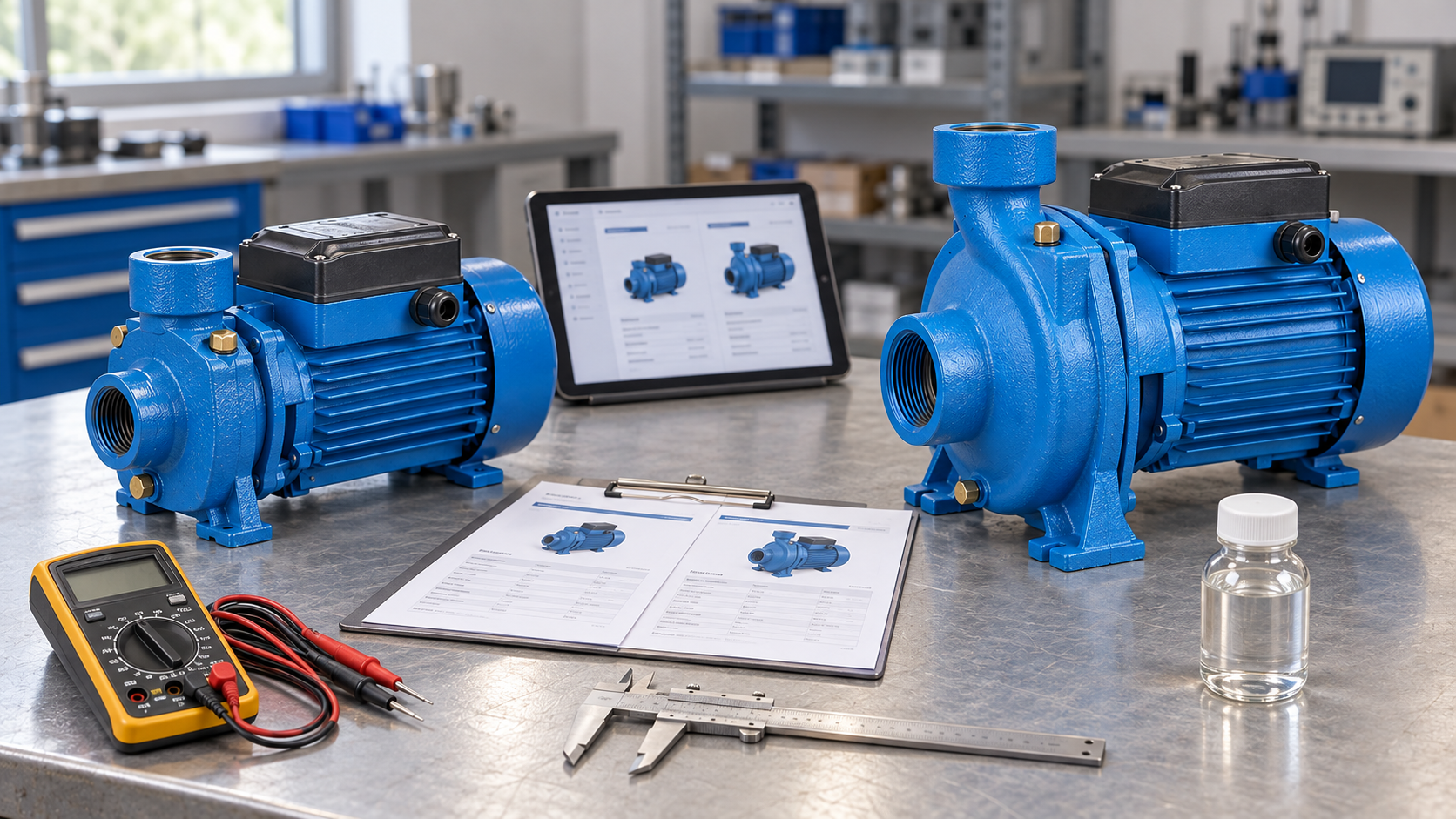
1. Start with the Required Flow
Begin with the amount of water the application needs per minute or per hour. If the main purpose is fast tank filling, large area irrigation, or standard bulk water transport, a centrifugal pump is generally the better first choice.
When the amount of water needed is limited, but the system needs a higher discharge pressure, a peripheral pump is more suitable. Choosing it only on the basis of maximum head may lead to slow filling or inadequate combined flow.
The easiest way to distinguish the two categories for your product range is flow demand. This makes it harder for users to compare two pumps with the same motor power as if they deliver the same water output.
2. Confirm the Total Head
Total head is the vertical lift, plus the needed outlet pressure, plus losses from pipes, valves, bends, etc. The pump must be able to deliver the appropriate flow at this total head.
Peripheral pumps are effective when the operating point is a relatively low flow and higher head. Centrifugal pumps are often more suitable when the operating point demands more flow at a moderate head.
Use the complete pump curve, not the maximum numbers listed on the box. This provides you with a solid basis for model selection and helps avoid performance complaints due to inaccurate comparisons.
3. Check the Expected Running Time
The expected daily running time affects motor loads, temperature, energy consumption, and service life. Both types of pumps can be operated continuously with the design and motor rated for continuous operation, but should operate in the recommended portion of the curve.
A peripheral pump that is used for a task that requires a higher flow may have to run much longer than a suitable centrifugal pump. This can eat into the early savings of purchasing a smaller or cheaper model.
Compare the long-term operating hours, values for current, efficiency, temperature rise, and continuous-duty ratings. These numbers are much more informative than assuming one type of pump is always suited for continuous use.
4. Confirm the Water Quality
Both pump types considered here are mainly clean water pumps. If you see sand, fibers, dirt or larger particles in the source, you may need a different type of pump.
Peripheral pumps need extra attention since their smaller channels are prone to tiny particles. The channels of a normal centrifugal pump may be wider, but the real limit of solids depends on the impeller and the casing in question.
Knowing the typical water conditions in your market might help you determine how wide the peripheral pump range should be. Areas with clean tank or municipal water could also have room for multiple models, while areas with sandy wells may have to focus on a different range.
5. Match the Electrical Configuration
The motor should be compatible with local voltage, frequency, and phase. You should also check the current, capacitor, thermal protection, insulation, cable, and plug requirements for the target market.
Two pumps could have comparable hydraulic performance but differing motor configurations. You can’t just change the nameplate on a 50 Hz motor and call it a 60 Hz motor. Frequency can alter motor speed, current, and pump performance.
In most cases, stocking the major local electrical version across the most relevant hydraulic models is more valuable than offering every voltage on every pump. This lets you control SKUs without missing any gaps in the main flow and head ranges.
6. Compare Materials and Build Quality
Pump type isn’t the only indicator of quality. You should also do comparisons of the pump body, impeller, shaft, mechanical seal, motor winding, bearings, and surface treatment.
Cast iron is the material of choice for general clean-water pumps, although for corrosion resistance, water-contact requirements or product positioning, stainless steel, brass, or engineering plastics can be used instead. It is usually necessary to check the material names against the real wetted sections, not by the appearance of the exterior shell.
A more expensive model should make a noticeable difference in materials, motor construction, test results, or operational performance. This gives you a technical foundation to build basic, better, and premium product tiers rather than dividing products on the basis of appearance only.
VI. Building a Clear Product Range
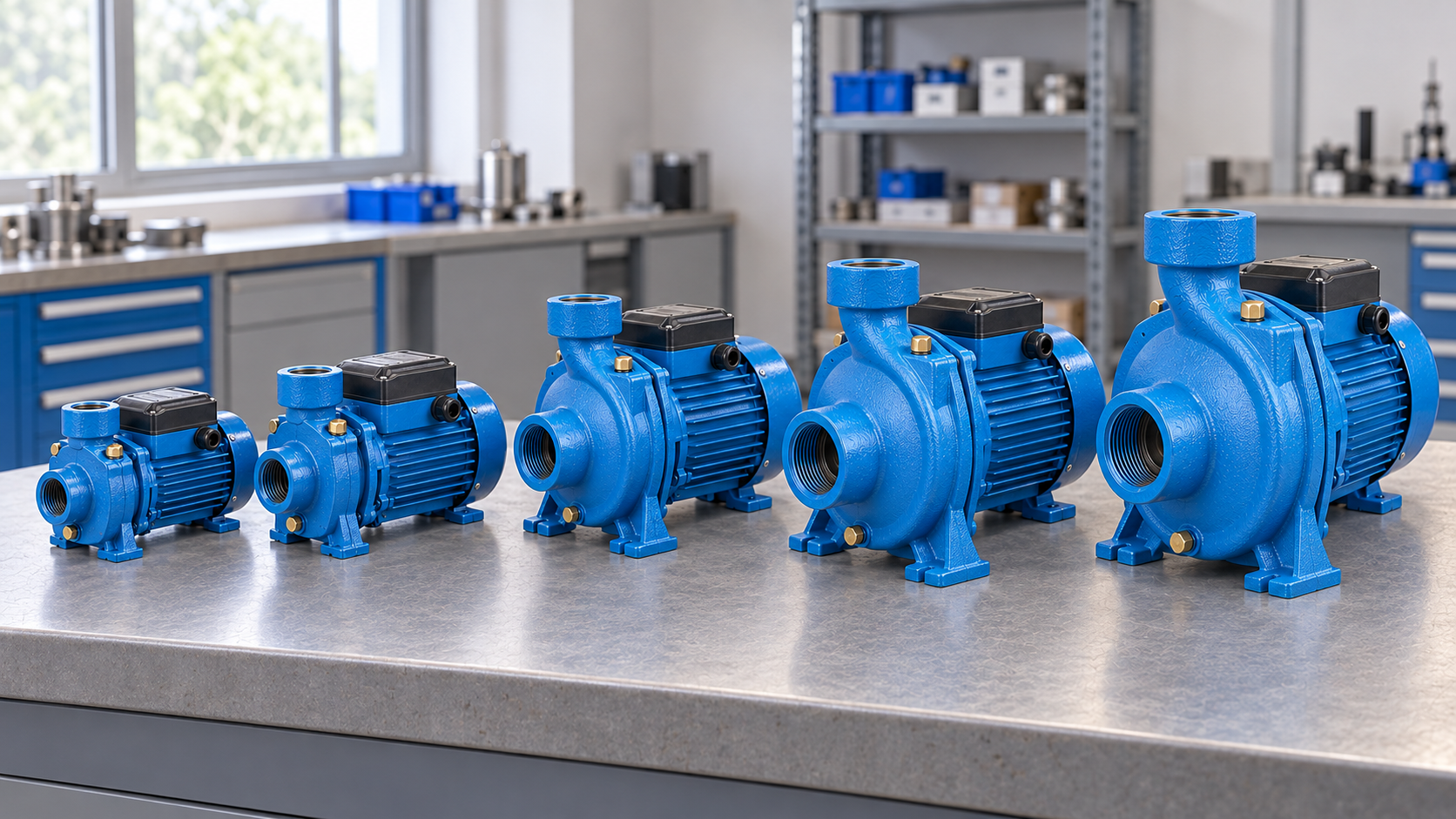
1. Separate Pressure-Focused and Flow-Focused Models
Your product range should include peripheral pumps in the lower flow and higher head section. The standard centrifugal pumps should cover the high-flow water transfer area.
This division provides a clear rationale for each series to exist. It also prevents a small peripheral pump from being advertised as a general transfer pump just because it has a high head figure.
With a defined performance boundary, your range is easy to control. You get both pressure-focused and flow-focused demand covered without carrying around different models that are competing for the same application.
2. Avoid Selecting Models by Power Alone
Motor power shows the amount of mechanical input available, but does not indicate how that power is used by the hydraulic design. Two pumps of 0.75 kW capacity can have varying flow, head, efficiency, and uses.
A range based on power alone can lead to several comparable motors that do not cover applications well. You may have a few pumps for small water transfer without a pump for higher pressure or larger flow.
We initially group the pumps by usable operating points and then compare their motor power. This provides you with a more realistic SKU structure and a clearer way to communicate the difference between the products.
3. Keep Useful Performance Gaps Between Models
Adjacent models should provide a significant increase in flow, head, connection size or application range. If their working curves are mostly overlapping, the extra SKU could split sales instead of expanding market penetration.
For example, when it reaches a greater flow band, adding another centrifugal pump is helpful. Adding a peripheral pump is helpful when it can meet a pressure need that cannot be met efficiently by the centrifugal pumps.
It is sometimes easier to stock and sell a smaller number of clearly distinct models than a big list of pumps with similar performance. This also allows you to concentrate order quantities on those models with the best market fit.
4. Match the Product Mix to Local Demand
Markets with stable demand for small water-supply and pressure applications could support a wider range of peripheral pumps. Markets including agriculture, tank filling and commercial water transport generally require more models of centrifugal pumps.
Product mix is also affected by local power conditions, water quality, pricing levels and connection requirements. Even a technically suitable pump may have low sales if its electrical version or pipe connection is not in line with local practice.
If you learn the distinction between peripheral and centrifugal pumps, you can adjust the ratio of these two pumps. And you can cover more practical applications, without cluttering your catalog with products that are different just in name or look.
VII. Conclusion
The performance requirements differ between peripheral and centrifugal pumps. The peripheral pump generally has a lower flow at higher pressure and in a compact design, whereas the typical centrifugal pump is suitable for higher volume water transfer at moderate head.
The choice between them is more than comparing the motor power, the maximum flow, or the maximum head. Verify the required operating point, water quality, running time, electrical standard, and product construction. This data helps you to develop clear product tiers, manage SKU overlaps, and reduce selection issues when the pumps reach your market.
HunGerät may offer specifications, performance curves, electrical configurations, and OEM options for peripheral and centrifugal pumps for different markets. Tell us your required flow, total head, voltage, frequency, application and target price range to compare suitable models for your product line.
VIII. FAQ
1. Is a Peripheral Pump a Type of Centrifugal Pump?
A peripheral pump is a rotodynamic pump with a rotating impeller but is generally classified as distinct from a traditional centrifugal pump. The steep pump curve and application range are the result of its regenerative flow channel.
2. What Is the Main Difference Between a Peripheral Pump and a Centrifugal Pump?
A peripheral pump normally provides lower flow at higher head, while a centrifugal pump normally provides higher flow at a moderate head. Compare both pumps at the same working head rather than by motor power alone.
3. Which Pump Provides Higher Pressure?
A peripheral pump will generally give a lower flow against a greater head than a centrifugal pump, which will normally give a higher flow against a moderate head. Compare both pumps at the same working head, not just by motor power.
4. Which Pump Provides More Water Flow?
A peripheral pump of the same power usually has a lower flow than a regular centrifugal pump. This makes it less suitable for tank filling, water transfer, and greater irrigation duties.
5. Can Two Pumps with the Same Power Have Different Flow and Head?
The shape of the pump curve is NOT a function of motor power. The power is shared between flow and head according to the impeller, casing, speed, internal channels, and hydraulic design.
6. Is a Peripheral Pump More Efficient Than a Centrifugal Pump?
The closer a conventional centrifugal pump is to its proper duty point, the more efficient it is. Efficiency still varies with model, so compare the curves and rated-point data rather than just pump type.
7. Which Pump Is Better for Pressure Boosting?
For low-flow pressure boosting, a peripheral pump is often well suited. In general, for higher pressure and more flow required by the system, a centrifugal or multistage pump is best.
8. Which Pump Is Better for Tank Filling?
The centrifugal pump is often better for tank filling as it can transfer more water at a moderate head. The filling time can be estimated by checking its actual flow at the installation head.
9. Which Pump Is Better for Irrigation?
If you need a larger volume of water for irrigation, the centrifugal pump is usually better. For a small number of outlets, the total flow must still be on the pump curve for a peripheral pump to be suitable.
10. Can a Peripheral Pump Handle Sand or Dirty Water?
No. A standard peripheral pump is designed for clean water and is particle sensitive. Sand and grit might block its small flow path or erode the impeller and casing.
11. Does a Centrifugal Pump Handle Particles Better Than a Peripheral Pump?
The standard centrifugal pump may be less affected by small particles because of the wider internal passages. If the manufacturer doesn’t specify a solids handling limit, it’s still a clean water pump.
12. Are Peripheral Pumps Self-Priming?
Not every peripheral pump is self-priming. Check the model and do not assume that a high pressure or a compact body gives the pump self-priming ability.
13. Do Centrifugal Pumps Need Priming?
In normal operation, standard centrifugal pumps must be primed before starting, which means that their casing and suction line must be full. The suction line is cleared of air only by a model that features a self-priming construction.
14. Can a Peripheral Pump Run Continuously?
Provided the motor and pump are rated for continuous duty, a peripheral pump can be run continuously so long as it is run within the recommended curve. The model limits for water supply, motor current, cooling, and liquid temperature should not be exceeded.
15. Why Is a Peripheral Pump Noisier in Some Applications?
Because of its narrow flow channel and repeated water movement, it might also have a higher-pitched operating sound than some centrifugal pumps. Noise can be increased by air in the suction line, cavitation, worn parts or operating outside the recommended range.
16. Can a Peripheral Pump Replace a Jet Pump?
Not automatically, as a jet pump is generally selected for suction lift and self-priming. It should be replaced by a peripheral pump only when the suction, flow, head and priming method are suitable.
17. How Should You Compare Peripheral and Centrifugal Pump Curves?
Choose the desired flow on the horizontal axis and read the head offered there. Compare both models at the same duty point, as the maximum flow and maximum head occur at different points.
18. Why Does a High Maximum Head Not Guarantee Strong Water Flow?
Maximum head is often determined at zero or near-zero flow. The pump may be delivering much lower pressure once the needed amount of water is flowing.
19. Which Pump Usually Has a More Compact Size?
In many low-power but high-head applications, a peripheral pump is more compact. The dimensions actually still depend mainly on motor, pump body, connection size and material.
20. What Information Should You Provide When Ordering These Pumps?
Specify required flow, total head, water source, suction height, voltage, frequency, phase, running time, and water quality. This allows the supplier to compare the operating points rather than just recommend a pump by power.