I. Introduction
When importing or distributing well pumps, the wrong pump type might result in slow-moving stock, installation problems, expensive warranty claims, and customers who can’t match products to their wells. The article compares jet pumps versus submersible pumps by well depth, performance, efficiency, installation, maintenance, and overall cost. It also shows you how to choose the right models and accessories and product mix for your market.
II. What Are Jet Pumps and Submersible Pumps?
1. What Is a Jet Pump?
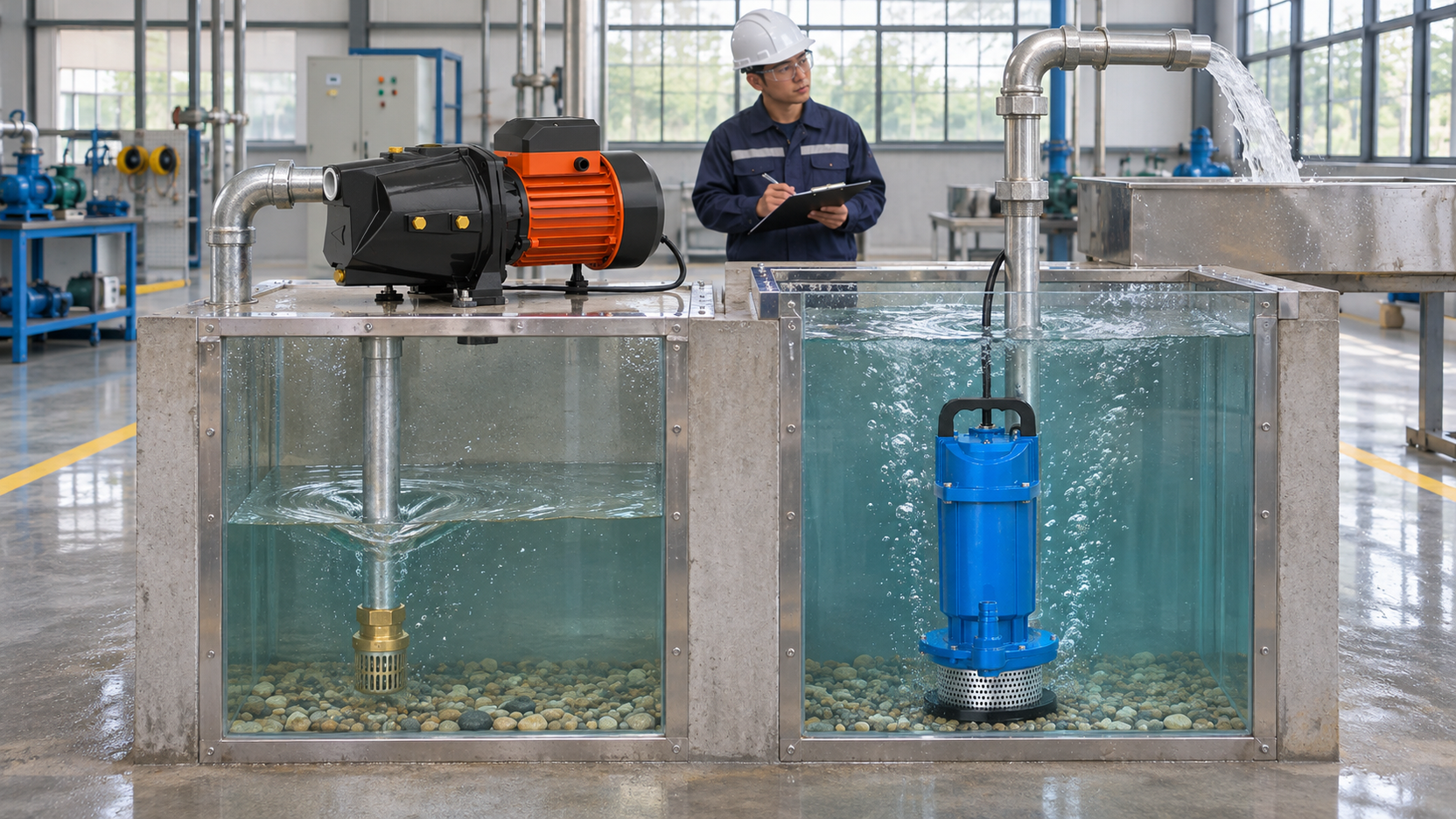
The jet pump is a centrifugal pump. It is located on the ground and uses a nozzle and venturi to create suction. A shallow well jet pump generally has its jet assembly within or immediately attached to the pump, while a deep well jet pump places the ejector inside the well and circulates water through two pipes. Both systems have the motor and main pump body above ground.
2. What Is a Submersible Pump?
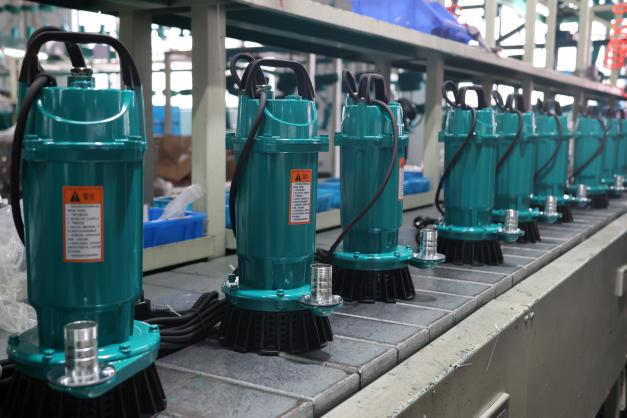
A submersible well pump is a thin unit that integrates a multistage pump with a sealed electric motor. It is placed inside the well, below the water level, and forces water up through a discharge pipe. As the pump is already submerged, it does not require surface suction or priming as does a jet pump.
III. Jet Pump vs Submersible Pump: Quick Comparison
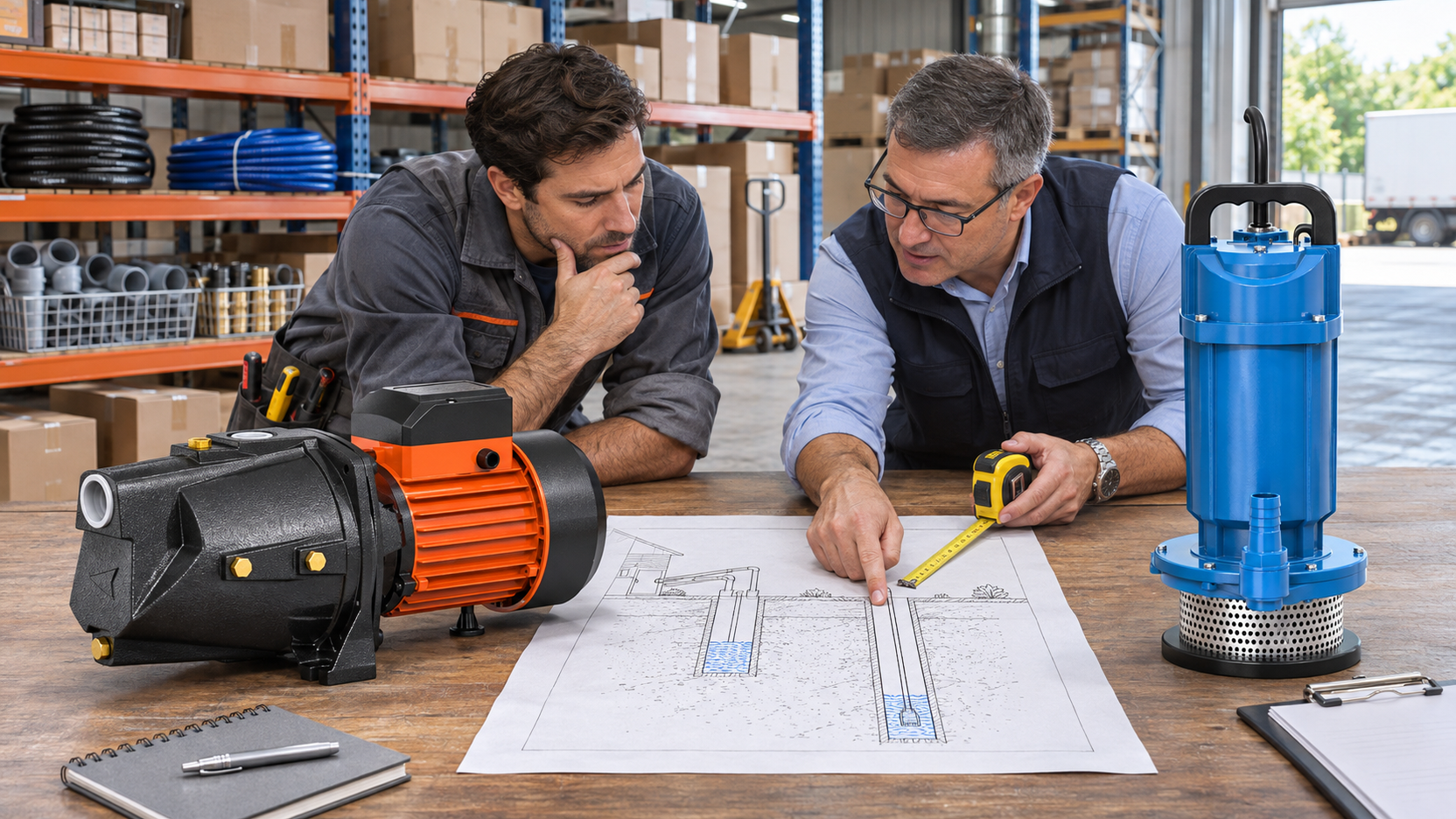
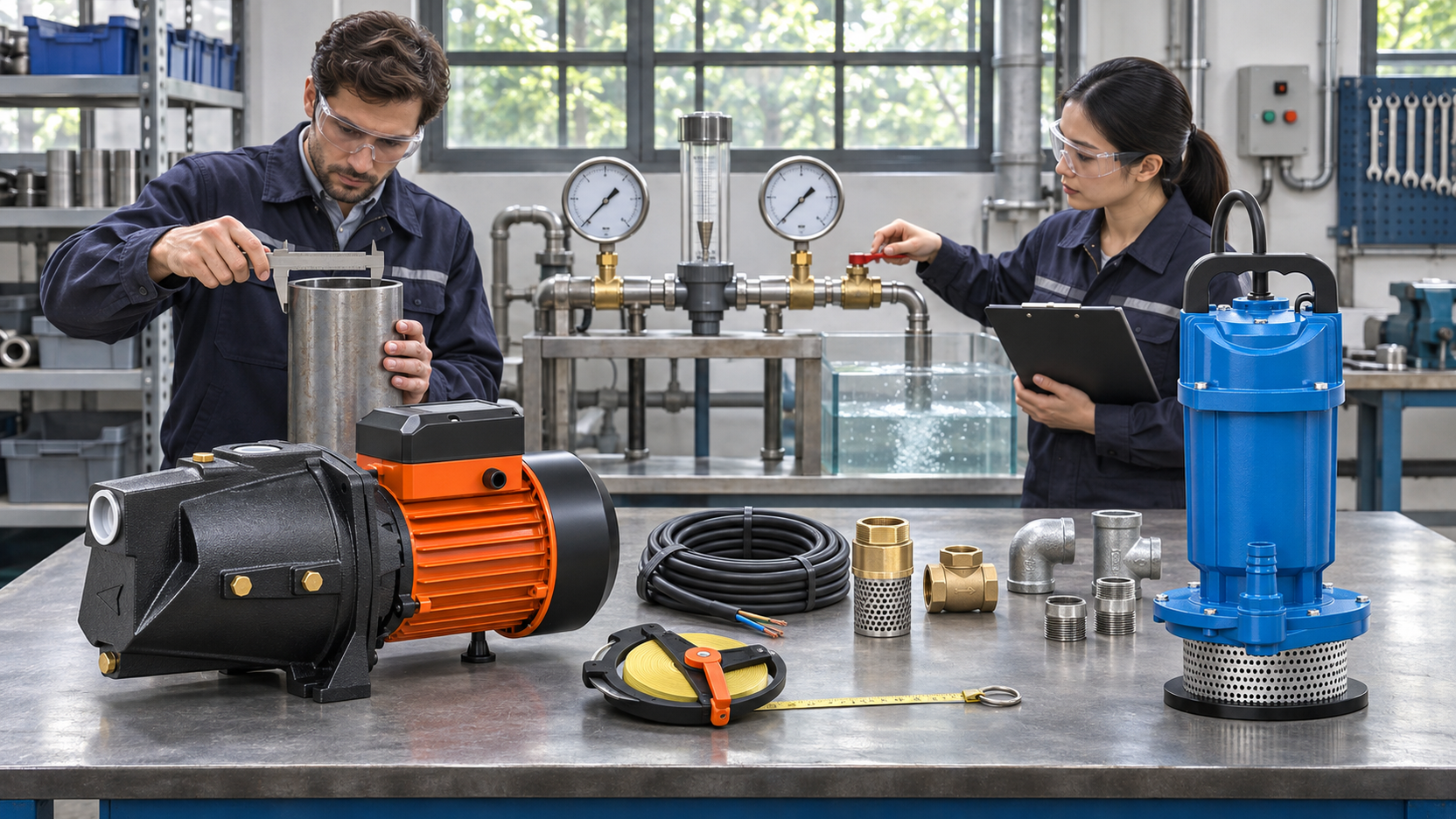
If a customer asks you whether a jet pump or submersible pump is better, you can’t answer the question just by comparing horsepower or pricing. A jet pump is often more practical if the water level is relatively shallow and easy maintenance is important. Submersible pumps are typically more powerful when the water level is deep, quiet operation is needed, or the system needs highly efficient high-head performance.
| Comparison | Jet Pump | Submersible Pump |
| Installation position | Above ground | Inside the well |
| How it moves water | Creates suction and draws water upward | Pushes water upward |
| Typical application | Shallow and selected medium-depth wells | Shallow to very deep wells |
| Priming | Usually required | Not required |
| Suction-pipe air leaks | Can reduce or stop performance | Not a suction-side problem |
| Efficiency at greater depths | Usually lower | Usually higher |
| Operating noise | Motor can be heard above ground | Generally quieter |
| Service access | Easier to reach | Must normally be removed from the well |
| Common after-sales risk | Loss of prime and suction leaks | Dry running and electrical problems |
| Main accessories | Ejector, foot valve, tank, and pressure switch | Cable, control box, check valve, and protection |
| Commercial position | Economical and repair-friendly | Efficient, quiet, and suitable for deep wells |
This chart should be used to qualify customers for your business before you offer a model. First, your sales team should collect dynamic water level, needed flow, total dynamic head, well yield, casing diameter, power supply, and local service conditions. If these details are not available, the quotation must clearly specify that the final pump selection is still pending confirmation.
IV. Which Pump Is Better for Different Well Depths?
1. Jet Pump
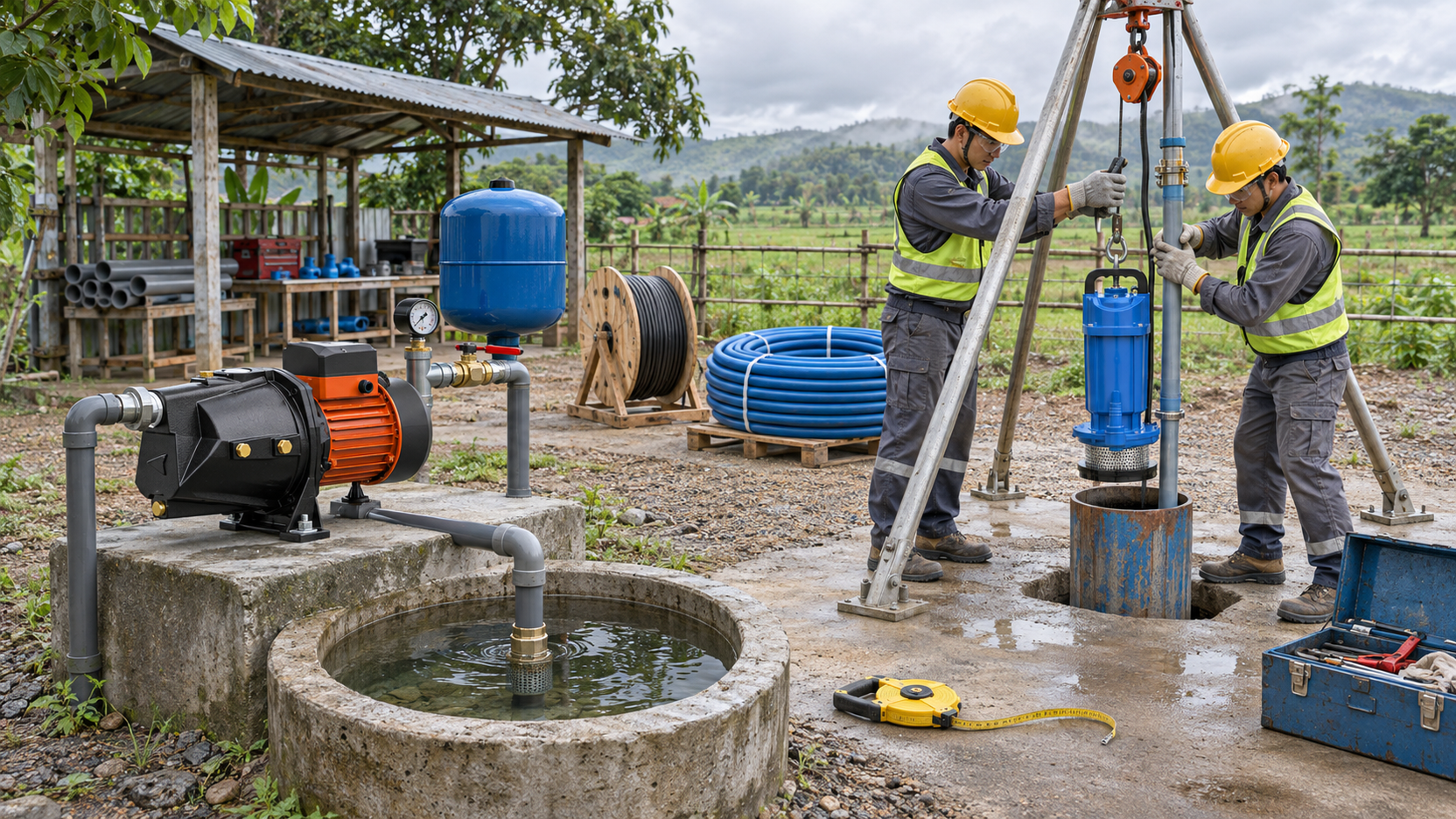
A shallow well jet pump is normally used where the total suction lift does not exceed about 25 feet or 7.6 meters. This is the vertical distance from the pump to the pumping water level, including the friction losses in the suction pipe, fittings, foot valve, and strainer. A deep well jet pump can be used outside the shallow-well range by locating the ejector in the well. However, it requires two pipes, and its available flow is very dependent on the pump, ejector, depth, and operating pressure. So you should avoid pushing 25 feet as a guaranteed operating depth or describing every deep well jet pump with a universal maximum depth.
2. Submersible Pump
A submersible well pump can be placed below the dynamic water level and can be chosen with enough stages to produce the desired head. This is usually the better choice for deep wells as it pushes water up instead of relying on suction from the surface. But the pump still has to be matched to the needed flow, total dynamic head, well yield, casing diameter, installation depth, cable length, and motor-cooling conditions. Just because a pump is submersible does not guarantee it can work in every well or at every depth.
3. Recommendation for Your Market
Before deciding what type to import, gather actual well information from your wholesalers, installers, and past enquiries. In most applications, water levels are available, clients are price-sensitive, and technicians prefer repairable above-ground equipment. Jet pumps can form the core of your offering. If your market uses deep drilled boreholes and offers expert installation services, then submersible pumps should have increased inventory and model coverage. Don’t just break this range down by horsepower, but break it down by the flow and head ranges that your market really needs.
4. Use Dynamic Water Level, Not Total Well Depth
Total drilling depth doesn’t tell you what pump to pick. A well that is 60 meters deep might have water only 5 meters below the surface, yet a much shallower well can have a large drawdown when it is being pumped. On the customer inquiry form, please include static water level, dynamic water level, well yield, total depth, and casing size. Making these fields required allows your sales team to identify unqualified applications before the quote and not after the pump has been installed.
V. How Do Their Performance and Efficiency Compare?
1. Jet Pump
In a jet pump, some of the motor’s power creates suction. A deep well jet pump also recirculates some of the water through the downhole ejector, so not all of the pumped water reaches the outlet. Its performance is sensitive to suction lift, pipe diameter, air leaks, and choice of ejector. Therefore, a single value of maximum flow is not enough to describe the whole range of a jet pump.
2. Submersible Pump
A submersible pump can drive water via a number of impellers and diffusers, allowing it to create a higher head effectively. It usually takes account of the increasing depth of the dynamic water level, although its flow and input power still vary along the performance curve. Too many stages can build up excessive pressure and consume energy. Too few stages may not be able to get the system to the desired pressure.
3. Recommendation for Comparing Suppliers
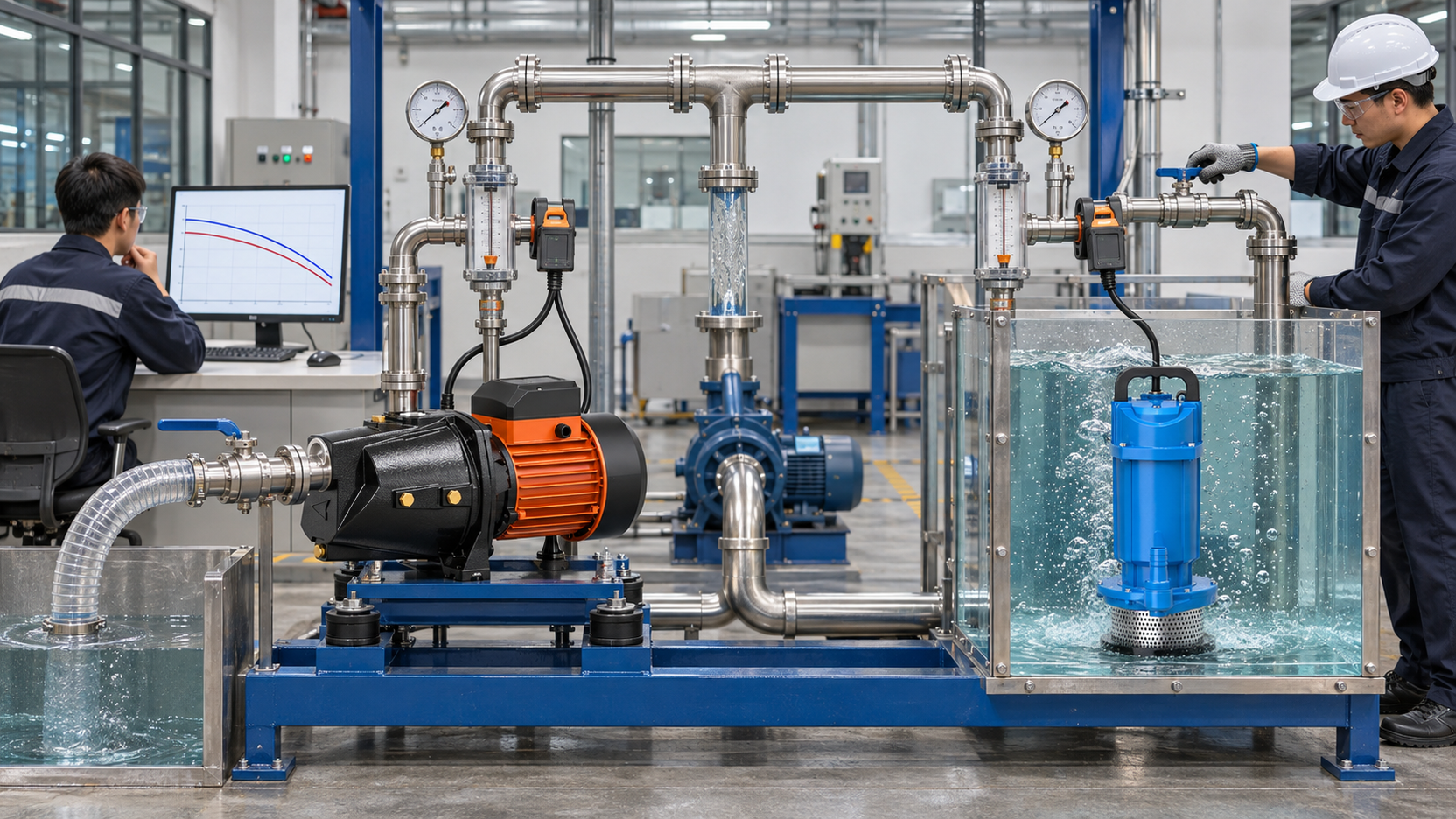
Request performance curves from each supplier under well-defined test conditions. Request data for several practical suction lifts, not just zero suction, for jet pumps. For submersible pumps, ask for flow, head, input power, motor rating, number of stages, and efficiency at the duty points your market uses. Compare the two types of pumps for the same flow and total dynamic head required. This prevents a supplier with a big maximum-flow figure from hiding poor performance under actual operating conditions.
4. Changing Water Levels and Well Yield
As the water level falls farther below the pump, the jet pump is more vulnerable to a loss of performance. The submersible pump can reach deeper water levels, but it can run dry if the well cannot recover fast enough. Ask suppliers to show how their models perform at normal and lowest expected dynamic water levels. For low-yield wells, your range should offer lower-flow alternatives and compatible dry-run or level protection rather than simply a larger motor.
VI. How Do Installation Requirements Compare?
1. Jet Pump Installation
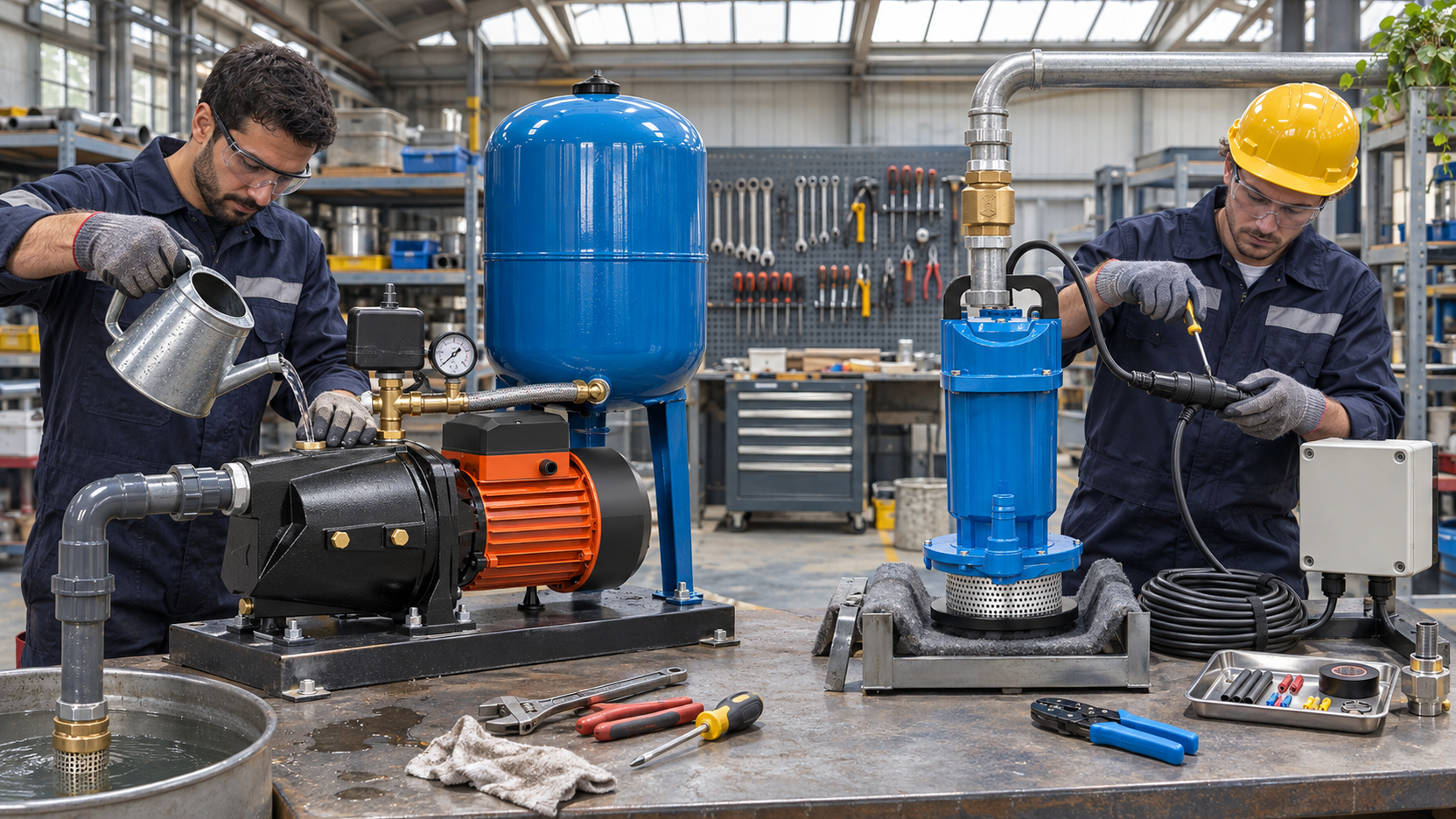
The jet pump is located above ground in a dry, ventilated place. A shallow well system usually requires only one suction pipe, whereas a deep well jet system requires two pipes and a properly matched ejector. Pipe diameter, ejector size, suction lift, pump curve, pressure-switch setting, and pressure tank all have to function together. Selling the pump without knowing the required ejector and accessories may give attractive pump pricing but transfers the matching problem to your customer.
2. Submersible Pump Installation
A submersible system needs a pump, motor, discharge pipe, electrical cable, cable joint, check valve, wellhead components, control equipment, and appropriate protection. The pump diameter should match the well casing, and the cable size should match the motor current and the length of installation. The motor design may also require a starting or control box for the customer. If these components are not clearly defined, two suppliers may appear to be offering the same product but may actually be quoting quite different system packages.
3. Recommendation for Product Packaging
Develop a standard Bill of Materials for each pump series that you offer. A jet pump package should include the compatible ejector, foot valve, pressure switch, pressure tank range, and recommended pipe size. A submersible package should specify the motor, cable size and length, control box, check valve, protection device, and appropriate diameter of casing. You can still quote pump-only prices, but quoting the pump-only and complete-system configurations makes it easy to compare bids and reduces missing-component complaints.
4. Priming, Pressure Tanks and Controls
Jet pumps must generally be primed and must have water in the suction line once the pump is stopped. The submersible pump needs no priming but dry-run and electrical protection. Both types may have a pressure tank and pressure switch in a standard automatic water supply system. Make sure the pump can achieve the pressure-switch cut-out setting and that the tank selected will be large enough to prevent excessive cycling before presenting a complete kit.
VII. How Do Maintenance and Service Costs Compare?
1. Jet Pump
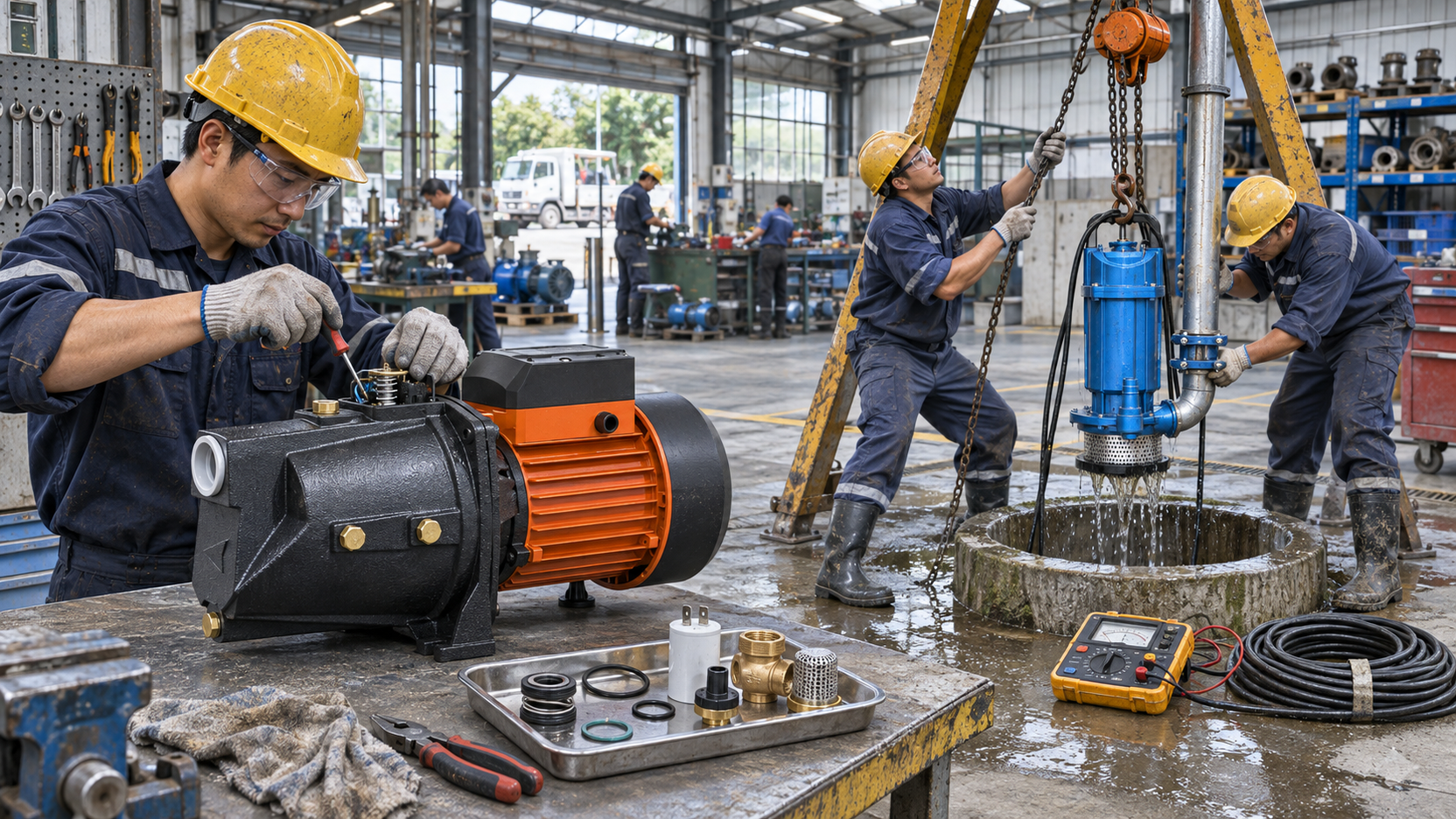
It is easier to access the jet pump with the motor, mechanical seal, impeller, nozzle, venturi, capacitor, and pressure switch still above ground. However, loss of prime, suction leaks, faulty foot valves, and incorrect pipe sizes might cause complaints not caused by the pump itself. Without a proper troubleshooting method, you can find your service crew replacing pumps that are not the problem while the true problem in your system stays unsolved.
2. Submersible Pump
It is more difficult to check a submersible pump, as the pump pipe and cable generally have to be pulled out of the well. Common problems are dry running, sand wear, cable damage, voltage drop, wrong control boxes, and insufficient motor cooling. The work needed to remove the pump means that even a little component fault might turn into a costly service job.
3. Recommendation for Your After-Sales System
Prepare two separate troubleshooting forms for the two types of pumps. For a jet pump claim, get the suction lift, pipe size, priming condition, foot-valve condition, pressure reading, and proof of suction leaks. For a submersible pump claim, collect installation depth, dynamic water level, cable length, supply voltage under load, motor current, control-box model, insulation test result, and water condition. This information helps you separate product failures from application and installation issues before you approve a replacement.
4. Spare Parts Planning
Jet pumps are often a less expensive alternative for shallow wells in terms of initial equipment and installation costs. They are affordable, reasonably easy to fix, and can be attractive in price-sensitive regions. Deep-well jet systems, however, require more piping and ejectors and may increase energy use due to recirculation losses. Repeated trouble with priming or the suction piping also raises the real service cost.
VIII. Which Pump Costs Less?
1. Jet Pump
Jet pumps are often a less expensive alternative for shallow wells in terms of initial equipment and installation costs. They are affordable, reasonably easy to fix, and can be attractive in price-sensitive regions. Deep-well jet systems, however, require more piping and ejectors and may increase energy use due to recirculation losses. Repeated trouble with priming or the suction piping also raises the real service cost.
2. Submersible Pump
A submersible system usually has additional downhole components and skilled installation labour. Pumping from a deep well might also be expensive. But it is usually more efficient for deep-well applications, does not require above-ground pump space, and is quieter in operation. Its higher purchase cost may be offset by lower energy use in applications with long running hours per day.
3. Recommendation for Comparing Total Cost
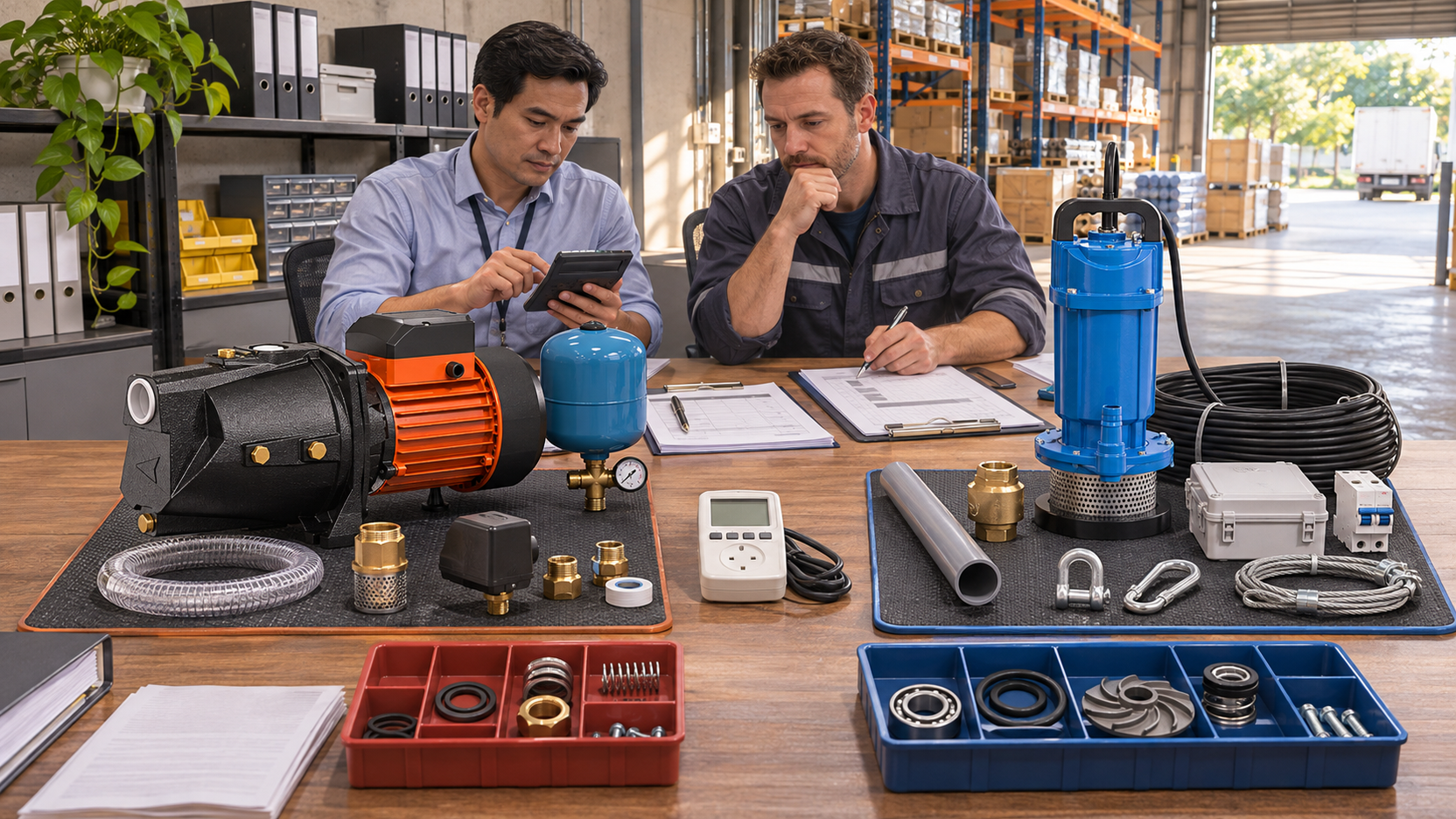
Consider the entire commercial cost, not just the cost of the pump. Include the cost of the pump purchased, accessories needed, installation difficulties, projected energy use, spare parts, service labour, and warranty exposure. When comparing suppliers, use the same method so a partial low bid does not appear more competitive than a complete pump bundle. This strategy also gives your sales staff a better answer when customers are comparing only the initial prices of a jet pump and submersible pump.
IX. When Should You Choose Each Pump?
1. Choose a Jet Pump When:
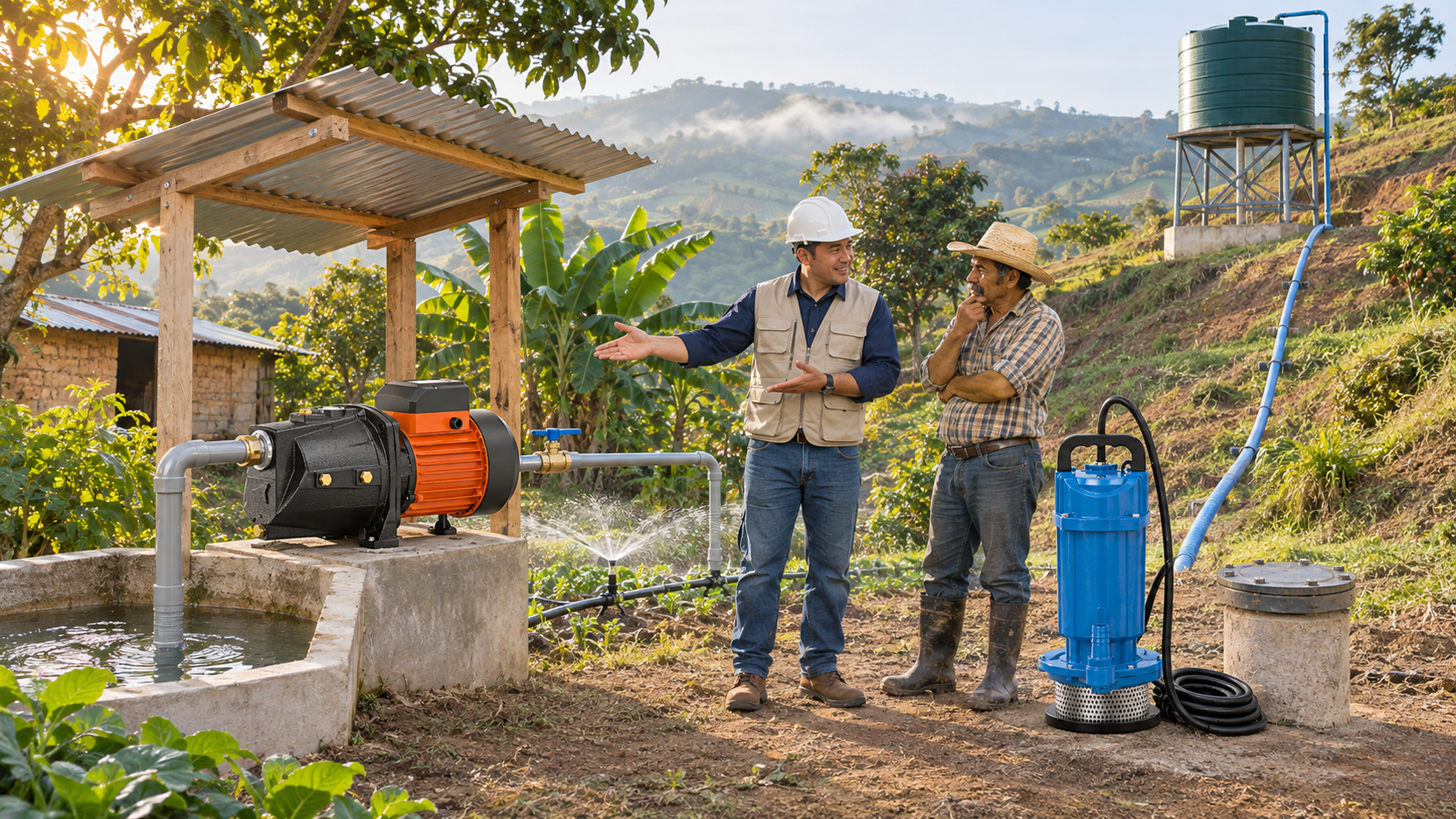
If the water source is within the range specified by the model, if above-ground service access is important, if the market favours repairable products, and if customers are sensitive to initial cost, you should select a jet pump. A shallow well jet pump is well suited for shallow wells, tanks, cisterns, domestic water supply, and light irrigation. A deep well jet pump can be used for some medium-depth applications if the customer wants the motor to be above ground and the well can accommodate the required piping configuration.
2. Choose a Submersible Pump When:
When the dynamic water level is deep. When the system demands a larger head. When a quiet pump is needed. When suction conditions would make a surface pump unreliable. It is also a good solution for drilled boreholes if professional equipment for installation and removal is available. Check casing diameter, duty point, well yield, installation depth, cable requirements, power supply, protection method, and water quality before purchase.
3. Stock Both When Your Market Has Mixed Well Conditions
If your market contains shallow wells, storage tanks, and deep drilled boreholes, then stocking only one type of pump means that your sales team will either have to decline orders or suggest inappropriate items. Select according to application zones: jet pumps for shallow, easily accessible water, convertible or deep well jet pumps for specified medium-depth applications, and submersible pumps for deep or high-head systems. Do not stock many pumps of the same horsepower and nearly the same duty point. Each model should fill a clear flow, head, price, or application gap.
X. Jet Pump vs Submersible Pump Selection Checklist
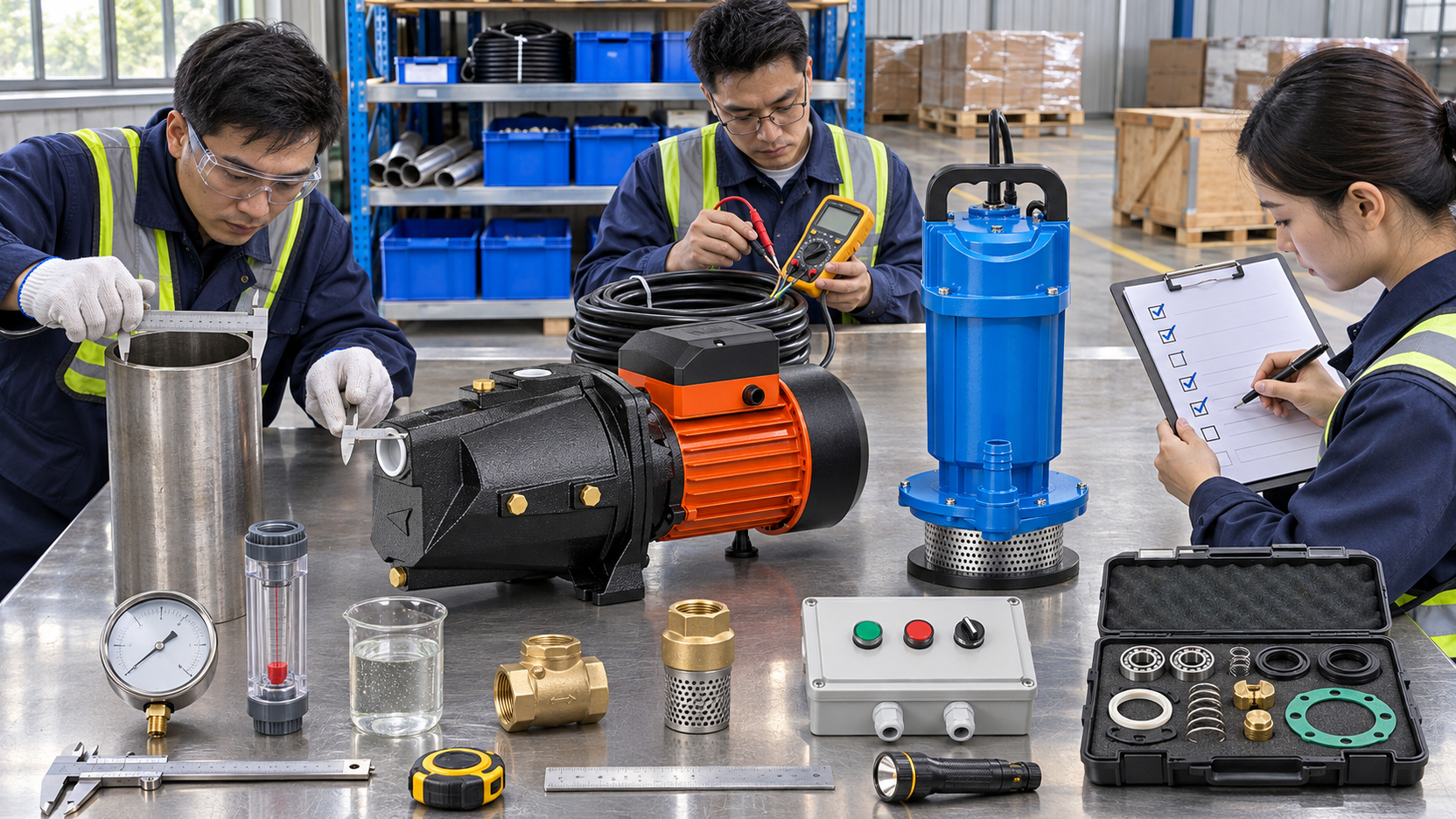
Before selecting a pump type or approving a supplier order, verify the target applications, static and dynamic water levels, well yield, casing diameters, required flow and head ranges, local voltage and frequency, water quality, installation practices, available service equipment, preferred control method, and acceptable retail price. Then, check supplier curves at their duty points, confirm what accessories are included with each model, identify required spare parts, and verify how warranty claims will be diagnosed. This makes pump selection a repeatable purchasing process instead of a horsepower/factory price decision.
XI. Conclusion
The decision between a jet pump and a submersible pump should not be simplified to “cheap pump vs. expensive pump.” Jet pumps are an economical choice for shallow or medium-depth wells and are easy to service. The limits of surface suction do not apply to a submersible pump, which is usually better suited for deep wells, higher heads, quiet operation, and an efficient long-term water supply.
The correct decision for your business is: which product can be reliably sold, installed, and maintained in your market. Plan your models with local well conditions, compare suppliers at equal duty points, package the right accessories, and prepare spare parts before launching the range. Reduce unsuitable stock, eliminate incomplete orders, and handle after-sales claims more efficiently.
HunGerät works together with water pump importers, distributors, and private-label buyers to build jet pump and submersible pump lines for different markets. Please send HunGerät your typical well depths, needed flow and pressure ranges, casing sizes, electrical specifications, target costs, and preferred package combinations. We can help you match pump models, accessories, and replacement parts to the applications your clients really buy.
XII. Frequently Asked Questions
1. What is the main difference between a jet pump and a submersible pump?
The jet pump is above ground and uses a jet assembly to pull water from the source. A submersible pump sits in the well and pushes water up through a discharge line.
2. Is a submersible pump better than a jet pump?
Submersible pumps are usually better suited for deep wells and high-head applications. For shallow wells, when lower initial cost and simple access for service are needed, a jet pump may be more suitable.
3. Which pump is best for a shallow well?
A shallow well jet pump is usually the best pump for a shallow well when the total suction lift is about 25 feet or less. A submersible pump may also be used, provided the diameter of the well and depth of water allow for proper installation.
4. Which pump is best for a deep well?
As a rule, the best pump for deep wells is a submersible well pump. Submersible well pumps force the water up and do not rely on suction at the surface. A deep well jet pump might still be relevant for some medium-depth wells.
5. How deep can a jet pump draw water?
A shallow well jet pump is normally used for total suction lifts of around 25 feet or less. A deep well jet pump can go deeper with a downhole ejector, but the real limit is a function of model, ejector, flow, and pressure.
6. Can you use a submersible pump in a shallow well?
Yes, if the well is large enough in diameter and water depth and has enough motor-cooling flow. However, a jet pump may be a simpler and more economical option in some shallow-well applications.
7. Which is more efficient, a jet pump or a submersible pump?
A submersible pump is usually more efficient at greater depths since it pumps water straight up. A deep well jet pump recirculates part of its water through the ejector, which causes extra hydraulic losses.
8. Which pump provides better water pressure?
Either pump can give good pressure if properly selected. You need to compare their performance curves at the required flow and total dynamic head, not horsepower.
9. Does a jet pump use more electricity than a submersible pump?
It may consume more energy for a similar duty from a deep well because of losses in suction and recirculation. Actual energy usage will depend on pump model, duty point, motor efficiency, and hours of operation.
10. Does a submersible pump need priming?
No. A submersible pump works underwater and does not need to be primed by suction. But it must always be submerged and must be protected against dry running.
11. Why does a jet pump lose prime?
A leaky foot valve, air leaks in the suction pipe, loose fittings, low water level, obstructed suction components, or lack of water in the pump casing are typical causes.
12. Do jet pumps and submersible pumps need pressure tanks?
Both types of pump are generally seen in conventional automatic well-water systems with pressure tanks. Depending on the controller and system design, the tank size can be reduced on variable-speed systems.
13. Which pump is quieter?
The submersible pump is usually quieter because the pump and motor are down in the well. Jet pump motors are above ground and are audible when running.
14. Which pump is easier to repair?
As a rule, a jet pump is easier to fix because it is accessible above ground. To check a submersible pump, it usually has to be lifted out of the well.
15. Which pump lasts longer?
Service life depends on sizing, water quality, operating hours, voltage, motor protection, installation quality, and maintenance. Both types of pumps can be damaged by dry running and sand.
16. Can sandy water damage jet pumps and submersible pumps?
Yes. Sand can erode the jet pump’s nozzle, venturi, impeller, and seal. It can also harm the stages, bearings, and other hydraulic parts of a submersible pump.
17. Can you replace a jet pump with a submersible pump?
Yes, in many wells. But you need to check the casing diameter, well condition, power supply, discharge pipe, control system, installation depth, and required duty point first.
18. Is a deep well jet pump better than a submersible pump?
A deep-well jet pump will give better access to the surface motor. A submersible pump will usually be more efficient and hydraulically simpler. The option depends on depth, energy cost, access to installation, and local service capacity.
19. What information should an importer request before selecting a well pump?
Static and dynamic water levels, well yield, total depth, casing diameter, needed flow, total head, water quality, electrical supply, pipe information, pressure requirements, and installation conditions should be requested.
20. Should a pump distributor stock both jet pumps and submersible pumps?
Yes, if your market includes shallow as well as deep boreholes. A targeted range of both types means you cover more applications without putting a pump type into unsuitable working conditions.