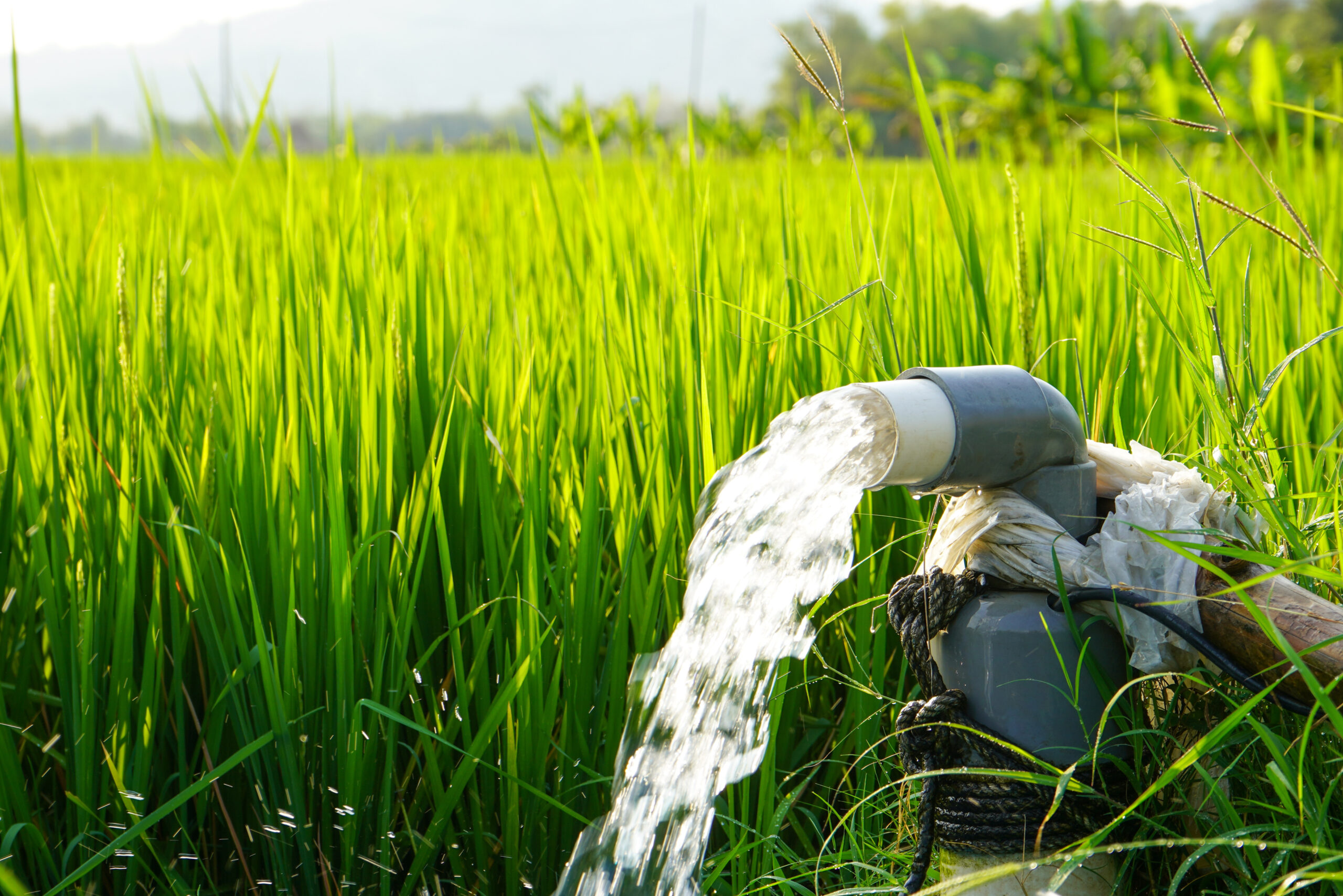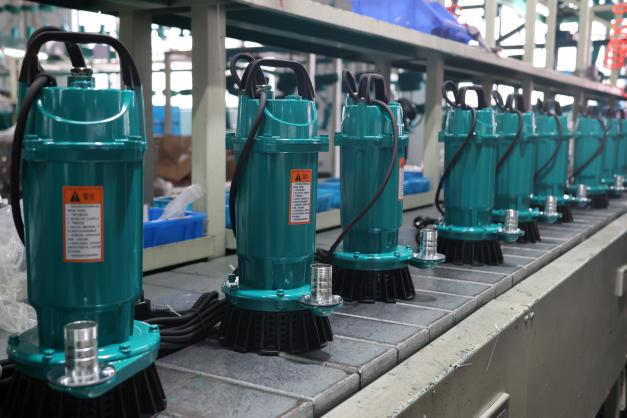
Wastewater pumps are not a single product category, and there is not one single selection rule. Submersible sewage pumps, self-priming pumps, grinder pumps, and sludge pumps all move wastewater, but vary in their ability to handle solids, viscosity, installation, and maintenance. If you are selling these pumps, you have to know what they are designed to do for each type. This article covers the main types of wastewater pumps and the facts you need to think about before adding them to your lineup.
I. How Are Wastewater Pumps Classified?
First, wastewater pumps are categorized according to their pumping principle. Rotodynamic pumps, such as centrifugal pumps, give velocity to the liquid. Such pumps are excellent for various continuous flow jobs. Positive displacement pumps give a fixed volume each cycle and are usually used for viscous sludge, metered transfer, or chemical dosing.
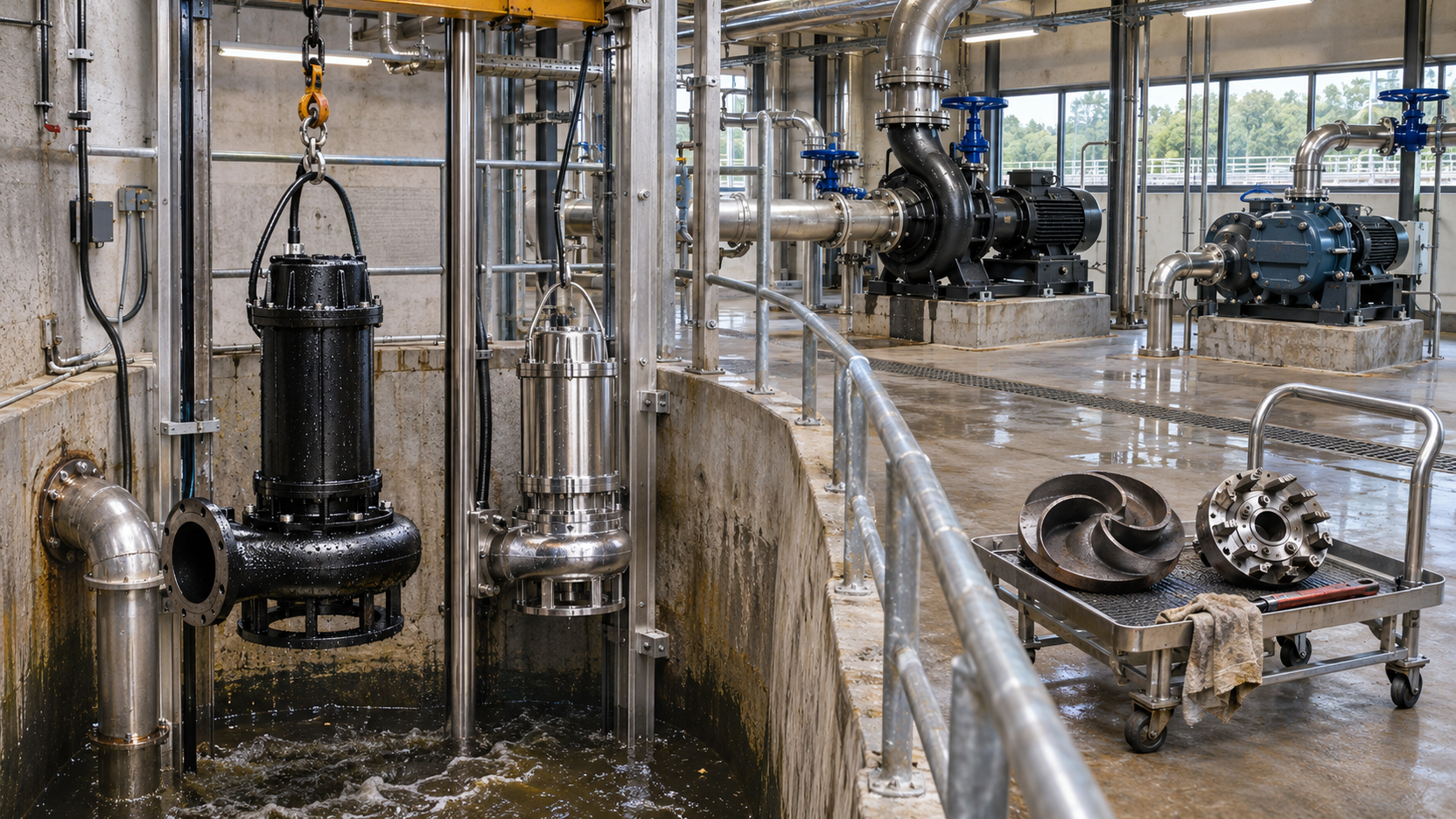
Another criterion for their classification is installation. There is a submersible pump for wastewater in the wet well and a dry-installed pump outside the liquid. A self-priming pump is also outside the liquid, but it may remove air from its suction line after the casing has been sufficiently filled.
The third category is solids handling design. Solids and fibers are treated in different ways by channel, vortex, grinder, cutter, chopper, and screw centrifugal types. So a more detailed description might be “a submersible centrifugal sewage pump with a vortex impeller” instead of “a wastewater pump”.
II. Centrifugal and Rotodynamic Wastewater Pump Types
1. Submersible Wastewater Pumps
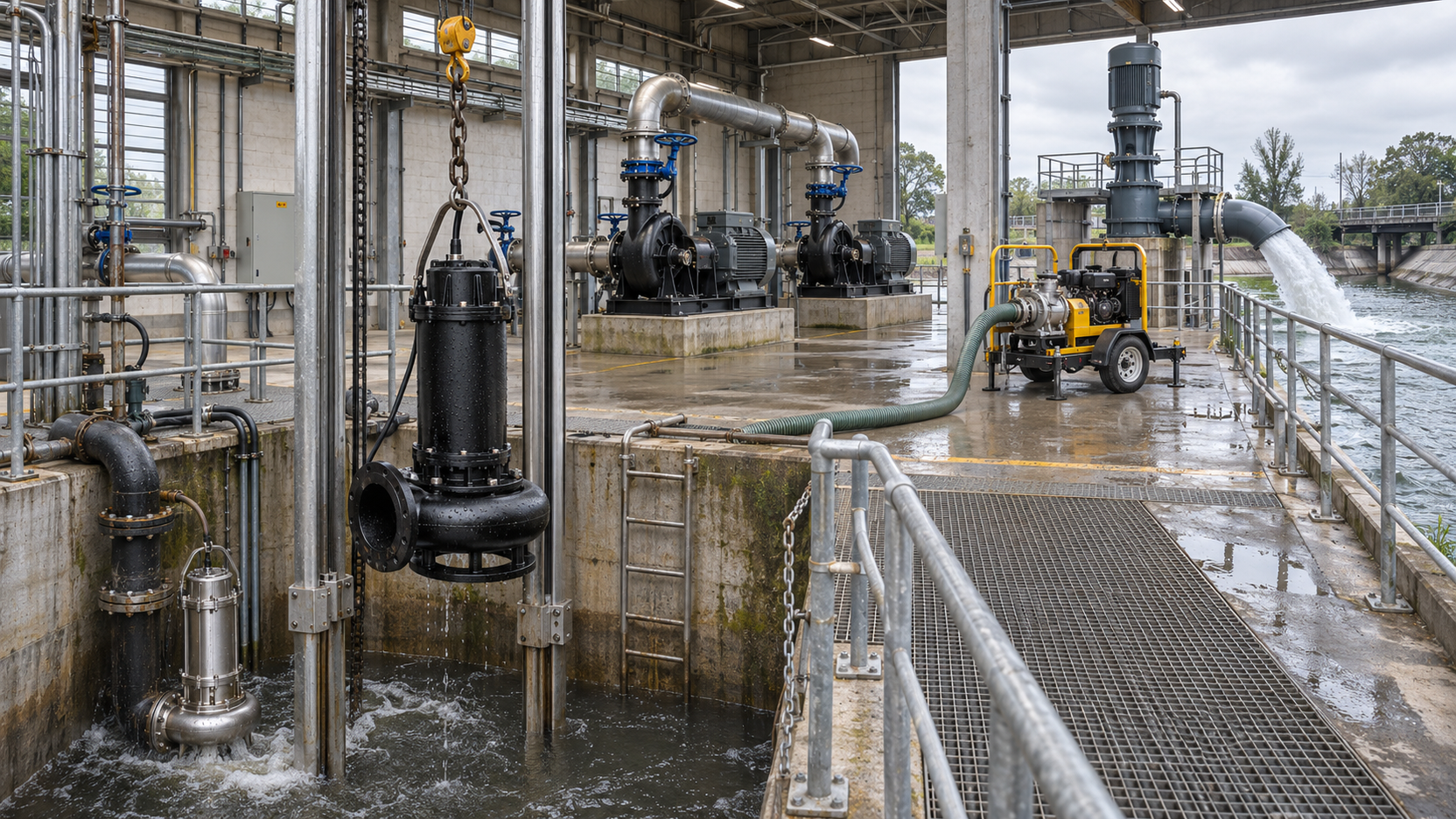
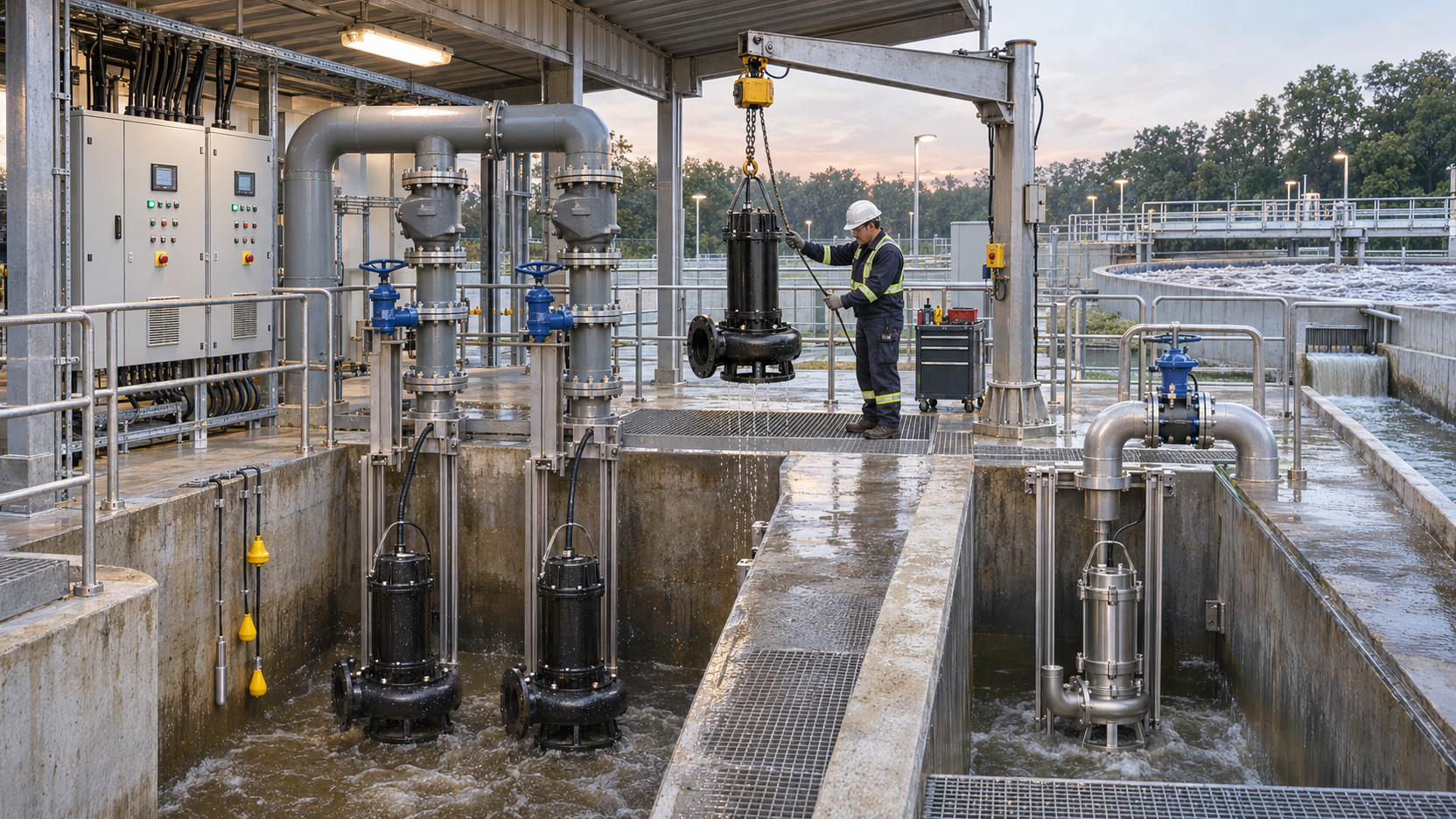
A submersible wastewater pump integrates the pump and a sealed motor into one unit that is placed within the wet well or tank. It saves space in the pump chamber and can be installed on guide rails for removal from above. Submersible pumps can have channel, vortex, grinder, or other impeller designs; therefore, the term “submersible” does not define the solids capacity of the pump. Before purchase, check for free passage, minimum operating level, cooling mechanism, cable entry, guide-rail connection, and lifting arrangement.
2. Dry-Installed Wastewater Pumps
A dry-installed wastewater pump is located in a dry pit or pump room and pulls liquid from the wet well. In larger stations, direct access to the motor, bearings, seals, and coupling facilitates service. The trade-off is more dependence on proper suction design. Check for flooding suction conditions, available NPSH, inlet plumbing, base and connection configuration, drainage, ventilation, and maintenance space.
3. Self-Priming Wastewater Pumps
The self-priming wastewater pump is located above or next to the fluid. As it fills, it displaces air from the suction pipe and pulls wastewater into the casing. Suitable for bypass pumping, portable work, industrial sumps, and where ground-level access is needed. Its effectiveness is limited by suction height, pipe length, friction, air leakage, temperature, and altitude. Don’t think of “self-priming” as infinite suction ability.
4. Axial-Flow and Mixed-Flow Pumps
Axial-flow and mixed-flow pumps are utilized for high flow at low to moderate heads. They are common at stormwater, flood control, drainage, and large treated effluent stations. Their selection is based on the whole working range, intake design, submergence, and screening and not on maximum flow alone. Radial centrifugal pumps should not be used as a replacement unless the system head and pump curve are well matched.
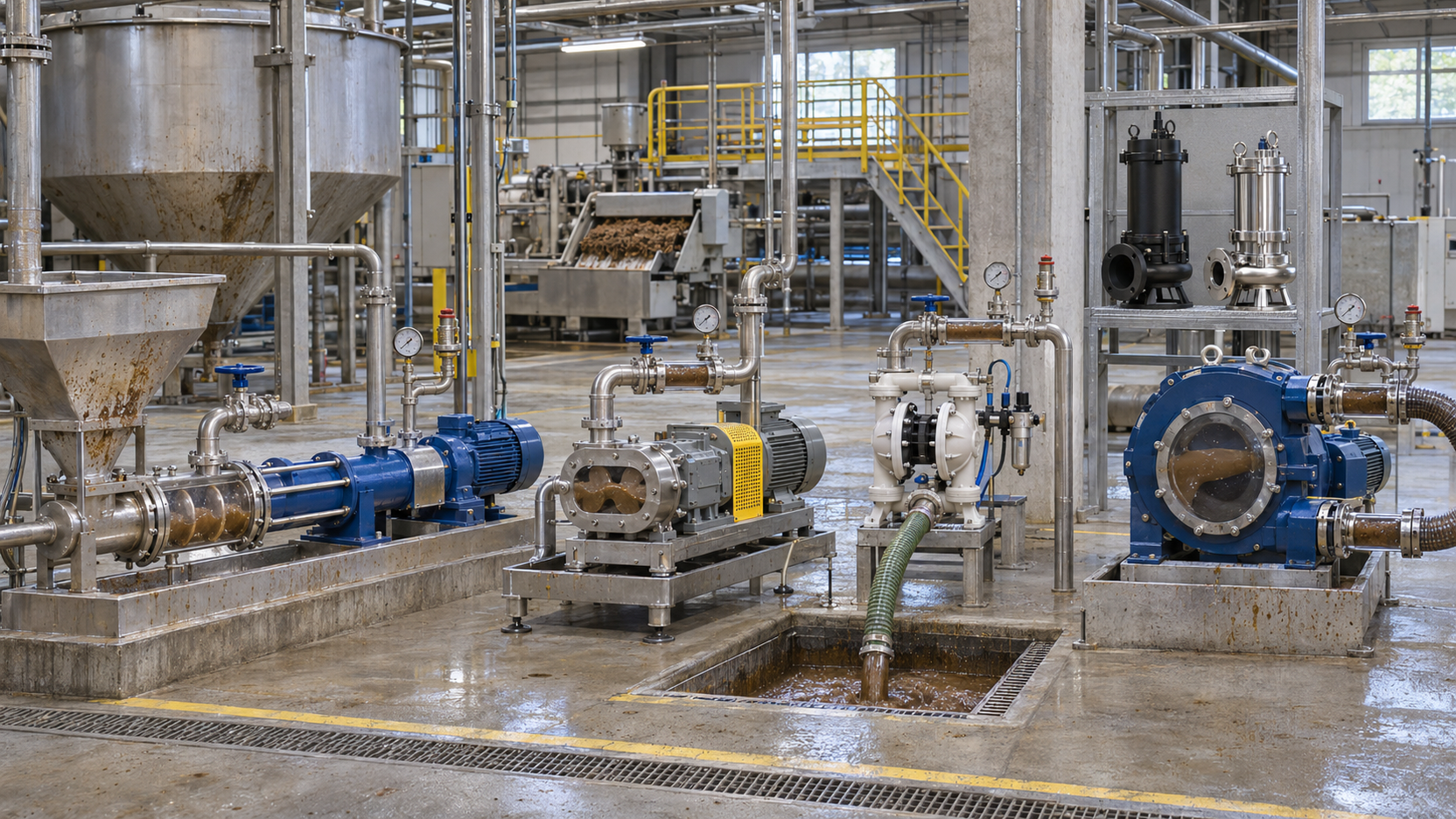
III. Positive Displacement Wastewater Pump Types
1. Progressing Cavity Pumps
A progressing cavity pump is a pump that moves sealed chambers through a helical rotor and stator. Its low-pulse, constant flow makes it perfect for thickened sludges, viscous waste streams, and shear-sensitive liquids. Very thick material could need a hopper or feed screw to reach the pumping portions. Before quoting this type, verify sludge concentration, viscosity, pressure, speed, rotor material, stator elastomer, dry-run protection, and expected grit wear.
2. Rotary Lobe Pumps
The rotary lobe pump transfers liquid through the casing with the help of two synchronized lobes. It may be self-priming and reversible and is commonly utilised for sludge, grease, and viscous wastewater. Hard particles and abrasive grit can erode the lobes, liners, and seals. Oversized objects can damage the spinning parts. Check permissible solids, pressure, speed, viscosity, relief protection, and access for wear parts for that particular model.
3. Diaphragm Pumps
Check valves direct flow, while a diaphragm pump operates by changing the volume of a chamber. With the correct materials, it can handle abrasive, corrosive, or solids-containing liquids. Air powered double diaphragm pumps are widely used in sump cleaning, intermittent sludge transfer and industrial wastewater. The flow is pulsating and the fibres can foul the check valves therefore verify the particle size, viscosity, valve design, diaphragm material, air consumption and discharge pressure.
4. Peristaltic Pumps
A peristaltic pump uses a set of revolving rollers or shoes to squeeze a flexible hose or tube. The wastewater merely contacts the hose. Design is suited for caustic chemicals, abrasive slurry, dosing and controlled sludge transfer. The hose is a scheduled wear item and its life is governed by pressure, velocity, temperature, chemistry and abrasiveness. Check continuous duty constraints, hose material, leak detection, lubricant requirements and replacement cost.
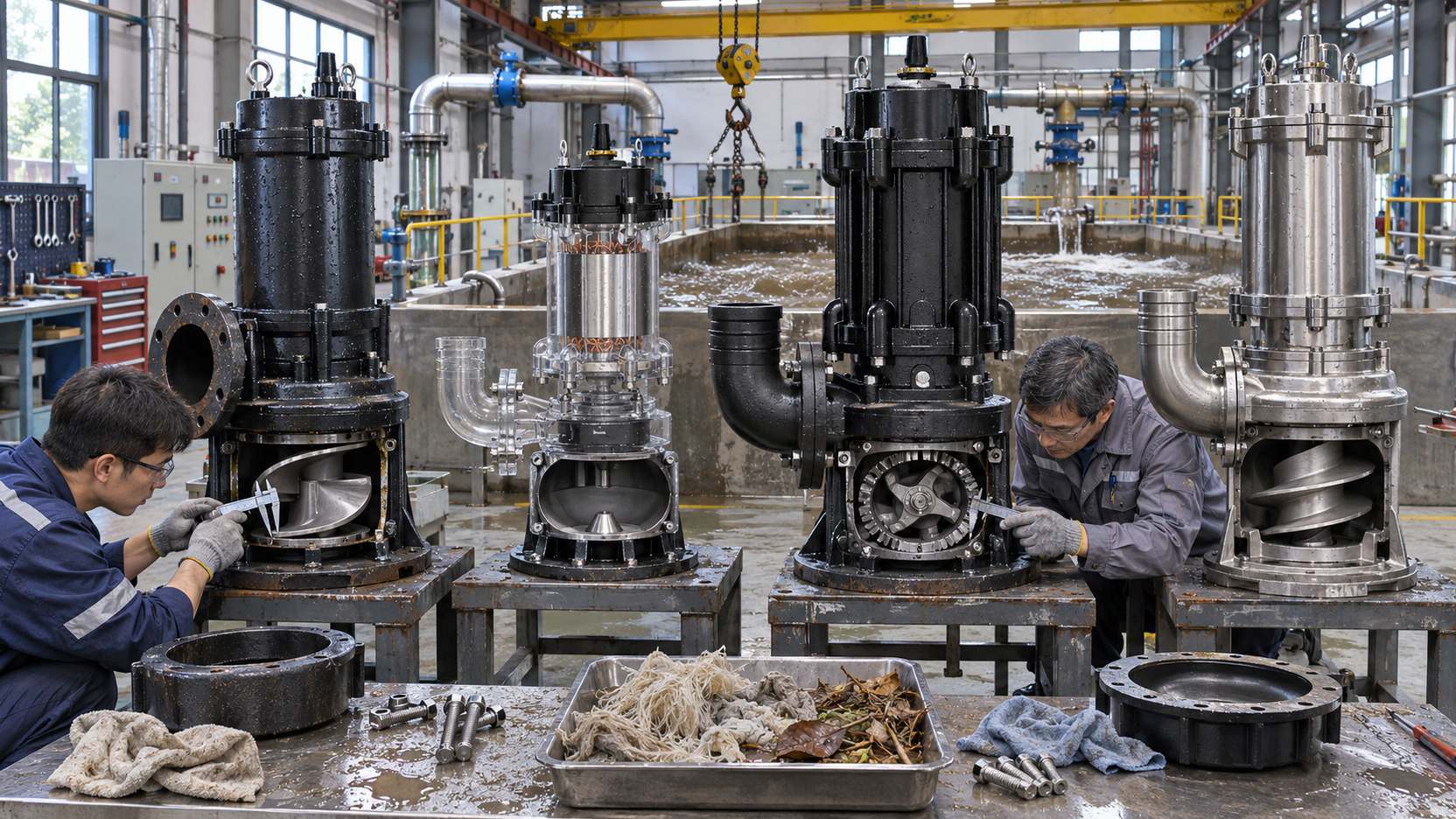
IV. Solids-Handling Designs for Centrifugal Wastewater Pumps
1. Channel Impeller
A channel impeller forces wastewater through one or more designated channels. It may give good hydraulic efficiency in raw sewage, screened wastewater and effluent duties. If the design is not good, rags and long threads may catch in the vane or channel. Ask for the number of channels, free passage diameter, permitted solids, suggested operating range and pump curve, instead of just a “non-clog” description.
2. Vortex Impeller
The vortex impeller is located behind the main flow path and adds energy by means of a revolving body of liquid. Within the casing, the majority of the wastewater can flow through without entering the narrow channels of the impeller, which could be good for fibres, soft sediments and entrained air. Less hydraulic efficiency than a well-selected channel design may be the trade-off. Use it when the fluid needs the bigger, less obstructed channel, not because vortex is better in and of itself.
3. Grinder, Cutter, and Chopper Pumps
Grinder, cutter and chopper pumps grind suitably soft materials or fibres before discharge. Grinder pumps are used for pressure sewers with smaller pipe sizes, while chopper kinds are used for more difficult fibrous material. They can’t cope with every foreign body. Stones, metal, hard plastic and fabrics might jam or even damage the cutting parts. Check the waste received, cutting geometry, material hardness, cleaning access, and availability of replacement cutters.
4. Screw Centrifugal Pumps
The inlet of a screw centrifugal pump is screw-shaped and leads into a centrifugal portion. It has an open flow path which allows for gentle pumping of solids and fibres. It finds use in raw wastewater, sludge and some food production waste. See also channel and vortex pumps of similar flow and head. Check size of solids, fibre content, sludge concentration, speed and clearance of impeller.
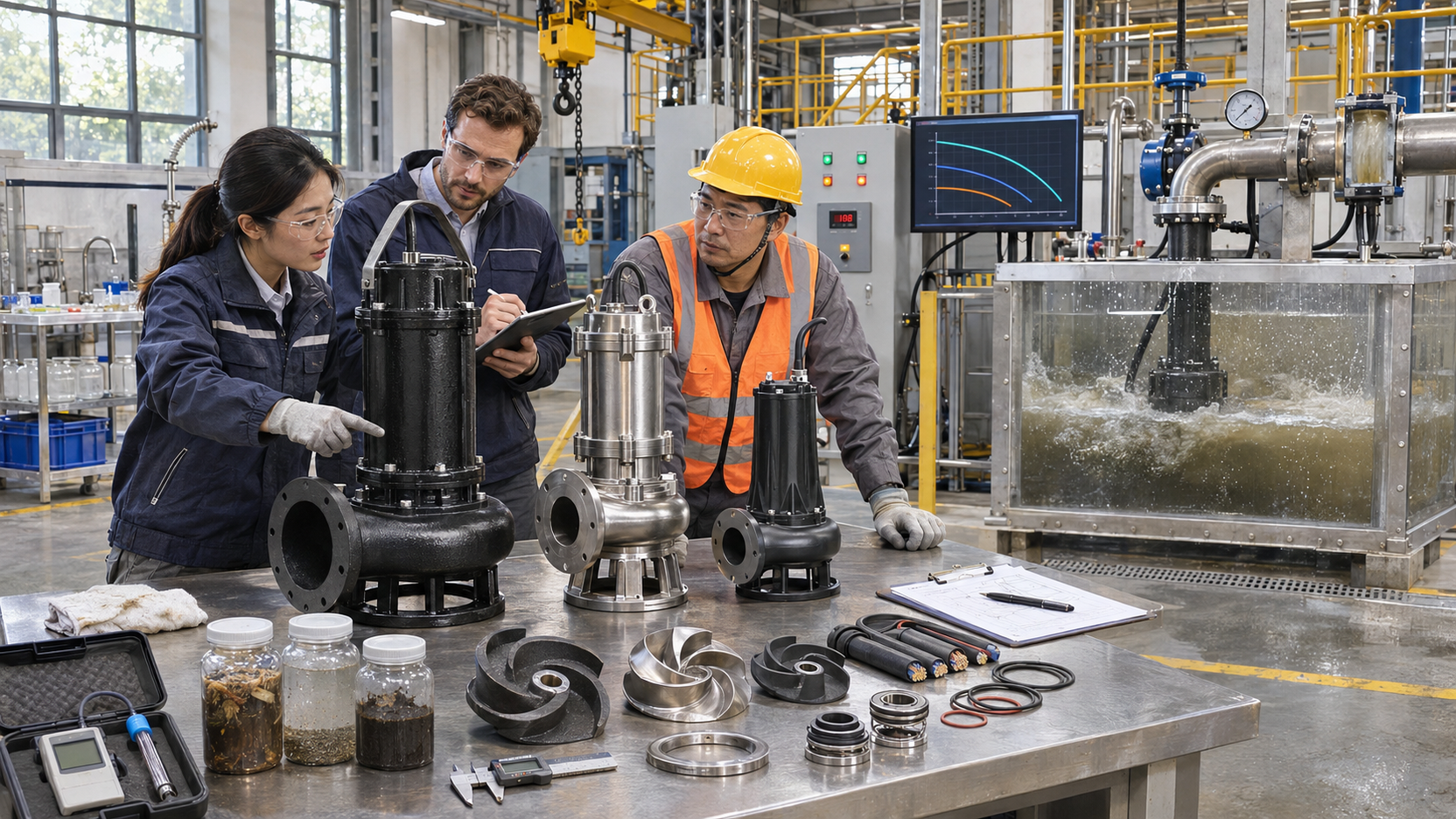
V. How Do You Choose the Right Wastewater Pump Type?
1. Define the Liquid First
Specify if the liquid is raw sewage, screened effluent, storm water, thin sludge, thicker sludge, chemical wastewater or dosing fluid. Record the maximum solids, rag and fibre, grit, viscosity, gas, temperature, pH and chemical composition. These variables will determine if you require a centrifugal solids handling pump, grinder, progressing cavity pump, rotary lobe pump or other design.
2. Compare the Required Flow and Head
For a centrifugal pump, assume the required flow and total dynamic head to be a single point of duty on the pump curve. Maximum flow and maximum head are different points, and should not be confused. For positive displacement pumps, it is necessary to check the pressure and speed. If the discharge pressure is increased, the torque and power demand increase even if there is minimal change in flow.
3. Match the Installation
When wet-well space is limited and the pump can be securely lifted for service, submersible installation is used. If direct access is important and suction conditions can be controlled, use dry installation. If the pump must be above the liquid, choose a self-priming installation. Check the real suction lift and pipe, not simply the installation name.
4. Check Materials and Wear Parts
Casing, impeller, shaft, seals, O-rings, cables and elastomers must be compatible with corrosive wastewater. An abrasive liquid needs the right materials, speed, clearances and consumable wear parts. For positive displacement versions, determine the correct rotor-stator set, lobes, liners, diaphragm or hose required for service. A clear spare parts list shall be included at the first product evaluation.
5. Verify the Motor and Controls
Check voltage, frequency, phase, rated current, start technique, duty rating, cooling method, allowed starts per hour, level controls, alarms and motor protection. Wastewater pump stations may additionally need duty-standby sequencing, leakage sensors or automatic switching. You will require an appropriate pump and electrical certification for hazardous places – a conventional version won’t do.
6. Test the Exact Configuration
Run the selected impeller, motor, materials and controls as one configuration before a bulk order is made. Check flow, current, head, start, stop, level control, temperature, vibration, fault response, and the approved solids handling condition. Then inspect the pump for any fibres stuck in it, damage to the cutter, leaking seal, heating of the stator, wear on the hose or difficulties in disassembly.

VI. How Should You Organize Your Wastewater Pump Range?
1. Separate Products by the Liquid They Handle
Drainage pumps are suitable for mildly dirty water. Use wastewater effluent pumps for water with fewer residual particles. Use full-passage sewage pumps for untreated sewage. For proper pressure sewer applications, grinder pumps are used. And post the actual particle or free-passage limit next to each category, so that identical power ratings don’t make different things appear interchangeable.
2. Describe Every Model Completely
Each model name or specification shall include the pumping principle, installation and solids handling design. “Waste water pump” is not very descriptive. A more descriptive name might be “submersible centrifugal sewage pump with vortex impeller”. Add desired liquid, pump curve, allowable solids, materials, seal arrangement, cooling method, electrical version and duty rating.
3. Control Type-Specific Spare Parts
Prepare spare lists for each pump design. Submersible centrifugal pumps may need seals, bearings, cables, impellers and wear plates. Grinder pumps require precision cut parts. Progressing cavity pumps require matching rotors and stators. Rotary lobe pumps require lobes and liners. You need the right hose for peristaltic pumps. Use the same model and revision codes on quotations, manuals, packing lists and spare-parts records.
VII. Conclusion
The main types of wastewater pumps vary by pumping mechanism, installation and solids handling design. Centrifugal pumps are employed in many sewage, effluent, drainage and storm water applications. For heavy sludges, controlled transfer and dosing, positive displacement pumps are often better. And then there are the centrifugal designs — channel, vortex, grinder and screw – which decide how a centrifugal pump handles solids and fibres.
Specify the liquid type, duty point, installation, materials, motor, controls, and method of service. This gives you a clearer product range and saves you having to sell a drainage pump, a sewage pump, a grinder pump and a sludge pump as interchangeable items.
If you plan a wastewater pump range, HunGerät would like to receive the description of the liquid, maximum solids, required flow and head, installation technique, electrical supply and planned order structure. With that information, we may discuss the pump types that fit your market.
VIII. FAQ
1. What are the main types of wastewater pumps?
The main types include centrifugal and other rotodynamic pumps, and positive displacement pumps. The most common types include submersible, dry-installed, self-priming, axial-flow, progressing cavity, rotary lobe, diaphragm and peristaltic.
2. Why can one wastewater pump have several type names?
Names may reflect different features. So a pump can be centrifugal by principle of operation, vortex by impeller design and submersible by installation, all at the same time.
3. Is a wastewater pump the same as a sewage pump?
The generic term is wastewater pump. A sewage pump is designed for waste water with the larger soft solids usually present in raw sewage.
4. What is the difference between a submersible and dry-installed wastewater pump?
A submersible pump is designed to operate in the liquid, whereas a dry-installed pump is installed in a dry pit or pump room. This option affects the cooling, suction design, access and service.
5. What is a self-priming wastewater pump used for?
It is used where the pump needs to be above the liquid, such as in bypass pumping, mobile drainage and accessible industrial sumps. The actual suction lift depends on the overall intake system.
6. What is the difference between an effluent pump and a sewage pump?
Effluent pumps are usually used for semi-treated wastewater with reduced particulates. A sewage pump is used for raw sewage and larger soft particles.
7. What is the difference between a sump pump and a sewage pump?
A sump pump is designed for water that contains few particles. Sewage pumps feature a larger or specially designed passageway for wastewater that contains soft solids.
8. Is a vortex impeller better than a channel impeller?
Not for all duties. Vortex designs provide a less crowded flow and channel impellers can provide increased hydraulic efficiency if the solids and fibres are appropriate for the passage.
9. What is the difference between a grinder pump and a sewage pump?
The sewage pump passes solids that can be hydraulically passed through it. A grinder pump grinds suitable soft solids before they enter a reduced pressure line.
10. Does non-clog mean the pump can never block?
The hydraulic design is non-clogging. Rags, wipes, oil, big items or operating outside the recommended range may still cause obstruction.
11. Which pump is suitable for thick sludge?
Common choices include rotary lobe pumps and progressing cavity pumps. The proper choice is dependent on solids concentration, viscosity, intake feeding, abrasiveness, pressure, and desired flow.
12. Which wastewater pump handles abrasive grit?
It depends on grit size and concentration. Don’t just choose a pump type, but rather choose acceptable wear materials, replaceable wear parts, controlled speed and internal clearances.
13. Which pump is suitable for corrosive industrial wastewater?
All materials in contact with the liquid must be compatible and a variety of pumps can be used. Verify the complete chemical composition against the casing, impeller or pumping element, shaft, seals, elastomers, hose and temperature constraints.
14. Which pumps are used for chemical dosing in wastewater treatment?
Diaphragm and peristaltic pumps are popular dosing choices because they provide controlled low flow. The choice of the final pump is determined by the required dose, pressure, turndown, chemical compatibility and calibration procedure.
15. How should you compare wastewater pump performance?
Compare centrifugal pumps at the same necessary flow and total dynamic head. For positive displacement pumps, check speed, pressure, torque and relief protection required.
16. What does free passage mean on a sewage pump?
Free passage is the defined clear size through which a solid may travel. It cannot predict accurately the handling by the pump of flexible rags, wipes or long fibres.
17. Can one wastewater pump handle every type of wastewater?
No. Raw sewage, storm water, grit, high density sludges, caustic waste waters and dosing chemicals all have special hydraulic, material and maintenance requirements.
18. Which spare parts should you stock?
Stock wear and failure parts specific to each design, such as: seals, cables, impellers, cutters, rotors, stators, lobes, liners, diaphragms, hoses. Match the part to the specific model and revision.
19. What information should you collect before ordering?
Gather information on: liquid description, max solids, fibres, grit, viscosity, chemistry, temperature, required flow, total head, installation, materials, duty cycle, voltage, phase, controls and servicing requirements.
20. How should you test a wastewater pump sample?
Test agreed duty point, motor current, controls, protection and realistic solids handling conditions. After testing, inspect the pump and record the exact impeller, motor, materials and control configuration acceptable for the bulk order.