I. Introduction
Two sewage pumps of equal horsepower and discharge size can have quite different behaviour when you consider particles, basin levels, and pipe resistance. Knowing only the motor power, you may miss the control cycle or hydraulic design that decides whether the pump is suitable for the wastewater. This guide will show you how a common submersible centrifugal Sewage Pump collects, detects, moves, and discharges sewage. It tells you what operating details to check for when comparing models, testing samples and establishing a reliable product range.
II. What Is a Sewage Pump?
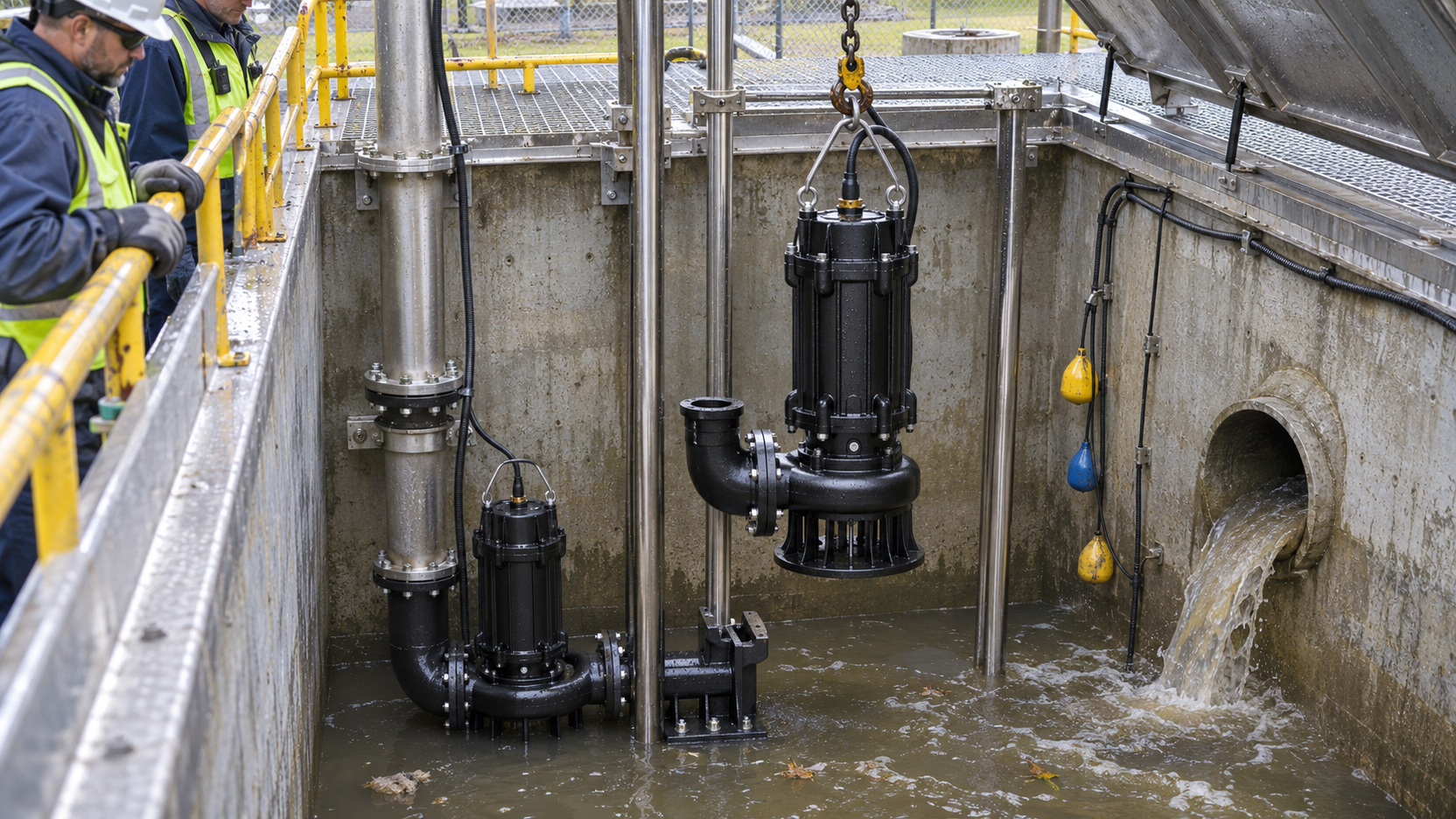
Sewage Pump A pump that transports wastewater, including liquids and permitted soft solids from a basin or wet well to a higher level of discharge. This article is concerned with the common submersible centrifugal design. There are other types of sewage pumps which may be installed dry, or may have different types of hydraulics or may have cutting mechanisms. The particular instructions for these need to be examined separately.
III. How Does a Sewage Pump Work?
1. Wastewater Enters the Basin
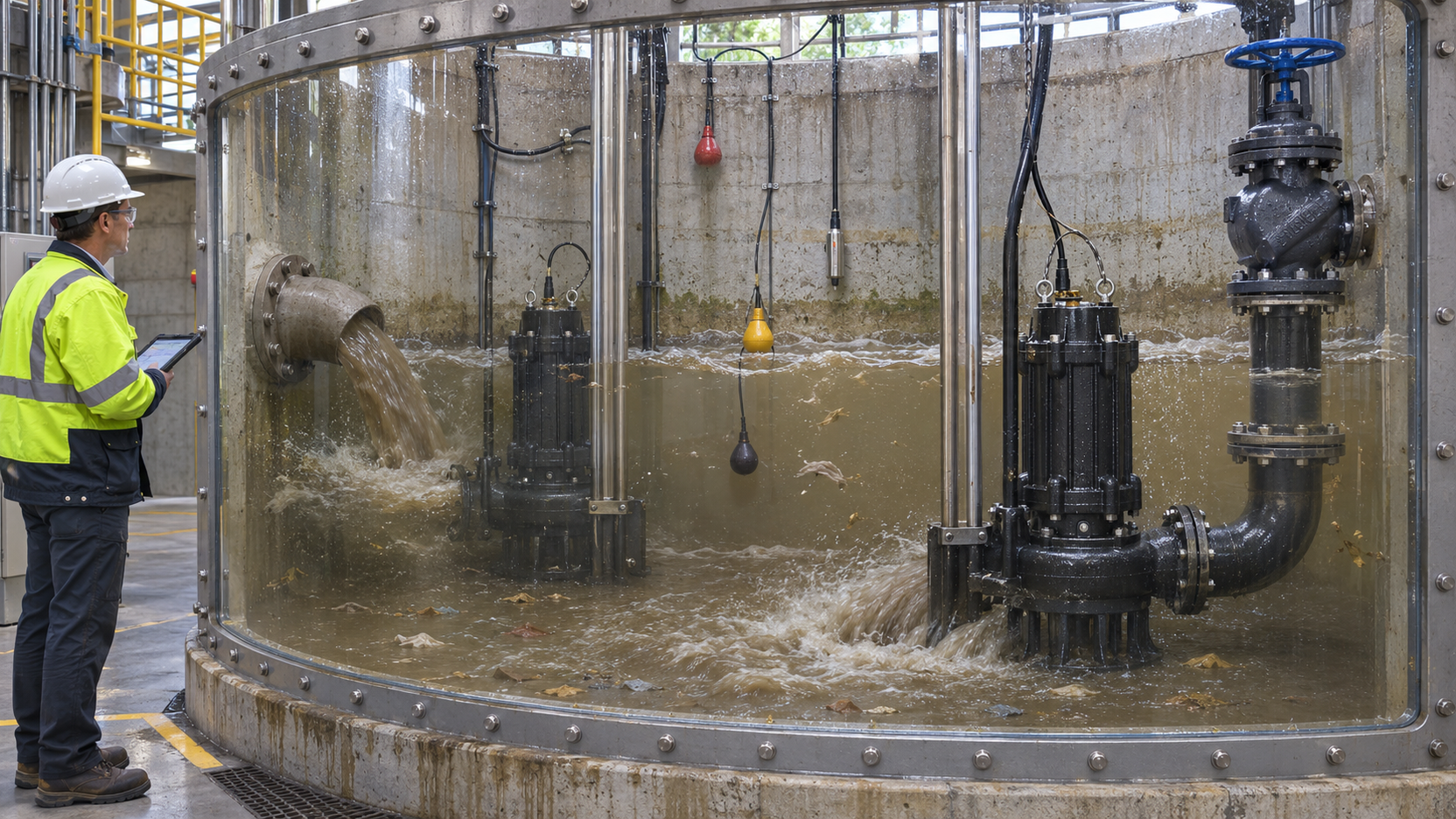
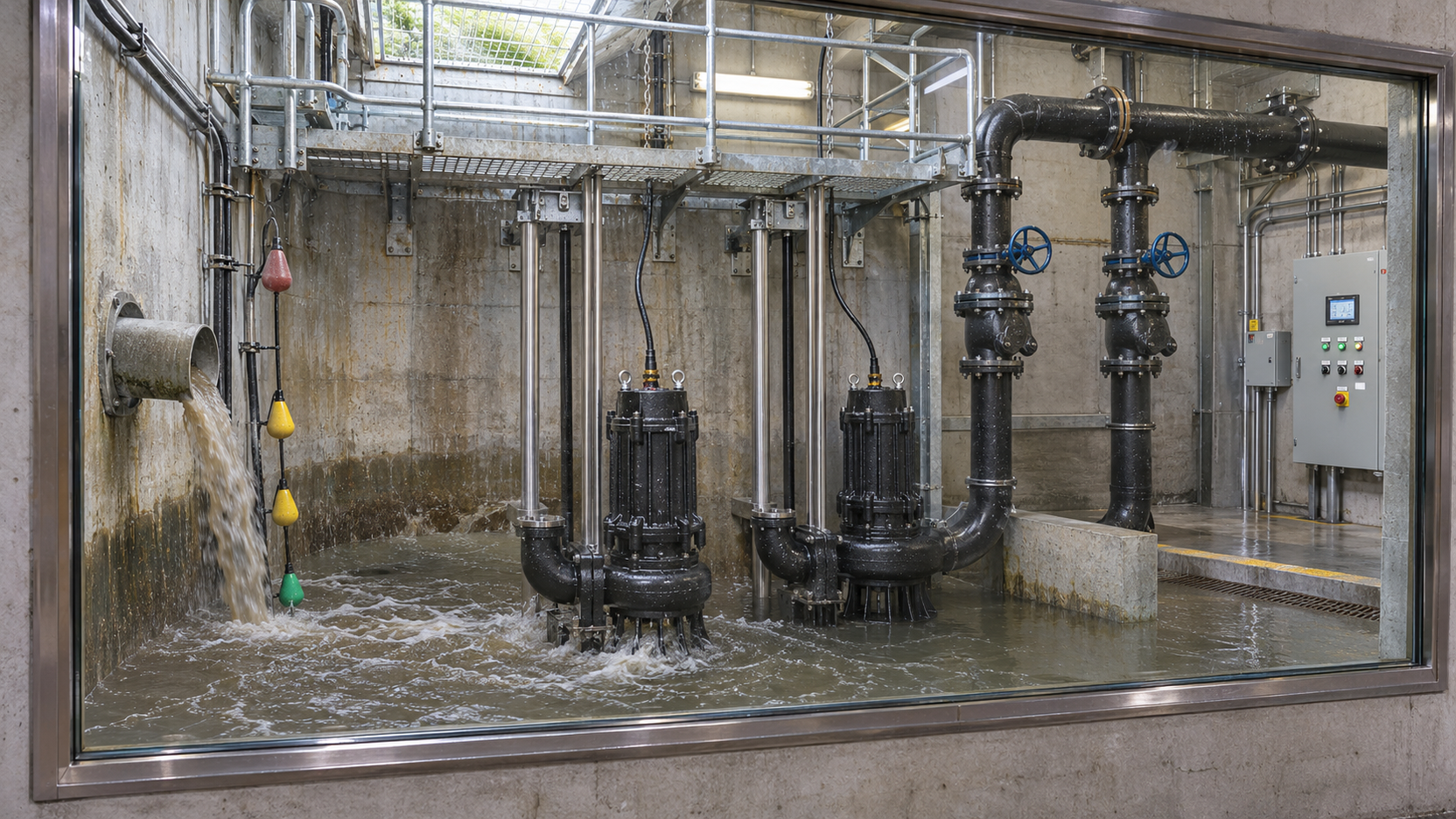
Wastewater flows by gravity first into a sewage pump basin (or wet well). In a small sewage ejector pump system and a bigger sewage pump station, the same collection principle is at work. The basin provides a storage of the intake for a time, and provides working volume between the start and stop levels of the pump. The usable volume and position of the inlet will effect cycling and float movement.
2. The Level Control Detects the Start Point
When the wastewater reaches a certain level, it is detected by a sewage pump float switch, level sensor or other control. The controller transmits a run command directly to the motor or via a control panel. A single pump may have a single start-stop device. A larger pump or a duplex sewage pump system may have distinct stop, start, assist and high-level alert signals.
3. The Motor Rotates the Impeller
The electric motor turns a shaft which is attached to the impeller. A submersible sewage pump has the motor inside the pump assembly and running in or around the pushed liquid depending on the cooling arrangement. The rotating shaft is supported by bearings and shaft seals keep the motor chamber separated from the effluent.
4. The Pump Creates Flow and Pressure
Mechanical energy is transferred to the wastewater by the revolving impeller and it is accelerated through the pump casing. Then the casing carries that flow to the discharge and turns some of its velocity into pressure. This pressure needs to be enough to overcome vertical lift, pipe friction, valves, fittings and any downstream system pressure at the needed flow.
5. Solids Pass or Are Reduced
Authorised soft solids travel through the entrance, impeller passage, casing and discharge of a conventional Sewage Pump without any deliberate grinding. A sewage grinder pump or macerator sewage pump has a cutting mechanism that grinds up appropriate solids before they are passed into the hydraulic stream. The second design is not always better, it serves various pipe and pressure situations.
6. Wastewater Leaves Through the Discharge Line
The pump forces wastewater through its discharge connection, check valve, isolation valve and pipe to a sewer, treatment process or other approved receiving point. The real output is at the overall head of the system, according to the pump curve. Maximum flow and maximum head are different end points. They cannot be combined as one operation condition.
7. The Pump Stops and Backflow Is Limited
When the basin level falls to the stop point, the level control takes away the run signal and the engine stops . The check valve then prevents wastewater from the discharge line from flowing back into the basin. If too much liquid is flowing back the pump can restart unnecessarily and a blocked or inadequate valve can offer resistance during operation.
IV. Which Components Complete the Operating Cycle?
1. Motor, Shaft, Bearings, and Seals
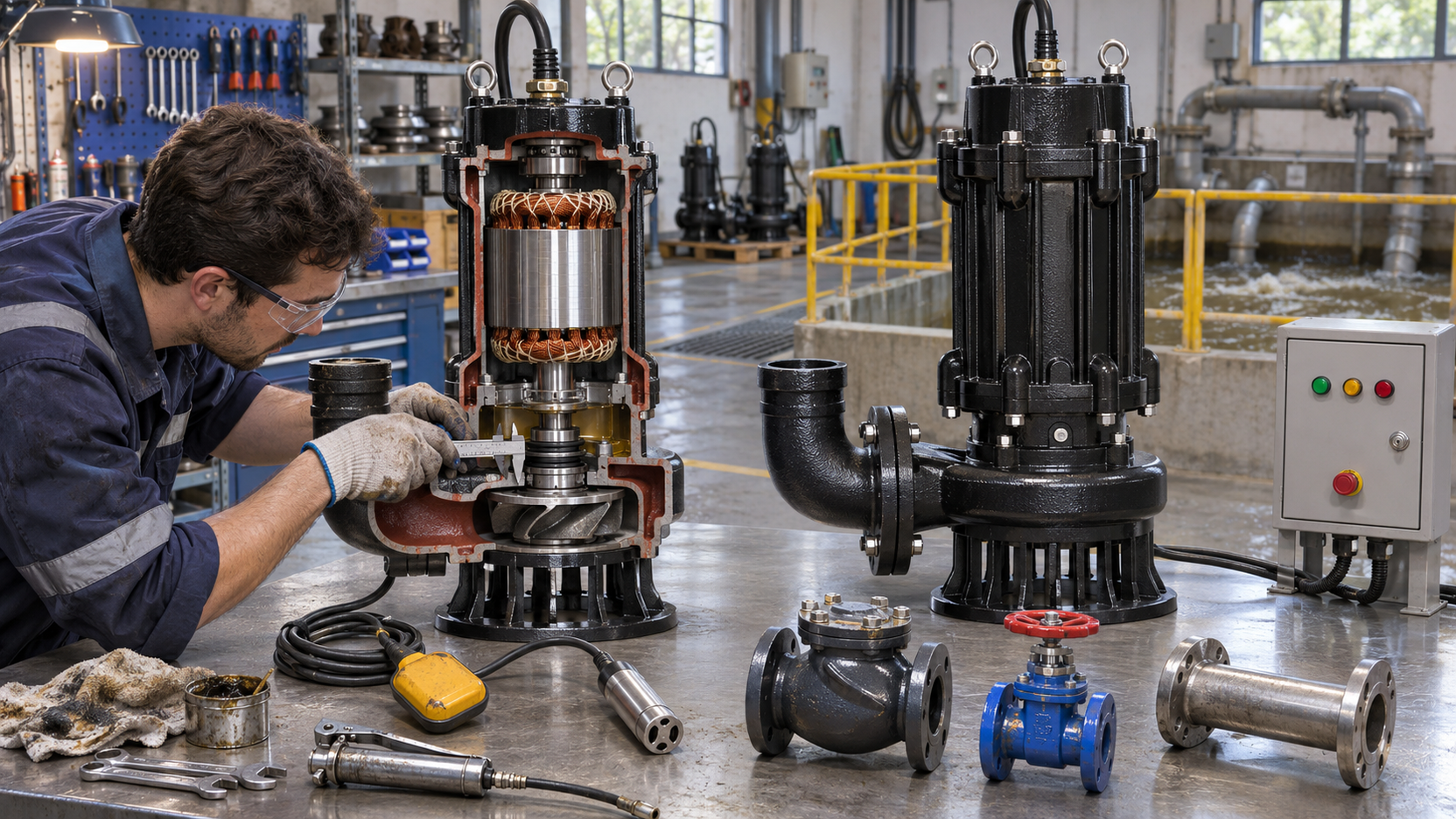
The motor generates torque, the shaft transfers it to the impeller, the bearings control shaft movement, and the seals keep the motor from wastewater. They should be designed for the operational duty, liquid temperature, installation position and projected number of starts. Motor horsepower rating alone is not a guarantee of hydraulic performance or solids handling ability.
2. Impeller and Pump Casing
The impeller imparts energy to the wastewater and the casing directs the flow to the discharge. The impeller form, clearance, free passage, balance and material influence the efficiency, clogging behaviour, vibration and wear. Hence, a non-clog sewage pump description should be based on a defined hydraulic design and route rather than an infinite assertion.
3. Basin or Wet Well
The basin receives intake and delivers a sufficient volume of liquid for a useful pump cycle. It must also offer the necessary pump submergence, float clearance, inlet separation, access, ventilation and room for guiding rails or a second pump if used. Even with the right pump curve, a too-small basin can induce too frequent starts.
4. Level Switch or Sensor
The level control device controls the pump start and stop and may include a separate high level alarm. Tethered floats, vertical floats, pressure or ultrasonic sensing and numerous control floats are common configurations. Selection of the procedure has to consider the basin shape, the wastewater, the control panel, and the necessary reliability.
5. Discharge Pipe, Check Valve, and Isolation Valve
The level control device controls the pump start and stop and may include a separate high level alarm. Tethered floats, vertical floats, pressure or ultrasonic sensing and numerous control floats are common configurations. Selection of the procedure has to consider the basin shape, the wastewater, the control panel and the necessary reliability.
6. Control Panel and Alarm
The control panel may start the motor, change duplex pumps, run an assist pump, check motor parameters, and report a high liquid level or equipment malfunction. Some smaller automatic pumps may employ an inbuilt switch. Kindly confirm the real inputs, protective functions, alarm outputs, reset mechanism, and version as not all Sewage Pumps have a separate panel.
V. How Do Different Hydraulic Designs Move Sewage?
1. Vortex Impeller
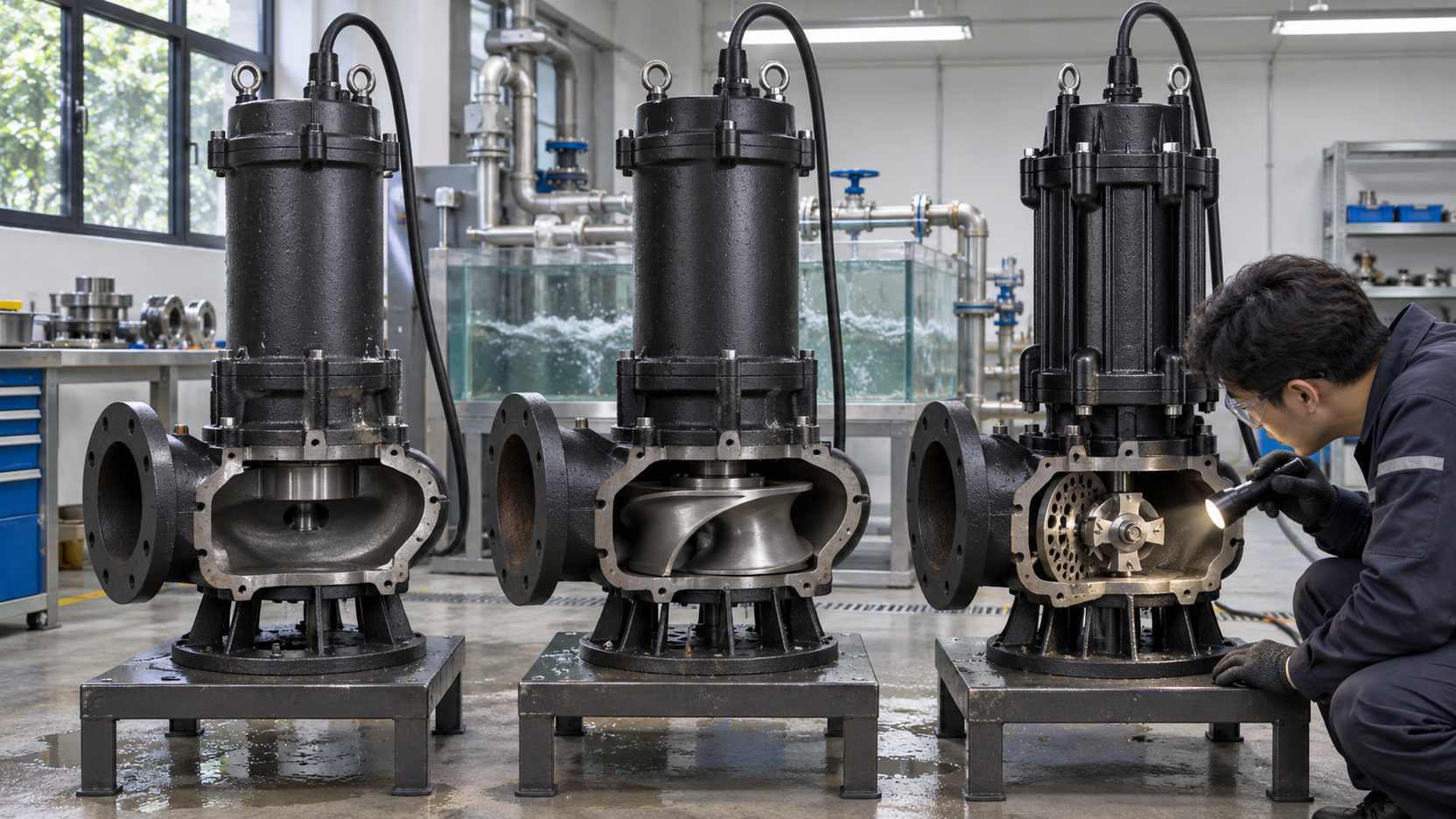
The impeller produces a vortex and the flow in the open pump casing is whirling. Much of the wastewater is transported without coming near the impeller vanes. This can lessen direct contact with some materials and fibres, but the free passage, efficiency, flow and head available still depend on the model. Use the curve and solids criteria instead of assuming all vortex pumps are obstruction-proof.
2. Channel or Non-Clog Impeller
A channel impeller pumps wastewater through one or more designated passageways through the impeller. It can offer good hydraulic efficiency with a helpful free channel, but lengthy fibres, abrasive sand and inappropriate particles may impact clogging or clearing. Together, check the number of channels, free passage, substance, curve and wastewater description.
3. Grinder or Cutter Mechanism
A grinder sewage pump has a spinning cutter and fixed section that chop up permitted solids before the mixture enters the pump. This allows for a certain pressure sewer design or smaller discharge pipe, but does not allow for wipes, metal, stones or other disallowed things. The operating assessment covers the cutter condition, the motor load, the pipe design, and the service access.
VI. What Determines Whether the Pump Works Reliably?
1. Flow, Total Head, and the System Curve
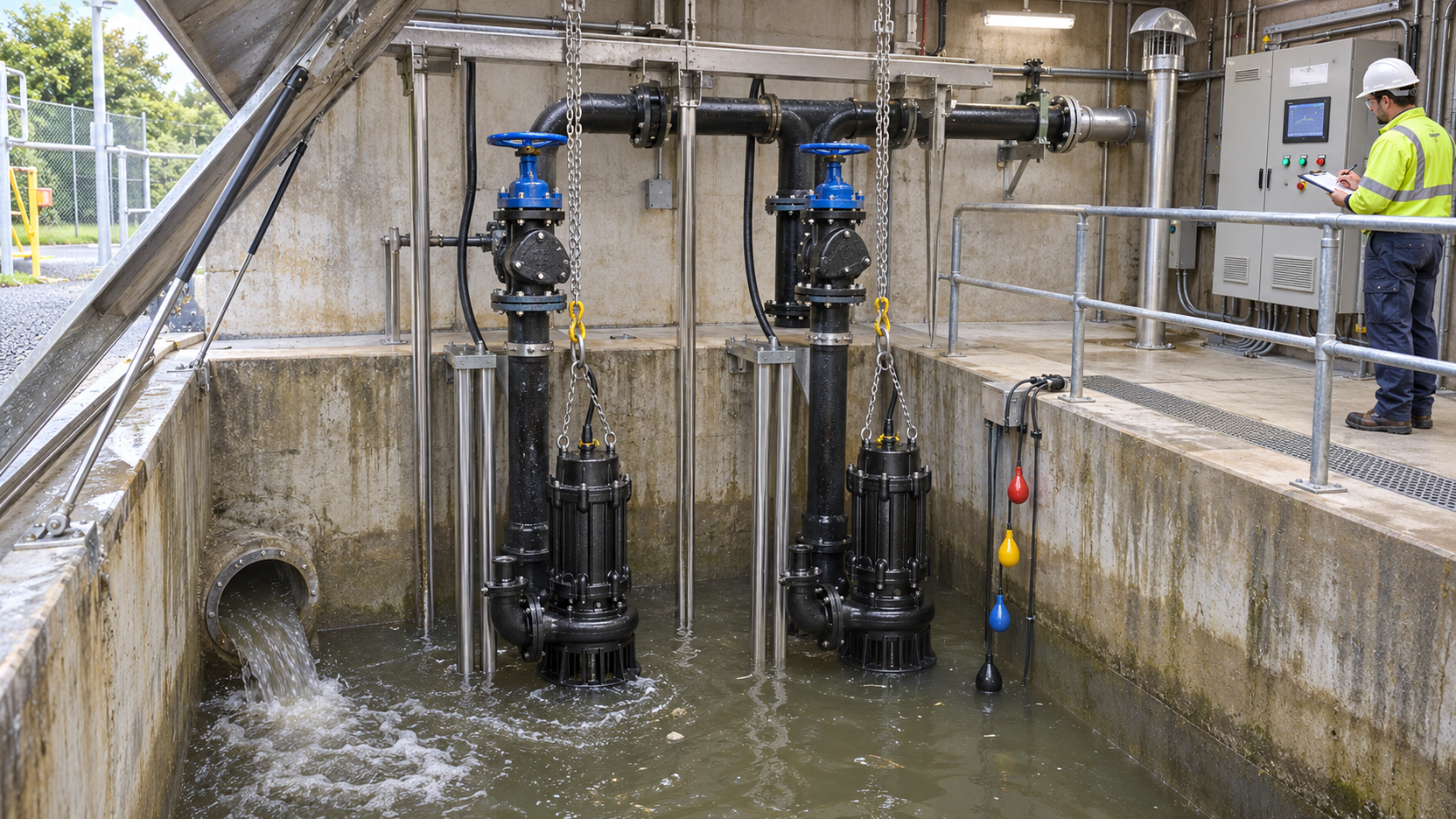
The operational point is the intersection of the pump curve and the system resistance. You do sewage pump sizing. You determine vertical lift, friction loss in pipe, loss in valves and fittings as well as pressure on the downstream side. Then you look at the available flow at that total head. If the point selected is not within the range for the appropriate curve, the pump may provide too little fluid, overload, vibrate, or run inefficiently.
2. Solids, Fibres, and Free Passage
Free passage generally indicates the maximum declared object geometry that can travel via the hydraulic path; however, real wastewater can also comprise flexible fibres, wipes, oil, grit and gas. Get the real wastewater description and impeller data before you select a model. Big pipe doesn’t fix a bad pipe or make every solid pumpable.
3. Basin Volume and Start-Stop Levels
The distance between the levels of start and stop controls the working volume discharged in each cycle. Too low a volume may cause repeated starts, and an inappropriate stop level may interfere with the cooling of the engine or result in minimal submergence. Basin size, inflow, control levels, permitted starts, and required pump coverage should all be checked as a system.
4. Discharge Layout and Backflow Control
An undersized pipe, too many fittings, a clogged check valve, trapped air or silt can reduce system resistance and flow. Leaking check valves can backflow wastewater and shorten the off-time. When installing a sewage pump, it is recommended to review the whole discharge path rather than just rating the performance based on a small manufacturer test pipe.
5. Motor Cooling, Duty, and Protection
Some pumps require the engine to stay immersed to keep it cool, while other kinds can be partially immersed or installed dry under certain conditions. For the exact version please check the working duty, min. liquid level, max. liquid and ambient temperature, voltage, frequency, phase, overload protection, seal monitoring and temperature sensors.
VII. What Should You Verify Before Ordering?
1. Complete Operating-Cycle Test
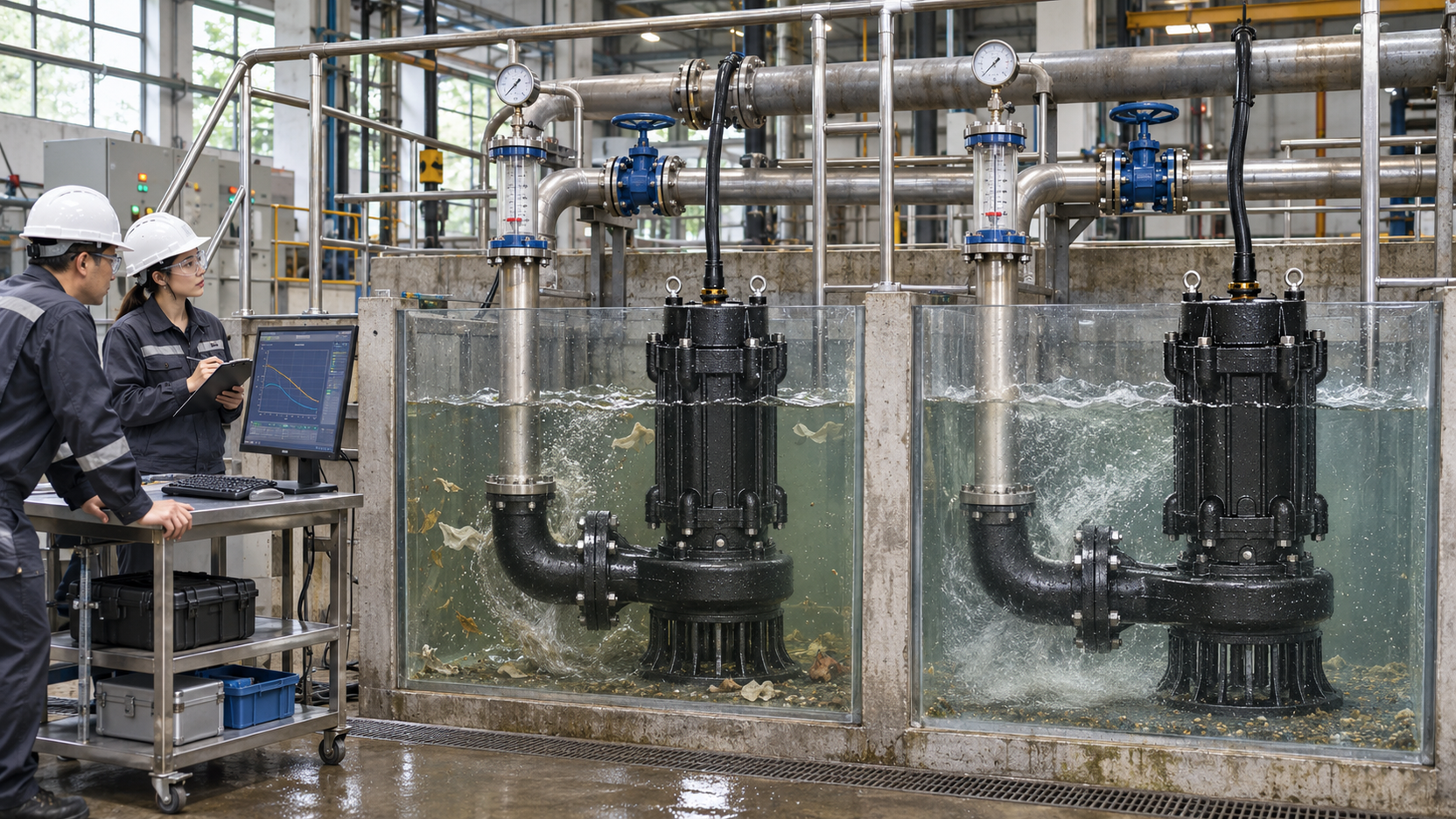
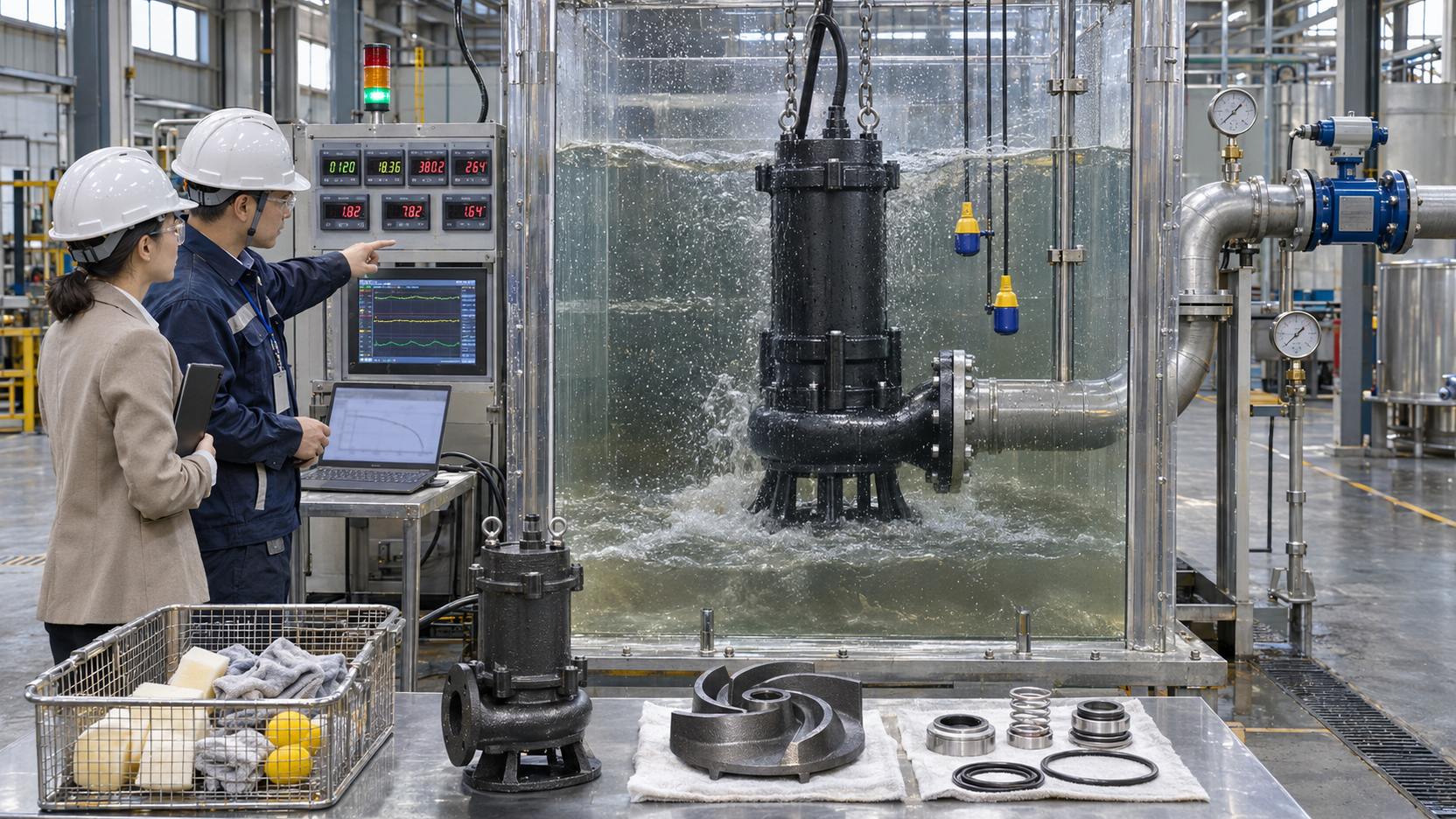
Test basin filling, start signal, acceleration, steady pumping, stop level, drain-back, restart, and high level response. Test alternation, assist operation, and response to one unavailable pump when the system is duplex. A short motor test on a dry floor does not tell how the whole sewage pump system will perform.
2. Pump Curve, Current, and Input Power
Log flow, head, current, input power, voltage, vibration at relevant operational stages. Compare results with motor data and authorised curve. This demonstrates if the sample gives the required output without relying on maximum values or a sewage pump size calculator that does not incorporate the real pipe system.
3. Solids Passage and Hydraulic Design
In the technical file, check impeller type, free passage, input geometry, discharge size and allowed solids. Any solids test should be performed in a safe, defined, repeatable way that represents the desired claim. Do not approve a non-clog statement based on a single demonstration with a single soft object without restriction.
4. Control Logic and Fault Response
Check start and stop levels, delays, maximum starts, alarm point, overload response, temperature response, seal alarm where fitted, reset procedure and recovery after power returns. Clear fault information lets you differentiate between a pump failure and a float, valve, basin or electrical problem during after-sales service.
5. Documents, Versions, and Service Parts
Design pump curve, dimensional drawing, wiring diagram, control description, materials, installation constraints, manual, nameplate, carton and parts diagram for same model. Different electrical, automatic/manual, impeller, cable, sensor and material variations under unique product codes, and confirmation of replacement seals, floats, cables, impellers, valves and control elements where applicable.
VIII. Conclusion
Submersible centrifugal Sewage Pump A typical submersible centrifugal Sewage Pump operates in a cyclic manner: Wastewater fills the basin, the level control energises the motor, the impeller imparts energy, acceptable solids pass or are reduced, the discharge line removes the sewage, and the pump de-energises at the lower level. The check valve will then prevent backflow until the next cycle.
Reliable operation still depends on pump curve, system head, wastewater, hydraulic design, basin volume, control levels, discharge arrangement, electrical supply, cooling and duty. If you are selecting Sewage Pumps for your product line, please give HunGerät your wastewater description, solids, needed flow, total head, basin, control mechanism, voltage, frequency and installation requirements. We can discuss an appropriate setup and validation plan.
IX. FAQ
1. What Is the Difference Between a Sewage Pump and a Sump Pump?
A Sewage Pump is designed to pump authorised sanitary wastewater with soft solids. A sump pump is primarily designed to remove groundwater, rain, or seepage and should not be used for toilet waste unless its documentation expressly permits this activity.
2. What Is the Difference Between an Effluent Pump and a Sewage Pump?
Typically, an effluent pump deals with settled or treated wastewater that has less suspended materials in it. Sewage Pump: Designed for raw wastewater and bigger soft solids within the given transit capacity.
3. Is a Sewage Ejector Pump the Same as a Sewage Pump?
A Sewage Ejector Pump is a type of Sewage Pump that is used to elevate wastewater when gravity cannot reach the sewer or septic system. The phrase is used to reference the system function. Sewage pumps are the larger product category.
4. When Do You Need a Sewage Pump for a Basement?
You need one where toilets or other sanitary equipment are below the gravity sewer connection. A sump pump is usually needed for groundwater that enters a basement drainage pit.
5. Can a Sewage Pump Be Used with a Septic Tank?
Yes a good Sewage Pump will pump raw wastewater to a septic tank. Usually, a pump sized for that system is required to pump the settled liquid from the tank to a drain field.
6. How Do Residential, Commercial, and Industrial Sewage Pumps Differ?
The designations are mostly scales of application. Don’t take a commercial or industrial label as a performance definition — compare real inflow, solids, duty, materials, controls, redundancy, service access, and required approvals.
7. Can a Sewage Pump System Be Installed Outdoors?
Yes, if the pump, basin, cable entrance, control enclosure, alarm and pipes are authorised for outside circumstances. Installation design should address flooding, freezing, corrosion, vehicle loads and service access.
8. Is a Self-Priming Sewage Pump the Same as a Submersible Sewage Pump?
No. Typically, a self-priming model is located outside the wet well and pumps sewage through a suction line. A submersible unit is in the wet well with its intake submerged.
9. Should You Choose an Automatic or Manual Sewage Pump?
An automatic type uses inherent or external level control for regular unattended cycling. The manual model is on a separate control signal and is usually used when the system already has a control panel.
10. Should You Choose a Single-Phase or Three-Phase Sewage Pump?
Select the phase to suit the supply available, motor size, manner of starting, protection and duty of application. Smaller ones are usually single-phase, and the larger tend to have 3-phase motors and dedicated controls.
11. Is Cast Iron or Stainless Steel Better for a Sewage Pump?
Neither material is always best. Cast iron offers a strong, cheap construction; an appropriate grade of stainless steel can give improved corrosion resistance. The entire set of wetted materials must be suitable for the wastewater.
12. When Is a Duplex Sewage Pump System Needed?
A duplex system is handy if the peak flow may demand two pumps or if one pump must be available during a breakdown or repair. The control shall cycle between normal duty and start the second pump at the set assist level.
13. What Affects Sewage Ejector Pump Installation Cost?
The primary factors are: basin work, excavation, access, length of pipe and head, venting, valves, electrical supply, control panel, alarm, permissions, restoration work. The price of a pump alone does not reflect the cost of the entire system.
14. How Often Should a Sewage Ejector Pump Run?
There is no universal normal frequency, as cycling relies on wastewater inflow, basin working volume, and control levels. An abrupt spike in starts may indicate increased intake, drain-back, a change in control, or poor pumping performance.
15. How Often Should a Sewage Pump Be Maintained?
Set the interval from wastewater severity, hours of operating, starts, alarms and site danger, and refer to the model manual. Regular checks include controls, valves, connections, leakage indicators, accumulation, odd sounds and recorded operational data.
16. How Long Do Sewage Pumps Last?
Service life is undefined. Operating time, number of starts, abrasive or corrosive wastewater, clogging, cooling, installation quality, maintenance, and availability of replacement parts are some of the factors affecting the economical service life of a pump.
17. When Should a Sewage Pump Be Repaired or Replaced?
Repair is feasible if the defect is isolated and the casing, motor and critical hydraulic parts are functional. If there is considerable damage, corrosion has advanced, parts are not accessible or the original pump is not suited for the duty, replacement is more appropriate.
18. Why Is the Sewage Pump Alarm Going Off?
The high level warning may be caused by intake being more than pump output or by a failure of the pump, level control, power supply, valve or discharge line. Minimise intake of wastewater where possible and schedule qualified examination prior to basin overflow.
19. What Causes a Sewage Ejector Pump to Clog?
Common causes are wipes, rags, long fibres, oil, inappropriate solids, a restricted hydraulic route, worn cutter or inadequate discharge conditions. Isolate the equipment before inspection and never reach into a sewage pump or basin when it can be started.
20. How Should You Compare Sewage Pump Manufacturers?
Common causes are wipes, rags, long fibres, oil, inappropriate solids, a restricted hydraulic route, worn cutter or inadequate discharge conditions. Isolate the equipment before inspection and never reach into a sewage pump or basin when it can be started.